
When managing money across borders, picking the right platform can save you time, money, and hassle. Here’s a quick breakdown of three popular options:
- PayPal: Convenient and widely accepted, but international transfers come with high fees (up to 5%) and currency conversion markups (3–4%). Best for individuals or small businesses already using PayPal.
- Wise: Transparent fees (as low as 0.33%) and mid-market exchange rates make it ideal for frequent international transactions. Offers multi-currency accounts for holding 40+ currencies.
- Mercury: Tailored for U.S.-based startups and tech companies. No monthly fees, but requires a U.S. LLC. Foreign currency payments are converted to USD automatically.
Quick Comparison:
| Feature | PayPal | Wise | Mercury |
|---|---|---|---|
| Account Setup | Email-based | Individual/business account | U.S. LLC + EIN required |
| Currencies Supported | 25+ | 40+ | USD only |
| Transfer Fees | 5% + fixed fee | 0.33%-2% | 1% for non-USD wires |
| Exchange Rate Markup | 3%-4% | 0.33%-2% | Varies by partner |
| Monthly Fees | $0 (personal) | $0 (personal), $5+ (business) | $0 |
Summary:
- Choose PayPal for convenience and global acceptance.
- Opt for Wise if you prioritize low fees and multi-currency management.
- Pick Mercury if you’re a U.S.-based startup needing fee-free banking.
Your choice depends on your specific needs – transaction volume, currency requirements, and business structure.
PayPal: Features, Fees, and International Use

PayPal has become a household name in digital payments, known for its widespread acceptance and ease of use. While its convenience is undeniable, international users may find its fee structure and account management policies a bit tricky, especially when dealing with cross-border transactions. Let’s break down key aspects like account setup, fees, and some pros and cons.
Account Setup and Access
Setting up a PayPal account largely depends on where you live. For U.S. residents, opening either a personal or business account is typically straightforward, requiring standard documentation. However, if you’re an American living abroad, things can get a little more complicated. You might need to tie your account to your country of residence rather than your U.S. citizenship, which can affect how you manage your account.
Switching between personal and business accounts isn’t seamless either – it could result in losing your transaction history. Business accounts, in particular, require more rigorous verification, which can sometimes slow down the approval process. These nuances are especially important for international users to consider before diving into PayPal’s services.
Fees and Currency Conversion Costs
PayPal’s fees can add up, particularly for international transactions. For personal transfers across borders, fees tend to increase with the transaction amount. Business accounts have a separate fee structure, which often comes into play for cross-border payments. On top of that, withdrawing funds can incur additional costs, and these vary depending on the country and withdrawal method. Currency conversion fees are another factor to watch out for – they can make international transactions pricier than you might expect.
Pros and Cons
One of PayPal’s biggest advantages is its widespread acceptance, making it a go-to choice for online shopping, freelancing, and other digital transactions. It also offers buyer protection, adding a layer of security for purchases. Domestic transactions are usually processed quickly, which is a plus for everyday users.
However, the downsides can’t be ignored. The fee structure, especially for international transfers and currency conversion, might not be ideal for those who frequently send or receive money across borders. Account verification and restrictions can be a hassle, especially when managing accounts tied to multiple countries. Lastly, the quality of customer support can vary depending on your region, which might leave some users frustrated when issues arise.
Wise: Features, Fees, and International Use
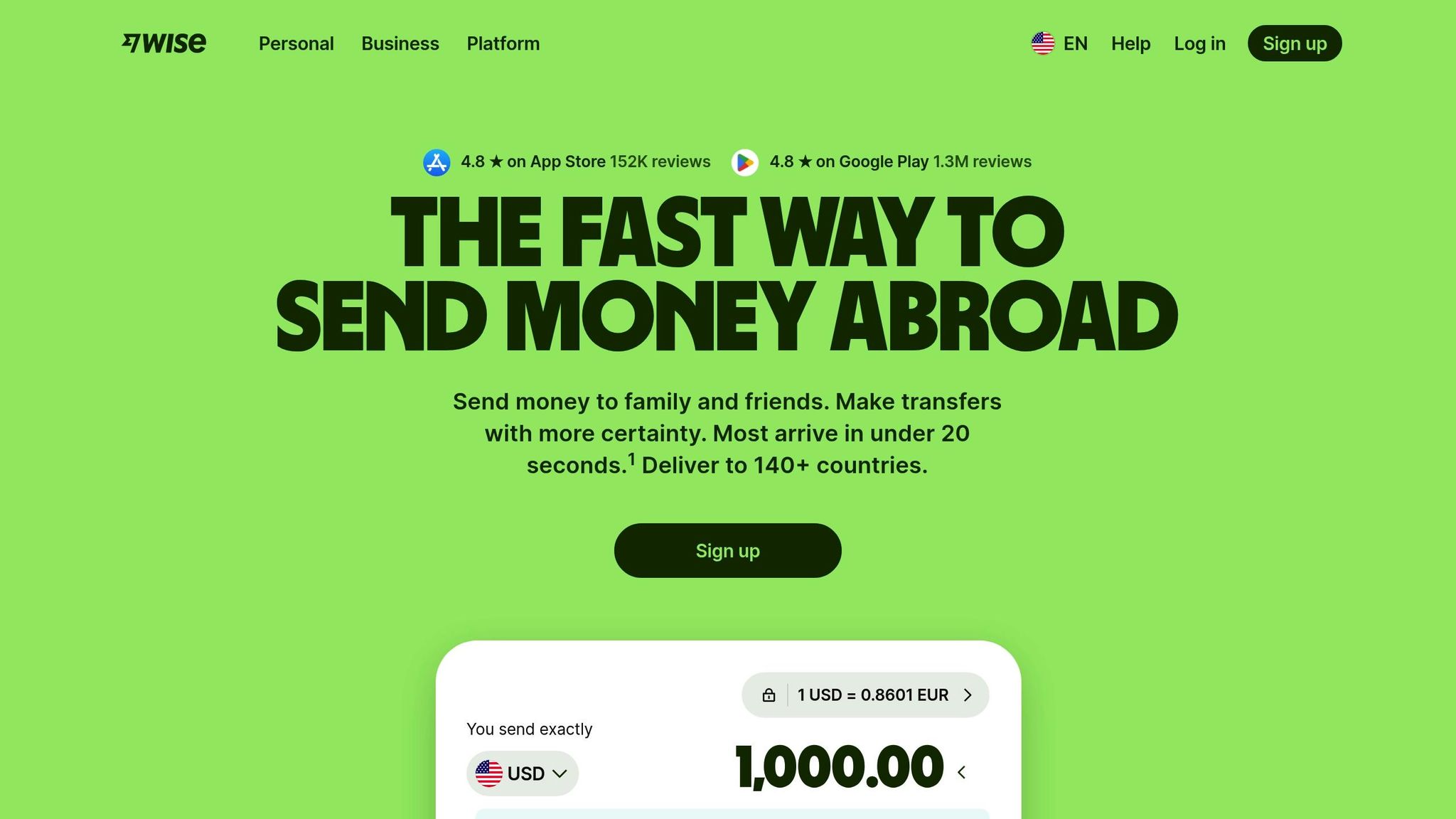
Wise has earned a reputation for its straightforward and fair approach to currency exchange, making it a go-to choice for individuals and businesses dealing with multiple currencies. Unlike traditional financial institutions, Wise is upfront about its fees and uses the mid-market exchange rate – no hidden markups. This transparency has made it especially appealing to expats, freelancers, and businesses that frequently send or receive money internationally. Let’s dive into its multi-currency account features and fee structure.
Multi-Currency Accounts and Exchange Rates
One of Wise’s standout features is its ability to hold more than 40 currencies in a single account – at no cost. This means you can receive payments in euros, store U.S. dollars, and keep British pounds, all in one account, without the hassle of managing multiple bank accounts. Unlike traditional banks that tack on hidden fees by marking up exchange rates, Wise allows users to convert currencies using the mid-market rate, ensuring you get the best value for your money.
Fees and Cost Transparency
Wise keeps its fees simple and competitive. Currency conversion and money transfer fees start at 0.57%, with some conversions as low as 0.33%, depending on the currency pair. The platform provides a detailed breakdown of all costs before you finalize any transaction, so there are no surprises.
Here’s a comparison of sending $1,000 USD to EUR via bank transfer:
| Provider | Recipient Gets | Exchange Rate Markup | Transfer Fee | Total Cost |
|---|---|---|---|---|
| Wise | 851.65 EUR | $0 USD | $9.87 USD | $9.87 USD |
| Bank of America | 836.83 EUR | $27.10 USD | $0 USD | $27.10 USD |
| Wells Fargo | 833.64 EUR | $30.81 USD | $0 USD | $30.81 USD |
| PayPal | 819.86 EUR | $42.05 USD | $4.99 USD | $47.04 USD |
Wise also offers a multi-currency debit card for a one-time fee of $9. This card allows free purchases and up to $100 USD in free ATM withdrawals each month. Beyond that, withdrawals incur a 2% charge on amounts over $100 USD, plus an additional $1.50 per withdrawal if you exceed three withdrawals in a month. Transfers between Wise users in the same currency are completely free, and the platform offers discounts for larger currency exchanges. Best of all, there are no registration or account maintenance fees.
Pros and Cons
Pros
Wise’s transparent pricing model is its biggest draw. You know exactly what you’re paying, and the mid-market exchange rates ensure you’re not losing money to hidden fees. The multi-currency account is a practical solution for managing international finances, and the low fees make it a cost-effective choice for frequent cross-border transactions. The platform is user-friendly, with an intuitive interface that simplifies currency conversion and money transfers. Customer support is generally reliable, and the service delivers on its promises.
Cons
That said, Wise does have its limitations. It doesn’t offer loans, mortgages, or investment products, so it’s not a complete replacement for traditional banking. While it’s excellent for currency conversion and international transfers, you’ll likely still need a traditional bank account for more comprehensive financial needs.
Mercury: Features, Fees, and International Use
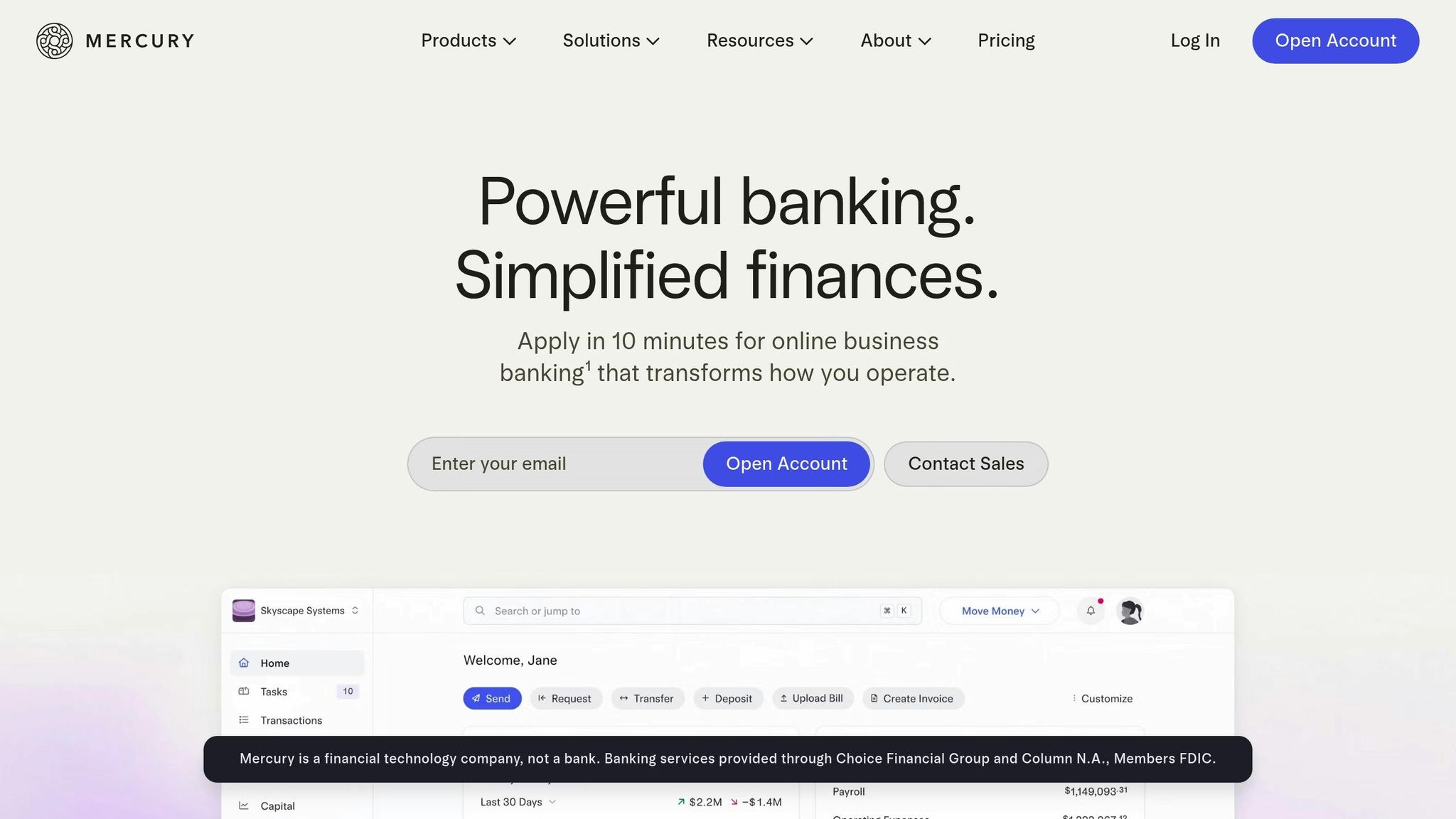
Mercury is a business banking platform tailored for startups and tech companies, offering a streamlined solution for entrepreneurs who need straightforward international banking services. Its appeal lies in its fee-free basic services and a focus on meeting the needs of modern businesses.
Account Requirements and Features
To open an account with Mercury, you need a U.S. LLC and an EIN, making it a practical choice for businesses with a U.S. presence – even if the owners themselves are not U.S. residents. Many international entrepreneurs take the step of setting up a U.S. LLC to access the U.S. market through Mercury.
One of the key features Mercury offers is support for international wire transfers, providing flexibility for businesses dealing with global transactions. These features align with Mercury’s commitment to simplicity and transparency in its fee structure.
Fees and Access
Mercury provides business checking and savings accounts with no monthly fees, no account minimums, and no fees for opening an account.
Here’s a breakdown of its fee structure for international transactions:
- A 1% fee applies to non-USD wire transfers to cover intermediary bank costs.
- For USD international wires, you can choose between:
- SHA option: Free for the sender; intermediary fees are deducted from the recipient.
- OUR option: Costs $15, covering all intermediary fees.
Receiving payments is generally free, whether via ACH transfer, wire, or check. For incoming international wires in non-USD currencies, funds are automatically converted to USD. The exchange rates depend on the processing partner.
If your monthly non-USD exchanges exceed $200,000, Mercury negotiates better exchange rates on your behalf, ensuring more favorable terms for high-volume transactions.
"Mercury is built for entrepreneurs. All of my businesses are under one login and I can do anything I need myself – make new accounts, transfer funds between them, and pay international vendors without hidden fees."
– Allen Walton, Founder & CEO, SpyGuy
Pros and Cons
Pros
- Mercury offers fee-free business banking, making it an excellent option for startups and small businesses.
- Its straightforward fee structure for international wire transfers makes cross-border transactions easier to manage.
Cons
- A U.S. business entity is required, so international entrepreneurs must establish a U.S. LLC to use the service.
- Mercury does not support holding multiple currencies; all foreign payments are automatically converted to USD, which can limit flexibility for managing funds in other currencies.
sbb-itb-39d39a6
Side-by-Side Comparison: PayPal vs Wise vs Mercury
Here’s a closer look at how PayPal, Wise, and Mercury stack up against each other, so you can decide which one aligns best with your international financial needs.
Feature Comparison Table
| Feature | PayPal | Wise | Mercury |
|---|---|---|---|
| Account Setup | Personal email required | Individual or business account | U.S. LLC and EIN required |
| Target Users | Individuals and businesses | Expats, freelancers, businesses | U.S.-based startups and tech companies |
| Monthly Fees | $0 for personal, varies for business | $0 for personal, $5+ for business | $0 for all accounts |
| Currency Support | 25+ currencies | 40+ currencies | USD only (auto-converts foreign currencies) |
| International Transfer Fees | 5% + fixed fee | 0.35%-2% of transfer amount | 1% for non-USD wires |
| Exchange Rate Markup | 3%-4% above mid-market rate | 0.35%-2% above mid-market rate | Varies by processing partner |
| Receiving Payments | Free for most methods | Free for most currencies | Free for all methods |
| Wire Transfer Options | Limited international wire support | Full international wire capability | Full international wire support |
| Minimum Balance | $0 | $0 | $0 |
| Global Accessibility | Available in 200+ markets | Available in 160+ countries | U.S. business entities only |
The table highlights key differences, but let’s break down the pros and cons of each platform to help you choose.
Summary of Pros and Cons
Each platform has distinct strengths and weaknesses, making them suitable for different types of users.
PayPal is ideal for individuals and small businesses already entrenched in its ecosystem. Its widespread recognition and ease of use make it a go-to option for digital nomads or freelancers who primarily receive payments. However, PayPal’s international transfer fees and exchange rate markups are higher, making it less appealing for frequent cross-border transactions.
Wise is the best choice for those who frequently send or receive money internationally. Its transparent fees and exchange rates close to the mid-market rate are a big draw for expats, freelancers, and businesses managing finances across multiple currencies. Additionally, its multi-currency account offers flexibility for handling diverse currencies without the steep costs associated with traditional banks.
Mercury is tailored for U.S.-based entrepreneurs and startups. It’s particularly appealing for those with a U.S. LLC, thanks to its zero monthly fees and straightforward international wire options. That said, its automatic conversion of foreign currencies to USD can be a limitation for businesses needing more flexibility with currency management.
In short, if you prioritize cost-effective international transfers, Wise is the clear winner. For businesses heavily integrated into online platforms, PayPal offers unmatched convenience. Meanwhile, Mercury stands out for U.S. startups seeking a simple, fee-free banking solution. The right choice depends on the volume of your transactions, the currencies you deal with, and your business structure.
How These Platforms Fit Your Asset Protection Strategy
Incorporating financial platforms into your asset protection strategy involves more than just comparing fees. The right platform should not only safeguard your assets but also ensure compliance with regulations, especially if your operations extend across borders. Your choice should align with both asset protection goals and tax planning needs.
Connecting Financial Platforms to Asset Protection
The financial platform you choose directly impacts how your transaction data is handled and how your business meets regulatory requirements, whether you’re using a domestic LLC or an offshore trust.
- PayPal stands out for its wide acceptance and ease of use, making it a practical option for entrepreneurs who value simplicity. It complies with international regulations, sharing transaction data with tax authorities as required. This predictability can be a plus for those who prefer a straightforward and regulated approach.
- Wise offers multi-currency accounts, streamlining the management of funds across different jurisdictions. By enabling you to hold and handle multiple currencies, Wise supports tax planning efforts while minimizing the hassle of currency conversions.
- Mercury is tailored for U.S.-based entrepreneurs who operate through U.S. legal entities. Requiring a U.S. LLC and EIN, Mercury aligns seamlessly with U.S. regulations. This makes it an excellent choice for simplifying compliance, especially for businesses looking to access international markets while maintaining a domestic banking relationship.
These structural benefits naturally lead to critical considerations around compliance and security, which are key to protecting your assets.
Compliance and Security Factors
Beyond operational features, compliance and security are essential pillars of a strong asset protection strategy. Each platform operates under distinct regulatory frameworks, influencing how your transaction data is managed and shared.
- PayPal adheres to CRS (Common Reporting Standard), promoting transparency in a regulated framework. This makes it easier to balance compliance requirements with privacy concerns, offering a clear path for integrating the platform into your strategy.
- Wise operates under European banking regulations and complies with GDPR standards. Its data protection measures and adherence to international agreements provide a dependable foundation for managing financial information securely.
- Mercury follows U.S. banking regulations, including AML (Anti-Money Laundering) and KYC (Know Your Customer) protocols. Its alignment with U.S. legal standards ensures that financial data is managed securely while supporting entrepreneurs with U.S. tax obligations.
Each platform also incorporates robust security measures, such as PayPal’s fraud protection, Wise’s regulatory oversight, and Mercury’s commercial safeguards. These features, combined with industry-standard encryption, add an extra layer of protection for your assets.
When selecting a financial platform, think about how its compliance and security practices fit into your broader goals. Whether your priority is optimizing taxes, maintaining privacy, or meeting regulatory requirements, choose a platform that complements your business structure and long-term strategy.
Conclusion
Blending robust compliance measures with security is a key part of managing financial operations effectively. The right platform can play a crucial role in safeguarding your assets, especially when navigating international operations.
For entrepreneurs in the U.S., ensuring the security of business funds is a top priority. For instance, Mercury provides FDIC insurance coverage of up to $5 million, offering an extra layer of protection for your company’s finances.
Whether you’re considering PayPal, Wise, or Mercury, it’s important to pick a platform that not only supports efficient operations but also enhances your asset protection strategy. Take the time to assess how each option aligns with your legal and security requirements to make the best decision for your business.
FAQs
How do I decide between PayPal, Wise, and Mercury for managing international transactions?
When deciding between PayPal, Wise, and Mercury for international transactions, it’s all about what works best for your specific needs.
Let’s talk about fees and exchange rates first. PayPal typically has higher fees and adds a markup on currency conversion. Wise, on the other hand, stands out with its lower, transparent fees and use of the mid-market exchange rate. Mercury is a great option if you’re looking for a U.S. bank account and frequently deal with U.S.-based payment platforms.
Next, consider transfer speed and supported currencies. Wise is known for its quick transfers – usually completed within 0-2 business days – and supports over 40 currencies. PayPal might support fewer currencies, but it’s available in more countries, making it a broader option for global transactions. Mercury, meanwhile, is designed for U.S.-focused transactions and integrates seamlessly with platforms like PayPal and Stripe.
To choose the best option, think about the volume of your transactions, the currencies you’ll use most, and whether having a U.S. bank account is a priority. Each platform shines in different areas, so match their strengths to your needs.
Why does Wise offer lower fees and better exchange rates than traditional banks?
Wise keeps fees low and exchange rates competitive by running its own payment network, sidestepping the expensive SWIFT system that traditional banks rely on. This approach cuts out intermediary fees and lowers transaction costs.
What’s more, Wise uses the mid-market exchange rate – the same rate you see on Google. Unlike banks that often sneak in hidden markups, Wise ensures transparency by offering this fair rate, helping you save more on international transfers.
What do international entrepreneurs need to open a Mercury account, and how can it benefit U.S.-based startups?
International entrepreneurs aiming to open a Mercury account must ensure their company is legally registered in the United States or another qualifying jurisdiction. As part of the application, you’ll need to provide key details, including your company’s legal name, industry, a business description, physical address, source of funds, and information about U.S. operations. Additionally, all owners are required to submit their full legal name, residential address, and a valid form of identification.
For startups based in the U.S., Mercury offers a range of perks. These include free USD wire transfers, FDIC insurance coverage of up to $5 million, and easy integration with popular accounting tools. Features like expense tracking, invoicing, and access to corporate cards further simplify managing business finances.
