
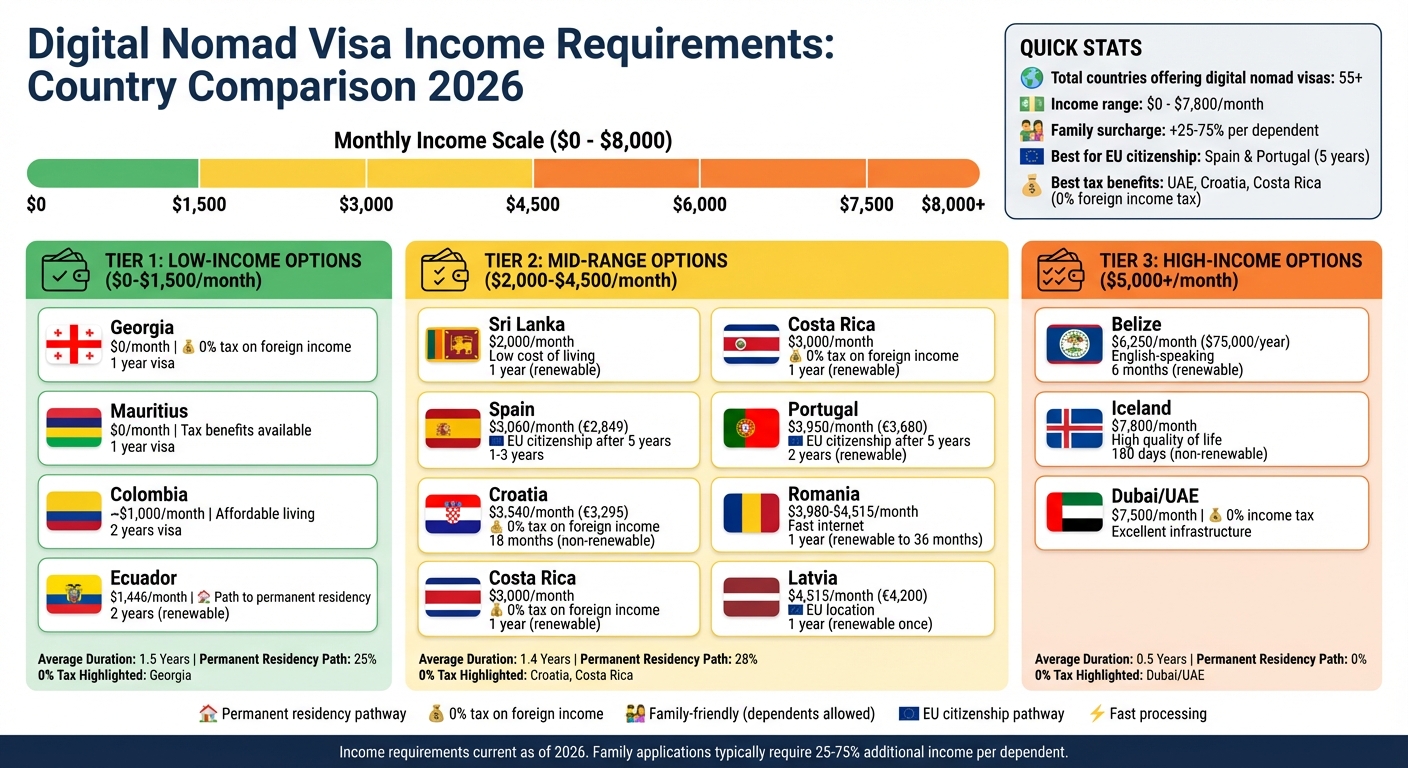
In 2026, over 55 countries offer the best digital nomad visas, each with varying income requirements. These visas allow remote workers to live abroad while earning income from foreign sources. Monthly income thresholds range from $0 (e.g., Georgia and Mauritius) to over $7,500 (e.g., Dubai). Family applications increase income requirements by 25%–75% per dependent. Here’s a quick overview:
- Low-income options: Georgia, Mauritius ($0), Colombia (~$1,000/month).
- Mid-range: Spain ($3,060), Portugal ($3,950), Croatia ($3,540).
- High-income: Iceland (~$7,800), Dubai (~$7,500).
- Tax benefits: UAE, Croatia, and Costa Rica offer 0% tax on foreign income.
- Long-term residency options: Spain and Portugal offer pathways to EU citizenship after five years.
Each country has unique costs, visa durations, and living expenses. Choosing the right destination depends on your income, lifestyle, and long-term goals. Below are more details on key countries and their requirements.
1. Portugal
Portugal’s D8 Digital Nomad Visa requires a minimum monthly income of €3,680 (about $3,950) for 2026. This amount is calculated as four times the national minimum wage, which is set at €920 per month under Decree-Law 139/2025. Your income must come from remote work, either through a foreign employer or a business registered outside of Portugal.
If you’re bringing family members, the income requirement increases. You’ll need an additional 50% of the base amount (€1,840 or $1,980) for a spouse and another 30% (€1,104 or $1,180) per child. For instance, a family of three would need a total monthly income of €6,624 (approximately $7,110). To prove this, you’ll have to submit 3–6 months of bank statements along with an employment contract or freelance service agreement.
The visa application fee is €110 (around $118), and the AIMA residence permit costs between €150 and €170 ($161–$183). Monthly living costs vary depending on the city. In Lisbon, a one-bedroom apartment typically costs $1,288–$1,932, while in Porto, you’re looking at $859–$1,288. More budget-friendly options can be found in Braga, where prices range from $537 to $859. Health insurance adds another €40–€120 ($43–$129) per month.
"AIMA assesses your financial means based on the minimum wage in force at the time of your appointment, not when you prepare your application", explains the Relocate Handbook Research Desk.
The D8 visa grants a 2-year residence permit, which can be renewed for 3-year periods. After 5 years of legal residence, you may qualify for permanent residency or Portuguese citizenship. To apply, you’ll also need a Portuguese Tax ID (NIF), which costs between €50 and €150 ($54–$161). Processing times generally range from 60 to 120 days.
Next, we’ll look at Spain’s digital nomad visa requirements.
sbb-itb-39d39a6
2. Spain
To qualify for Spain’s digital nomad visa in 2026, you’ll need to show a minimum monthly income of €2,849 ($3,060). This amount is tied to 200% of Spain’s Minimum Interprofessional Wage (SMI), which is €1,221 per month as set by Royal Decree 126/2026. Since the SMI is paid in 14 installments annually (€17,094 total), the monthly average comes to €1,424.50, and doubling that sets the threshold.
"The financial threshold to be approved for Spain’s Digital Nomad Visa in 2026 is a minimum of €2,849 gross per month", says Esme Fox, journalist at The Local Spain.
If you’re applying with dependents, the financial requirement increases. For a spouse or partner, you’ll need to add 75% of the SMI, and for each child, an additional 25%. For example, a family of three would need approximately €4,273.51 per month. Additionally, your income must predominantly come from outside Spain – freelancers can only earn up to 20% of their income from Spanish clients. You’ll also need to provide proof of a professional relationship lasting at least three months.
The application fee for U.S. citizens is around $190, and private health insurance costs between €50 and €200 ($54–$215) per month. The insurance policy must have zero copays and no deductibles. If you apply from within Spain during the 90-day visa-free period, you may receive a three-year residence permit. On the other hand, applying through a Spanish consulate abroad typically results in a one-year visa. For self-employed individuals, there’s an additional monthly social security contribution of €452.94.
Some applicants may also qualify for Spain’s Beckham Law, which offers a flat 24% tax rate on income up to €600,000 for up to six years. However, you must apply within six months of registering with Spanish Social Security to take advantage of this benefit. Missing this window means losing eligibility permanently.
Living costs in Spain vary depending on the city. For instance, renting a one-bedroom apartment in a major city typically costs between €800 and €1,300 (about $860–$1,395).
Now, let’s take a look at Croatia’s requirements and other visa options.
3. Croatia
To qualify for Croatia’s digital nomad visa in 2026, you’ll need a minimum monthly income of €3,295 ($3,540). This amount, which is 2.5 times the country’s average net salary, was increased in March 2025 due to updates in the Law on Foreigners. Planning to bring your family? Add about 10% more per additional person, which works out to approximately €330 ($355) per month.
If you prefer, you can show proof of savings instead. For a 12-month stay, you’ll need €39,540, and for an 18-month stay, the requirement is €59,310. Applicants must now provide six months of bank statements or payslips – up from three months previously.
"Croatia’s combination of no income tax + 18‑month duration is unique in Europe", says Sarah Chen, Expat Researcher.
The visa offers a maximum stay of 18 months, during which foreign income is taxed at 0%. However, it cannot be renewed. Once your visa expires, you’ll have to leave Croatia for a mandatory six-month cooling-off period. Additionally, time spent on this visa doesn’t count toward permanent residency.
Living Costs
- Zagreb: €950–€1,500 per month
- Split: €1,050–€1,800 per month (prices rise 30–40% in summer)
- Dubrovnik: €1,200–€2,500 per month
Visa application fees range from €60 to €150, and private health insurance costs between €300 and €800 annually.
If you are considering other Mediterranean options, you might also explore the Italy Digital Nomad Visa Guide for a similar lifestyle. Next, let’s look at Malta’s digital nomad visa requirements…
4. Malta
Malta’s digital nomad visa requires applicants to have a minimum gross annual income of €42,000 (about $45,150 or $3,500 per month). This income threshold was increased from €32,400 on April 1, 2024. To prove eligibility, applicants must submit 12 months of payslips or tax returns, along with three months of bank statements.
The visa is valid for one year and can be renewed up to three times, allowing for a maximum stay of four years. To qualify for renewal, visa holders must spend at least five months per year living in Malta. Family members, including spouses and dependent children, can join the main applicant, with an application fee of €300 per person. Processing times typically range from 30 to 60 days.
Malta also offers tax advantages for digital nomads: during the first year, foreign-sourced income is entirely exempt from Maltese income tax. From the second year onward, only income brought into Malta is taxed, and it’s taxed at a flat rate of 10%. However, this visa does not lead to permanent residency or citizenship.
Living Costs
Living expenses in Malta vary depending on the location. For instance, renting a one-bedroom apartment in Valletta’s city center costs around $1,067 (€988) per month, with utilities adding another $86 (€80). In Sliema, similar apartments rent for about $1,078 (€998), while utilities average $135 (€125). St. Julian’s is slightly more expensive, with rent averaging $1,231 (€1,140). Monthly grocery costs for two people typically range between $500 and $700 (€460–€650).
Applicants should also plan for relocation expenses. The application fee is €300 ($322) per person, and there’s an additional €100 ($107) fee for issuing a residence card. Altogether, total relocation costs are estimated at approximately €2,500 ($2,690). Private health insurance, which is mandatory and must cover the EU, costs between €400 and €1,200 ($430–$1,290) annually.
Now, we move to Romania’s requirements…
5. Romania
Romania sets its income requirement for digital nomads at three times the national average gross monthly salary – around $3,980 to $4,515 per month (approximately €3,700 to €4,200) as of early 2026 [42–44]. This puts Romania in the middle range compared to other European digital nomad programs. For instance, Spain’s threshold is about $3,063 (€2,849), while Iceland’s requirement is significantly higher at $7,385 (€6,866).
If you are considering becoming a digital nomad, To start, applicants need to obtain a 90-day Type D visa from a Romanian consulate. Once in the country, they can convert it into a 12-month residence permit. The permit is renewable annually, allowing a stay of up to 36 months in total. Renewals come with a lower income threshold, equal to the national average gross salary, making it easier to extend your stay. Additionally, spouses and dependent children are eligible to join.
Romania is also known for its excellent internet infrastructure, with average broadband speeds of 230–260 Mbps. High-speed fiber internet is available at incredibly low prices, ranging from $6 to $12 per month. As RentRemote highlights, "Romania offers something increasingly rare in Europe: a legitimate, affordable path to living and working legally in an EU country, without the crowds, the inflated rents, or the bureaucratic nightmares of more popular destinations".
Living Costs
Living costs in Romania vary depending on the city. In Bucharest, a one-bedroom apartment in the city center typically rents for $590–$860 (€550–€700), with total monthly expenses falling between $1,400 and $1,830 (€1,300–€1,700). Cluj-Napoca offers slightly lower rents, with similar apartments priced at $430–$590 (€400–€550). Timisoara is the most budget-friendly option, where rents range from $375 to $485 (€350–€450).
Application fees for the initial visa and residence permit are around $129 each. Additional costs, including translations, notarizations, and apostilles, range from $215 to $430. Private health insurance premiums vary between $54 and $129 monthly. For digital nomads staying less than 183 days within a 12-month period, Romanian income tax does not apply. However, those exceeding this threshold are subject to a flat tax rate of 10%.
Next, we take a closer look at Latvia’s digital nomad visa requirements.
6. Latvia
To qualify for Latvia’s digital nomad visa, you need to earn at least 2.5 times the national average gross monthly salary, which is approximately $4,515 per month (€4,200). This requirement places Latvia on the higher end of European options, similar to Estonia’s $4,840 (€4,500) but significantly higher than Spain’s $3,063 (€2,849) and Croatia’s $3,543 (€3,295).
Your employer or business must be based in an OECD member country. Immigration expert Nadia Dardón explains, "Latvian visa rules require applicants to show a monthly income that is at least 2.5 times the average gross monthly salary in Latvia". You’ll also need to provide tax or social insurance records proving six months of employment or self-employment.
The visa is initially valid for 12 months and can be renewed once for another year, allowing a maximum stay of two years. After that, you must leave Latvia for at least six months before reapplying. Family members can join you, but you’ll need additional savings: $9,550 (€8,880) for a spouse and $2,865 (€2,664) per child. However, keep in mind that spouses cannot work for Latvian employers.
Living Costs
Living in Latvia, particularly in Riga, is relatively affordable. A single person’s monthly expenses average around $1,118 (€1,040), while a family of four spends about $2,258 (€2,100), excluding rent. Renting a one-bedroom apartment in Riga’s city center costs roughly $538–$565 (€500–€525). If you’re looking to save, smaller cities like Liepaja offer even lower costs, with total monthly expenses for a single person averaging $731 (€680).
The visa application fee is $65 (€60) for standard processing or $129 (€120) for expedited service. Health insurance is mandatory, requiring minimum coverage of $45,800 (€42,600), with annual costs typically ranging from $108 to $323 (€100–€300+). Be aware that staying in Latvia for 183 days or more within a 12-month period makes you a tax resident, meaning your global income could become subject to Latvian taxes.
Next, let’s explore the digital nomad visa requirements for Iceland.
7. Iceland
Iceland sets the bar high when it comes to income requirements for its digital nomad visa program. To qualify, a single applicant must earn at least ISK 1,000,000 per month (roughly $7,800). For those applying with a spouse or cohabiting partner, the income threshold rises to ISK 1,300,000 per month (approximately $10,100). This makes Iceland’s program one of the most financially demanding in Europe.
The visa, officially named the "Long-Term Visa for Remote Workers", is valid for up to 180 days and cannot be extended or renewed. To enjoy the full 180 days, you must apply from your home country; entering the Schengen area before applying reduces the stay to 90 days. Additionally, reapplication is only allowed 12 months after your previous visa expires.
Family members, including spouses, cohabiting partners (with proof of at least one year together), and children under 18, are eligible to join you. For children between 6 and 16, you’ll need to provide proof of schooling arrangements, whether through remote learning from your home country or enrollment in an Icelandic school. The application fee is ISK 12,200 (around $85–$95), payable via international bank transfer before you submit your documents. Applications must be submitted in paper form, either by mail or via drop box, as there is no online application option.
Living Costs
The high income requirement reflects Iceland’s elevated cost of living. In Reykjavik, renting a one-bedroom apartment in the city center costs about $1,992 per month, while groceries for two people typically range from $800 to $1,000 monthly. In smaller cities like Akureyri, rent averages $1,289, with grocery expenses between $600 and $800. Additionally, you’ll need health insurance that provides at least ISK 2,000,000 in coverage per person, as standard travel insurance won’t meet the requirements.
If you stay fewer than 183 days, you generally won’t become a tax resident, and your foreign income won’t be taxed in Iceland under specific tax and residency solutions for digital nomads. However, visa holders do not receive an Icelandic ID number (kennitala), which means you cannot work for local employers or access public services. The visa does allow travel within other Schengen countries for up to 90 days in any 180-day period.
Next, we’ll explore the digital nomad visa requirements for Norway.
8. Norway
Norway doesn’t have a specific visa tailored for digital nomads. Instead, remote workers can apply for the Skilled Worker Residence Permit under the "Self-employed with a company abroad" category. One unique aspect of this permit is that applicants must secure at least one contract with a Norwegian client, unlike other countries that allow income from international clients to qualify.
To meet the income requirement, applicants must earn at least $42,573.60 annually (approximately €35,500 or NOK 417,900). Additionally, they need to provide evidence of a university degree, vocational training, or six years of relevant work experience. The permit is valid for two years and can be renewed twice, allowing for a maximum stay of six years. The application fee is 6,300 NOK, with an additional VFS service fee of around €27. Processing times range from 4 to 8 weeks.
Family members can join the permit holder, provided the work contract is for at least six months. However, each family member must submit a separate application. All foreign documents must be apostilled and translated into English or Norwegian. Applicants also need to provide proof of accommodation, such as a rental agreement, and valid health insurance.
These requirements reflect Norway’s distinct approach to remote work permits.
Living Costs
Living in Norway requires careful budgeting, as expenses are among the highest in Europe. In Oslo, a single person typically spends between $3,630 and $5,500 per month. Rent for a one-bedroom apartment in central Oslo averages between $2,035 and $2,200, and groceries cost 50% to 80% more than the EU average. Costs in Bergen are about 15–20% lower, while Trondheim is 20–25% cheaper. Relocating to Norway may require an initial budget of $3,960–$7,920 for setup costs, plus $990–$1,980 for winter essentials.
If you stay in Norway for more than 183 days, you’ll become a tax resident. Norway’s base tax rate is 22%, with additional surtaxes applied to worldwide income. It’s also worth noting that visa holders cannot access public services or take on employment with local companies beyond their contracted Norwegian client. However, the permit allows for travel within other Schengen countries for up to 90 days in any 180-day period.
9. Ecuador
Ecuador’s digital nomad visa, officially called the Visa Nómada, requires a monthly income of $1,446. This amount is set at three times Ecuador’s Unified Basic Salary ($482) for 2026. The income must come from foreign sources, whether that’s from a foreign employer, international clients, or a business registered outside the country.
The visa is valid for up to two years, with the option to renew once, allowing a maximum of four years of temporary residency. If you’re bringing dependents, you’ll need to add $250 per month for each one. Additionally, after 21 months of continuous residence, you’ll be eligible to apply for permanent residency.
"The Professional Visa requires only $482/month – one-third of the Digital Nomad threshold – and accepts any lawful income source, not just foreign employment." – Chip Moreno, Founder, EcuaPass
For those with a university degree, Ecuador’s Professional Visa might be a better fit. It requires an income of just $482 per month, which is $964 less than the digital nomad visa. Government fees for this visa total $320, broken down into a $50 application fee and a $270 visa grant fee. Applicants aged 65 and older receive a 50% discount on these fees. Additionally, you’ll need health insurance valid in Ecuador, with options like SafetyWing starting at approximately $47 per month.
Living Costs
Monthly living expenses in Ecuador are around $1,000, including rent. In Quito, renting a one-bedroom apartment in the city center averages $445 per month, while similar apartments outside the center cost about $245. Overall, consumer prices in Quito, including rent, are about 57.5% lower than in Houston, Texas. General expenses, excluding rent, typically amount to $500 per month, making the $1,446 income requirement more than sufficient for a comfortable lifestyle.
Next, we review Costa Rica’s digital nomad visa requirements.
10. Costa Rica
Costa Rica offers a unique setup for digital nomads, with specific income and cost requirements. To qualify for Costa Rica’s digital nomad visa, individuals must have a monthly income of $3,000, while those with dependents need $4,000 per month. Importantly, all income must come from sources outside Costa Rica, as working for local companies or clients is not allowed under this visa program.
The visa is valid for one year and can be extended for an additional year. To renew, applicants must have spent at least 180 days in Costa Rica during the first year. Dependents covered under this visa include spouses or civil partners, children under 25, and children with disabilities. Additionally, foreign income is entirely exempt from Costa Rican income tax.
Applicants must secure health insurance with at least $50,000 in coverage, which typically costs between $75 and $200 per month. Non-Spanish documents must be officially translated, and bank statements covering the past 12 months are required. There’s also a $100 government filing fee, and processing takes about 15 working days.
Living Costs
The $3,000 monthly income requirement provides a comfortable lifestyle in Costa Rica. In San José, renting a one-bedroom apartment in the city center costs between $541 and $650 per month. Basic utilities average around $85, and internet runs $35 to $40. However, living in beach towns like Tamarindo is more expensive, with rents averaging $950 and utilities about $100. Monthly grocery costs for two people range from $300 to $450 in San José and $400 to $550 in coastal areas.
This cost breakdown highlights how Costa Rica’s financial structure aligns with the needs of digital nomads. Up next, we’ll explore the digital nomad visa requirements for Belize.
11. Belize
Belize’s "Work Where You Vacation" program stands out with one of the highest income requirements in Central America. To qualify, individual applicants need an annual income of $75,000, while those applying with dependents must earn $100,000 per year. For individuals, this breaks down to about $6,250 per month – far exceeding regional standards like Ecuador’s $1,275–$1,410 monthly threshold.
This permit lasts for six months and can be renewed, as long as income criteria continue to be met. Dependents, including spouses and minor children, can be added with the necessary documentation. However, all income must come from outside Belize. The country’s territorial tax system ensures that foreign earnings are not subject to local income tax.
The application process involves a fee of $250 per adult and $100 per child. Applicants are also required to secure health insurance with a minimum coverage of $50,000, provide a police clearance certificate issued within the past six months, and submit a notarized banking reference. Processing typically takes two to four weeks, and applications are handled through the Belize Immigration Department via email at [email protected].
Living Costs
The high income requirement makes more sense when you consider Belize’s cost of living, which is higher than in many neighboring countries. In San Pedro on Ambergris Caye, renting a one-bedroom apartment in the city center ranges from $1,200 to $1,800 per month. Utilities typically add $150 to $250, while internet costs between $60 and $100 monthly. Groceries for two people average $600 to $900 per month. In more affordable areas like Caye Caulker, rents are lower, at around $800 to $1,200, with groceries costing between $500 and $750 monthly.
Belize’s English-speaking population is a big draw for U.S. digital nomads, as is the Belize Dollar’s fixed exchange rate to the U.S. Dollar (2 BZD = $1 USD), which removes any concerns about fluctuating currency values.
Next, we’ll take a closer look at Dominica’s digital nomad visa requirements.
12. Dominica
Dominica’s Work in Nature (WIN) Extended Stay Visa offers remote workers an 18-month stay in the country. To qualify, applicants need an annual income of at least $50,000 (roughly $4,167 per month) and must earn this income through employment or business activities outside of Dominica. Working for local companies is not allowed. Unlike some European programs that typically last 12 months, this visa provides a longer stay but is non-renewable, meaning you’ll need to leave once the 18 months are up. Applications are submitted online at windominica.gov.dm, and processing takes about 14 to 21 days. There’s a non-refundable $100 application fee, and if approved, the visa costs $800 for individuals or $1,200 for families (covering a spouse and children under 18).
To apply, you’ll need a passport valid for at least six months beyond your intended stay, proof of income (via bank statements or pay stubs), evidence of remote employment or business registration, health insurance that covers the entire 18-month period, and a police clearance certificate issued within the last 90 days. Once approved, you must enter Dominica within 90 days of paying the visa fee.
Living Costs
Living in Roseau, Dominica’s capital, is relatively affordable. A single person can expect monthly expenses of around $800, while a family’s costs average $1,600. Rent for a one-bedroom apartment in the city center is approximately $240 per month. Groceries usually cost about $220, with utilities ranging from $200 to $250 monthly. Dominica uses the East Caribbean Dollar (XCD), with an exchange rate of about 2.7 XCD to $1 USD. Overall, the cost of living is about 17.6% lower than in Canada.
While internet infrastructure in key areas like Roseau is reliable, connection speeds may not compare to those in tech-forward nations like Estonia or Japan.
Next, we’ll take a closer look at St. Lucia’s digital nomad visa requirements.
13. St. Lucia
St. Lucia’s "Live It" program offers remote professionals a chance to stay on the island for up to 12 months with no minimum income requirement. The application process is quick – around 5 business days – and must be completed at least two weeks before your travel date. Upon arrival at the airport, you’ll pay a $70.30 (190 XCD) multiple-entry visa fee.
If you’re traveling with family, the program allows spouses and dependent children to join the primary applicant. To apply, you’ll need passport photos, a passport valid for at least six months, proof of accommodation, and a return ticket. Be sure to print your approval letter to present at customs.
Living Costs
Monthly expenses for a single person in St. Lucia average around $1,165. Renting a furnished studio costs about $648 per month – or $1,018 if you’re in the city center. Groceries typically run around $295 monthly, and a casual lunch is about $18. In the capital, Castries, you can get reliable internet with 75 Mbps speeds for approximately $60 per month. The local currency is the Eastern Caribbean Dollar (XCD), with an exchange rate of about 2.7 XCD to $1 USD.
If you’re considering a more structured long-term option, St. Lucia also provides a Work Permit. This requires a minimum monthly income of €1,800 (roughly $1,945) and €5,400 in savings. Processing times range from 30 to 90 days. After five years, this pathway can lead to permanent residency.
You might also consider the New Zealand digital nomad visa if you’re looking for a different climate. Next, we’ll look at Sri Lanka’s digital nomad visa to compare other regional opportunities.
14. Sri Lanka
Sri Lanka introduced its Digital Nomad Visa (DNV) in February 2026, aimed at remote workers, freelancers, and business owners earning income from outside the country. With a minimum monthly income requirement of $2,000, it’s one of the more accessible options in Asia. For comparison, Japan’s requirement is around $5,500 per month, while South Korea’s is even higher—both significantly more than the Thailand digital nomad visa requirements.
The visa is valid for 12 months and can be renewed annually as long as applicants meet the income and tax registration criteria. The application fee is $500, which covers the main applicant, their spouse, and dependents. If you’re bringing more than two dependents, an additional $500 in monthly income is required for each extra family member. Applicants must also secure international health insurance covering medical treatment in Sri Lanka, as standard travel insurance won’t suffice. Other requirements include a police clearance certificate issued within the last three months from your country of residence. Processing time for the visa typically ranges from 2 to 4 weeks.
Living Costs and Family Benefits
Sri Lanka stands out for its affordability, making it an attractive choice for digital nomads. In Colombo, renting a one-bedroom apartment in the city center costs $275–$383 per month, with basic utilities adding $55–$85 and Wi-Fi around $14–$15 monthly. Groceries for two people average $250–$350 per month. Outside Colombo, living costs drop further – city-center apartments in Kandy rent for $160–$220, while Galle averages $209.
Visa holders enjoy several practical perks, such as the ability to open bank accounts, lease property, and enroll children in private or international schools. However, renewal requires proof of tax registration with Sri Lanka’s Inland Revenue Department. It’s also mandatory to report any changes in employment, income, or dependents within 30 days. Note that local employment or earning income from Sri Lankan sources is strictly prohibited.
15. Global Wealth Protection
Managing your income is just the first step to sustaining your digital nomad lifestyle. The real challenge lies in structuring your finances to minimize tax exposure while staying compliant across multiple jurisdictions.
This is where Global Wealth Protection (GWP) steps in, offering tailored solutions for location-independent entrepreneurs. From private U.S. LLC formation to offshore company setups (like Estonia’s e-Residency program), GWP helps digital nomads stabilize their income streams and handle tax obligations more efficiently. These financial structures are particularly helpful for securing visas in countries such as Croatia, UAE, Sri Lanka, Uruguay, Slovenia, and Japan. For example, if you’re relocating to Dubai, setting up an offshore business can exempt you from the UAE’s 9% corporate tax, provided your income comes exclusively from foreign clients. Similarly, Estonia’s e-Residency program allows you to establish and manage an EU-based company entirely online, with 0% tax on retained earnings. Only distributed profits are taxed at a 20% rate.
GWP also offers customized relocation reports starting at $29. These reports cover key details like tax implications, visa pathways, and risk assessments tailored to your situation. For instance, Spain’s Beckham Law could reduce your tax burden with a flat rate of 15%–24% on Spanish-sourced income, instead of progressive rates that can climb to 47%. U.S. citizens, on the other hand, can benefit from strategies like the Foreign Earned Income Exclusion (FEIE), which is projected to reach $130,000 in 2026. These insights are designed to simplify complex decisions and are seamlessly integrated into GWP’s membership program for ongoing support.
The GWP Insiders membership program offers continuous guidance on internationalization strategies, jurisdiction-specific advice, and exclusive resources to optimize your global tax position. This is especially useful when handling compliance requirements for digital nomad visas, such as providing 3–6 months of bank statements, tax returns, and apostilled employment contracts.
Pros and Cons
When exploring digital nomad visas in 2026, it’s essential to balance factors like affordability, tax policies, and long-term possibilities. Here’s a closer look at how some of the most popular options stack up.
Colombia offers one of the most accessible visas, with the lowest income threshold globally – around $900 to $1,100 per month. This makes it an appealing choice for early-career freelancers or those just starting their nomadic journey. However, challenges like safety concerns and limited infrastructure may detract from its appeal.
Spain and Portugal are top picks for those eyeing permanent residency. Both countries provide pathways to EU citizenship after five years. Spain processes applications within just 20 business days, making it the fastest in Europe. Portugal, on the other hand, has a higher monthly income requirement of €3,680 ($3,920) compared to Spain’s €2,849 ($3,035). Additionally, Portugal’s process – requiring a local tax number and a Portuguese bank account – can take 4–7 months. Spain also has an edge with its Beckham Law, offering a flat 15%–24% tax rate for the initial years, while Portugal applies progressive tax rates unless specific innovation incentives are applicable.
For those focused on tax advantages, countries like Croatia, Indonesia, Costa Rica, and the UAE stand out, offering a 0% local income tax on foreign-sourced earnings. The UAE, while requiring a higher income threshold of $5,000 per month, compensates with excellent infrastructure and no income tax, making it especially appealing for high earners. However, these destinations lack a pathway to permanent residency.
High-income countries such as Iceland and Japan cater to professionals earning $6,700–$7,800 per month. However, these visas limit stays to six months without renewal, restricting long-term options. In contrast, Thailand’s Destination Thailand Visa (DTV) provides a five-year validity with 180-day entries for just $280, offering great flexibility at a low cost.
The ease of application varies significantly. For instance, Georgia and Mauritius require no application fees or minimum income, with Georgia’s fully online process taking only two weeks. Meanwhile, the Czech Republic demands more effort, including a specific trade license and a mandatory immigration interview. Many programs now accommodate dependents, typically requiring an additional 20%–50% in income per family member.
Ultimately, choosing the right visa depends on aligning your financial situation and lifestyle preferences with the requirements of your desired destination. Each country offers its own mix of benefits and challenges, so careful planning is key.
Conclusion
Selecting the right digital nomad visa requires aligning your financial situation and long-term plans with each country’s specific requirements. If you’re on a tighter budget, consider the more affordable options mentioned earlier. On the other hand, for those aiming for EU permanent residency, Portugal and Spain stand out – despite their higher income requirements – since both offer a pathway to permanent residency after five years.
When deciding, weigh factors like income thresholds, visa duration, and tax obligations carefully. For higher earners, tax planning becomes even more critical. Spain’s Beckham Law, for instance, offers a flat 15% tax rate, while countries like the UAE, Croatia, and Panama impose no local tax on foreign-sourced income. U.S. citizens, however, face added layers of complexity due to citizenship-based taxation. Still, the 2026 Foreign Earned Income Exclusion allows up to $130,000 to be excluded from federal taxes, which can provide some relief.
For families, it’s especially important to calculate the total income required upfront, as family visa thresholds tend to rise with additional dependents. Countries such as Portugal and Spain are particularly appealing for families, thanks to their established healthcare and education systems.
Navigating international tax treaties, setting up compliant corporate structures, and safeguarding assets across borders often calls for expert advice. Firms like Global Wealth Protection specialize in helping location-independent professionals with tailored tax strategies, offshore company setups, and asset protection. Whether you’re utilizing Spain’s Beckham Law or establishing tax-efficient structures in jurisdictions like Anguilla, professional guidance ensures you maximize benefits while staying compliant with both home and host country regulations.
Every digital nomad visa comes with its own set of advantages and challenges. The key is to plan carefully and choose a program that aligns with your financial goals and lifestyle priorities.
FAQs
Does savings count if my monthly income is below the minimum?
If your monthly income falls short of the minimum required for a digital nomad visa, savings typically won’t count toward meeting the income threshold. Most countries require you to demonstrate that your income meets or exceeds their set minimum. That said, some countries might accept proof of available funds or financial support as part of their criteria. It’s important to review the specific requirements for each destination to understand what they accept.
Will I owe taxes if I stay more than 183 days?
Staying in a country for over 183 days often means you might be considered a tax resident there. This could result in being required to pay taxes on your worldwide income. However, the exact rules depend on the tax laws of the specific country you’re in. Always check local regulations to understand your obligations.
Can I apply with my spouse and kids, and how much more income is needed?
Yes, you can usually apply alongside your spouse and children. However, many countries require you to demonstrate extra income – typically 1.5 to 2 times the individual income threshold – to ensure you can support your family. Requirements differ depending on the country, so it’s essential to review the specific guidelines for accurate information.
