
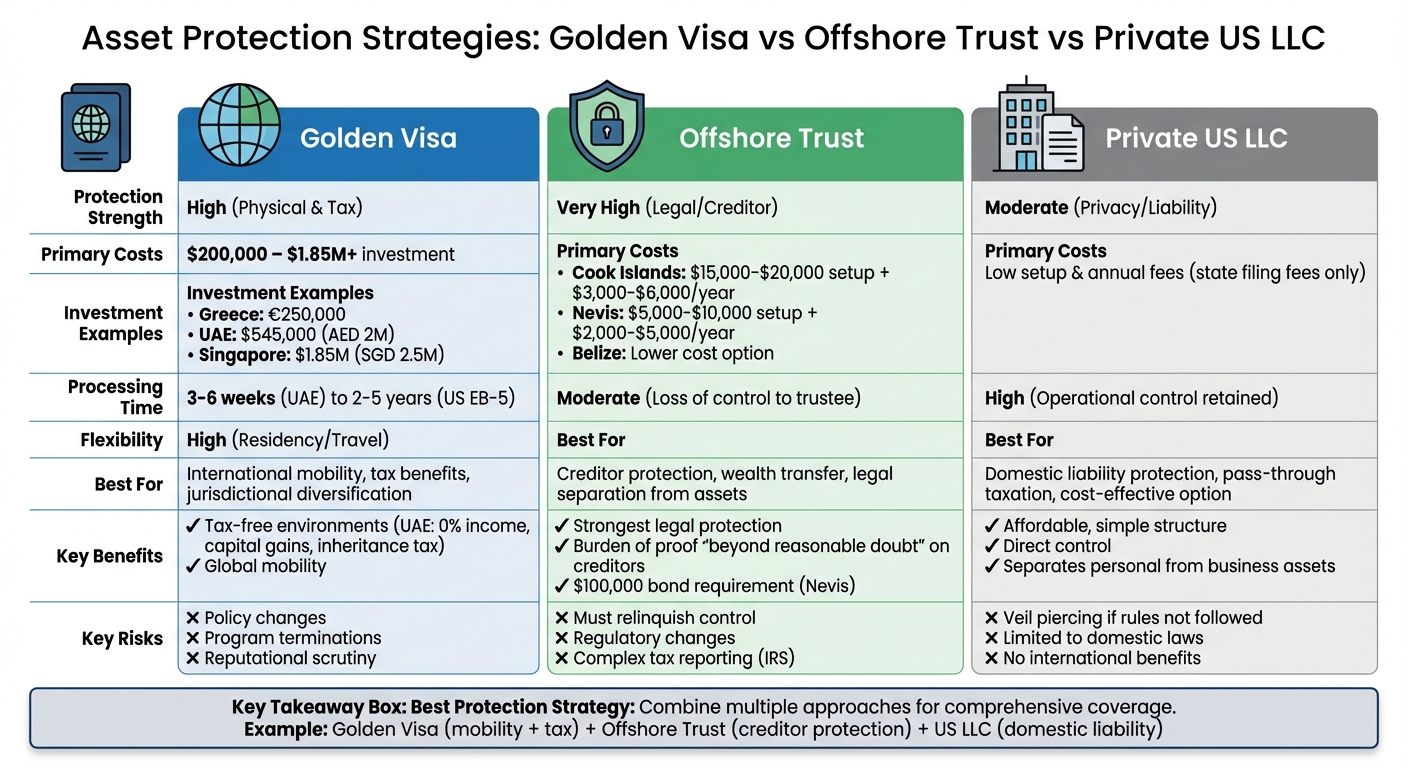
Golden Visas, offshore trusts, and private US LLCs are three popular strategies for shielding wealth. Each has its strengths and weaknesses depending on your goals – whether it’s tax benefits, legal protection, or privacy. Here’s a quick breakdown:
- Golden Visas: Offer residency in exchange for investment (e.g., real estate or funds). They provide tax perks and global mobility but can be expensive and subject to policy changes.
- Offshore Trusts: Strong legal protection against creditors by separating you from your assets. However, they require giving up control and involve high setup and maintenance costs.
- Private US LLCs: Affordable and provide liability protection domestically, but lack international benefits and rely on strict compliance with state laws.
Key Takeaway: Golden Visas are ideal for international mobility and tax benefits, offshore trusts excel in creditor protection, and US LLCs are a cost-effective domestic option. Combining strategies may offer the best protection. Always consult legal and tax experts before proceeding.
1. Golden Visa Programs
Asset Protection Strength
Golden Visas offer a way to safeguard assets by shifting them into a different legal jurisdiction. By establishing residency and relocating assets to another country, you create a layer of separation from potential creditors or legal disputes in your home country. As Henley & Partners explains:
Acquiring a golden visa is the best possible insurance policy against economic and political risk in a volatile world.
How this protection works varies depending on the country. For example, Portugal enforces regulatory separation for assets. Meanwhile, the UAE Golden Visa provides a tax-free environment – no taxes on income, capital gains, or inheritance – helping prevent wealth erosion through taxation.
That said, it’s important to note that a Golden Visa doesn’t make your assets invisible. They remain subject to international reporting obligations and could still be affected by claims under treaty agreements.
Now, let’s dive into the financial requirements tied to these visas.
Investment Thresholds and Costs
The cost of obtaining a Golden Visa can vary significantly. Greece offers one of the most affordable entry points in Europe, requiring just €250,000 in real estate. On the other hand, Singapore’s program demands a hefty investment of around $1.85 million (SGD 2.5 million) in approved businesses or funds. The UAE sits somewhere in the middle, with an investment of approximately $545,000 (AED 2 million) in freehold property.
But the initial investment isn’t the only financial factor to consider. For instance, Portugal’s fund-based route comes with annual fees ranging from 1.5% to 2.5%. Over seven years, a 2% fee on a €500,000 investment could amount to €70,000. Applicants should also budget for legal fees and potential tax obligations if they spend more than 183 days in the host country, triggering tax residency.
Processing times vary as well, impacting how quickly you can secure residency. The UAE typically processes applications within 3–6 weeks, whereas Portugal takes 12–18 months. The U.S. EB-5 program is even slower, with timelines stretching from 2 to 5 years. During these processing periods, your capital may be tied up, and fund-based programs often require illiquidity periods of 5–10 years, which can extend beyond the five-year minimum for citizenship eligibility.
Flexibility and Legal Risks
Golden Visas come with conditions and can be revoked, unlike full citizenship. Governments may discontinue these programs without warning. For instance, Spain ended its Golden Visa program on April 3, 2025, and Portugal recently closed its real estate investment route in October 2023, leaving only fund-based options available. If a program is terminated, recovering your investment can be a lengthy and difficult process. This highlights the importance of having a clear exit strategy.
There’s also a reputational angle to consider. The application process often attracts scrutiny, especially in today’s age of digital and social media monitoring. Interestingly, Americans have led the charge in seeking alternative residency options for two consecutive years leading into 2025.
Tax residency rules can add another layer of complexity. Holding a Golden Visa doesn’t automatically mean you owe taxes, but spending more than 183 days in certain countries, like Portugal, could make you liable for income tax on your global earnings. However, some programs, such as the UAE’s, don’t require a minimum stay, while Portugal only asks for seven days per year to maintain residency.
While Golden Visas provide a way to spread risk and protect assets, they don’t offer complete immunity from financial or legal exposure. Careful planning is essential.
sbb-itb-39d39a6
2. Offshore Trusts
Asset Protection Strength
Offshore trusts are a solid way to shield your assets from potential creditors by transferring control to an independent trustee in another country. Unlike Golden Visas, which rely on physical relocation for protection, offshore trusts work by legally separating you from your assets.
For example, in Nevis, creditors must pay a $100,000 cash bond to the Ministry of Finance before they can even file a lawsuit against an international trust. Similarly, both the Cook Islands and Nevis require creditors to prove fraudulent transfer claims to a much higher standard than the civil threshold used in U.S. courts.
However, there’s a catch: you must relinquish direct control over your assets. As Ipanema Partners puts it:
"The integrity of the structure depends entirely on the trustee’s absolute discretion. You, as the settlor, cannot retain the power to force distributions, demand the return of principal, or unilaterally direct the trustee’s actions."
The risks of retaining control are clear in cases like FTC v. Affordable Media, where the settlors of a Cook Islands trust were jailed for civil contempt. They had appointed themselves as Trust Protectors and retained the authority to fire the trustee, which allowed the court to enforce a repatriation order by deeming the trust invalid.
While asset protection is a key benefit, the financial and administrative commitments of offshore trusts are equally important to consider.
Investment Thresholds and Costs
Unlike Golden Visa programs with specific investment requirements, offshore trusts don’t have a set minimum. However, they are generally suited for individuals with significant assets, given the costs involved in setting up and maintaining the trust.
- Cook Islands Trusts: Setup costs range from $15,000 to $20,000, with annual fees between $3,000 and $6,000.
- Nevis Trusts: More affordable, with setup fees of $5,000 to $10,000 and annual costs of $2,000 to $5,000.
- Belize Trusts: Typically on the lower end of the pricing spectrum.
Blake Harris highlights the affordability of Belize trusts:
"The costs of establishing and maintaining an offshore trust in Belize are also generally lower than other locations."
For U.S. residents, tax compliance adds another layer of complexity. Offshore trusts require detailed IRS reporting of foreign-held accounts, which means hiring a CPA familiar with foreign trust regulations to avoid penalties. Alternatively, a Nevis LLC might be a less expensive option, as it doesn’t require initial capital or an offshore fiduciary.
While costs are important, the legal and structural nuances of offshore trusts demand careful attention.
Flexibility and Legal Risks
The effectiveness of offshore trusts depends heavily on how they are structured and managed. To provide protection, these trusts must be irrevocable, meaning you give up control to an independent trustee. Retaining any significant control can lead a court to invalidate the trust, stripping away its protective benefits.
Timing also plays a critical role. Setting up a trust after a liability arises can trigger fraudulent conveyance claims. Under U.S. Bankruptcy Code Section 548, there’s a 10-year look-back period for transfers made to self-settled trusts with the intent to defraud. In In re: Momentum Development, LLC, a court ruled that the four-year statute of limitations for fraudulent transfers could restart when a final judgment was entered.
The location of assets matters too. In United States v. Huckaby, a Nevada Spendthrift Trust was used to protect real estate in California. However, since the property was physically located in California, local laws applied, and the trust’s protection was deemed invalid.
Some offshore trusts include "flee clauses", allowing trustees to move the trust to a new jurisdiction if legal or political threats arise. While this can offer added protection, it may come with extra costs.
It’s also important to note that while offshore trusts are tax-neutral in their jurisdictions, they don’t exempt U.S. residents from domestic taxes. These trusts are classified as grantor trusts, meaning all income must be reported on the settlor’s tax return. As CitizenX explains:
"Offshore trusts are not ‘tax evasion’ vehicles – they must be properly reported and are designed to avoid double-taxation and offer tax deferral or planning advantages, not to hide income."
3. Private US LLCs
Asset Protection Strength
A private US LLC creates a legal barrier between your personal assets and business liabilities. This means that, in the event of lawsuits or debts, your personal property is generally protected. As Goldstone Financial Group points out:
"LLCs provide business owners with a protective barrier that separates personal assets from business liabilities, ensuring that personal property remains untouched in the event of company-related claims or legal issues."
However, this protection has its limits. Courts can "pierce the corporate veil" if you engage in activities like personal negligence, illegal conduct, or mixing personal and business funds. For instance, using your personal bank account for LLC-related expenses can undermine this safeguard. Unlike certain international structures, a US LLC focuses solely on domestic legal protection and remains tied to U.S. legal and economic systems.
In addition to asset protection, an LLC offers a budget-friendly approach to business formation, as detailed below.
Investment Thresholds and Costs
Starting an LLC is a far less expensive endeavor compared to obtaining a Golden Visa. The costs are typically limited to state filing fees and occasional professional services, which are minimal compared to Golden Visa investments that range from $18,000 to over $500,000 . Another advantage is pass-through taxation – LLC profits go directly to the owners, avoiding corporate-level taxes. This is far simpler than navigating the complex international tax rules, such as FATCA and PFIC regulations, often associated with Golden Visa investments.
While cost and tax benefits are clear, LLCs also offer operational flexibility, though they come with some legal risks.
Flexibility and Legal Risks
LLCs provide a high degree of flexibility, allowing you to maintain direct control over how assets are managed and distributed. This is in contrast to offshore trusts for asset protection, where control is handed over to an independent trustee. However, this control comes with a caveat: failing to follow strict rules – such as keeping personal and business finances completely separate – can compromise the liability protection LLCs offer. For example, transferring assets to an LLC after a liability arises could be classified as fraudulent conveyance.
Another legal risk involves using a Self-Directed IRA to fund an LLC for residency or Golden Visa purposes. U.S. regulators consider this a prohibited transaction, which could result in excise taxes as high as 100% of the account value.
To ensure your LLC maintains its protective benefits, it’s critical to adhere to state regulations, file annual reports on time, and keep your finances clearly separated. Consulting professionals familiar with both state laws and IRS requirements is highly recommended.
Advantages and Disadvantages
Asset protection strategies come with their own set of benefits and challenges, depending on the approach you choose.
Golden Visas act as a safeguard against political and economic uncertainties, offering relocation rights, enhanced global mobility, and access to different legal systems. Take the UAE Golden Visa, for instance – it provides 0% income tax, 0% capital gains tax, and 0% inheritance tax, making it a tax-friendly option. On the flip side, these programs are subject to regulatory changes and face reputational risks, as they are increasingly scrutinized for potential ties to money laundering. Unlike Golden Visas, offshore trusts focus more on creditor protection and legal separation.
Offshore Trusts excel in protecting assets from creditors by creating a separate legal entity managed by a trustee. They’re particularly useful for transferring wealth across generations. However, you’ll lose some control since the trustee manages the assets. Additionally, global transparency rules have tightened, leading to more rigorous reporting requirements for these structures.
Private US LLCs offer a domestic alternative with their own advantages and limitations. They’re affordable to set up, provide straightforward liability protection, and allow for pass-through taxation, all while letting you retain control of your assets. That said, their protection is limited to domestic legal systems, and you need to maintain a clear separation between personal and business finances to ensure liability protection. Unlike Golden Visas, LLCs don’t offer physical mobility or tax residency perks.
Here’s a quick comparison of the three strategies:
| Strategy | Protection Strength | Primary Costs | Flexibility | Key Risks |
|---|---|---|---|---|
| Golden Visa | High (Physical & Tax) | $200,000 – $1.85M+ investment | High (Residency/Travel) | Policy changes, reputational risks |
| Offshore Trust | Very High (Legal/Creditor) | Setup & annual maintenance fees | Moderate (Loss of control) | Regulatory changes, trustee issues |
| Private US LLC | Moderate (Privacy/Liability) | Low setup & annual fees | High (Operational control) | Veil piercing, limited to domestic laws |
For those with significant wealth, combining these strategies can be especially effective. For example, using a Golden Visa for its mobility and tax benefits alongside an offshore trust for asset protection creates a well-rounded defense.
Conclusion
Selecting the right asset protection strategy means aligning your specific needs with the appropriate tools. Golden Visas are ideal if you’re seeking jurisdictional diversification, tax benefits, and a backup residency option. For example, the UAE Golden Visa offers tax-free advantages with processing times as short as 3–6 weeks. However, if your primary concern is safeguarding assets from lawsuits, a Golden Visa alone won’t suffice.
While Golden Visas provide residency and tax perks, they don’t cover all legal risks. Offshore trusts, on the other hand, are considered the strongest option for legal protection. As Blake Harris explains:
The Cook Islands is generally recognized as the safest jurisdiction for offshore asset protection.
Offshore trusts shift the burden of proof for creditors to the much stricter standard of "beyond a reasonable doubt", and in jurisdictions like Belize, asset protection activates as soon as the trust is established.
For a simpler approach, private U.S. LLCs offer charging order protection and privacy without unnecessary complexity. Harris also highlights:
a Nevis LLC can be used in combination with an offshore asset protection trust or on its own to hold and protect assets even if they are located elsewhere in the world.
These strategies represent a range of options – from global mobility to robust legal safeguards – designed to meet diverse financial goals and risk profiles. Whether you’re aiming for tax efficiency and international flexibility with a Golden Visa, creditor protection through an offshore trust, or domestic privacy and control with a private LLC, the choice depends on your priorities. In many cases, combining these tools provides the most comprehensive coverage. Be sure to consult with tax and legal experts to craft a strategy tailored to your unique circumstances before making significant financial commitments.
FAQs
Does a Golden Visa actually protect my assets from U.S. lawsuits?
A Golden Visa doesn’t shield your assets from U.S. lawsuits. Its main function is to grant residency or immigration advantages, but it doesn’t prevent legal actions from being taken against your assets. Protecting your wealth usually involves separate legal measures beyond simply acquiring a Golden Visa.
Will a Golden Visa make me a tax resident and tax my worldwide income?
Golden Visas grant legal residence in a country, but they don’t automatically make you a tax resident. Whether or not you become subject to taxation on your worldwide income depends on the country’s specific tax laws and factors such as how much time you spend there or the strength of your financial connections to the country.
Should I combine a Golden Visa with a trust or LLC for better protection?
Combining a Golden Visa with a trust or LLC can provide an extra layer of asset protection, depending on your specific financial and legal circumstances. By establishing a trust or LLC, you create a separate legal entity that can offer greater privacy and help safeguard your assets from potential liabilities. However, the effectiveness of this approach depends on factors like the country involved, the structure of the trust or LLC, and the types of assets being protected. It’s essential to work with experienced legal and financial professionals to ensure this strategy aligns with your goals and requirements.
