
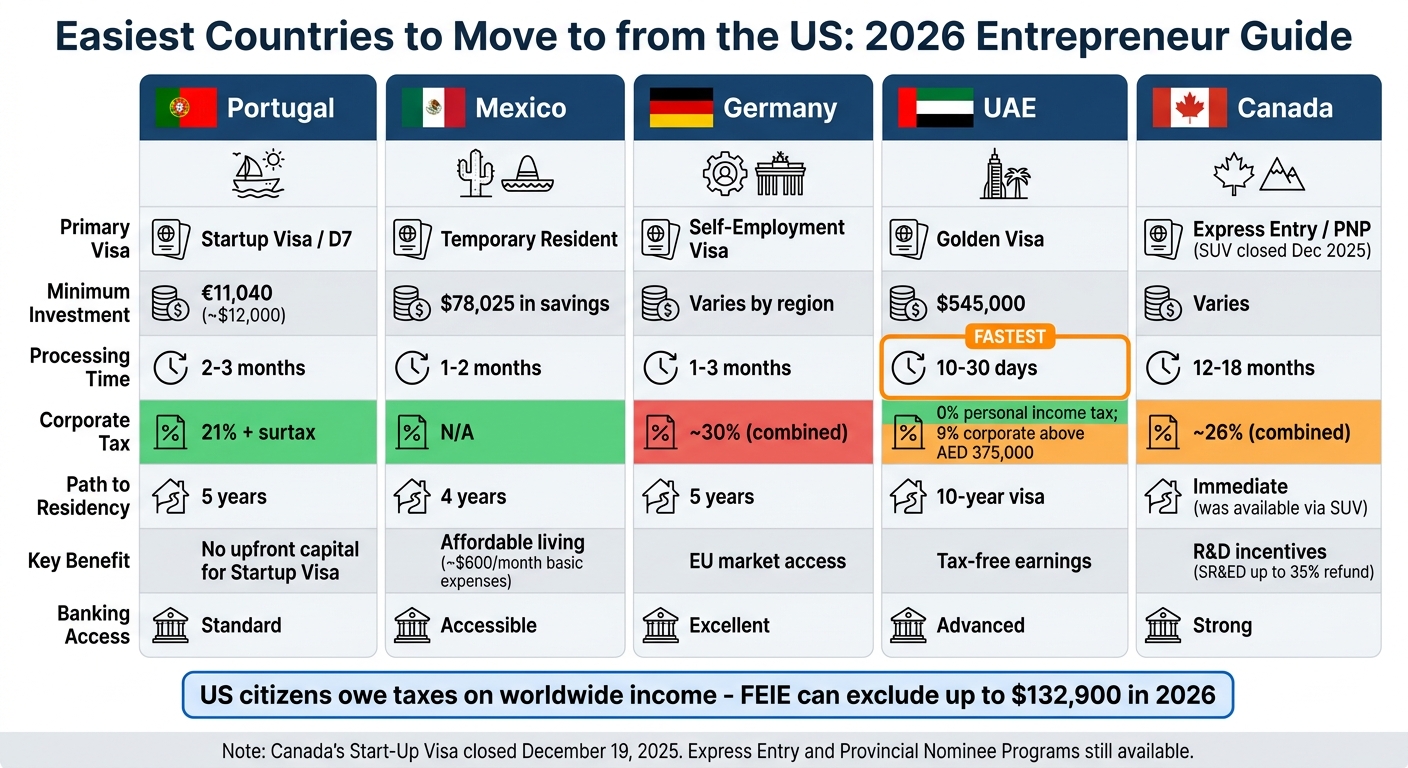
Looking to move your business abroad? Here’s a quick rundown of the best countries for U.S. entrepreneurs and digital nomad visas in 2026. These destinations stand out for their straightforward visa programs, tax advantages, and business-friendly environments. Whether you’re chasing lower taxes, faster visa processing, or access to global markets, there’s an option for you:
- Portugal: Startup Visa with no upfront capital, 21% corporate tax, and permanent residency after 5 years.
- Mexico: Affordable living with a Temporary Residency visa requiring $78,025 in savings.
- Germany: Strong EU market access, ~30% corporate tax, and various self-employment visa options.
- UAE: 0% personal income tax, quick visa processing (10–30 days), and free-zone benefits.
- Canada: R&D incentives, 26% corporate tax, and permanent residency options via Express Entry.
Quick Tip: Countries like Estonia and the UAE offer zero tax on reinvested profits, while Portugal and Mexico provide lower financial barriers for entry. Banking access and local startup ecosystems are key factors to consider when choosing your destination.
Quick Comparison
| Country | Visa Type | Min. Investment | Processing Time | Corporate Tax | Residency Path |
|---|---|---|---|---|---|
| Portugal | Startup Visa / D7 | €11,040 | 2–3 months | 21% + surtax | 5 years |
| Mexico | Temporary Resident | $78,025 | 1–2 months | N/A | 4 years |
| Germany | Self-Employment Visa | Varies by region | 1–3 months | ~30% | 5 years |
| UAE | Golden Visa | $545,000 | 10–30 days | 0% (personal) | 10-year visa |
| Canada | Express Entry / PNP | Varies | 12–18 months | ~26% | Immediate (SUV closed) |
Pro Tip: U.S. citizens still owe taxes on worldwide income, but programs like the Foreign Earned Income Exclusion (FEIE) can help reduce federal taxes. Don’t overlook banking access – it can make or break your relocation plans.
How to Evaluate Countries for Entrepreneur Relocation
Relocating as an entrepreneur means carefully balancing visa access, business infrastructure, and tax policies with your unique goals. Start by outlining your timeline and funding needs. For example, if you need to launch operations within 30 days, countries like Estonia or the UK, which offer one-day company incorporation, can be excellent options. On the other hand, if raising venture capital is a priority, choosing a location with investor-friendly legal structures might outweigh the need for speed.
Banking access is another critical factor. Even in countries with fast company registration processes, delays in opening business accounts can stall your plans. Take Hong Kong, for instance – 96% of fintech clients successfully open accounts within three business days. In contrast, other jurisdictions might take weeks or even reject applications outright.
Physical presence requirements also vary significantly. Locations like the UK, Hong Kong, and UAE allow full remote control without requiring a local resident director. Meanwhile, places like Singapore or certain Canadian provinces mandate this, adding complexity for entrepreneurs managing operations from abroad. Lastly, visa policies and processing times should be reviewed to identify the fastest and most practical entry options.
Visa Requirements and Processing Times
As of 2026, 33 countries offer dedicated entrepreneur visa programs, with processing times ranging from just one week under Georgia’s Individual Entrepreneur program to as long as 12–18 months for Canada’s Start-Up Visa, which closed to new applications on December 19, 2025.
Startup visas increasingly emphasize endorsement rather than capital. For example, the UK Innovator Founder visa has no minimum investment requirement but does demand a Letter of Support from an approved incubator, VC fund, or accelerator. However, approval rates for UK endorsing bodies remain relatively low at around 36–40%. Other programs still focus on financial thresholds: Australia’s Subclass 188 visa requires between $1.5 million and $15 million AUD, while the Netherlands’ DAFT visa – available exclusively to US citizens – requires only €4,500 and no business plan.
"The endorsement requirement is the real filter here. You’ll need to convince one of the approved bodies that your business idea is genuinely innovative." – Openvisa Blog
The path to permanent residency is another key consideration. The UK offers settlement after just three years on the Innovator Founder visa, making it one of the fastest paths globally. Comparatively, Estonia and the Netherlands require five years, while Canada’s Start-Up Visa historically provided immediate permanent residency. It’s worth noting that while Estonia’s e-Residency program has attracted over 100,000 participants who have launched more than 27,000 companies since 2014, it doesn’t grant physical residency rights.
For US citizens, the Netherlands’ DAFT visa stands out for its low barriers and lack of a mandatory business plan. Meanwhile, Singapore’s EntrePass requires applicants to establish a company no older than six months, whereas the UK allows applications from already-established businesses. Beyond visas, the local business environment and startup support systems will influence how smoothly your venture operates.
Business Environment and Startup Support
Once visa requirements are addressed, the quality of a country’s digital infrastructure and startup ecosystem becomes crucial. Estonia, for example, enables seamless online management of public services and tax filings through its e-Residency program. Similarly, the UK offers efficient digital registration systems, making administrative tasks less burdensome.
Access to startup funding also varies widely. In 2025, the UK attracted £29.4 billion in investment, making it Europe’s leading venture capital hub. That same year, Singapore hosted over 4,000 tech startups and saw SGD 12 billion in VC deals. On the Henley Opportunity Index for 2026, Switzerland earned a perfect 100 for earning potential, while Singapore scored 98 for top-tier employment prospects.
For deep-tech startups, R&D incentives can be a game-changer. Programs like Canada’s SR&ED and New Zealand’s 15% refundable tax credit appeal to research-heavy companies, though they require detailed documentation. Additionally, Start-Up Chile offers equity-free grants of up to $80,000, which can be particularly appealing for cash-strapped ventures.
Labor laws can also impact your ability to scale. Rigid regulations around termination, notice periods, and social contributions may increase operational risks over time. Researching local labor laws early is a smart move if you plan to hire.
Tax Rates and Financial Advantages
Tax policies can significantly influence your bottom line, so it’s essential to evaluate them after considering visa frameworks and business support. Corporate tax rates range from 0% on reinvested profits in Estonia to over 26% in countries like Canada and Chile. In Singapore, the 17% corporate tax rate often drops below 10% for the first SGD 200,000 due to startup exemptions.
"Estonia’s corporate tax structure: 0% on reinvested profits. You only pay 20% when distributing dividends. For growth-stage startups that reinvest most of their revenue, this is transformative." – WhereToEmigrate Research Team
Some countries, like Singapore and the UAE, do not tax capital gains or foreign-sourced income that isn’t brought into the country. On the other hand, the UK, Netherlands, Canada, and Chile do impose these taxes.
Additional personal tax relief options can further reduce costs. For example, the Netherlands offers the 30% ruling for highly skilled migrants, while the UK lowers corporate tax from 25% to 19% for profits under £50,000. In the UAE, certain free zones provide 0% personal income tax, although setup packages can cost around AED 15,000 (~$4,100 USD).
sbb-itb-39d39a6
Best Countries for US Entrepreneurs in 2026
Looking to relocate your business in 2026? These five countries are worth considering, thanks to their visa options, business-friendly environments, and tax policies. Each offers unique benefits depending on your goals, whether you’re after market access, funding opportunities, or lifestyle upgrades. Here’s a breakdown to help you decide.
Portugal: A Haven for Startups and Digital Nomads
Portugal is making waves with its Startup Visa, which lets entrepreneurs launch businesses without needing upfront capital – provided they team up with an approved incubator. After five years, this visa can lead to permanent residency. If you’re relying on passive income, the D7 Visa is another option, requiring proof of around €920 in monthly income.
In 2024, Portugal introduced IFICI, a flat 20% tax rate on qualifying income for up to 10 years, replacing the Non-Habitual Resident (NHR) regime. Corporate tax stands at 21%, plus surtaxes.
Portugal also shines in healthcare, scoring 81.2 out of 100, and offers a growing number of English-taught university programs, with annual tuition ranging from €3,600 to €4,500. Lisbon and Porto are becoming tech hotspots, making Portugal a top choice for digital entrepreneurs.
Mexico: Affordable Living Close to Home
Mexico offers US entrepreneurs a mix of proximity, affordability, and cultural richness. The Temporary Residency visa requires proof of $4,630 in monthly income or $78,025 in savings. After four years, you can apply for permanent residency.
"Portugal and Spain are favored by retirees for their affordable low cost lifestyles and quality healthcare. Meanwhile, Mexico and Costa Rica remain popular due to their vibrant cultures and friendly locals." – Total Law
Living costs can be as low as $600 per month for basic expenses. Cities like Mexico City, Guadalajara, and Playa del Carmen have thriving expat communities, coworking spaces, and networking events. While many expats opt for private healthcare, medical services are still affordable compared to US standards.
Next, let’s look at a European powerhouse with access to lucrative markets and a strong tech ecosystem.
Germany: A Gateway to EU Markets
Germany is a magnet for skilled entrepreneurs, offering visa options tailored to tech and engineering professionals. The EU Blue Card requires a minimum salary of €45,300 – or €41,041 for high-demand jobs. Alternatively, the Freelance Visa is available if you can prove stable income and existing client contracts.
Corporate taxes average around 30% when federal and local rates are combined. Germany also supports newcomers with integration programs that include language and cultural education. With strong industrial and tech hubs in cities like Berlin, Munich, and Hamburg, plus its central location in Europe, Germany provides unmatched access to EU markets.
While Germany excels in market access, the UAE offers a completely different advantage: zero personal income tax.
United Arab Emirates: Tax-Free Earnings and Business-Friendly Zones
The UAE stands out with its 0% personal income tax and a 9% corporate tax on income above AED 375,000, introduced in 2023. The Golden Visa offers a 10-year residency for entrepreneurs, with investment requirements varying based on incubator approval.
Setting up a business in one of the UAE’s free zones starts at approximately AED 5,750. Dubai CommerCity, the region’s first e-commerce-focused free zone, offers a full suite of logistics and digital commerce solutions. The UAE is also known for its excellent digital infrastructure and global connectivity.
Keep in mind, non-residents might face extra hurdles when opening business bank accounts.
Canada: Entrepreneur-Friendly Programs and R&D Incentives
Although Canada’s Start-Up Visa (SUV) program closed to new applicants in December 2025, entrepreneurs can still take advantage of the Express Entry system and Provincial Nominee Programs. Historically, the SUV granted immediate permanent residency, even if the business didn’t succeed.
Corporate taxes in Canada average about 26% when federal and provincial rates are combined. The Scientific Research and Experimental Development (SR&ED) program is another highlight, offering refunds of up to 35% on eligible R&D expenses – just be sure to keep detailed records.
Monthly office costs range from CAD 800 to 1,500. With its multicultural society, universal healthcare, and strong venture capital networks, cities like Toronto, Vancouver, and Montreal are particularly appealing for entrepreneurs.
Each of these countries brings something different to the table. Whether you prioritize tax advantages, market access, or a vibrant community, there’s a destination to match your ambitions.
Country Comparison for Entrepreneurs
Side-by-Side Comparison Table
Relocating as an entrepreneur involves evaluating key factors like visa options, tax rates, startup costs, and residency pathways. The table below compares Portugal, Mexico, Germany, the UAE, and Canada based on these critical metrics.
| Country | Primary Visa | Min. Investment/Capital | Processing Time | Corporate Tax | Path to Permanent Residency |
|---|---|---|---|---|---|
| Portugal | Startup Visa / D2 | €11,040 (savings) | 2–3 months | 21% + surtax | 5 years |
| Mexico | Temporary Resident | $78,025 (savings) | 1–2 months | N/A | 4 years |
| Germany | Self-Employment Visa | Varies by region | 1–3 months | ~30% (combined) | 5 years |
| UAE | Golden Visa | AED 2M (~$545,000) | 10–30 days | 0% up to AED 375,000; 9% above | 10-year visa |
| Canada | Start-Up Visa* | CAD 75,000–200,000 | 12–18 months | ~26% (combined) | Immediate |
*Canada’s Start-Up Visa program will close to new applicants in December 2025, but options like Express Entry and Provincial Nominee Programs remain available.
Key takeaways: The UAE boasts the quickest visa processing time (10–30 days). Canada’s Start-Up Visa previously offered immediate permanent residency, while Portugal (including the Portugal digital nomad visa) and Mexico provide moderate processing times with lower financial barriers. Germany, on the other hand, has region-specific and industry-specific requirements that can vary.
"The real test is not incorporation speed – it is banking access. Getting your company registered takes a day or two… Getting a business account that international clients and suppliers accept is where most non-resident founders get stuck." – Bertrand Théaud, Founder, Statrys
Banking often becomes a significant hurdle for entrepreneurs. For instance, in the UAE, non-residents frequently face challenges opening business accounts without a residency visa and a physical office lease. By contrast, in Hong Kong, 96% of fintech-based business accounts are opened within three business days. These differences highlight how banking access can directly impact operational efficiency. Addressing these challenges is a crucial step when planning your move and setting up your business abroad.
Planning Your Move as an Entrepreneur
Protecting Assets and Structuring Your Business
Choosing the right legal structure before relocating can help reduce taxes and safeguard your personal assets. For example, Estonia’s corporate tax model allows businesses to reinvest profits tax-free, as taxes are only applied when profits are distributed.
"Estonian companies pay 0% corporate tax on retained earnings – tax only triggers when profits are distributed." – Ciarán Kelly, Business Tax Analyst, Eunomist
In the UAE, Free Zones provide 100% foreign ownership and corporate tax exemptions under specific conditions, making them an attractive option for entrepreneurs. Other destinations like Switzerland, Monaco, and Andorra are also popular for their strong legal systems, financial privacy, and asset protection measures.
To avoid becoming a tax resident in a new country, limit your stay to less than 183 days in most jurisdictions. Additionally, compare capital gains tax rates across countries – these can vary widely, from about 20% in Estonia and Lithuania to 33% in Ireland.
Once your business structure is sorted, the next step is setting up efficient banking channels in your new location.
Setting Up Business Banking Abroad
Accessing banking services can be a significant hurdle for entrepreneurs relocating internationally. Fintech providers in Hong Kong, for instance, have streamlined the process, with 96% of business accounts approved within three days. On the other hand, traditional banks in places like Singapore, the UAE, and Germany often require in-person verification, making fintech solutions a more convenient option.
Platforms such as Wise Business, Revolut Business, Mercury, and Relay are bridging the gap between international and US banking. These services offer multi-currency accounts, transparent exchange rates, and remote onboarding. In Estonia, fintech solutions dominate, with 70% of e-resident companies using them, though around 25% still rely on traditional banks despite stricter requirements.
Setting up a US LLC in states like Wyoming or Delaware can also be a smart move. Doing so provides access to US capital markets, banking systems, and payment gateways while you operate internationally. Virtual office services can help meet local address requirements for compliance.
Once your banking is in place, it’s crucial to stay on top of US tax obligations to avoid unexpected penalties.
Staying Compliant with US Tax Laws
For US entrepreneurs living abroad, staying compliant with tax laws is non-negotiable. The US operates on a citizenship-based taxation system, meaning you owe taxes on worldwide income regardless of where you reside. However, the Foreign Earned Income Exclusion (FEIE) can help. By meeting the Physical Presence Test – spending at least 330 full days outside the US in a 12-month period – you can exclude up to $132,900 of foreign earned income from federal taxes in 2026.
Keep in mind, though, that the FEIE doesn’t exempt you from the 15.3% self-employment tax on net earnings. To avoid paying social security taxes in both the US and your host country, you can use totalization agreements with over 30 countries. For instance, if you’re in the UK, Germany, or Canada, obtaining a "Certificate of Coverage" ensures you aren’t taxed twice.
You’ll also need to file specific forms if you hold foreign financial accounts. The FBAR is required if the total value of all foreign accounts exceeds $10,000 at any point during the year, while FATCA applies if foreign assets surpass $200,000 at year-end or $300,000 at any time. Failing to file FBAR can result in fines of up to $10,000 for non-willful violations, and much steeper penalties for willful violations.
Finally, consider establishing residency in a no-income-tax state like Florida, Texas, Nevada, or Wyoming before moving abroad. This can eliminate state-level tax obligations. However, be cautious with states like California, New York, Virginia, and New Mexico, as they are known for aggressively taxing former residents’ worldwide income. Don’t forget to file Form 2555 with your tax return to claim the FEIE – it’s not automatic.
Conclusion
Relocating as a U.S. entrepreneur isn’t just about picking the easiest visa option – it’s about aligning your business model, financial objectives, and lifestyle preferences with the right country. As outlined earlier, your decision should consider all critical factors. A quick path to residency won’t mean much if local banking systems slow down your operations or if the tax structure clashes with your growth plans.
Focus on market access, not just tax rates. For instance, if most of your customers are in the Asia-Pacific region, Hong Kong’s territorial tax system might be more advantageous than Portugal’s lower cost of living. Additionally, the strength of local startup ecosystems can play a big role in shaping your growth trajectory, far beyond visa and tax perks.
Evaluate operational readiness – the time between registering your company and being fully functional. In some countries, incorporation might take just one day, but setting up banking could drag on for six weeks. Also, check if the country mandates a locally resident director, as this requirement could add complexity and costs, such as hiring nominee services.
FAQs
Which visa is best if I need to move and start operating fast?
If you’re in a hurry to relocate, focus on visas that offer quick processing times and straightforward requirements. For example, Iraq’s business visa can be processed in just 5 days. On the other hand, Austria’s self-employed key workers visa may take between 30 and 60 days.
For digital entrepreneurs, Estonia’s startup visa combined with its e-Residency program allows for fast incorporation and seamless business operations. Ultimately, your decision should hinge on whether your priority is fast residency, efficient business setup, or a balance of both.
How do I avoid getting stuck opening a business bank account abroad?
To open a business bank account in another country without hiccups, it’s crucial to understand the local banking rules and gather the required documents ahead of time. Reach out to financial institutions or legal experts who specialize in helping expatriates navigate these processes. Make sure you meet all the identification, residency, and business registration requirements specific to that country. By preparing thoroughly and seeking professional advice, you can avoid unnecessary delays or complications.
Will I still owe U.S. taxes if I move my business overseas?
U.S. citizens or residents who move their business overseas are generally required to pay U.S. self-employment taxes on their net foreign business income. This rule applies even if you’re eligible for the foreign earned income exclusion. It’s essential to consult IRS guidelines to stay compliant with your tax responsibilities while running a business abroad.
