
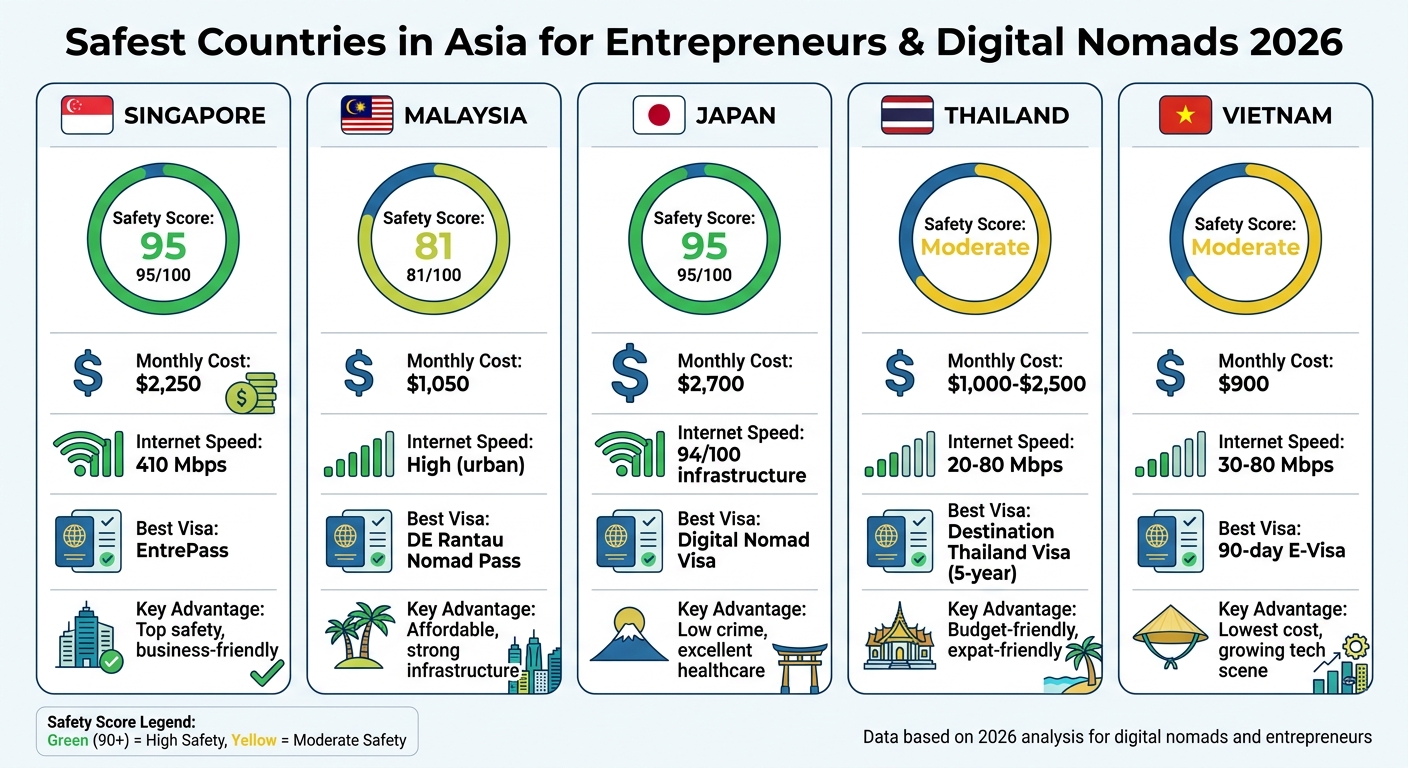
Asia is becoming a top destination for entrepreneurs and digital nomads in 2026, thanks to its mix of safety, affordability, and opportunities. Countries like Singapore, Malaysia, Japan, Thailand, and Vietnam stand out for their unique advantages. Here’s a quick overview:
- Singapore: Safest in Asia with a 95/100 safety score, excellent infrastructure, and business-friendly policies. High cost of living (~$2,250/month).
- Malaysia: Affordable (~$1,050/month) with strong safety (81/100) and accessible nomad visas like the DE Rantau Pass.
- Japan: Low crime (95/100 safety score), world-class healthcare, and a structured business environment. Higher living costs (~$2,700/month).
- Thailand: Budget-friendly (~$1,000–$2,500/month) with vibrant expat communities and long-term visa options.
- Vietnam: Most affordable (~$900/month) with emerging tech hubs and low living costs, though visa options are limited.
Quick Comparison
| Country | Safety Index | Monthly Cost | Best Visa Program | Key Advantage |
|---|---|---|---|---|
| Singapore | 95/100 | ~$2,250 | EntrePass | Top safety, business-friendly |
| Malaysia | 81/100 | ~$1,050 | DE Rantau Nomad Pass | Affordable, strong infrastructure |
| Japan | 95/100 | ~$2,700 | Digital Nomad Visa | Low crime, excellent healthcare |
| Thailand | Moderate | ~$1,000–$2,500 | Destination Thailand Visa | Budget-friendly, expat-friendly |
| Vietnam | Moderate | ~$900 | 90-day E-Visa | Lowest cost, growing tech scene |
Each country offers a mix of safety, cost, and infrastructure. Whether you’re seeking a high-end setup or a budget-friendly base, Asia has options tailored to your needs.
1. Singapore
Safety Metrics
Singapore boasts an impressive safety score of 95/100, making it one of the safest places in the world. Violent crime is nearly nonexistent, and even petty theft is so rare that walking alone late at night – say, at 3 AM – is considered perfectly safe. The country’s strict law enforcement plays a big role, with fines of S$300 for littering and up to S$1,000 for importing gum illegally.
"If Hong Kong is Asia’s trading floor, Singapore is its boardroom – orderly, efficient, and meticulously planned."
– WhereNext Research Team
Visa & Residency Options
While Singapore doesn’t have one of the best digital nomad visas, it offers several work and residency options for remote workers and entrepreneurs. Most remote workers rely on employer-sponsored passes like the Employment Pass (EP), which requires a minimum monthly salary of S$5,600 (or S$6,200 for roles in financial services) and uses the COMPASS points system. Entrepreneurs can explore the EntrePass, which is geared toward founders with innovation-focused ventures and requires S$50,000 to S$100,000 in capital. High-earning professionals making at least S$30,000 a month may qualify for the ONE Pass, a flexible 5-year visa that allows business ownership and employment with multiple companies.
| Visa Type | Minimum Monthly Salary | Highlights |
|---|---|---|
| Employment Pass (EP) | S$5,600 | Employer-sponsored visa with COMPASS evaluation |
| ONE Pass | S$30,000 | 5-year visa for top global talent, offering flexibility |
| Tech.Pass | S$22,500 | Designed for experienced tech leaders and experts |
| EntrePass | N/A | For startup founders; requires S$50,000+ in capital |
Singapore’s visa options reflect its commitment to supporting professionals and entrepreneurs alike.
Business Environment
Singapore makes it easy for foreign investors, allowing 100% ownership of private limited companies without requiring a local partner. The business registration process, handled through ACRA‘s BizFile+ system, is efficient and usually completed in just a few days. Taxes are another highlight: the corporate tax rate is a flat 17%, with no taxes on capital gains or dividends. For individuals, the progressive income tax system results in effective rates of roughly 7% to 12% for mid- to senior-level professionals.
"In a world where confidence, clarity and continuity are increasingly scarce, Singapore offers something more unusual than ever: a jurisdiction where ambition and stability coexist."
– Withers LLP
This combination of ease of doing business and favorable tax policies makes Singapore a top choice for entrepreneurs.
Cost of Living
Living in Singapore comes with a higher price tag, with monthly expenses for a single person typically ranging from about US$3,200 to US$5,000. Rent is a significant factor – 1-bedroom condos in the city center cost S$3,000 to S$5,000 per month, while more spacious suburban HDB flats are available for S$1,800 to S$2,500 monthly. To save on food costs, many residents opt for meals at hawker centers, which cost just US$3–5 per meal and can significantly reduce monthly expenses compared to dining at restaurants. Car ownership, however, is a luxury due to the Certificate of Entitlement (COE) often exceeding S$100,000, making Singapore’s efficient MRT system the preferred mode of transportation.
Digital Infrastructure
Singapore’s digital setup is world-class, with average download speeds of 262 Mbps and 1 Gbps fiber broadband available for just S$40–50 per month. For coworking, spaces are widely available and cost between US$100 and US$300 monthly. English being the primary business language further enhances the city-state’s appeal for remote workers and entrepreneurs.
With its focus on safety, business-friendly policies, and cutting-edge connectivity, Singapore stands out as an ideal destination for professionals and entrepreneurs looking to relocate.
sbb-itb-39d39a6
2. Malaysia
Safety Metrics
Malaysia scores an impressive 68/100 for safety, with violent crime being rare and overall safety rated as "Very High". While petty theft can occasionally occur in busy tourist spots, the country provides a secure environment for long-term residents. Malaysia is also a prominent medical tourism destination, offering JCI-accredited healthcare facilities. A standard doctor consultation typically costs between $10 and $20.
Visa & Residency Options
Malaysia stands out for its tax and residency solutions for digital nomads. The DE Rantau Nomad Pass is one of the most straightforward digital nomad visas in Asia. It requires an annual income of $24,000 for tech roles and $60,000 for non-tech roles. The application process is fully online and takes about 6 to 8 weeks. The visa fee is approximately RM 1,000 (around $220) for the main applicant. This pass allows stays ranging from 3 to 12 months, with an option to renew for another year, offering a total duration of up to 24 months.
"Considered by many as the easiest digital nomad visa to secure in all of Asia, Malaysia boasts both affordability and a reputation as one of the top expat-friendly countries globally."
– Katelynn Minott, CEO, Bright!Tax
For those seeking longer-term residency, the MM2H Silver Tier program requires a RM 150,000 fixed deposit and RM 5,000 in monthly offshore income. Alternatively, the Sarawak S-MM2H offers a more affordable, state-level option [17, 21].
Business Environment
Malaysia allows 100% foreign ownership of private limited companies, making it easier for entrepreneurs to establish businesses. However, a key tax change came into effect in 2026: foreign-sourced income remitted to Malaysia by tax residents (those staying 182 days or more) is now subject to progressive tax rates ranging from 0–30%. This marks the end of Malaysia’s previous territorial tax advantage [17, 21]. Entrepreneurs planning extended stays should seek professional tax advice to navigate these changes. It is also essential to understand the broader implications of digital nomad taxes when living abroad. Despite this, Malaysia’s business environment remains attractive, offering an affordable lifestyle alongside its professional opportunities.
Cost of Living
Malaysia provides first-rate infrastructure at a fraction of the cost compared to neighboring countries. Living in Malaysia is about 60% cheaper than Singapore and 40% cheaper than Bangkok. Monthly expenses for a single person range from $1,000 to $1,800 in Kuala Lumpur and $800 to $1,400 in Penang. Renting a one-bedroom apartment in the city center costs between $440 and $780 in Kuala Lumpur and $265 to $555 in Penang.
Eating out is highly affordable, with meals at hawker centers costing just $1.30 to $3.30, while dining at Western-style restaurants ranges from $11 to $27. Internet access is also budget-friendly, with 100 Mbps fiber-optic plans priced between $22 and $35 per month. These cost advantages make Malaysia an appealing option for professionals seeking an affordable yet high-quality lifestyle.
Digital Infrastructure
Malaysia’s urban centers offer strong digital connectivity, with average internet speeds exceeding 100 Mbps and power grid reliability at 99.5% uptime. Major cities have widespread 5G coverage, and fiber internet speeds range from 100 to 500 Mbps. English is widely spoken in business settings, reducing communication barriers for international entrepreneurs. Kuala Lumpur is ideal for those seeking excellent infrastructure and networking opportunities, while Penang offers a more relaxed, UNESCO-listed environment with living costs that are 20–30% lower.
3. Japan
Safety Metrics
Japan stands out as one of the safest countries in Asia, earning an impressive safety score of 95/100. Violent crime is nearly nonexistent. This strong culture of safety is evident in everyday life – young children can commute on public transit without concern, and women feel secure walking alone at night. It’s a level of public order that’s deeply woven into daily routines.
Healthcare in Japan is also highly regarded, ranking 2nd globally for accessibility and quality. While digital nomads are required to carry private insurance, long-term residents can take advantage of the affordable and high-quality National Health Insurance system, adding a layer of security for both personal and professional life.
Visa & Residency Options
Japan introduced its Digital Nomad Visa in 2024, offering stays of up to 6 months, renewable twice for a total of 18 months. This is similar to other remote work options like the New Zealand Digital Nomad Visa. To qualify, applicants need an annual income of at least ¥10 million (around $68,000) and must secure private health insurance covering a minimum of ¥10 million. The application fee is ¥3,000.
For entrepreneurs, the Startup Visa provides a flexible window of 6 months to 2 years to establish a business without needing immediate capital. However, changes to the Business Manager Visa in October 2025 increased the capital requirement from ¥5 million to ¥30 million (about $195,000). Applicants must also hire at least one full-time local employee and typically prove Japanese proficiency at the JLPT N2 level. These visa options make Japan an attractive and efficient choice for entrepreneurs looking to establish themselves in a safe and structured environment.
Business Environment
Japan’s business ecosystem is supported by its well-organized visa system and strong economic framework. In 2025, Japan was ranked the 4th freest economy globally, with an economic freedom score of 80. The country boasts world-class infrastructure, from its famously punctual public transportation to a fiber-optic internet network that ensures reliable connectivity for remote work.
Each city offers unique business opportunities: Tokyo excels in Fintech and SaaS, Osaka focuses on Deep Tech and Healthcare, and Fukuoka is becoming a hotspot for community-driven startups with lower living costs. Immigration fees are manageable at ¥5,500 when processed online.
Support for entrepreneurs is robust. Organizations like JETRO offer free temporary office space and legal advice, while local municipal programs provide rent subsidies and networking opportunities. Additionally, the Digital Nomad Visa allows holders to stay under the 183-day tax residency threshold, ensuring that foreign-sourced income remains untaxed for stays under one year.
Cost of Living
Since 2025, a weaker yen has made Japan a more affordable option for dollar-earning expats. Monthly expenses for a single person range from $2,500–$3,500 in Tokyo, $1,800–$2,500 in Osaka, and $1,200–$1,700 in Fukuoka. Housing costs vary significantly: one-bedroom apartments in central Tokyo typically cost $1,000–$1,800, while similar options in Fukuoka range from $400–$800. Coworking spaces charge between $100 and $350 per month, and share houses or coliving arrangements make it easier to navigate the rental market.
Digital Infrastructure
Japan’s urban areas deliver exceptional internet speeds, with fixed-line broadband exceeding 200 Mbps and standard 1 Gbps fiber connections widely available. Power reliability is also impressive, with 99.5% uptime. However, free public Wi-Fi can be unreliable outside major transit hubs, so getting a pocket Wi-Fi or local eSIM upon arrival is a smart choice.
Tokyo offers the most robust English support, particularly within its tech sector. That said, learning basic Hiragana and Katakana can help with everyday tasks like managing utilities, navigating healthcare, or using public services. While tools like Google Translate assist with Kanji, even a basic understanding of Japanese can make daily life much easier in a country where most systems operate in the local language. Combined with its advanced connectivity and stable environment, Japan remains a top destination for global professionals.
4. Thailand
Safety Metrics
Thailand is a favorite destination for entrepreneurs and digital nomads, thanks to its safety and affordability. Violent crime against foreigners is rare, with cities like Chiang Mai often highlighted as some of the safest in the region. However, road safety remains a concern, especially for motorbike riders. Wearing helmets and securing comprehensive international health insurance is essential.
Healthcare is another strong point. Thailand is a global leader in medical tourism, with facilities like Bumrungrad Hospital in Bangkok offering excellent care at a fraction of U.S. costs. A visit to a general practitioner typically costs between $15 and $45, while dental procedures are 50–80% cheaper than in the U.S.. For entrepreneurs, these savings on medical expenses add to the country’s financial appeal.
The visa landscape has also improved significantly. The introduction of the Destination Thailand Visa (DTV) in 2024 and the 10-year Long-Term Resident (LTR) visa has eliminated the need for remote workers to rely on tourist visas. While political events may occasionally grab headlines, they rarely affect the daily lives of expats. With a cost of living ranging from $1,000 to $2,500 per month depending on the city, Thailand offers an attractive combination of affordability and stability.
Visa & Residency Options
Thailand now provides two main visa options for long-term stays. The Destination Thailand Visa (DTV) is a 5-year, multiple-entry visa tailored for remote workers, freelancers, and even those studying Muay Thai. It allows stays of up to 180 days per entry, with an option to extend for another 180 days. Application fees range from $280 to $420, and applicants must show proof of at least 500,000 THB (approximately $14,000) in their bank account for the three months prior to applying. Applications must be made at a Thai embassy or consulate, with locations like Taipei and Jakarta known for efficient processing.
"The DTV is Thailand’s smartest immigration move in decades – a visa that finally acknowledges remote workers with stable foreign income are ideal long-term residents." – ThailandCorner
For high-income professionals, the Long-Term Resident (LTR) Visa offers a 10-year renewable residency with tax benefits. The "Work-from-Thailand" category requires an annual income of $80,000 from a well-established overseas employer. Alternatively, the "Wealthy Global Citizens" category requires $1,000,000 in total assets, with $500,000 invested in Thai assets. The application fee is $1,400 per applicant or dependent. LTR holders enjoy a 0% tax rate on foreign income and a flat 17% tax rate on Thai income, compared to the usual progressive rate of up to 35%. However, both visas restrict working for Thai companies or taking Thai clients, ensuring all income originates from abroad.
Business Environment
Thailand’s business infrastructure has evolved to meet the needs of remote workers. The country boasts over 140 coworking spaces, with Bangkok hosting more than 100 and Chiang Mai over 40. Monthly coworking costs range from $70 to $200, depending on location and amenities. Popular neighborhoods like Sukhumvit and Ari in Bangkok are hubs for tech-focused nomads, offering excellent infrastructure and networking opportunities.
Internet connectivity is top-notch, with fixed broadband speeds averaging 145 Mbps nationwide – the fastest in Southeast Asia. Reliable providers like AIS and True offer 5G and fiber options. The DTV also helps remote workers manage their stay to remain under the 183-day tax residency threshold. However, new rules introduced in January 2024 require careful planning for those staying 183 days or more, as tax obligations may apply. Many nomads now transfer only what’s necessary for living expenses.
Cost of Living
Thailand delivers a high standard of living at a reasonable cost. In Chiang Mai, living comfortably costs about $1,000–$1,400 per month, while Bangkok’s world-class amenities push that range to $1,500–$2,500. Rent varies by city: a one-bedroom condo in Chiang Mai costs $230–$430, whereas in central Bangkok, it’s $430–$860. Meals from street vendors are a bargain, often priced at just $1–$2.
| City | Comfortable Monthly Budget | Rent (1-bed) | Coworking (Hot Desk) |
|---|---|---|---|
| Chiang Mai | $1,000–$1,400 | $230–$430 | $70–$130 |
| Bangkok | $1,500–$2,500 | $430–$860 | $100–$200 |
| Koh Phangan | $1,000–$1,500 | Varies | Varies |
| Phuket | $1,100–$1,700 | Varies | Varies |
Banking is straightforward, with expat-friendly institutions like Bangkok Bank and Kasikorn Bank (KBank) often accepting a condo lease as proof of address. Additionally, Thailand’s VAT rate is just 7%, which is lower than in many other countries.
Digital Infrastructure
Thailand’s urban areas offer excellent internet connectivity, with fixed broadband speeds averaging 145 Mbps. In Bangkok and Chiang Mai, speeds typically range from 50–200 Mbps and 30–100 Mbps, respectively. While the mainland enjoys reliable power, island destinations like Koh Phangan may experience occasional outages due to weather. For critical work, sticking to major cities like Bangkok or Chiang Mai is advisable.
With growing 5G coverage, affordable coworking options, and a strong expat community, Thailand’s digital infrastructure is well-suited for remote work. It provides an excellent base for entrepreneurs and digital nomads looking to thrive in Southeast Asia.
5. Vietnam
Safety Metrics
Vietnam stands out as one of Asia’s safest destinations for entrepreneurs and digital nomads, thanks to its low violent crime rates and reliable infrastructure. Foreign visitors are required to register their temporary residence with local authorities within 24–48 hours of arrival to meet legal requirements. Additionally, starting January 1, 2025, all bank account holders must update their biometric information, enhancing the security of the country’s modern QR-code payment system.
Healthcare in Vietnam is affordable, but securing private international health insurance is recommended for access to English-speaking clinics. Annual costs for such insurance range from $500 to $1,200. The World Bank highlights Vietnam’s remarkable transformation from one of the world’s poorest nations to a middle-income economy in just a generation. This progress is reflected in its booming tourism industry, with international visitors increasing from 17.5 million in 2024 to a projected 23 million by the end of 2025. These factors contribute to a stable and welcoming environment for long-term residents.
Visa & Residency Options
Vietnam currently lacks a dedicated digital nomad visa. Instead, remote workers often rely on the 90-day multi-entry e-visa, which costs $25 and is typically processed within three business days. For extended stays, the recently introduced 5-year Talent Visa (Decree No. 221/2025/NĐ-CP) targets highly skilled professionals in fields like technology, arts, and science, allowing stays of up to 90 days per entry.
Entrepreneurs have access to the DT investor visa system, which offers different tiers based on investment levels. The entry-level DT4 visa requires an investment under VND 3 billion (about $122,000) and grants a 12-month residency, while the DT1 visa, requiring an investment above VND 100 billion (approximately $4.07 million), offers a 10-year temporary residence card. Finance professionals can benefit from the Vietnam International Financial Centre framework, which provides a 10-year UD1 residence card with a processing time of just three days and a pathway to permanent residency after three years.
"The 10-year residence card alone puts Vietnam’s IFC ahead of what DIFC offered in its first five years of operation." – Regional immigration adviser, Baker McKenzie
Tax residency is determined after spending 183 days or more in the country per year. Residents are subject to progressive tax rates ranging from 5% to 35% on worldwide income, while non-residents pay a flat 20% tax on Vietnam-sourced income.
Business Environment
Vietnam has made impressive strides in digital infrastructure. Cities like Da Nang and Ho Chi Minh City now offer affordable high-speed internet plans, with 50–200 Mbps connections costing just $8–$12 per month. Coworking spaces are also reasonably priced, with memberships ranging from $50 to $150 per month. Beyond coworking, a thriving café culture provides reliable Wi-Fi and plenty of power outlets for remote work.
"If you were to design a country from scratch for digital nomads, you might end up with something remarkably close to Vietnam." – Digital Nomad Index
However, undersea cable issues can occasionally disrupt international bandwidth by 30%–50% for weeks at a time. To stay connected, having a backup mobile hotspot or secondary connection is a smart move. Local SIM cards from providers like Viettel or Mobifone offer generous data plans (60–120 GB per month) for just $4 to $12.
Cost of Living
Vietnam offers an excellent balance of cost and quality, with monthly living expenses ranging from $1,000 to $1,500. Renting a one-bedroom apartment in Ho Chi Minh City or Hanoi typically costs $300–$600, while similar accommodations in Da Nang range from $200 to $400. Daily expenses are equally affordable, with street food meals priced at $1.20–$2.40 and mid-range restaurant meals costing $6–$12.
| City | Monthly Budget | Rent (1-Bedroom) | Primary Appeal |
|---|---|---|---|
| Da Nang | $700–$1,100 | $200–$400 | Beachfront, modern infrastructure, relaxed pace |
| Ho Chi Minh City | $900–$1,600 | $300–$600 | Economic engine, startup ecosystem |
| Hoi An | $800–$1,300 | Varies | UNESCO heritage, tight-knit community |
| Hanoi | $900–$1,400 | $300–$600 | Traditional aesthetic, creative scene |
Motorbike rentals are another budget-friendly option, costing $50–$100 per month. For those planning to drive, converting a home country license to a Vietnamese one within the first month is essential, as International Driving Permits from countries under the 1949 Geneva Convention (e.g., the US, UK, and Australia) are not recognized. Opening a local bank account at institutions like Vietcombank or Techcombank is straightforward, requiring only a passport and valid visa, which simplifies rent payments and other transactions.
Digital Infrastructure
Urban centers such as Da Nang, Ho Chi Minh City, and Hoi An are well-equipped with reliable high-speed internet. Vietnam’s economy is increasingly mobile-driven, with QR-code payments becoming the norm, making cash less necessary. Apps like Grab are widely used for ride-hailing, food delivery, and logistics, adding to the convenience.
Coworking spaces and coliving facilities often feature commercial-grade internet with backup connections. Da Nang, in particular, is gaining traction as a digital nomad hotspot, rivaling places like Chiang Mai and Bali. It offers a mix of beach access, mountain views, and living costs 30–40% lower than Ho Chi Minh City.
Comparison: Advantages and Disadvantages
Here’s a side-by-side look at the benefits and trade-offs of each country, based on the detailed profiles provided earlier.
Each destination presents a mix of strengths and limitations in terms of safety, cost of living, and accessibility. Singapore, for instance, ranks as Asia’s safest country with a Global Peace Index (GPI) score of 1.339 and an impressive infrastructure rating of 95/100. However, its monthly living expenses hover around $2,250, which is more than twice the cost of living in Thailand ($1,000) or Vietnam ($900). Japan, while boasting a GPI score of 1.525 and a safety index of 82/100, comes with even higher monthly expenses at $2,700. Its Digital Nomad Visa, limited to six months with no extensions, further restricts long-term stays.
Malaysia offers a balanced option, with the second-highest safety ranking in Asia (GPI 1.427) and a more affordable monthly cost of $1,050. This makes it a compelling alternative to Singapore, especially for those seeking strong infrastructure without the steep expenses. Meanwhile, Thailand’s Destination Thailand Visa allows stays of up to five years, with entries capped at 180 days, provided applicants maintain savings of around $14,500. Vietnam, the most budget-friendly option at $900 per month, lacks a dedicated digital nomad visa but offers 90-day e-visas instead.
"Singapore ranks as the safest country in Asia for nomads, followed by Malaysia and Japan." – MoveAndStay
Internet speeds also vary widely. Singapore leads with an average of 410 Mbps, while Thailand and Vietnam range from 20–80 Mbps and 30–80 Mbps, respectively. Additionally, Singapore’s business-friendly environment allows company formation to be completed in just one day – much quicker than the global average of 20 days – making it a magnet for entrepreneurs despite its high living costs.
The table below provides a clear summary of the key metrics and advantages for each country:
| Country | Safety Index | Monthly Cost | Internet Speed | Best Visa Program | Key Advantage |
|---|---|---|---|---|---|
| Singapore | 86/100 | ~$2,250 | 410 Mbps | EntrePass | Fast business setup, highest safety |
| Malaysia | 81/100 | ~$1,050 | High (urban) | DE Rantau Nomad Pass | Affordable with strong safety |
| Japan | 82/100 | ~$2,700 | 94/100 (infra) | Digital Nomad Visa | Excellent healthcare, low crime |
| Thailand | Moderate | ~$1,000 | 20–80 Mbps | Destination Thailand Visa | 5-year visa, vibrant community |
| Vietnam | Moderate | ~$900 | 30–80 Mbps | 90-day E-Visa | Lowest costs, emerging tech scene |
Your choice ultimately depends on what matters most. Singapore and Japan are ideal for entrepreneurs who value stability and high-end infrastructure. On the other hand, Thailand and Vietnam cater to those in earlier stages of their journey, offering affordability with manageable compromises in safety. These comparisons can help pinpoint the best destination for balancing security and cost efficiency.
Conclusion
Choosing the safest destinations in Asia requires balancing your personal and professional priorities.
Singapore stands out with its strong asset protection, top-notch infrastructure, and institutional stability, though it comes at a premium cost of about $2,250 per month. On the other hand, Malaysia offers a compelling alternative, blending affordability and security. With a safety index of 81/100 and monthly living expenses around $1,050, Malaysia provides nearly the same level of safety as Singapore at less than half the price. The DE Rantau Nomad Pass allows for up to two years of residency, provided you earn at least $24,000 annually.
For those on tighter budgets, Thailand and Vietnam are excellent options. Thailand’s Destination Thailand Visa grants five years of multiple-entry access for those with savings of around $13,600, and its Chiang Mai communities are particularly appealing to digital nomads. Meanwhile, Vietnam offers an incredibly low monthly cost of about $900 and 90-day e-visas, making it ideal for bootstrapping entrepreneurs.
If you’re a tech professional who values exceptional healthcare and cultural richness, Japan might be your best bet. Its healthcare system scores 90/100, and while living costs are higher – around $2,700 per month – it offers a quality of life that appeals to those earning roughly $67,000 annually. However, its six-month visa might limit long-term stays.
Ultimately, the right destination for you will depend on how you prioritize factors like stability, infrastructure, and cost – critical considerations for entrepreneurs and nomads alike.
FAQs
Which country is best if I want to avoid becoming a tax resident?
Singapore, Hong Kong, and Malaysia stand out as top choices for those aiming to avoid tax residency in Asia. These countries are known for their low or even zero tax rates, paired with legal systems that cater well to expatriates. Their pro-business environments also make them appealing destinations for entrepreneurs and digital nomads looking for a tax-efficient place to settle.
What’s the easiest long-stay visa for U.S. remote workers in Asia?
For U.S. remote workers eyeing Asia, a Digital Nomad Visa is often the simplest option. These visas are tailored for those working online and provide the opportunity for extended stays in various countries across the region. Each destination has its own set of requirements, so it’s important to review them carefully to find the one that aligns best with your situation.
How do I choose between Singapore, Malaysia, Thailand, and Vietnam on a $1,500/month budget?
For a budget of $1,500 per month, Vietnam stands out as the most affordable option. Expats can live comfortably here for anywhere between $1,000 and $1,800 per month.
Thailand, on the other hand, offers better infrastructure and more amenities tailored to expats, though it comes at a slightly higher cost – typically around $1,500 to $2,500 per month.
If you’re seeking a balance between affordability and modern conveniences, Malaysia is a great choice, with an average monthly cost of about $1,700.
Meanwhile, Singapore is in a league of its own in terms of safety and development. However, it far exceeds this budget, with living expenses averaging $3,150 per month.
Ultimately, your decision will depend on what matters most to you – whether it’s keeping costs low, prioritizing safety, or enjoying better infrastructure.
