
Managing finances across borders can be a challenge for remote entrepreneurs. Traditional banks often mean high fees, poor exchange rates, and delays. Thankfully, modern platforms like Wise, Revolut, Payoneer, Airwallex, and crypto wallets offer faster, cost-effective solutions for international payments. Here’s a quick breakdown:
- Wise: Great for low-cost international transfers with transparent fees and mid-market exchange rates.
- Revolut: Offers multi-currency accounts and competitive exchange rates, ideal for European users.
- Payoneer: Perfect for freelancers and marketplace sellers, with local bank details for global payments.
- Airwallex: A comprehensive option for businesses with high transaction volumes or complex needs.
- Crypto Wallets: Provide global access, low fees, and 24/7 availability, though crypto volatility is a risk.
Each platform has strengths and weaknesses, so your choice depends on your business model, transaction volume, and global reach. For smaller businesses, Wise and Payoneer are simple and effective. Larger operations may benefit from Airwallex’s advanced tools, while crypto wallets suit those seeking independence from traditional systems.
| Platform | Best For | Fees | Key Features |
|---|---|---|---|
| Wise | Low-cost transfers | 0.35%-2.85% + fixed fee | Transparent pricing, mid-market rates |
| Revolut | European businesses | Tiered plans, low rates | Multi-currency accounts, rate alerts |
| Payoneer | Freelancers, marketplaces | $0-$3 per payment | Local bank details, marketplace links |
| Airwallex | High-volume transactions | Low margins, no monthly fees | Payment acceptance, global accounts |
| Crypto Wallets | Decentralized transactions | $1-$20 per transaction | 24/7 access, no geographic limits |
These platforms can save time and cut costs, offering better solutions than traditional banks. Start small by testing one that aligns with your needs.
1. Wise
Wise is a digital platform designed for multi-currency transactions, offering a streamlined solution to the often-complicated world of international banking for remote entrepreneurs. Unlike traditional banks that rely on multiple intermediaries for transfers, Wise uses a peer-to-peer system to match currency demands globally. This approach helps cut down on both costs and transfer times.
Multi-Currency Convenience
With Wise, you can manage over 50 currencies in one account. This means you can receive payments in euros, pay suppliers in British pounds, and handle everyday transactions in U.S. dollars – all from a single, borderless account. The platform even provides local bank details for major currencies, allowing you to receive payments as if you had a local account in regions like the UK, the eurozone, Australia, or Canada.
This feature is especially helpful for entrepreneurs working with recurring international clients. Instead of converting funds every time you get paid, you can hold the money in its original currency and exchange it only when rates are favorable or when you need it in another currency. This reduces conversion losses and simplifies global financial management.
Transparent Fees for International Transfers
Wise is known for its clear and competitive pricing. The fees include a small percentage of the transfer amount – typically 0.35% to 2.85% – plus a fixed fee that varies depending on the currency pair and payment method. For example, transferring $10,000 from USD to EUR might cost around $45 in fees, compared to the $150–400 charged by many traditional banks for similar transactions.
The platform provides a detailed fee breakdown before you confirm a transfer. It uses the mid-market exchange rate – the same rate you’d find on Google or financial news platforms – adding its transparent fee on top. Unlike traditional banks, Wise doesn’t hide extra costs in unfavorable exchange rates.
Wide Reach and Speedy Transfers
Wise operates in over 80 countries and supports multiple payment methods, including bank transfers, debit cards, and credit cards. Many transfers are completed within 24 hours, with some currency pairs offering same-day or next-day delivery. This speed is essential for paying contractors on time or acting quickly on new business opportunities.
The platform also offers a debit card linked to your multi-currency balance, allowing you to spend directly in local currencies while traveling for business. With no extra conversion fees, this card makes international expenses hassle-free. Additionally, Wise provides 24/7 customer support through various channels to assist with any issues.
Built-In Security and Transparency
Wise prioritizes security with bank-level safeguards like two-factor authentication, device recognition, and transaction monitoring. It’s regulated by financial authorities, including the Financial Conduct Authority (FCA) in the UK and FinCEN in the U.S. Customer funds are kept in segregated accounts with trusted banks, adding another layer of protection.
The platform also offers real-time transaction tracking, so you’re never left wondering about the status of your transfer. Notifications keep you updated at every step, from payment confirmation to the final delivery of funds.
These features make Wise a practical and efficient tool for remote entrepreneurs managing cross-border transactions. It simplifies global banking while saving time and money.
2. Revolut
Revolut is a digital banking platform tailored for remote entrepreneurs. Unlike Wise, it focuses on tiered fee structures and automated currency conversion tools. With Revolut, users can open and manage accounts entirely online, eliminating the need for physical branches.
The platform has gained popularity among digital nomads and remote business owners, thanks to its emphasis on international transactions and multi-currency capabilities. It allows users to hold, exchange, and spend money in multiple currencies from a single account. Revolut also offers competitive exchange rates and lets users set rate alerts to automate currency conversions, helping them make smarter exchange decisions.
Multi-Currency Management
With Revolut, managing multiple currencies in one account becomes seamless. This feature is especially helpful for remote entrepreneurs working across borders, simplifying both daily expenses and international payments.
Flexible Fee Structure
Revolut uses a tiered fee system to cater to different financial needs. Basic accounts cover standard transfers, while premium tiers come with reduced fees and additional perks. This flexibility allows users to pick a plan that matches their transaction volume and financial goals.
Global Reach and Accessibility
Revolut operates in numerous countries and provides both physical and virtual debit cards. These cards are designed for smooth international transactions, whether you’re shopping online or at local stores. They also help minimize unnecessary fees, making cross-border spending less of a hassle.
Focus on Security
Revolut prioritizes security with advanced encryption, multi-factor authentication, and biometric verification options. Users can instantly freeze or unfreeze their cards through the app, adding an extra layer of control. Additionally, customer funds are protected by standard deposit insurance schemes, adhering to local regulations.
Revolut stands out as a secure and versatile alternative to traditional banks, offering digital tools that meet the evolving needs of remote entrepreneurs.
3. Payoneer
Payoneer stands out as a go-to financial platform for remote entrepreneurs who handle international payments. Unlike traditional banking services, Payoneer focuses on cross-border payment solutions, making it a favorite among freelancers, e-commerce sellers, and digital service providers.
What makes Payoneer especially appealing is its ability to offer domestic-style account details across different regions. This feature removes the hassle of high international wire transfer fees, simplifying business dealings with clients from around the globe. It’s a strong foundation for their multi-currency management system.
Multi-Currency Support
Managing over 150 currencies from a single dashboard is a breeze with Payoneer. The platform handles automatic currency conversions at rates typically 2% above the mid-market rate for most currency pairs. For remote entrepreneurs, this means you can maintain balances in multiple currencies, avoiding extra conversion fees when working with clients in different countries.
Through its Global Payment Service, Payoneer provides local bank account details in key regions like the United States, United Kingdom, European Union, Australia, and Japan. For example, if you’re based in Thailand, you can receive USD payments from American clients directly into your Payoneer account using U.S. bank routing numbers – completely bypassing international transfer fees for your client.
International Transaction Fees
Payoneer keeps its fee structure transparent and straightforward. Receiving payments costs between $0 to $3 per transaction, depending on the payment method and currency. Withdrawing funds to your local bank account is just $1.50 per transaction, no matter the withdrawal amount.
Another plus? There are no monthly maintenance fees for standard accounts, making Payoneer a budget-friendly option for entrepreneurs with fluctuating income levels.
Global Accessibility
Operating in over 200 countries and territories, Payoneer offers localized support in more than 30 languages. The platform also integrates seamlessly with popular marketplaces and platforms like Amazon, Upwork, Airbnb, and Getty Images, allowing you to collect payments automatically from these sources.
For added flexibility, you can access your funds with the Payoneer Mastercard. It works worldwide at ATMs and point-of-sale terminals for both cash withdrawals and purchases.
Security Features
Payoneer prioritizes security with bank-level 256-bit SSL encryption and two-factor authentication. It’s regulated by financial authorities, including the Financial Conduct Authority in the UK and various state regulators in the U.S., ensuring compliance with strict financial standards.
Customer funds are protected through segregated fund accounts, which means your money is kept separate from Payoneer’s operational funds. The platform also features real-time transaction monitoring and advanced fraud detection systems to flag unusual activity. If needed, users can freeze their Mastercard instantly via the mobile app, offering immediate protection against unauthorized access.
4. Airwallex
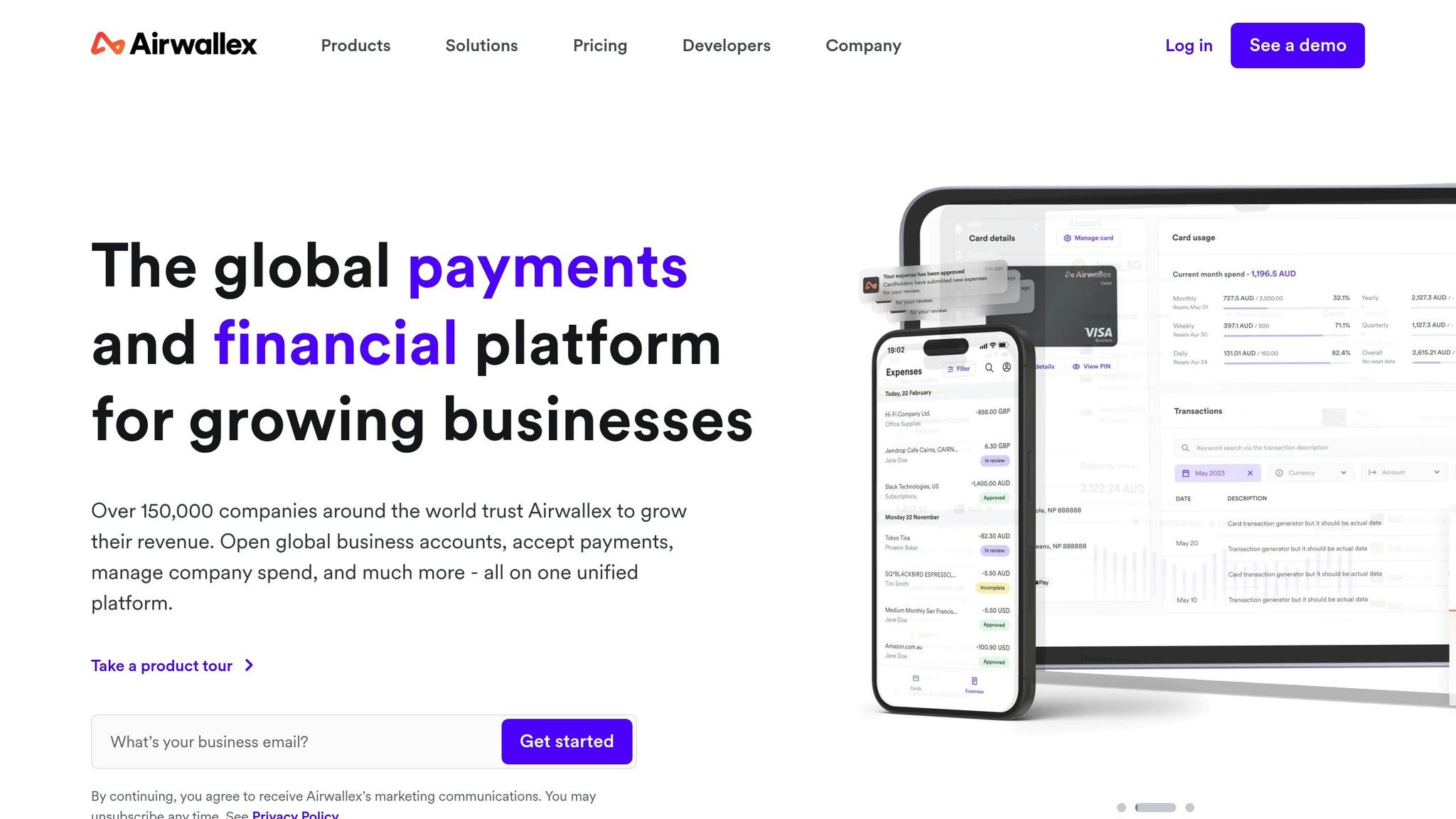
Airwallex offers a powerful suite of global payment solutions designed to simplify and enhance business transactions worldwide.
By combining essential payment services with modern automation and integration tools, Airwallex helps businesses streamline their financial operations and manage international transactions more efficiently.
Multi-Currency Support
With Airwallex, businesses can easily handle transactions in multiple currencies. The platform provides real-time exchange rates and upfront pricing transparency, so users always know the costs before confirming a transaction. One standout feature is the Global Accounts service, which gives businesses access to local bank account details in major financial regions. This makes receiving international payments more straightforward and hassle-free for clients.
International Transaction Fees
Airwallex’s pricing approach is designed to be more budget-friendly compared to traditional banks. Standard business accounts come with no monthly fees, and international transfers are priced competitively. Currency conversions are handled with minimal margins, ensuring businesses save money on every transaction.
Global Accessibility
Available in many countries, Airwallex provides round-the-clock customer support through live chat, email, and phone. The platform also integrates seamlessly with popular business tools like accounting software and e-commerce systems. For businesses with unique needs, Airwallex offers API access, allowing tailored integrations to fit specific workflows.
Security Features
Airwallex prioritizes security with features like encryption, multi-factor authentication, and real-time fraud detection. The platform complies with regulations from top financial authorities and keeps funds in segregated bank accounts for added safety. Businesses can also set custom spending limits and transaction approval workflows, giving them greater control and peace of mind over their finances.
sbb-itb-39d39a6
5. Crypto Wallets
As digital platforms continue to reshape traditional finance, crypto wallets have become an appealing option for remote entrepreneurs. These wallets provide a secure way to store, send, and manage cryptocurrencies, giving users direct control over their digital assets.
Unlike traditional bank accounts, crypto wallets operate on decentralized networks. This setup ensures that entrepreneurs retain full control of their funds. No bank can freeze accounts, impose transaction limits, or require piles of paperwork for international transfers. For remote entrepreneurs working across different countries, this level of financial independence can be a game-changer.
Multi-Currency Support
Popular wallets like MetaMask, Trust Wallet, and Exodus support hundreds of cryptocurrencies and tokens. This flexibility allows remote entrepreneurs to accept payments in a variety of digital currencies, ranging from Bitcoin and Ethereum to stablecoins like USDC and Tether.
Stablecoins are particularly useful for businesses. These digital currencies are tied to traditional currencies, like the US dollar, to maintain a stable value. By holding USDC or USDT, entrepreneurs can avoid the volatility of other cryptocurrencies while still leveraging blockchain technology. This approach offers the stability of cash with the added benefit of quick, global transactions.
Many wallets also feature cross-chain functionality, enabling users to manage assets across multiple blockchain networks from a single interface. This eliminates the hassle of juggling multiple wallets for different currencies and can help reduce transaction costs, as discussed below.
International Transaction Fees
Crypto wallets offer a cost-effective alternative to traditional banking for international transactions. While bank transfers often charge 3-5% in fees plus fixed costs of $15–$50, crypto transactions typically cost just a few dollars, regardless of the amount sent.
For example, Bitcoin transactions generally cost between $1-5 in network fees, while Ethereum transactions range from $2-20 depending on network activity. Newer blockchains like Polygon or Binance Smart Chain are even more affordable, with fees as low as $0.01-0.50. This makes them ideal for frequent international payments.
Additionally, traditional international wire transfers can take 3-5 business days to process. In contrast, cryptocurrency transactions are usually completed within minutes or hours, giving remote entrepreneurs faster access to their funds. This speed, combined with lower costs, makes crypto wallets a practical tool for managing global finances.
Global Accessibility
Crypto wallets are available 24/7 and can be accessed from any internet-connected device. This means remote entrepreneurs can send and receive payments anytime, anywhere. For those working across time zones with international clients, this constant availability is incredibly useful.
Cryptocurrency also bypasses many of the regulatory hurdles associated with traditional banking. Entrepreneurs don’t need to maintain bank accounts in multiple countries or deal with complex international banking systems. A single crypto wallet can handle transactions worldwide without geographical restrictions.
Most wallets are also device-agnostic, functioning seamlessly on smartphones, tablets, and computers. Whether working from a café in Bangkok or a co-working space in Berlin, remote entrepreneurs can easily manage their finances on the go.
Security Features
Crypto wallets use private key encryption to ensure only the owner can access their funds. Unlike bank accounts, where the institution has ultimate control, crypto wallets give users complete custody of their assets through private keys.
For maximum security, hardware wallets like Ledger and Trezor store private keys offline. These devices require physical confirmation before completing transactions, making them nearly immune to online hacking. For entrepreneurs managing substantial digital assets, hardware wallets provide a level of security that traditional banking cannot match.
Some wallets also offer multi-signature functionality, which requires multiple approvals to process transactions. Entrepreneurs can set up wallets that need authorization from both personal and business keys or involve trusted partners for high-value transfers.
Additionally, most wallets come with backup and recovery options through seed phrases – a set of 12 or 24 words that can restore access if the device is lost or damaged. This ensures that entrepreneurs don’t lose access to their funds due to technical issues or theft.
With their low-cost international transfers, global accessibility, and strong security features, crypto wallets are an invaluable tool for remote entrepreneurs, complementing other financial solutions discussed earlier.
Platform Comparison: Benefits and Drawbacks
Here’s a breakdown of popular financial platforms, focusing on their strengths and limitations for remote entrepreneurs.
The right platform for your business depends on your specific needs. While each option has its advantages, they also come with certain challenges that could affect your operations.
Wise is known for its straightforward approach to international transfers. It uses mid-market exchange rates and offers a clear fee structure, making it a cost-efficient choice. However, it lacks payment gateway functionality, which can be a drawback for businesses needing to accept customer payments. Its multi-currency account is more suitable for managing outgoing payments rather than incoming ones.
Revolut provides multi-currency support and competitive exchange rates, making it an appealing choice for European businesses. However, U.S. users may find the platform less accommodating due to limited corporate card availability and weaker payment acceptance features.
Payoneer is a favorite among freelancers and online sellers, thanks to its seamless marketplace integrations. It allows users to receive payments in multiple currencies and offers local bank account details for major markets. On the downside, its foreign exchange fees can vary, making it harder to predict costs.
Airwallex positions itself as a comprehensive financial solution. It offers transparent interbank exchange rates, wide multi-currency support, and integrates both payment acceptance and outgoing transfers. This makes it ideal for businesses with complex international needs, especially those handling higher transaction volumes.
Crypto wallets stand out for their global accessibility and 24/7 operation. They often have low transaction fees and give users full control over their digital assets. However, the volatility of cryptocurrencies can pose risks for businesses, though stablecoins may help mitigate these fluctuations.
| Platform | Currency Handling | Typical Fees | Global Access | Key Strength | Main Limitation |
|---|---|---|---|---|---|
| Wise | Supports multiple currencies | Clear, transparent structure | Global | Cost-efficient, transparent pricing | Lacks payment gateway functionality |
| Revolut | Multi-currency accounts | Competitive rates | More limited in the U.S. | Strong European operations | Limited corporate features in the U.S. |
| Payoneer | Supports various currencies | Variable fees | Broad global reach | Strong marketplace integrations | Inconsistent foreign exchange fees |
| Airwallex | Wide multi-currency coverage | Competitive for global payments | Global | Comprehensive all-in-one platform | Best for higher-volume transactions |
| Crypto Wallets | Supports digital assets | Generally low fees | 24/7 worldwide | Unrestricted access | Exposure to market volatility |
Cost efficiency remains a critical factor when comparing these platforms. Nearly half of businesses cite high payment processing fees as a challenge, with international transfers averaging 4.26% for a $500 transaction – a modest decrease of 0.26 percentage points over the past five years. Additionally, 40% of banks have lost at least 5% of their market share to fintech competitors. These alternative platforms often provide faster processing times and greater transparency compared to traditional banking systems.
For remote entrepreneurs, Wise and crypto wallets often offer the best cost savings. However, those needing more robust business features may find Airwallex or Payoneer a better fit. Freelancers and marketplace sellers, in particular, benefit from Payoneer’s integrations, while businesses focused on Europe might prefer Revolut’s tailored offerings. Each platform has its niche, so aligning your choice with your specific business goals is key.
Conclusion
Alternative banking platforms bring distinct advantages compared to traditional banks, with each option tailored to specific business needs. Choosing the right solution can make a significant difference in supporting remote operations effectively.
Wise is perfect for outgoing international transfers, thanks to its transparent fees and mid-market exchange rates. On the other hand, Payoneer simplifies incoming payments by providing localized bank details, making it particularly useful for freelancers and online sellers working with marketplaces – though foreign exchange fees can vary.
For businesses handling large transaction volumes, Airwallex offers an integrated solution that combines payment acceptance and transfers. However, smaller businesses may find its robust features more than they need at the moment.
Crypto wallets provide global access, low fees, and 24/7 availability without geographic restrictions. However, U.S.-based entrepreneurs should carefully consider the regulatory landscape and the inherent volatility of cryptocurrencies.
The right choice depends on three main factors: transaction volume, geographic focus, and business model complexity. For start-ups with minimal international activity, Wise offers a simple and efficient solution. Meanwhile, established businesses with broader global operations may benefit from Airwallex’s all-in-one capabilities.
Remote entrepreneurs can gain a competitive edge by leveraging these modern financial tools instead of sticking to traditional banking systems. The secret lies in aligning the platform’s features with your specific business needs, rather than being swayed by flashy options.
To put this into practice, start by reviewing your monthly transaction patterns, pinpointing key markets, and testing platforms with smaller amounts before fully committing. This careful approach helps reduce disruption during the transition and ensures your financial tools are optimized for protecting and managing international assets.
FAQs
What are the key benefits of using digital platforms like Wise and Payoneer for international transactions compared to traditional banks?
Digital platforms like Wise and Payoneer have transformed how we handle international payments. They offer lower fees, real exchange rates, and quicker processing times compared to traditional banks. Plus, their transparent pricing and use of mid-market exchange rates mean no hidden surprises, saving you money on currency conversions.
Wise supports over 40 currencies, allowing you to send and receive payments globally with minimal markups. It’s a great choice for managing international transactions seamlessly. Meanwhile, Payoneer operates in over 190 countries and even provides a prepaid Mastercard, giving you easy access to your funds wherever you are.
For remote entrepreneurs, these platforms are game-changers. They provide an efficient and affordable way to manage cross-border payments, cutting down on the steep fees and delays that often come with traditional banking.
What’s the best way for remote entrepreneurs to choose a financial platform that fits their business needs?
When selecting a financial platform, remote entrepreneurs should first assess their unique requirements. Key factors to consider include the volume of transactions, the need for international payments, and the ability to scale as the business grows.
Focus on platforms that provide robust security measures, a user-friendly interface, and tools that easily integrate with your current systems. It’s also important to evaluate how effectively the platform manages global transactions, supports multiple currencies, and accommodates the evolving needs of your business. By prioritizing adaptability and efficiency, you’ll ensure the platform aligns with both your immediate needs and long-term growth plans.
What risks should remote entrepreneurs be aware of when using crypto wallets for international payments, and how can they stay protected?
Using crypto wallets for international payments can expose users to certain risks. Among the most pressing are security threats like hacking, phishing, and malware attacks, all of which can lead to serious financial losses. On top of that, the unpredictable nature of cryptocurrency markets and the absence of regulatory protections can create additional challenges or unexpected setbacks.
To navigate these risks, entrepreneurs should prioritize strong security measures. This includes enabling multi-factor authentication and opting for secure, well-established wallets. Diversifying cryptocurrency investments and keeping up with market trends can help manage the impact of price swings. Staying alert for phishing schemes and scams is equally important to ensure the safety of funds.
