
Retiring abroad can help reduce tax burdens, especially for U.S. retirees facing high income and capital gains taxes. Countries like Panama, Belize, Greece, and Malaysia offer tax-friendly residency programs that cater to retirees with significant assets. Each destination provides unique financial advantages, residency options, and lifestyle perks. Here’s a quick breakdown:
- Panama: No taxes on foreign income, popular Pensionado Program ($1,000 monthly pension requirement), and discounts on services.
- Belize: Foreign income tax-free, Qualified Retired Persons (QRP) Program ($2,000 monthly income), and English-speaking communities.
- Greece: Flat 7% tax on all foreign income for 15 years, with EU access and robust healthcare.
- Malaysia: Territorial tax system (foreign income untaxed), Malaysia My Second Home (MM2H) Program, and affordable healthcare.
While these destinations offer appealing tax benefits, U.S. citizens must still comply with U.S. worldwide income tax laws. Professional tax guidance is essential to optimize savings and ensure compliance. Choosing the right country depends on your financial goals, healthcare needs, and lifestyle preferences.
1. Panama
Panama has become a popular destination for wealthy retirees, thanks to its territorial tax system. This system ensures residents only pay taxes on income earned within Panama. Any income generated outside the country – like pensions, investment earnings, or rental income from foreign properties – is completely tax-free.
This setup is especially attractive for retirees with global investments. Whether you’re receiving Social Security, withdrawing from a 401(k), or earning dividends from U.S. stocks, none of it is subject to Panamanian taxes. Additionally, there are no taxes on capital gains from foreign investments, making Panama an appealing choice for those with diverse financial portfolios.
Residency Programs and Requirements
Panama offers straightforward residency options, with the Pensionado Program being one of the most popular. To qualify, you need to show proof of a guaranteed monthly pension or retirement income of at least $1,000. This income can come from a government source, private entity, or recognized financial institution, and official documentation is required.
If the Pensionado Program isn’t a fit, there’s the Qualified Investor Program. This requires a minimum investment of $300,000 in approved sectors like real estate, forestry, or agriculture. The investment must remain in place for at least five years.
Both programs start with temporary residency, which can transition to permanent residency after five years of living in Panama. Permanent residents can even apply for citizenship after another five years, though citizenship isn’t necessary to enjoy the country’s tax benefits. These clear pathways make settling in Panama a straightforward process for retirees.
Key Benefits and Lifestyle Advantages
Panama’s appeal goes beyond taxes. The country uses the U.S. dollar as its currency, which eliminates exchange rate concerns. Its banking system is well-developed, with many international banks operating in Panama City.
Retirees in the Pensionado Program also enjoy a host of discounts, ranging from 15% to 50% on services like dining, hotels, medical care, and entertainment. Prescription medications come with a 10% discount, and domestic airline tickets are 25% off.
Geographically, Panama is well-connected to both North and South America. Its international airports provide direct flights to major U.S. cities, making travel convenient. Additionally, English is widely spoken in business circles and expat hubs like Panama City, Boquete, and Coronado, making it easier for retirees to settle in.
Healthcare and Infrastructure
Panama offers quality healthcare, with several hospitals in Panama City meeting international standards. Legal residents can access the Social Security healthcare system for a monthly fee based on income, typically ranging from $50 to $200. Private healthcare is also affordable compared to U.S. prices, and many doctors are trained in the U.S. or Europe.
Infrastructure, while varying by region, is generally reliable. Panama City boasts high-speed internet and modern amenities, while expat-friendly areas like Boquete and Pacific coast beach towns offer a quieter lifestyle with good connectivity and essential services.
Foreigners enjoy the same property rights as citizens, making it easy to invest in real estate and establish a comfortable life in this growing market.
2. Belize
Belize offers a tax-friendly environment that closely mirrors Panama’s territorial tax system, with some added perks. The country taxes only income earned within its borders, meaning foreign pensions, dividends, rental income, and capital gains from overseas investments are completely tax-exempt. This setup makes Belize an appealing choice for retirees who rely on multiple income streams. Whether you’re withdrawing from retirement accounts, earning passive income from investments, or collecting rent from U.S. properties, Belize won’t tax these earnings.
Residency Programs and Requirements
Belize provides several residency options, but the Qualified Retired Persons (QRP) Program stands out for retirees with substantial income. To qualify, applicants must be at least 45 years old and demonstrate a monthly income of $2,000 from a pension, annuity, or other retirement source. This income must be deposited into a Belizean bank account.
Participants in the QRP program are required to spend a minimum of 30 days per year in Belize to maintain their status. A major benefit of this program is the ability to import personal belongings – such as vehicles, household goods, or even a boat – without paying customs duties, which can lead to significant savings for those relocating with valuable assets.
If the QRP program isn’t a fit, permanent residency is another option. This path requires living in Belize for one continuous year on a temporary permit and proving financial self-sufficiency. Unlike the QRP program, there’s no specific income threshold for this route.
Why Retirees Love Belize
Beyond tax benefits, Belize offers an appealing environment for retirees. As an English-speaking country, it eliminates language barriers, which is a rare advantage among tax-friendly destinations. Its legal system is based on British common law, providing a familiar framework for American retirees. Plus, the U.S. dollar is widely accepted alongside the Belize dollar, simplifying financial transactions and avoiding exchange rate headaches.
Traveling back to the U.S. is a breeze, thanks to direct flights from cities like Miami and Los Angeles, with flight times often under three hours. This accessibility makes it easy to stay connected with family and business interests.
Belize also boasts stunning natural beauty. The barrier reef system, the second-largest in the world, is a haven for diving and snorkeling enthusiasts. Whether you prefer the Caribbean coastline or lush jungle interiors, Belize offers diverse landscapes to suit various lifestyles. Popular expat hubs like Ambergris Caye, Placencia, and the Cayo District provide established communities and social networks, making it easier for newcomers to settle in.
Healthcare and Infrastructure
Healthcare in Belize is a mixed bag. Basic medical services are available nationwide, but specialized care often requires a trip to Belize City or even medical tourism to nearby countries like Mexico or Guatemala. Many retirees opt for international health insurance or travel back to the U.S. for major treatments. However, private healthcare facilities in Belize City and expat areas deliver quality care, and routine healthcare costs are much lower than in the U.S. Prescription medications are generally accessible, though certain specialized drugs might need to be imported.
Infrastructure quality varies depending on location. Expat-friendly regions usually have reliable utilities, including electricity, water, and internet. High-speed internet is readily available in developed areas, making it easy to stay connected or work remotely. In more rural locations, occasional service interruptions may occur, but they are less common in popular expat destinations.
For those considering property investment, Belize offers strong protections for foreign buyers. Non-residents enjoy the same property ownership rights as citizens, making it straightforward to purchase land or real estate. This allows retirees to establish a secure home base while taking advantage of Belize’s tax-friendly policies and relaxed lifestyle.
3. Greece
Greece has a tax-friendly program for pensioners, offering a flat 7% tax on all foreign income for up to 15 years. This setup is particularly appealing to retirees with multiple income streams from abroad.
Residency Requirements and Qualification
To take advantage of Greece’s pensioner tax regime, you need to meet a few key criteria. First, you must not have been a Greek tax resident for at least 5 out of the last 6 years before applying. Additionally, your tax residence must be transferred from a country that has a tax information-sharing agreement with Greece. Fortunately, this includes most developed nations like the United States, Canada, the United Kingdom, and Ireland.
For non-EU/EEA citizens, obtaining a residency permit is mandatory, which is often done through the Golden Visa program. To maintain your tax residency status, you’ll need to spend more than 183 days per year in Greece. Another important detail: the application for non-dom status must be submitted by March 31 of the year you establish your tax residence in Greece. These requirements ensure a streamlined process for retirees looking to benefit from Greece’s tax system.
How the Tax System Works
Once approved, the 7% flat tax is applied to all foreign income sources, making it an attractive option for retirees with diverse earnings. This tax is paid as a single lump sum each year, with the deadline falling in late July. Greece also has double taxation treaties in place, allowing retirees to claim tax credits for any taxes paid abroad, further easing the financial burden. However, missing the lump-sum payment voids the benefit, and the taxpayer will then be subject to Greece’s standard worldwide income tax rules.
sbb-itb-39d39a6
4. Malaysia
Malaysia stands out as an attractive option for wealthy retirees, thanks to its territorial tax system. Under this system, income earned abroad is typically not subject to local taxes, making it particularly appealing for retirees with diverse streams of foreign income.
Malaysia My Second Home (MM2H) Program
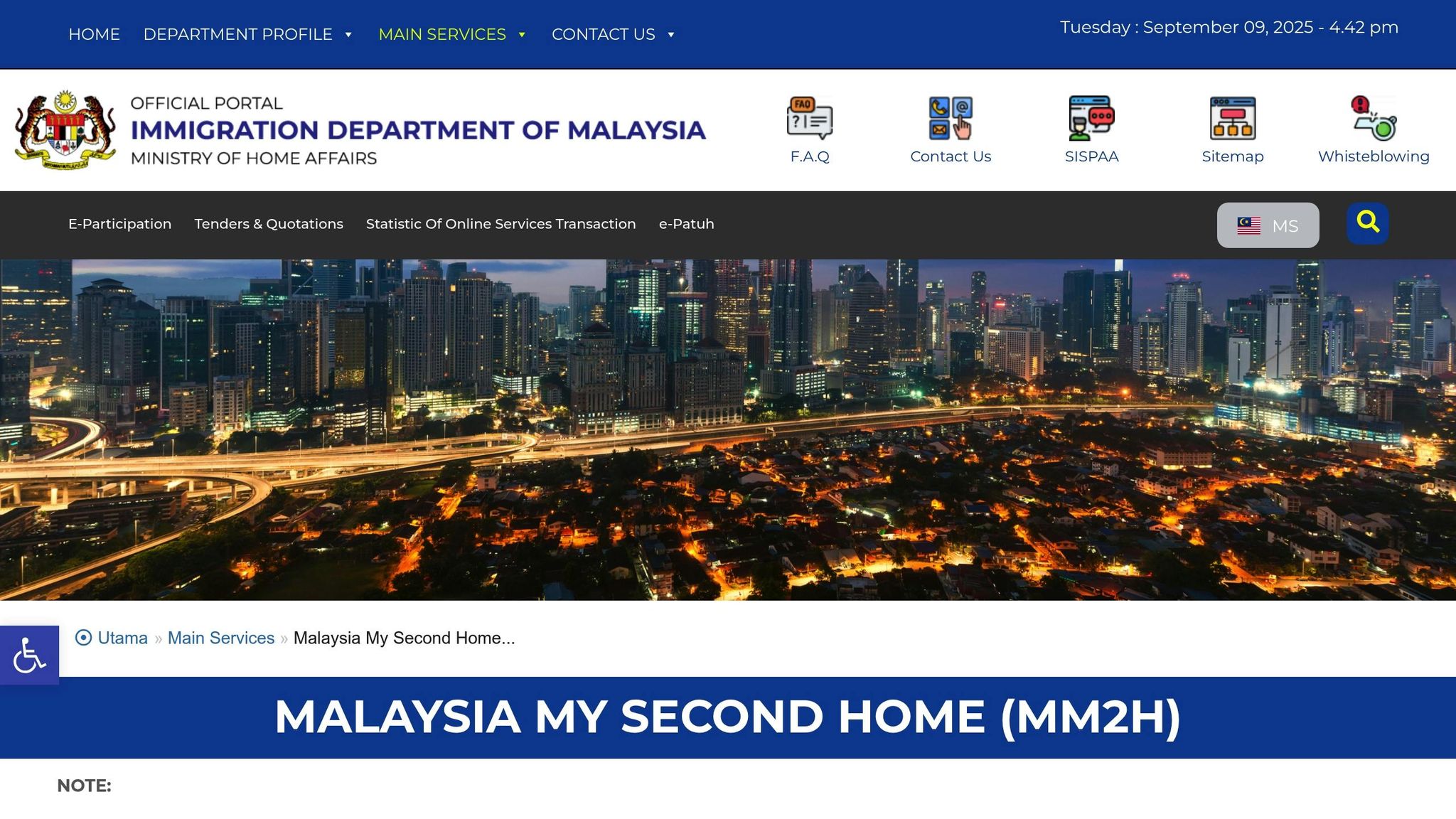
The Malaysia My Second Home (MM2H) program serves as the main route for affluent retirees seeking long-term residency. This program offers a renewable visa with multiple entry privileges, making it ideal for those planning to settle in Malaysia. However, applicants must meet specific financial requirements, including proving adequate liquid assets and offshore income. Additionally, participants are required to place a fixed deposit in a Malaysian bank. Always consult official sources to confirm the latest eligibility criteria and conditions.
Tax Residency and Benefits
To qualify as a tax resident in Malaysia, individuals generally need to spend at least 183 days in the country within a calendar year. Once tax residency is established, foreign income brought into Malaysia is typically not taxed. Retirees should, however, stay updated on any changes to tax policies. Malaysia has also signed double taxation agreements with several countries, ensuring that income isn’t taxed twice in different jurisdictions. Beyond tax advantages, retirees benefit from the country’s excellent healthcare system and affordable cost of living.
Healthcare and Living Standards
Malaysia is known for having one of the top healthcare systems in Southeast Asia. Both public and private healthcare facilities adhere to international standards, with private care being significantly more affordable than in many Western nations. Major cities boast internationally accredited hospitals staffed by English-speaking professionals, adding to Malaysia’s appeal as a retirement destination.
The cost of living in Malaysia is another major draw. While expenses can vary depending on the location, retirees often find that they can enjoy a high standard of living at a fraction of what it would cost in Western countries.
Key Considerations
It’s essential to note that the requirements for the MM2H program can change over time, so verifying the latest information before applying is crucial. While English is widely spoken in urban areas, retirees may encounter language barriers in more rural regions. Additionally, Malaysia’s tropical climate – with its warm temperatures and high humidity – might take some getting used to for those accustomed to cooler climates.
Pros and Cons
Here’s a comparative look at the pros and cons of some popular retirement destinations, focusing on tax benefits, lifestyle, and healthcare. Each location offers distinct advantages and challenges, depending on your priorities.
Panama is attractive for its complete exemption on foreign-sourced income. Retirees can also enjoy substantial savings through the Pensionado program, which provides discounts that can add up to thousands of dollars each year. However, the higher investment threshold and relatively elevated cost of living might be drawbacks for some.
Belize simplifies the process with its Qualified Retired Persons (QRP) program, allowing duty-free importation of personal goods and requiring just $2,000 in monthly foreign income. While this makes it accessible, the country’s limited healthcare infrastructure could be a concern for retirees seeking advanced medical care.
Greece offers a 7% flat tax on foreign income for 15 years, covering pensions, dividends, interest, and capital gains. This setup provides tax clarity and potential savings for retirees with varied income sources. Greece also boasts excellent healthcare and a rich cultural environment. However, some retirees may find the flat tax rate less appealing compared to jurisdictions that fully exempt foreign income.
Malaysia combines tax advantages with affordability through its territorial tax system and the Malaysia My Second Home (MM2H) program. It is known for its top-tier healthcare system, with private care often costing less than in Western countries. On the downside, the program’s requirements can change unpredictably, and the tropical climate with high humidity might not suit everyone.
| Jurisdiction | Tax Benefits | Investment Requirement | Monthly Income Requirement | Key Advantages | Main Drawbacks |
|---|---|---|---|---|---|
| Panama | Complete foreign income exemption | Investments | $1,000 pension | Pensionado discounts, US dollar economy | High investment threshold |
| Belize | Foreign income exemption | None | $2,000 | Easy qualification, English-speaking | Limited healthcare options |
| Greece | 7% flat tax for 15 years | Varies by program | Varies | EU access, excellent healthcare | Higher tax rate than full exemptions |
| Malaysia | Territorial taxation | Fixed deposit required | Varies by program | Affordable healthcare, low living costs | Tropical climate, changing program rules |
U.S. citizens face additional hurdles no matter where they retire, as the United States taxes worldwide income regardless of residency. This means retirees must carefully plan their finances to comply with U.S. tax laws. Key considerations include optimizing Foreign Tax Credits and ensuring proper FBAR filings for overseas assets.
To navigate these complexities, a well-thought-out strategy is essential. This might involve combining foreign income exemptions with U.S. tax credits and working with specialized advisors to structure retirement income in a way that maximizes benefits across jurisdictions.
Conclusion
Picking the right tax-free residency isn’t just about crunching numbers – it’s about finding the perfect balance between financial perks and your ideal lifestyle. Countries like Panama, Greece, and Malaysia each bring something unique to the table, whether it’s a complete exemption on foreign income or a simplified flat tax rate like Greece’s 7%. Belize is another option that deserves consideration for those exploring alternatives. But tax benefits alone don’t paint the full picture.
Retirement satisfaction goes far beyond saving on taxes. Factors like access to quality healthcare, the cost of living, a sense of community, and how well you connect with the local culture are just as important. After all, what good is a zero-tax haven if it doesn’t meet your day-to-day needs or feels like a poor fit for your lifestyle?
For U.S. citizens, the stakes are even higher. The United States’ citizenship-based taxation means you’ll still need to report worldwide income, no matter where you live. This makes professional tax guidance a must. Working with expat tax advisors can help you structure your retirement income wisely, stay compliant with both U.S. and local tax laws, and avoid costly penalties. The right advice can save you money and headaches in the long run.
As more countries compete to attract retirees with enticing tax breaks and lifestyle perks, doing your homework is key. Partnering with experts – like the team at Global Wealth Protection – can help you align your residency choice with both your financial objectives and the life you envision for your golden years.
FAQs
How can U.S. citizens handle taxes on worldwide income while living in a tax-free country?
U.S. citizens are required to pay taxes on their worldwide income, regardless of where they live – even if they reside in a country that doesn’t impose income taxes. This stems from the U.S.’s citizenship-based taxation system, which mandates that citizens file annual tax returns no matter their location.
To help mitigate the burden of double taxation, there are options like the Foreign Tax Credit, which provides a credit for taxes paid to foreign governments, and the Foreign Earned Income Exclusion, which allows certain foreign income to be excluded from U.S. taxation. However, living in a country with no income tax doesn’t exempt U.S. citizens from meeting their tax responsibilities back home.
Staying on top of your filing obligations is crucial. Working with a tax professional can help you navigate compliance while finding ways to make the most of available credits and exclusions.
What kind of healthcare can retirees expect in tax-friendly countries, and how does it compare to the U.S.?
Retirees relocating to countries with tax advantages often discover affordable, well-regarded healthcare systems that are easier on the wallet compared to the U.S. Take France, for instance – it offers universal healthcare with low consultation fees and access to a wide network of medical professionals. Likewise, destinations like Colombia and Malta provide top-notch medical care at a fraction of what you’d typically pay in the U.S.
What makes these systems appealing is the combination of reduced out-of-pocket expenses and simpler insurance processes, offering retirees a chance to save money while still receiving high-quality medical services.
What should retirees think about when selecting Panama, Belize, Greece, or Malaysia for tax-friendly residency?
Retirees eyeing tax-friendly havens like Panama, Belize, Greece, or Malaysia should weigh crucial factors such as tax benefits, cost of living, and how straightforward it is to secure legal residency. Each destination has its own perks, so it’s essential to evaluate how their residency programs align with your financial plans and lifestyle needs.
On top of that, think about how these countries handle asset protection and privacy for both personal and business matters. Structuring your assets and income wisely can help you take full advantage of tax savings while staying compliant with local regulations.
