
Want to work remotely while living abroad? Digital nomad visas make it easier than ever. These visas let you legally reside in another country while working for a foreign employer or running your own business. From tax perks to family inclusion, each program has its own rules and benefits.
Here’s a quick look at 10 of the best digital nomad visas for 2025:
- Spain: Offers a 12-month visa with tax breaks under the Beckham Law (flat 24% tax for eligible workers).
- Greece: 1-year visa with family inclusion; income requirements start at $3,815/month.
- Portugal: Long-term residency options; tax regime changes in 2024 impact new applicants.
- Italy: 1-year visa for remote workers earning $30,500+ annually.
- Hungary (White Card): 12-month renewable visa with low living costs in Budapest.
- Bulgaria: Just launched in 2025; flat 10% income tax for residents.
- Malta: 1-year permit with Schengen access and remittance-based taxation.
- Croatia: 1-year visa; foreign income is tax-exempt for most remote workers.
- Estonia: Known for its digital infrastructure; 1-year visa with a $3,800/month income requirement.
- Georgia: Open to U.S. citizens with $2,000/month income or $24,000 in savings; no EU access.
Quick Comparison
| Country | Duration | Income Requirement | Tax System | Schengen Access |
|---|---|---|---|---|
| Spain | 12 months | Flexible | Flat 24% (Beckham Law) | Yes |
| Greece | 12 months | $3,815/month | Standard EU rates | Yes |
| Portugal | Long-term | Varies | New tax regime (2024) | Yes |
| Italy | 12 months | $30,500/year | Progressive (23%-43%) | Yes |
| Hungary | 12 months | Proof of stable income | Territorial | Yes |
| Bulgaria | 12 months | $26,235/year | Flat 10% | Yes |
| Malta | 12 months | Varies | Remittance-based | Yes |
| Croatia | 12 months | $2,500/month | Tax-exempt (foreign) | Yes |
| Estonia | 12 months | $3,800/month | Flat 20% | Yes |
| Georgia | 180+ days | $2,000/month | Territorial | No |
Each visa has unique benefits, but factors like income requirements, tax rules, and lifestyle costs can help you decide. Remote workers from the U.S. should also consider double taxation rules and tools like the Foreign Earned Income Exclusion. Ready to find your next destination? Let’s dive into the details.
Tax Implications
If you spend more than 183 days in Spain, you’ll be considered a tax resident, which means your worldwide income becomes subject to Spanish taxation.
However, visa holders might benefit from Spain’s Beckham Law. This tax regime allows eligible individuals to pay a flat 24% tax on income up to €600,000 for six years, with a rate of 47% applied to income exceeding that threshold – even if they stay in Spain for more than 183 days. To qualify, applicants must meet specific criteria: they must not have been Spanish residents in the previous five years and must submit their application to Spanish tax authorities within six months of receiving the visa. It’s worth noting that this regime is designed primarily for employees of foreign companies, so freelancers may not be eligible.
For American citizens, there’s an extra layer of complexity. Due to citizenship-based taxation, they are still required to file U.S. federal tax returns. They can use tools like the Foreign Earned Income Exclusion (which will cover up to $130,000 in 2025) or the Foreign Tax Credit to help reduce their U.S. tax liability.
2. Greece Digital Nomad Visa
Greece’s digital nomad visa program invites remote workers to experience life in the Mediterranean while continuing their careers. This initiative is tailored for non-EU/EEA/Swiss citizens, enabling them to live and work in Greece while maintaining professional ties outside the country.
Eligibility Requirements
This visa is specifically for remote workers who rely on information and communication technology to perform their jobs. Applicants must work for companies or clients based outside Greece and cannot be employed by Greek businesses. The program is primarily aimed at non-EU/EEA/Swiss citizens.
The minimum income requirements depend on the applicant’s family situation:
| Applicant Type | Minimum Monthly Income |
|---|---|
| Single applicant | $3,815 (€3,500) |
| Applicant + Spouse | $4,578 (€4,200) |
| Applicant + Spouse + 1 Child | $5,267 (€4,830) |
For each additional family member, the income requirement increases by 15%. Self-employed individuals need to provide evidence of their business activity, including their company’s purpose and an address registered outside Greece.
Once eligibility is confirmed, applicants can move on to the next steps in the process.
Application Process
Applications must be submitted at the nearest Greek Embassy or Consulate; you cannot apply while already in Greece. Be prepared to provide the following documents:
- A valid passport with at least three months of validity beyond your intended stay
- Health insurance covering your time in Greece
- A clean criminal background check from your home country
- Proof of accommodation in Greece (e.g., a rental agreement)
- A signed declaration stating you will not work for a Greek company
The processing time typically ranges from 2 to 4 weeks.
Visa Benefits
The digital nomad visa is initially valid for 12 months. After that, you can apply for a residence permit, which extends your stay by an additional two years. This extension is handled through Greece’s Ministry of Migration and Asylum and can only be processed while in the country. Family members, including spouses and dependents, can be added to the application, though this will increase the required income threshold. The visa grants full legal status to live and work remotely anywhere in Greece.
Tax Implications
If you live in Greece for more than 183 days in a calendar year, you will be considered a tax resident, and your global income will be subject to Greek taxes. However, Greece offers tax incentives and has double taxation agreements with numerous countries, including the United States. U.S. citizens, who are taxed based on citizenship, must still file federal tax returns but can reduce their U.S. tax liability by using options like the Foreign Earned Income Exclusion (up to $130,000 in 2025) or the Foreign Tax Credit.
3. Portugal Digital Nomad Visa
Portugal’s digital nomad visa is tailored for remote workers who want to live in the country while maintaining their professional ties outside of Portugal. To qualify, applicants must demonstrate proof of their work activity and financial stability. For the most accurate and updated requirements, it’s best to refer to official Portuguese consulate resources.
Similar to other European programs, Portugal’s initiative blends lifestyle perks with well-defined tax policies.
Overview and Benefits
This visa provides long-term residency options, which can be renewed, and also allows for family reunification. Once registered locally, visa holders gain access to essential services like banking and healthcare. For detailed eligibility criteria, it’s advisable to consult official sources.
Tax Implications
If you spend 183 days or more in Portugal within a 12-month period, you’ll typically be classified as a Portuguese tax resident. This means your global income becomes subject to Portuguese taxes. The Non-Habitual Resident (NHR) regime, which previously offered tax benefits, ended for new applicants on January 1, 2024. However, transitional provisions are in place until March 31, 2025, for those meeting specific conditions.
The NHR regime has been replaced by the Tax Incentive for Scientific Research and Innovation (IFICI), also referred to as the Incentivised Tax Status (ITS) program. Under this system, eligible professionals enjoy a flat 20% tax rate on qualifying Portuguese-sourced income. Additionally, most foreign-sourced income – such as dividends, interest, capital gains, and rental income – is exempt from taxation.
For those who don’t qualify under the IFICI/ITS program, Portugal’s standard progressive income tax rates apply, ranging from approximately 13.25% to 48% for higher income levels. Unlike the old NHR framework, foreign pension income is now taxed at progressive rates between 14.5% and 53%.
Portugal has signed double taxation agreements with 81 countries, including the United States, to help avoid double taxation. However, U.S. citizens are still required to file federal tax returns and may use options like the Foreign Earned Income Exclusion or Foreign Tax Credit to lower their overall tax burden. Obtaining a Portuguese Tax Identification Number (NIF) is a key step for handling tax matters in the country.
4. Italy Digital Nomad Visa
Italy introduced its digital nomad visa in 2024, giving remote workers the opportunity to live and work in Italy for up to one year.
Eligibility Requirements
To be eligible for Italy’s digital nomad visa, you must be a non-EU citizen working remotely for a company or clients based outside of Italy. Applicants need to provide proof of remote employment or freelance contracts, as well as evidence of an annual income of at least €28,000 (approximately $30,500).
Other requirements include valid health insurance that covers you in Italy, a clean criminal background check from your home country, and proof of accommodation in Italy. This can be either a rented or owned property, but proper documentation must be submitted when applying.
Application Process
The application process starts at an Italian consulate in your home country. Processing times typically range from 30 to 90 days.
You’ll need to provide several documents, including your passport, proof of remote employment or freelance contracts, financial statements, health insurance details, a criminal background check, and accommodation documentation. All documents must be apostilled and translated into Italian by certified translators. The application fee is about €116 (roughly $125), and some consulates may require an in-person interview.
Visa Benefits
The digital nomad visa grants 12 months of legal residency in Italy, with the option to renew for another year. Visa holders can travel freely within the Schengen Area for up to 90 days within any 180-day period. Additionally, you can open an Italian bank account to access essential services. Under certain conditions, family members, including spouses and dependent children, can join you.
Another perk is access to Italy’s expanding coworking spaces and digital infrastructure. Cities like Milan, Rome, and Florence have invested in high-speed internet and modern workspaces, making them appealing hubs for remote workers. However, understanding the tax implications of this visa is essential.
Tax Implications
If you stay in Italy for more than 183 days in a calendar year, you may be classified as an Italian tax resident, meaning your worldwide income would be subject to Italian taxes. Italy’s tax rates are progressive, ranging from 23% to 43%.
For new residents, Italy offers a special tax regime that allows eligible individuals to pay a flat tax on foreign-sourced income. It’s a good idea to consult a tax professional to explore this option and understand its requirements.
For U.S. citizens, Italy’s tax treaty with the United States helps avoid double taxation. However, you’ll still need to file U.S. tax returns. You might be able to use the Foreign Earned Income Exclusion or Foreign Tax Credit to lower your tax burden. If you’re self-employed in Italy, be aware that social security contributions, ranging from 24% to 33%, may apply.
Lifestyle and Cost of Living
Italy is known for its excellent quality of life, though costs vary by region. Northern cities like Milan and Turin are pricier, while southern areas and smaller towns tend to be more affordable.
Housing is often the biggest expense. A one-bedroom apartment in a city center typically costs between $1,200 and $1,800 per month, while smaller cities offer more budget-friendly options.
Italy’s healthcare system is highly regarded, and digital nomad visa holders can access emergency care if needed. The country’s extensive transportation network, including high-speed trains, makes traveling between regions convenient. Italy’s emphasis on work-life balance, with a focus on leisure and family time, offers a refreshing change from more work-driven cultures. However, be prepared for slower bureaucratic processes and potential language barriers, especially in smaller towns.
5. Hungary White Card
Hungary introduced the White Card in early 2024, offering non-EU digital nomads a one-year renewable residency to work remotely while enjoying life in Hungary. Below is a breakdown of the eligibility criteria, application steps, key benefits, tax factors, and lifestyle perks tied to the program.
Eligibility Requirements
To be eligible for the White Card, applicants must meet these conditions:
- Be a non-EU citizen.
- Work remotely for employers or clients based outside Hungary.
- Provide proof of remote work, such as employment contracts or freelance agreements.
- Show evidence of stable income.
- Hold valid Hungarian health insurance.
- Present a recent criminal background check.
- Provide documentation of accommodation in Hungary.
Application Process
Applications must be submitted at a Hungarian consulate or embassy in your home country. Required documents include:
- A valid passport.
- A completed application form.
- Passport-sized photos.
- Proof of remote work and income.
- Health insurance documentation.
- A criminal background check.
- Accommodation details.
Some consulates may request an in-person interview. Processing times are generally efficient, making the process relatively straightforward.
Visa Benefits
The White Card provides a 12-month residency in Hungary, with the option to renew. As Hungary is part of the Schengen Area, visa holders can also enjoy short-term travel across other Schengen countries. Additional perks include access to local services like opening a bank account and using Hungary’s growing network of coworking spaces. Family members can also be included under the program, making it a convenient option for those traveling with loved ones.
Tax Implications
Hungary’s territorial tax system is designed to benefit digital nomads whose income originates from outside the country. However, staying in Hungary for an extended period could result in being classified as a tax resident, which would subject worldwide income to Hungarian taxes. U.S. citizens should note that Hungary has bilateral tax treaties in place to help avoid double taxation. Given the complexities of tax laws, consulting a professional well-versed in both Hungarian and U.S. tax regulations is highly recommended.
Lifestyle and Cost of Living
Hungary offers an appealing mix of affordability and quality of life, particularly in Budapest. The city boasts a vibrant cultural scene, modern infrastructure, and an active digital nomad community. While living costs depend on individual preferences and location, Hungary generally provides lower expenses for housing, dining, and transportation compared to many Western European nations. Its central location in Europe also makes it an excellent base for exploring neighboring countries. That said, digital nomads may occasionally face language barriers or administrative hurdles during their stay, but these challenges are often manageable with a bit of preparation.
6. Bulgaria Digital Nomad/Freelancer Visa
Bulgaria introduced its Digital Nomad Visa on June 27, 2025, with full applications expected to open by late September, once all secondary regulations are finalized.
Eligibility Requirements
This visa caters to remote workers employed by companies or clients outside Bulgaria. To qualify, applicants need to demonstrate a stable monthly income that’s at least twice the Bulgarian minimum wage (about $440) and an annual income of at least $26,235.
Beyond financial criteria, applicants must meet several other requirements:
- Hold valid international health insurance covering their entire stay in Bulgaria.
- Provide a clean criminal record certificate from their home country or current country of residence.
- Show proof of accommodation in Bulgaria.
- Confirm that their work is exclusively for employers or clients outside Bulgaria.
While the process mirrors other digital nomad programs, Bulgaria sets its own financial and procedural benchmarks.
Application Process
To apply, start by securing a long-term Visa D at your nearest Bulgarian embassy or consulate. This involves scheduling an in-person appointment and submitting all necessary documents, including:
- A valid passport (with at least six months’ validity and two blank pages).
- Proof of income and remote work arrangements.
- Health insurance coverage.
- A clean criminal background check.
- Proof of accommodation in Bulgaria.
- Current passport-sized photos.
- Bulgarian translations and apostilles for required documents.
- (Optional) A letter explaining your motivation for living in Bulgaria.
Once you arrive in Bulgaria, apply for a long-term residence permit through the Ministry of Interior‘s Directorate. Make sure to submit your residence permit application at least 14 days before your Visa D expires.
Visa Benefits
The visa grants an initial residency permit valid for 12 months, with the option to renew according to program guidelines. Bulgaria also offers an attractive tax environment, adding to the appeal of this visa.
Tax Implications
Bulgaria has a flat 10% personal income tax rate. However, if you spend more than 183 days in the country within a 12-month period, you may be classified as a tax resident. This means your worldwide income could be subject to Bulgarian taxes. For U.S. citizens, a tax treaty between Bulgaria and the United States helps avoid double taxation by offering foreign tax credits and certain exemptions. Given the complexities of tax obligations under this program, consulting a tax professional is highly recommended.
7. Malta Nomad Residence Permit
Malta’s Nomad Residence Permit, introduced in June 2021, offers remote workers the chance to live and work in a Mediterranean setting within the European Union. Designed for non-EU nationals, this program allows individuals to continue their professional activities abroad while enjoying life on this sunny island.
Eligibility Requirements
To qualify for the permit, applicants need to prove they work remotely for employers or clients outside Malta. Key requirements include:
- Proof of stable income that meets the program’s financial threshold
- A valid passport with sufficient remaining validity
- Documentation confirming accommodation in Malta
- Comprehensive health insurance coverage
- A clean criminal record certificate from their home country
This straightforward list of criteria ensures a smooth and efficient application process.
Application Process
The application is handled online through Identity Malta, the official platform for the program. Applicants must create an account and submit documents such as proof of income, employment or client contracts, and accommodation details. There is an application fee, with additional costs for residence permits and accompanying family members. As part of the process, biometric data collection may also be required.
Visa Benefits
Once approved, the permit grants residency for one year, with the option to renew annually. Permit holders can travel within the Schengen Area under standard short-stay rules. The program also allows family members to join and provides access to local banking services and Malta’s healthcare system.
Tax Implications
Malta offers attractive tax benefits for non-domiciled residents through its remittance-based taxation system. Under this system, foreign income is taxed in Malta only if it is brought into the country. Combined with tax treaty agreements, this setup can help reduce the risk of double taxation.
Lifestyle and Cost of Living
Malta’s mild Mediterranean climate and year-round sunny weather make it a favorite among digital nomads. The island’s reliable internet infrastructure and small size make traveling between regions convenient. While living costs vary, urban areas like Valletta generally have higher rents compared to smaller towns. With both English and Maltese as official languages, communication is easy for most remote workers, adding to Malta’s appeal as a digital nomad hub.
sbb-itb-39d39a6
8. Croatia Digital Nomad Visa
In January 2021, Croatia introduced its Digital Nomad Visa, giving non-EU citizens the chance to live and work remotely while keeping jobs based outside the country. This program has become popular among remote workers drawn to the mix of European Union perks and the Mediterranean lifestyle. Let’s break down what you need to know about eligibility, the application process, and the benefits of this visa.
Eligibility Requirements
The Croatian Digital Nomad Visa is designed for remote professionals, freelancers, and entrepreneurs who can show a stable foreign income. To qualify, applicants must prove a monthly income of at least €2,300 (about $2,500) or maintain a balance of €27,600 (roughly $30,000) over six months.
Other key requirements include:
- A valid passport with at least three months of validity left.
- Proof of accommodation in Croatia, such as a rental agreement.
- Comprehensive health insurance.
- A clean criminal background check issued within the past six months.
Unlike some other programs, Croatia doesn’t require specific degrees or professional certifications. The program is open to a wide range of professions, including software developers, designers, writers, consultants, and online business owners. Family members can join the primary applicant, but each person must meet the financial requirements individually.
Application Process
You can apply for the visa at Croatian consulates or embassies in your home country. Processing usually takes 15 to 30 days, and the application fee is €80 (around $87), with additional consular fees depending on the location.
Here’s what you’ll need for the application:
- Employment contracts or agreements showing remote work arrangements.
- Bank statements proving financial stability.
- Proof of accommodation, like a rental agreement or hotel booking.
- A completed visa application form and recent passport-sized photos.
Once approved, you must register your temporary residence with the local police within 48 hours of arriving in Croatia. This process is simple and can often be done at a local police station or online in larger cities.
Visa Benefits
The visa allows a one-year stay, with the option to extend for another year. Visa holders can travel freely within Croatia and make short trips to other Schengen Area countries under regular tourist rules. Croatia officially joined the Schengen Area in January 2023, adding more travel flexibility.
Families can move with the primary applicant, making this visa appealing for those with children. Additionally, visa holders can access Croatia’s healthcare system through private insurance and open local bank accounts, simplifying daily life.
Remote workers can settle anywhere in Croatia, whether it’s the vibrant capital of Zagreb or scenic coastal cities like Split and Dubrovnik. The program doesn’t limit movement within the country, so you’re free to explore its diverse regions.
Tax Implications
Croatia offers tax advantages for digital nomads. Income earned from foreign sources is generally not taxed in Croatia, as long as it comes from employers or clients outside the country. However, staying in Croatia for more than 183 days in a calendar year may classify you as a tax resident, potentially subjecting you to Croatian income tax on worldwide earnings. Tax rates range from 20% to 47.2%, depending on income levels, but deductions and allowances may apply.
Croatia has double taxation treaties with over 60 countries, including the United States, which can help avoid paying taxes twice. For longer stays, consulting a tax professional familiar with both Croatian and home country tax laws is highly recommended.
Lifestyle and Cost of Living
Living expenses in Croatia range from $800 to $1,500 per month, depending on the location. Coastal hotspots like Dubrovnik and Split are pricier, especially during the summer tourist season, while cities like Zagreb and Osijek offer more budget-friendly options year-round.
Croatia’s internet infrastructure is solid, with average speeds exceeding 50 Mbps in major cities, making it ideal for remote work. Co-working spaces are widely available in cities like Zagreb, Split, and Rijeka, with monthly memberships costing between $100 and $200.
With 1,100 miles of Adriatic coastline, Croatia is a haven for outdoor enthusiasts. You can enjoy sailing, diving, and hiking in stunning national parks like Plitvice Lakes and Krka. The coastal areas bask in over 2,600 hours of sunshine annually, offering a Mediterranean climate, while inland regions have a more continental feel. English is widely spoken in tourist hubs and among younger professionals, though picking up some basic Croatian phrases can enrich your experience.
9. Estonia Digital Nomad Visa
Estonia introduced its Digital Nomad Visa in August 2020, tailoring it for remote professionals while leveraging its reputation for digital efficiency. Known for its advanced digital infrastructure, Estonia is especially appealing to tech-savvy individuals and professionals in the technology sector.
Eligibility Requirements
The Estonian Digital Nomad Visa is designed for remote workers, freelancers, and entrepreneurs who earn a stable income from sources outside Estonia. Applicants must demonstrate a monthly income of at least €3,500 (approximately $3,800) over the six months prior to applying. This income requirement is higher than many similar programs in Europe.
Here’s what you’ll need to qualify:
- A valid passport with at least three months of validity remaining
- Proof of employment with a company registered outside Estonia or evidence of freelance work for foreign clients
- Health insurance with coverage of at least €30,000 ($32,600)
- A clean criminal background check from your home country
There’s no requirement for specific educational qualifications, but you must show you can independently manage remote work. The visa is ideal for professionals like software developers, digital marketers, graphic designers, consultants, and online entrepreneurs. However, family members cannot be included, which makes this program less suitable for those traveling with dependents.
Application Process
To apply, you’ll need to visit an Estonian embassy or consulate in your home country. The process typically takes 15 to 30 days, and the application fee is €80 (around $87).
Key documents required include:
- Employment contracts or client agreements proving remote work arrangements
- Bank statements showing the required income level
- A motivation letter explaining why you’ve chosen Estonia
- A completed application form and recent passport photos
Once your application is approved, you’ll receive a Type D visa, granting entry to Estonia. After arriving, you must register your residence address within three days. This can be done through the country’s online e-governance portal or by visiting a local government office.
Visa Benefits
The visa allows you to stay in Estonia for one year, though it cannot be extended under the same program. If you wish to stay longer, you can explore other Estonian residence permits. Additionally, as an EU member state, Estonia enables visa holders to travel freely within the Schengen Area for up to 90 days in any 180-day period.
While living in Estonia, you’ll enjoy access to the country’s advanced digital services. This includes the ability to open a local bank account, access private healthcare, and utilize the nation’s renowned e-governance systems. With over 99% internet coverage and average speeds exceeding 100 Mbps, Estonia is a haven for digital nomads.
The country’s compact size makes it easy to explore. Tallinn, the capital, blends medieval history with modern amenities, while Tartu offers a lively university-town vibe.
Tax Implications
Estonia’s tax system has some unique features that may benefit remote workers. For instance, the country doesn’t tax undistributed corporate profits, and personal income tax is straightforward. However, if you stay in Estonia for more than 183 days within a 12-month period, you’ll become a tax resident and be subject to a flat 20% income tax on your worldwide income.
If you maintain tax residency in another country, Estonia won’t tax income earned from foreign sources. Additionally, Estonia has double taxation agreements with over 50 countries, including the United States, which helps avoid paying taxes twice on the same income.
It’s a good idea to consult a tax professional to navigate the rules and ensure compliance.
Lifestyle and Cost of Living
Living in Estonia is relatively affordable, with monthly expenses ranging from $1,000 to $1,800, depending on your lifestyle and location. Tallinn, the capital, is the priciest option, while smaller cities like Tartu and Pärnu offer more budget-friendly living. Renting a one-bedroom apartment in Tallinn costs $600 to $900 per month, while similar accommodations in smaller towns range from $400 to $600.
Estonia’s digital infrastructure is among the best in the world, with excellent internet connectivity and a strong focus on online freedom. Co-working spaces are plentiful, especially in Tallinn, where monthly memberships cost between $150 and $300. Popular options include Lift99, Garage48, and Workland, which also provide networking opportunities with Estonia’s vibrant startup scene.
The country experiences a continental climate, with cold winters averaging 23°F (-5°C) and mild summers around 68°F (20°C). Winter days are short, with only about 6 hours of daylight in December, while summer days stretch to nearly 19 hours of sunlight. English is widely spoken, particularly among younger professionals and in the tech industry, making communication easy for English-speaking nomads.
Estonia’s location offers convenient access to neighboring countries. You can take a 2-hour ferry ride to Finland or catch affordable flights to major European cities. This makes Estonia an excellent base for exploring the Baltic region and beyond.
10. Georgia Remotely from Georgia Program
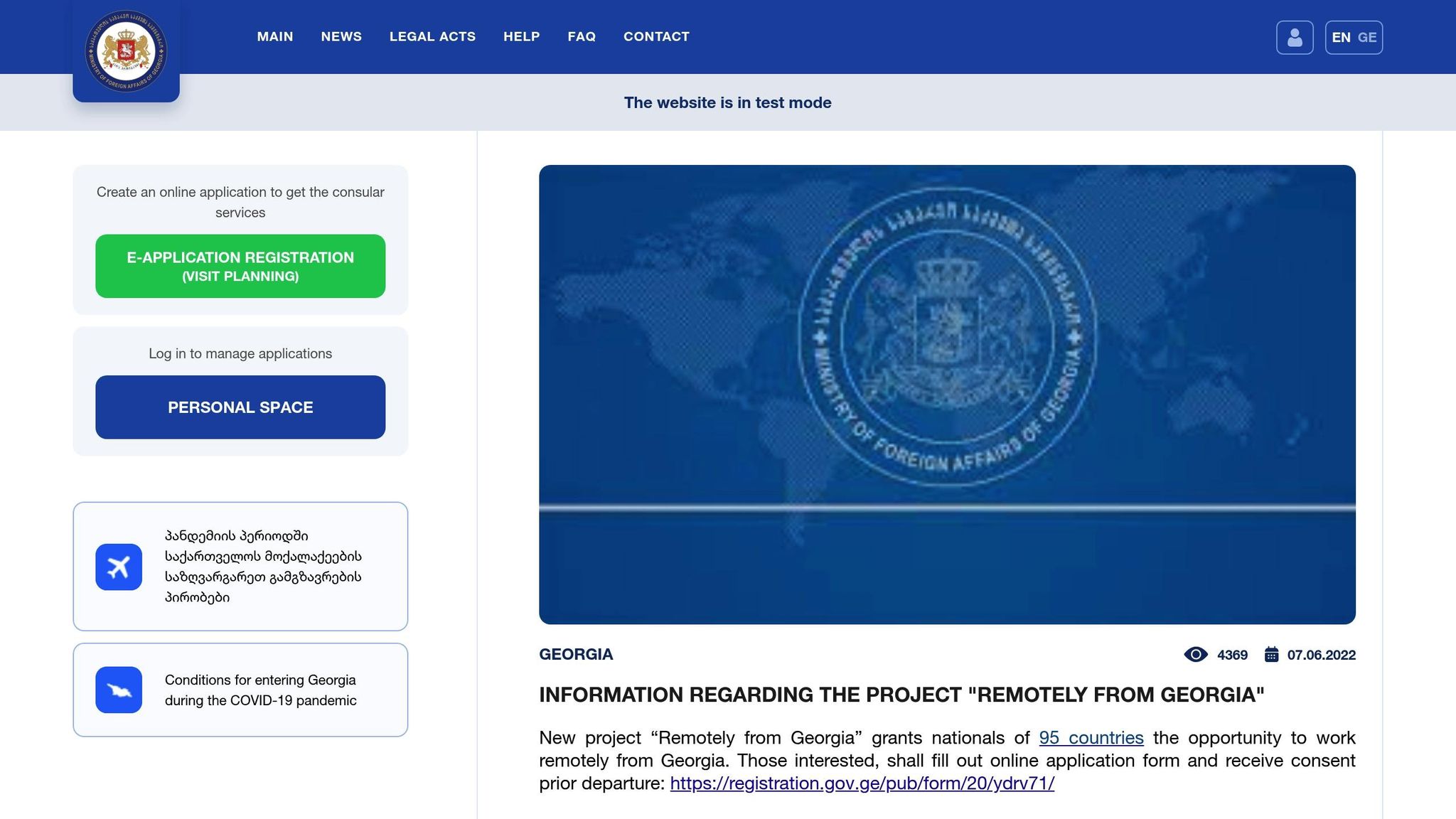
The "Remotely from Georgia" program invites remote workers to live and work in Georgia for over 180 days, offering a unique opportunity for long-term stays in the country.
Eligibility Requirements
This program is open to freelancers, full-time employees, and business owners who earn their income from outside Georgia. To qualify, applicants must:
- Be a citizen of one of the 95+ eligible countries (check your status to confirm).
- Show proof of a minimum monthly income of $2,000 or have a bank balance of at least $24,000.
Comparison: Pros and Cons
Digital nomad visas come with a variety of perks and requirements, and understanding these differences can help you pick the right one for your lifestyle and work needs.
Many European programs include Schengen Area access, which means you can travel freely across 27 European countries. This feature is available in countries like Spain, Portugal, Greece, Italy, Hungary, Malta, Croatia, and Estonia – ideal for those who want the freedom to explore multiple destinations without needing extra visas.
Certain programs also provide tax advantages. For example, U.S. citizens may benefit from the Foreign Earned Income Exclusion (up to $130,000 in 2025) or the Foreign Tax Credit, potentially reducing federal tax obligations.
When it comes to costs, application fees range widely – from around $80 to over €1,000, depending on the country. Income requirements also differ significantly. Georgia has one of the lowest thresholds, requiring $2,000 monthly, while Spain and Portugal demand higher earnings.
Here’s a quick look at some key differences across popular programs:
| Country | Fee | Schengen Access | Tax Benefits | Digital Nomad Score |
|---|---|---|---|---|
| Spain | $86 | Yes | Standard EU rates | Very High (5.0) |
| Portugal | $80 | Yes | Standard EU rates | High (3.18) |
| Greece | €1,000+ | Yes | Standard EU rates | Not specified |
| Italy | ~$116 | Yes | Standard EU rates | Not specified |
| Croatia | $58 | Yes | Tax exempt | Not specified |
| Estonia | $85 | Yes | Standard EU rates | Not specified |
| Georgia | Not specified | No | Territorial tax system | Not specified |
Lifestyle factors are another consideration. European destinations often come with higher living expenses but offer excellent infrastructure and a rich variety of experiences. On the other hand, Georgia stands out for its affordable cost of living and a growing expat community, though it lacks EU access.
Visa duration and renewal policies are crucial for those planning long-term stays. Most European programs start with visas lasting one to two years and provide options for renewal. Georgia, meanwhile, allows stays beyond 180 days with relatively simple extension procedures.
Language barriers might also influence your decision. Countries like Estonia and Malta are known for widespread English proficiency, while Spain, Italy, and Bulgaria may require some familiarity with the local language.
The application process can vary in complexity. Some programs demand extensive paperwork, including criminal background checks and proof of accommodation, while others are more straightforward. Processing times typically range from a few weeks to several months.
Finally, geographic location matters, especially for U.S. citizens who plan frequent trips back home. While European destinations involve longer flights and higher travel costs, they also offer access to cultural and business opportunities within the EU.
For U.S. digital nomads, Spain, Portugal, and Croatia stand out as strong options. They combine Schengen access, manageable income requirements, and attractive tax benefits, making them appealing choices for balancing work and lifestyle goals.
Conclusion
Selecting the best digital nomad visa involves weighing your career needs, financial plans, and personal lifestyle. For U.S.-based professionals, this choice also means navigating the complexities of worldwide tax obligations, making smart tax planning a must.
Many European visa programs simplify entry with Schengen access and straightforward renewal options, reflecting a growing push toward easier mobility. Tax considerations play a key role here – while U.S. citizens are subject to global tax rules, tools like exclusions and credits can help reduce their tax burden. Countries with territorial tax systems or special tax breaks for digital nomads, like Croatia and Georgia, offer unique advantages. These destinations not only provide potential tax savings but also attract digital nomads with affordable living costs and thriving expat communities. Additionally, European visa programs often come with clear renewal processes and pathways to permanent residency, opening up broader opportunities for travel and business within the EU.
To navigate these choices effectively, it’s wise to consult professionals experienced in international tax planning and asset protection. They can help you structure your business, manage taxes, and protect your wealth as you embrace location independence.
Ultimately, your visa decision will shape not just where you live but also your financial outlook for the future.
FAQs
What should I consider when selecting the best digital nomad visa in 2025?
When selecting a digital nomad visa in 2025, it’s crucial to weigh several factors to find the right fit for your lifestyle and work needs. Start by examining the visa’s duration, whether it offers renewal options, and what the application process entails. Many countries require proof of remote work and a minimum income, so make sure you meet these criteria before applying.
Beyond the visa itself, think about your potential destination’s cost of living, internet quality, and safety levels – these will significantly influence your daily comfort and productivity. It’s also worth exploring whether the area has an active digital nomad community or support networks. Having access to like-minded individuals can make settling into a new place much easier and more enjoyable.
By taking these aspects into account and matching them with your career goals, budget, and personal preferences, you’ll be better equipped to choose a visa program that aligns with your global work-life aspirations.
What are the tax implications for digital nomads in Spain, Greece, and Portugal?
The tax systems for digital nomads in Spain, Greece, and Portugal each come with their own set of perks and considerations:
- Spain: Spain’s Beckham Law offers a flat 24% income tax rate on earnings up to €600,000 (about $635,000). Income exceeding this limit is taxed at higher rates. This scheme is specifically aimed at attracting foreign professionals to the country.
- Portugal: Under the Non-Habitual Resident (NHR) program, digital nomads can enjoy a flat 20% tax on local income for up to 10 years. However, global income may be taxed on a progressive scale, with rates ranging from 13.25% to 48%, depending on its origin and amount.
- Greece: Greece uses standard progressive tax rates that range from 9% to 44%, depending on income levels. That said, the country provides tax incentives for foreign residents who meet specific criteria, which can reduce their overall tax burden.
These tax policies can play a big role in helping digital nomads decide which destination best fits their financial plans and lifestyle needs.
What are the benefits of choosing a digital nomad visa in a country like Georgia instead of a Schengen Area country?
Georgia offers 365 day visa-free entry for most nationalities, lower costs, and territorial taxation (only local income taxed). No complex applications or 90-day Schengen limits. English widely spoken, fast internet, minimal bureaucracy, and easier banking access. Schengen visas are expensive with strict requirements and mobility restrictions. Georgia provides simpler long-term stays and potential tax advantages for remote workers.
Why Consider a Digital Nomad Visa in Georgia?
Choosing Georgia as your base with a digital nomad visa comes with some clear perks. First up, affordability. Georgia boasts a low cost of living, which means your money goes a lot further. Plus, remote workers enjoy an incredibly low flat income tax rate of just 1%. Compare that to many Schengen countries, where higher living expenses and complicated tax systems can quickly eat into your earnings.
Another big win? Georgia’s straightforward application process. It’s refreshingly simple and allows for longer stays without the usual red tape you’d face in Schengen countries. Unlike those destinations, Georgia imposes fewer restrictions on work and residency durations, giving you more freedom to live and work on your terms.
When you add up the low costs, tax perks, and ease of entry, Georgia becomes a standout option for digital nomads looking for flexibility and financial freedom. It’s a smart alternative to pricier, more regulated Schengen destinations.
