
Digital nomad visas got harder in 2026. If I’m planning to live abroad while working online, I need to expect higher income rules, more document checks, stricter renewal limits, and closer tax tracking.
Here’s the short version:
- Europe is getting tougher fastest, especially Portugal, Spain, Greece, and Croatia
- Monthly income floors now often sit around $2,500 to $4,000
- Some countries are making renewals harder with more paperwork and cooling-off periods
- Schengen day counting is tighter because EES now logs entries and exits digitally
- Outside Europe, Costa Rica, Dubai, and Indonesia are also asking for more proof and using tougher enforcement
- A visa still does not protect me from local tax residency
If I stay too long, miss a rule, or submit weak documents, I could face:
- a denied renewal
- a local tax bill
- banking trouble
- fines, visa loss, or even an entry ban
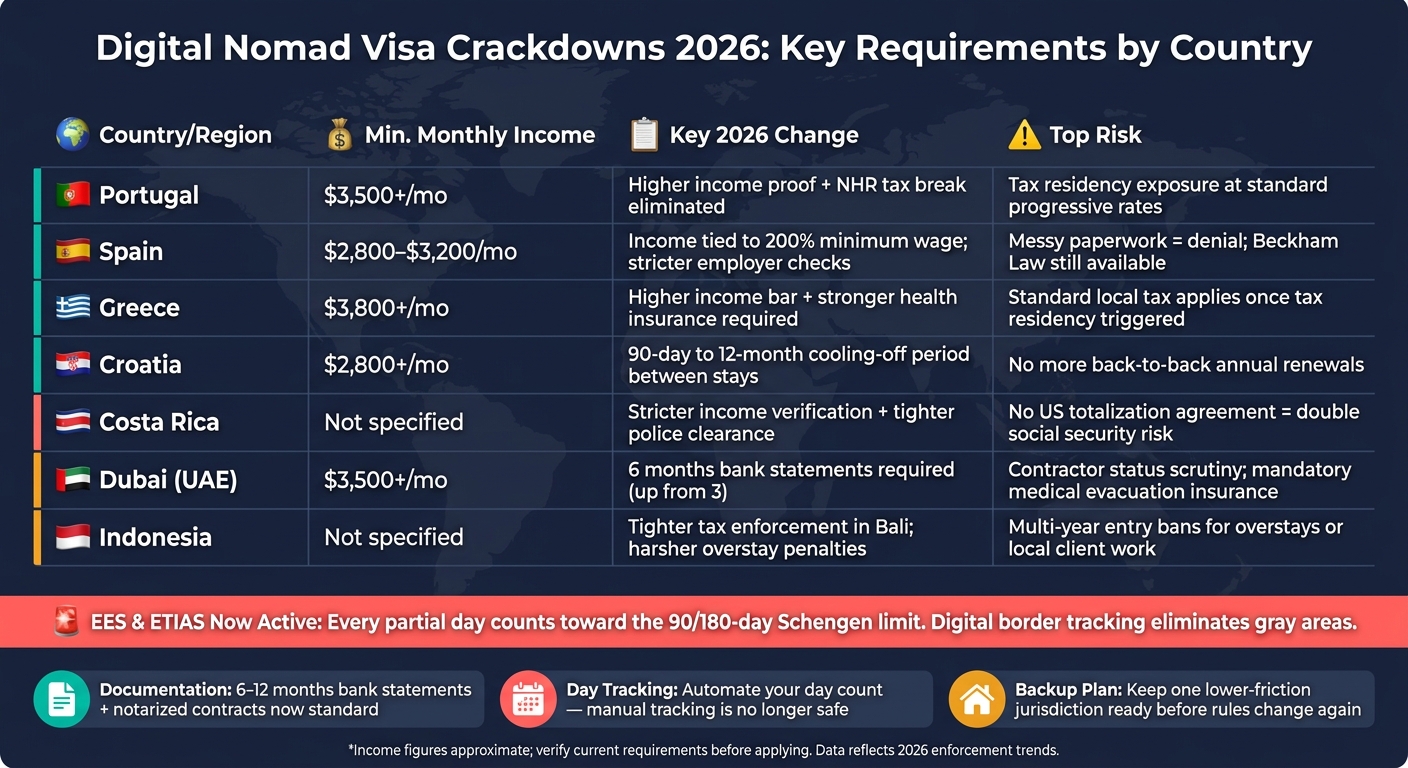
Digital Nomad Visa Requirements by Country 2026
Quick comparison
| Place | Main 2026 shift | What I should watch |
|---|---|---|
| Portugal | Higher income proof, tighter tax scrutiny | D8 income proof, post-NHR tax costs |
| Spain | Income test tied to minimum wage, stricter review | employer ties, clean paperwork, tax status |
| Greece | Higher income bar, tighter insurance checks | tax residency and document quality |
| Croatia | Cooling-off period for repeat stays | no easy back-to-back yearly use |
| Costa Rica | More income and background checks | tax treatment and U.S. Social Security overlap |
| Dubai (UAE) | 6 months of bank statements required | contract proof, insurance, income source |
| Indonesia | Harder enforcement on misuse and overstays | local work limits, tax checks, entry-ban risk |
The bottom line: I can’t treat a nomad visa like a simple stay permit anymore. With expanding options for digital nomads comes increased complexity. In 2026, I need to track my days, line up my tax and residency position, and keep my paperwork clean before I apply, renew, or move.
sbb-itb-39d39a6
Where rules are tightening most in Europe: country-by-country changes
| Country | Monthly income | Stay length | Renewal rule |
|---|---|---|---|
| Portugal | ~$3,500+ | 1–2 years | Reduced/stricter |
| Spain | ~$2,800–$3,200 | 1 year (initial) | Up to 5 years total |
| Croatia | ~$2,800+ | 1 year | Cooling-off period required |
| Greece | ~$3,800+ | 1–2 years | Tighter criteria |
Approximate ranges; exact requirements vary by visa route and supporting documentation.
The pattern across Europe is pretty clear: higher income tests, tighter renewals, and less room to extend stays.
Portugal and Spain: higher income requirements and stricter tax enforcement
Portugal’s D8 Digital Nomad Visa now calls for $3,500 or more per month in verifiable remote income, and officials are checking remote work arrangements more closely. That means applicants need cleaner proof of who they work for and how they earn.
Portugal’s old NHR tax break is also gone. So if you stay longer, you’re now looking at standard progressive tax rates instead. For many nomads, that was the big draw, and without it, long-term stays can look a lot less attractive.
Spain is moving in a similar direction. Its Digital Nomad Visa links the income test to 200% of the minimum wage, which comes out to roughly $2,800 to $3,200 per month. Authorities are also taking a closer look at employer ties and the exact nature of remote income.
Spain still offers a 24% flat tax rate under the Beckham Law for people who qualify, with income above €600,000 per year taxed at 45%. But there’s a catch: the paperwork bar is higher now, so getting approved is less forgiving if your documents are messy or incomplete.
The shift in Southern Europe doesn’t stop there. Other countries are also making renewals harder.
Greece and Croatia: fewer renewal paths and shorter repeat stays
Greece has kept its tax incentive, but the entry bar has moved up. The income threshold is now $3,800 per month, and applicants need stronger health insurance documents as well. Once you cross into tax residency, standard local tax rules apply.
Croatia has changed the rhythm of repeat stays in a big way. It now requires a 90-day to 12-month cooling-off period before you can apply again. In plain English, that shuts down the old playbook of using Croatia as a back-to-back base year after year.
Schengen enforcement in 2026: EES, ETIAS, and day-count tracking
Across Schengen, enforcement is now strict enough to flag overstay risk before renewal or even before exit. With EES and ETIAS, the old habit of being a little loose with the 90/180-day rule gets a lot riskier, because every partial day counts.
Outside Europe, the same pressure is showing up in Costa Rica, the UAE, and Indonesia.
Beyond Europe: stricter compliance in Costa Rica, the UAE, and Indonesia
Outside Europe, the same trend is showing up in Costa Rica, the UAE, and Indonesia: more proof, closer tax checks, and tougher penalties when people get the rules wrong.
| Jurisdiction | Main change | Why it matters |
|---|---|---|
| Costa Rica | Stronger income verification and stricter police-clearance standards | Local tax authorities may challenge remote income as locally sourced; no US totalization agreement means double social security exposure |
| Dubai remote work visa | Six months of bank statements required as of January 27, 2026, up from three | Stricter checks on contractor status and income source; private health insurance with medical evacuation coverage is mandatory |
| Indonesia | Tighter tax enforcement in Bali and harsher penalties for visa misuse | Overstays can now result in multi-year entry bans |
Costa Rica: stricter background checks and less room to assume tax exemption
Costa Rica has tightened income verification and document standards for digital nomad applicants. Police-clearance rules are stricter, and authorities are looking more closely at where income comes from. If your paperwork doesn’t line up, or your income trail is messy, delays or denials are much more likely.
For US nomads, the bigger issue may be tax. Local tax authorities may question whether remote earnings are exempt from Costa Rican tax. Costa Rica also has no totalization agreement with the US, which can leave workers exposed to double social security tax. So the main risk isn’t just getting the visa. It’s what happens after, when tax treatment comes into play.
UAE and Indonesia: higher entry standards and tougher enforcement
As of January 27, 2026, Dubai’s remote work visa requires six months of bank statements, up from three, plus a minimum monthly income of $3,500. The UAE still has 0% personal income tax, which is a big draw. But officials are taking a closer look at remote work contracts, and private health insurance with medical evacuation and repatriation coverage is mandatory. In plain English: meeting the income floor isn’t enough if your documents don’t hold up.
Indonesia is putting pressure on a different part of the process. Authorities are tightening tax enforcement in Bali and using tougher penalties for visa misuse, including working for local clients or overstaying. Overstays can now lead to multi-year entry bans. That puts visa status and tax exposure near the top of the checklist.
What remote workers should do now: protect legal stay, tax position, and mobility
When visa rules get tighter, the job changes fast. It’s no longer about picking the next nice place to live. It’s about showing you’re compliant. The crackdowns in Europe, Costa Rica, the UAE, and Indonesia all point in the same direction: legal stay, tax position, and mobility need active management. You can’t just assume things will work out.
Check your current visa, day count, and tax residency exposure
Move before your renewal, exit, or relocation forces the issue. Track your visa expiration date, your days in-country, and any tax residency trigger. In some places, you can be treated as a tax resident before 183 days if your personal and financial ties are stronger there. Authorities now cross-check physical presence and income against border and financial records. Keep a tax residency certificate from your main tax home.
If your day count or tax position is getting close to a trigger, deal with it before your next border crossing or renewal.
Match your visa strategy to your business structure and income proof
Your income source matters just as much as your income level. Employees need employer permission to work from the host country. Freelancers need contracts and proof of income from non-local clients, since working for local clients can lead to revocation or fines. Business owners also need to watch permanent establishment risk.
Documentation rules have gotten much stricter. Many destinations now ask for:
- 6 to 12 months of bank statements
- Notarized contracts
- Employer verification letters
If your paperwork no longer matches the destination’s rules, move to a backup base before the next rule change hits.
Build a backup residency and relocation plan before rules change again
If your main destination adds renewal blocks, cuts stay limits, or makes tax exposure too hard to manage, you need a ready fallback, not an open browser tab. Keep one backup residence in a lower-friction jurisdiction lined up. Also keep your insurance compliant, your documents clean, and a day-count log for every country.
Conclusion: Digital nomad planning in 2026 requires more care, not less
One thing is clear: digital nomad rules are getting tighter on both entry and tax enforcement. Governments are now policing remote work more aggressively than they’re promoting it. Income thresholds are going up, border tracking is more automated, tax enforcement is moving past simple day counts, and renewals are harder to predict. Compliance now matters just as much as income and location.
For U.S. remote workers, the risk isn’t only visa denial. Your visa needs to line up with your tax plan, entity setup, and day-count strategy. Across Europe, Costa Rica, the UAE, and Indonesia, the pattern looks the same: proof requirements are going up, and enforcement leaves less room for mistakes. One slip into accidental tax residency can lead to costly local tax exposure.
Act before renewal deadlines, not after. Audit your documents, track your days, and keep a backup jurisdiction ready. For example, the New Zealand digital nomad visa offers a structured path for those looking outside traditional hubs. When delays hit, they can trigger tax and visa problems that could have been avoided.
Choose jurisdictions with clear entry rules, stable renewals, and tax treatment you can plan around. In 2026, the safest plan is simple: stay compliant, stay documented, and keep one backup option ready.
FAQs
Which countries are getting toughest on nomad visas in 2026?
Europe is tightening the screws in the most visible way. Spain, Portugal, Croatia, and Estonia now have tougher rules, with higher income thresholds, stricter renewal or documentation checks, background checks, and stronger proof that applicants work remotely.
The same pattern is showing up in other parts of the world too. Thailand, Indonesia, Malaysia, Mexico, Costa Rica, Colombia, the UAE, Qatar, Oman, and Canada are all increasing scrutiny through stricter financial, tax, contract, entry, and verification requirements.
Can I still owe local tax with a digital nomad visa?
Yes. A digital nomad visa does not automatically exempt you from local tax.
Your tax duties usually depend on two things: how long you stay and whether you have meaningful economic ties to the country, such as local clients or business activity there. In plain English, the visa lets you live and work there for a period of time, but it doesn’t promise a free pass on taxes.
Some countries also require you to get a local tax ID even when you don’t actually owe tax. That part trips people up all the time. You might assume “no tax due” means “nothing to do,” but that’s not always how it works.
Miss registration rules, filing deadlines, or exemption requirements, and you could end up with surprise tax bills or penalties.
What documents should I prepare before applying or renewing?
Prepare organized records that show financial stability and compliance. That usually means employment or business paperwork like a signed employment letter, contracts, pay stubs or invoices, and business registration if it applies to you.
You should also keep:
- 3 to 12 months of bank statements
- Proof of savings or passive income
- Updated visa and tax records
- Private health insurance
- Copies of your passport, itinerary, accommodations, and onward or return travel
Keep these records in both digital and printed form. It sounds simple, but having paper copies and backup files can save you a lot of stress if you’re asked for documents on short notice.