
Yes – but only in a narrow set of cases. If I leave the U.S. and simply live abroad, the U.S. does not charge an exit tax just for moving. The issue starts when I formally give up U.S. citizenship or end long-term green card status, and then meet one of the covered expatriate tests.
Here’s the plain-English version:
- Moving abroad is not the trigger
- Renouncing citizenship or giving up a long-term green card can be the trigger
- I can become a covered expatriate if I:
- have $2,000,000+ in net worth
- had average annual U.S. income tax above $211,000 over the last 5 years
- or fail to certify 5 years of tax compliance on Form 8854
- If covered, the IRS may treat my assets as sold the day before expatriation
- In 2026, the first $910,000 of mark-to-market gain is excluded
- Big IRAs, deferred comp, founder stock, and crypto can create the largest tax bills
- Right now, no new exit tax law has replaced IRC §877A
- For 2026, the bigger issue looks like tighter enforcement, not a brand-new system
That’s the main point: this is less about leaving America and more about how I leave the U.S. tax system.
A quick way to think about it:
| Situation | Exit tax risk in 2026 |
|---|---|
| I move overseas but keep U.S. citizenship | No exit tax trigger |
| I renounce U.S. citizenship | Possible |
| I give up a green card after 8 of the last 15 tax years | Possible |
| I expatriate and fail Form 8854 compliance rules | High risk |
If I were reading this for planning, I’d focus on three things first: net worth, 5-year tax compliance, and asset type. Those three items drive most of the risk.
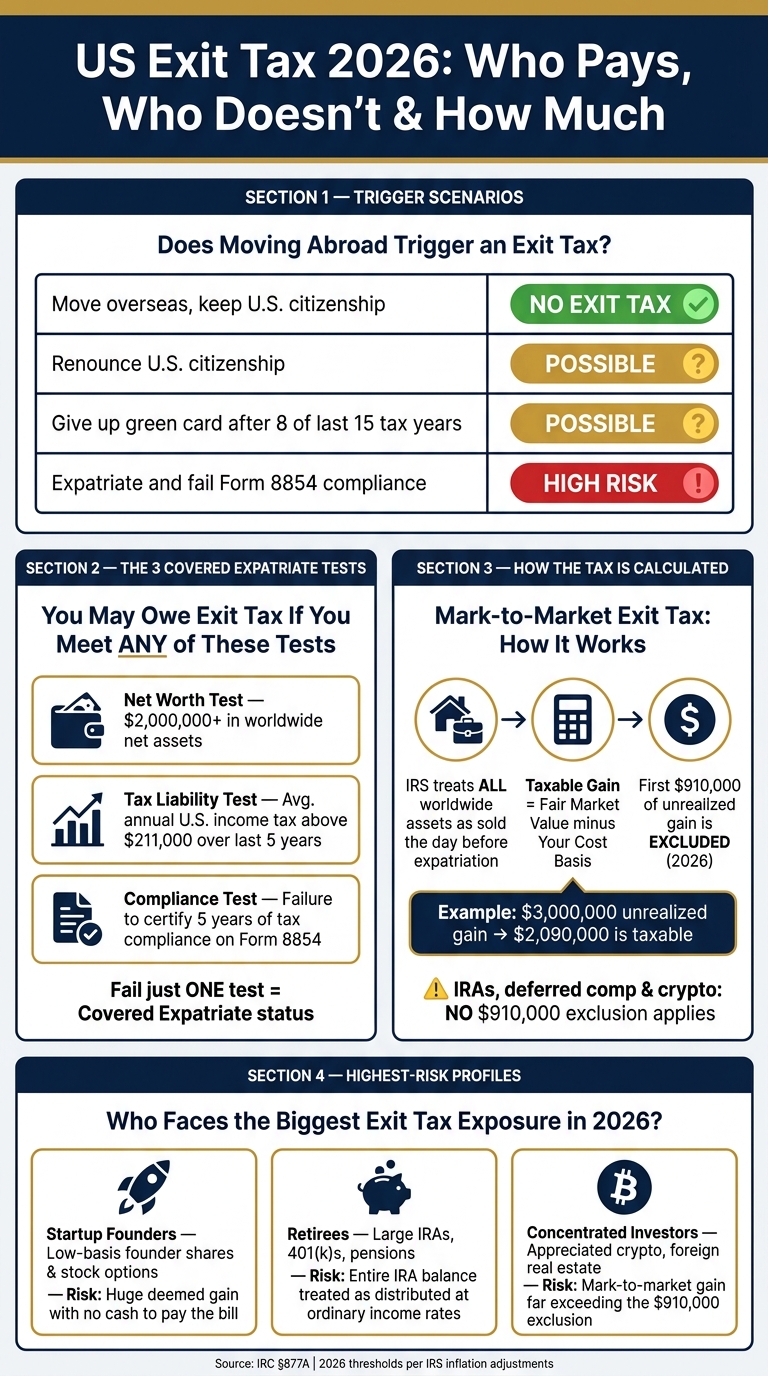
US Exit Tax 2026: Who Pays, Who Doesn’t & How Much
How the US exit tax works today under IRC §877A
IRC §877A sets the rules for the U.S. exit tax. It applies only when someone formally expatriates by renouncing U.S. citizenship or giving up a green card after meeting the long-term resident threshold.
Who qualifies as an expatriate or long-term resident
For U.S. citizens, expatriation happens on the renunciation date. For green card holders, the trigger is the 8-of-15 rule: if you held a green card in at least 8 of the last 15 tax years, you are a long-term resident (LTR). If you give up your green card after meeting that test, you also fall under the expatriation regime.
The three covered expatriate tests for 2026
| Test | 2026 Threshold |
|---|---|
| Net Worth Test | $2,000,000 or more in worldwide net assets |
| Tax Liability Test | Average annual net income tax for the 5 preceding years exceeds $211,000 |
| Compliance Test | Failure to certify five tax years of U.S. compliance on Form 8854 |
These tests matter because covered expatriate status decides whether the exit tax rules come into play. Fail just one test, and that can be enough. That includes the Form 8854 certification rule. So even if your net worth is under $2 million, missing that filing can still make you a covered expatriate. Once that status applies, it opens the door to mark-to-market tax treatment and other exit-tax rules.
There are a few narrow exceptions. They apply to certain dual citizens from birth and some people who expatriate before age 18½.
Filing requirements that apply even without exit tax
Even if you do not owe mark-to-market tax, expatriating citizens and long-term residents still have filing duties. You must file a final tax return for the year you leave – either Form 1040 or a dual-status return if your residency ends partway through the year – and Form 8854, the Initial and Annual Expatriation Statement.
Before expatriating, line up your last five years of tax returns, FBARs, and FATCA filings. That step matters because a Form 8854 compliance failure can turn an otherwise clean departure into a covered expatriation event.
Covered status is just the starting point. The next step is figuring out which assets and deferred items the IRS taxes when you exit.
sbb-itb-39d39a6
What gets taxed at exit and who faces the most exposure
Mark-to-market tax on worldwide assets
If you’re a covered expatriate, the IRS treats your worldwide assets as if you sold them the day before expatriation. The taxable gain is the asset’s fair market value minus your basis.
For 2026, the first $910,000 of unrealized gain is excluded. So if your unrealized gain is $3,000,000, about $2,090,000 is taxable before other adjustments.
This rule can reach a lot more than people expect. It may apply to:
- Worldwide real estate
- Brokerage accounts
- Startup shares with little basis
- Interests in closely held companies
- Cryptocurrency
Crypto can be a nasty surprise here. If a position has gone up sharply and the gain wasn’t planned for, the expatriation tax hit can be steep.
Different rules apply to retirement accounts, deferred compensation, and trust interests.
Retirement accounts, deferred compensation, and trusts
Retirement accounts and deferred compensation follow separate rules. In many cases, they can be harsher because the $910,000 exclusion does not apply, and the income is usually taxed at ordinary income rates instead of capital gains rates.
| Asset Type | Exit Tax Treatment | Tax Character | Key Planning Lever |
|---|---|---|---|
| IRA / other tax-deferred accounts | Deemed distribution of full balance on day before exit | Ordinary income | Timing of pre-exit distributions |
| Eligible deferred compensation (qualified pensions) | 30% withholding at time of future payment | Ordinary income | Confirm whether the plan is eligible |
| Ineligible deferred compensation (RSUs, non-qualified plans) | Deemed distribution of present value on day before exit | Ordinary income | Plan for immediate tax and liquidity |
| Non-grantor trust interests | 30% withholding on taxable portion of future distributions | Ordinary income | Review trust distribution timing |
One of the biggest shocks is the IRA deemed distribution rule. If you have a large traditional IRA and expatriate as a covered expatriate, the IRS treats the entire balance as distributed the day before you leave. That amount is added to your income at ordinary rates, and there’s no exclusion.
Ineligible deferred compensation can be just as rough. RSUs and non-qualified deferred compensation plans may trigger tax before you get any cash, because the tax is based on the present value of unpaid benefits.
That’s why these rules don’t hit everyone the same way.
The highest-risk profiles in 2026
| Profile | Typical Assets | Main Covered-Expatriate Test Risk | Biggest Exit-Tax Pressure Point |
|---|---|---|---|
| Startup founders | Low-basis founder shares, stock options | $2M net worth test | Deemed sale of illiquid equity with no cash to pay the tax |
| Retirees | Large IRAs, 401(k)s, pensions, brokerage accounts | Average tax liability test | Deemed distribution of full retirement account balance at ordinary income rates |
| Investors with concentrated positions | Appreciated crypto, foreign real estate, closely held company stakes | Income tax liability test | Mark-to-market gain well above the $910,000 exclusion |
Startup founders often run into a plain cash-flow problem. Founder shares with very low basis can produce a huge deemed gain, even if no actual sale happened and no cash came in.
Retirees can get hit hard too. A large IRA balance may be treated as fully distributed in the exit year, and that kind of tax bill catches plenty of people off guard.
Investors with concentrated positions face a different issue: sharp appreciation. Crypto is the clearest example. If the gain is large enough, the exit-tax bill can climb far past the $910,000 exclusion, which is why valuation records and basis support need close attention.
Planning options to reduce or manage exit tax exposure
How to avoid covered expatriate status where possible
The key moment comes before expatriation. That’s when compliance, valuation, and timing can still change the outcome. After renouncing, your options get much tighter. Fixing problems before you file Form 8854 is usually far easier than trying to sort them out later.
Pre-exit planning matters most because one mistake can settle the issue fast: if you miss five years of tax compliance, you become a covered expatriate no matter your net worth or income. That means missing returns, FBARs, and Form 8854 should be handled before expatriation, not after.
Gifting before expatriation can help bring net worth down, but there are limits. Gift-tax rules and fraudulent-transfer rules can reduce how much this move actually does for you. And if the goal is to lower the tax-liability test, that usually takes a five-year runway, not a last-minute fix.
Once you know where the status risk sits, the focus shifts to the size of the tax bill itself.
How to lower the exit-tax bill when covered status cannot be avoided
If covered status can’t be avoided, the next job is simple in theory: shrink the gain base. Start with a full list of assets and tax basis. That groundwork matters. Capital losses can offset mark-to-market gains, and assets with high basis create less taxable gain even when their market value is high.
Illiquid assets need supportable valuations. A weak appraisal can make the bill worse, while a solid one can keep the numbers in line with fair market value.
The right move depends on the person:
- Founders often need valuation and liquidity planning.
- Retirees often need income-test planning.
- Investors often need gain-control planning.
| Strategy | Primary Goal | Best Fit by Profile |
|---|---|---|
| Net-worth reduction | Avoid $2 million threshold | Individuals near the limit |
| Compliance catch-up | Pass 5-year certification | Delinquent or non-filers |
| Loss harvesting | Lower mark-to-market gain | Asset-heavy covered expatriates |
| Valuation review | Support fair market value | Private equity and real estate holders |
| Deferral election | Manage cash flow on illiquid assets | Founders and illiquid asset holders |
Deferral can postpone tax on illiquid assets, but there’s a catch: it requires IRS security and interest keeps accruing. So no, it’s not a free pass. What it can do is ease the cash-flow strain for founders sitting on low-basis equity with no liquidity event on the horizon.
For founders with illiquid holdings and investors with concentrated positions, valuation and liquidity planning matter just as much as covered status.
Where post-exit structuring fits in
Offshore structures may help after expatriation, but they do not reverse exit tax that has already been triggered under U.S. law. Order matters here. Finish the exit-tax analysis first, then build any post-exit structure on top of a clean compliance record.
The remaining question for 2026 is whether the IRS will change the law or simply enforce the current rules more aggressively.
2026 outlook: Will the US tax leavers more aggressively?
Current law versus proposed policy changes
Now that the rules and risk areas are on the table, the next issue is simple: will 2026 bring a new law, or just tougher policing of the rules already in place?
So far, no new exit tax has been enacted. In 2026, §877A still governs formal expatriation, and the big policy question is whether residency-based tax changes pick up support.
One proposal to watch is H.R. 10468. It would allow some Americans living abroad to elect non-resident status after three years outside the U.S. and five years of tax compliance. But there’s a catch: deferred income would be taxed at the time of that election. Unless that changes, the current system stays in place. That puts the focus less on rumor and more on enforcement.
What enforcement trends suggest for 2026 and beyond
The near-term issue is how the government applies the law it already has. The 2024 Roger Keith Ver case is a reminder that expatriation issues can come back years later, especially when crypto valuation and offshore reporting are in dispute.
For 2026, the pressure points look pretty clear:
- Form 8854 accuracy
- Asset valuation
- FATCA and FBAR filing history
That’s where problems tend to start. A bad valuation, a weak paper trail, or missing filings can turn an old move into a current tax fight.
Conclusion: The real decision point before leaving the US tax system
The table below draws a clean line between enacted law and ideas that are still being debated.
| Regime | Trigger | Who Is Targeted | Assets Affected | 2026 Likelihood |
|---|---|---|---|---|
| Current §877A Law | Formal expatriation (renunciation or green card relinquishment) | Covered expatriates who meet the net worth, tax liability, or compliance tests | Worldwide assets, mark-to-market | Enacted law |
| RBT Departure Tax (H.R. 10468) | Election of non-resident status after 3+ years abroad | Eligible Americans with a five-year compliance history | Deferred income | Proposed, under discussion |
| Ultra-high-net-worth exit-tax proposals | Expatriation by very high-net-worth individuals | Ultra-wealthy taxpayers | Total wealth and unrealized gains | Low, speculative |
The key moment is the formal expatriation date. Up to that point, taxpayers may still fix compliance gaps and support their valuations with records. For anyone thinking about expatriation, the filing date, asset mix, and compliance history shape the level of exposure.
FAQs
How do I know if I’m a covered expatriate?
You’re a covered expatriate if you renounce U.S. citizenship or give up your green card and meet any one of these tests:
- Your net worth is $2 million or more on the expatriation date
- Your average annual net income tax liability for the previous five years is more than $206,000
- You can’t certify full U.S. federal tax compliance for those five years
There’s one more catch: if you don’t file Form 8854, you’re automatically treated as a covered expatriate.
Which assets usually create the biggest exit tax bill?
The biggest exit tax bills usually come from assets hit by the deemed sale rule or those treated as full distributions.
Real estate, investment accounts, and private business interests are handled as if you sold them at fair market value the day before expatriation. That can set off capital gains tax, even if no sale actually happened.
Retirement accounts and deferred compensation plans, such as IRAs and 401(k)s, can be even more expensive. The IRS treats them as fully distributed right before expatriation, then taxes that amount as ordinary income.
Can I reduce or defer the exit tax before renouncing?
Yes. Careful planning and timing before renouncing citizenship or giving up a green card can cut or delay exit tax.
One big goal is to avoid covered expatriate status. That matters because the exit tax rules hit much harder once you fall into that bucket. It also helps to stay fully tax compliant for the five years before expatriation. Miss that step, and things can get messy fast.
There are a few other ways people may trim their exposure. You can use the inflation-adjusted gain exclusion, manage gains and losses before expatriation, and, in some cases, defer tax on certain pensions or deferred compensation.
The main idea is simple: what you do before expatriation can change how much tax you owe, and when you owe it.