
Short answer: not yet – but I wouldn’t ignore the shift. The U.S. dollar is still the top reserve currency, yet the data points to a slow move into gold, non-dollar trade settlement, and foreign assets. For me, the main takeaway is simple: the biggest risk is having too much of my wealth tied to one currency, one market, and one legal system.
Here’s the plain-English version:
- The dollar still dominates, with foreign holders owning about $30 trillion in dollar assets and deposits.
- Central banks are adding gold at a high pace, with more than 1,000 tons bought in both 2022 and 2023.
- A slow shift matters, even without a full dollar collapse, because it can mean higher inflation, higher borrowing costs, and less buying power.
- U.S. investors are often overexposed at home, with roughly 85% to 90% of equity exposure staying domestic.
- My first line of action would be diversification: more foreign assets, some non-USD exposure, and a measured gold allocation.
- If stress gets worse, I’d also look at where assets are held, not just what assets I own.
So no, this is not a “sell everything” story. It’s a risk concentration story.
If I wanted a simple action list, it would look like this:
- Cut home bias
- Add international exposure
- Hold some gold
- Review currency risk
- Check custody and legal concentration
That’s the core point of the article: don’t panic about headlines; pay attention to what too much USD exposure could do to your wealth over time.
Is the US dollar actually losing reserve status? What the data says
The dollar is still the main reserve currency. But the data shows a slow move into other assets and settlement paths. The clearest places to look are central bank reserves, trade settlement, and the reserve moves made by sanctioned countries. Even if this shift stays slow, it can still shape inflation, interest rates, and the buying power of your assets.
Central bank reserves, trade settlement, and the limits of de-dollarization
The clearest signal comes from what central banks are doing with reserves. In the first half of 2024, global central banks added a net 483 tons of gold to their reserves. That was a 5% increase over the prior record set in H1 2023. In 2022, net central bank gold purchases reached 1,136 tons, the highest level recorded since 1950. Buying also stayed above 1,000 tons for two straight years, in 2022 and 2023.
That matters because gold is a reserve asset that no single government controls. When central banks buy more of it, they’re not ditching the dollar overnight. They are, however, making room for an asset outside the direct reach of any one state.
On the trade side, Russia’s National Wealth Fund held $600.9 billion in assets as of May 2021 and later announced the full removal of all U.S. dollar assets. Russia’s Finance Minister Anton Siluanov stated plainly:
"Dollar assets will be removed from the National Wealth Fund (NWF) altogether as Washington continues to impose sanctions on Moscow."
Still, it’s worth keeping this in proportion. Most of this movement is coming from sanctioned or openly adversarial states. Neutral or allied central banks have not made broad exits from the dollar at scale.
US debt, interest rates, and why reserve status matters
Reserve status comes with a built-in trade-off. If the world wants dollars, the U.S. has to keep supplying them. In practice, that means running steady trade deficits.
The result is huge. Foreign governments and private entities hold about $30 trillion in dollar-denominated financial assets and bank deposits. That equals about 150% of U.S. GDP. As long as that demand holds up, the system keeps humming along. If it weakens over time, U.S. borrowing costs can move higher and the dollar can lose buying power.
Headline fears vs. measurable reserve-status signals: a comparison
| Signal | What the data currently shows | Why it matters | What would count as meaningful erosion |
|---|---|---|---|
| Foreign USD holdings | ~$30 trillion (150% of U.S. GDP) | Shows massive global reliance on USD liquidity | A sustained, multi-year decline in total foreign-held USD assets |
| Central bank gold buying | Record levels, with 1,000+ tons in 2022 and 2023 | Points to a shift toward reserves no single government controls | Gold becoming the primary settlement asset over USD |
| Trade invoicing | Russia and China settling more trade in non-dollar currencies | Reduces forced demand for dollars in energy trade | Major non-adversarial trade blocs such as the EU or ASEAN abandoning USD invoicing |
The picture here is gradual diversification, not a full retreat from the dollar. And that’s the part people often miss: slow changes can still matter a lot when the starting point is this big. A small shift in reserve behavior can ripple into inflation, interest rates, and the market value of a portfolio.
sbb-itb-39d39a6
What a weaker reserve role could do to your wealth
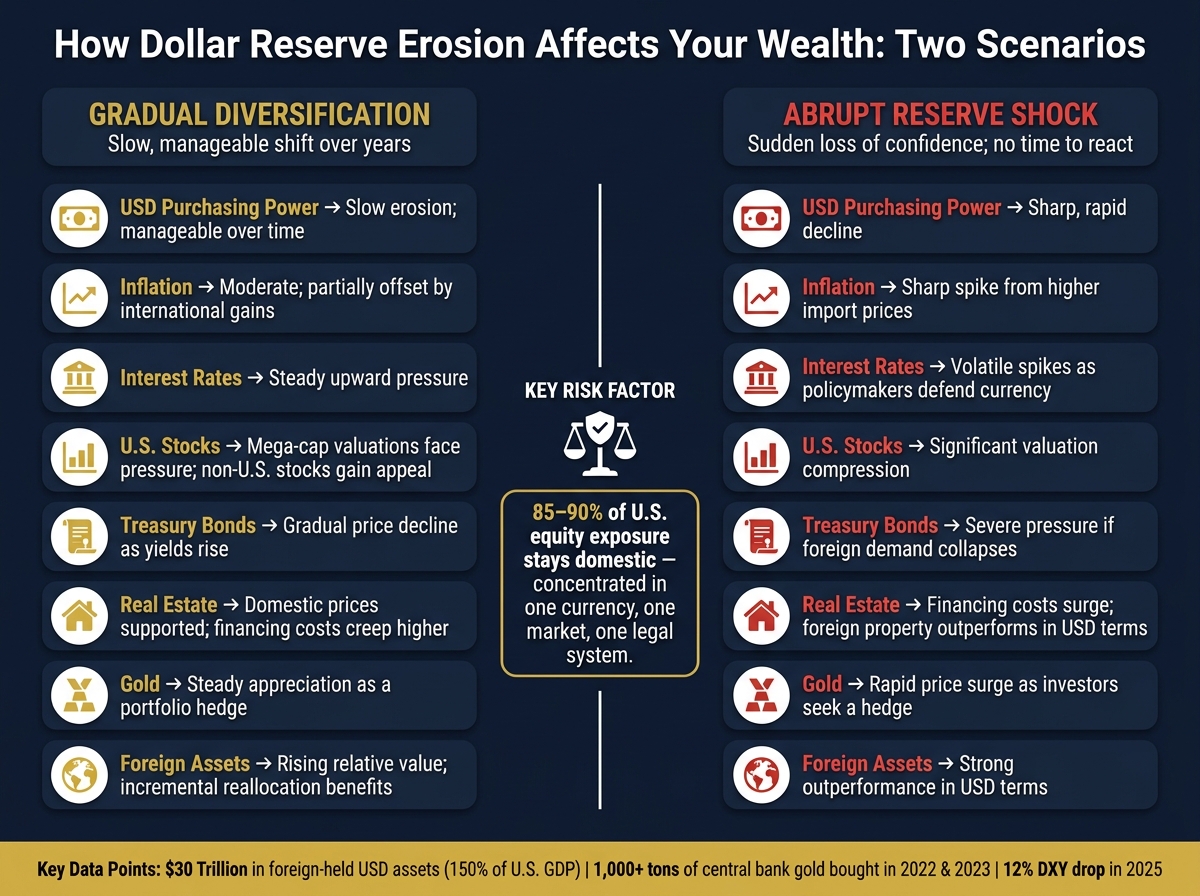
USD Reserve Status: Gradual Diversification vs. Abrupt Shock – Impact on Your Wealth
This isn’t just headline chatter. Even a slow loss of reserve standing can eat into purchasing power, push borrowing costs higher, and weigh on asset prices in portfolios that lean hard on the dollar. And that kind of strain usually shows up in two places first: your day-to-day bills and the price of what you own.
Purchasing power, inflation, and the cost of living when the dollar weakens
When the dollar loses ground, imported goods get pricier. So do a lot of the things people buy without thinking twice about where they came from: electronics, clothes, and food that crossed a border before landing on a store shelf. Trips abroad cost more. Tuition paid in another currency costs more in dollar terms. And U.S. companies that depend on parts or materials from overseas often pass those higher costs along to buyers.
Gold tends to climb when the dollar buys less. A 2025 drop of nearly 12% against the DXY shows how fast that pressure can show up. A move like that also makes euro-denominated assets and foreign debt payments more costly for U.S. investors.
How stocks, bonds, real estate, and gold could react
The impact won’t be the same across the board. Each asset class tends to react in its own way.
| Asset Class | Likely Reaction to Reserve Erosion | Primary Risk or Driver |
|---|---|---|
| U.S. Stocks | Valuation pressure; higher volatility | Concentration in mega-cap tech |
| Treasury Bonds | Downward price pressure | Rising yields if foreign demand for Treasurys weakens |
| Real Estate | Mixed; domestic prices may be supported by inflation | Higher financing costs; foreign debt payments become more expensive |
| Gold | Strong upward pressure | Higher demand for physical gold |
| Foreign Assets | Increased relative value in USD terms | Benefit from negative correlation to U.S. economic shocks |
Bank rules can also tilt demand toward physical gold instead of paper claims, which may help support prices. In U.S. stocks, the main issue is concentration. The S&P 500 leans heavily on a small cluster of mega-cap tech names. If a dollar shock pushes rates up and squeezes valuations, that kind of index could take a hard hit. International markets, with different sector mixes and lower starting valuations, may hold up better.
Gradual diversification vs. abrupt reserve-status shock: two scenarios compared
The pace matters just as much as the event itself. A slow shift gives investors time to react. A sudden loss of confidence doesn’t.
| Scenario | USD Purchasing Power | Inflation | Interest Rates | Stocks | Bonds | Real Estate | Gold | Foreign Assets |
|---|---|---|---|---|---|---|---|---|
| Gradual Diversification | Slow erosion; manageable over time | Moderate; partially offset by international gains | Steady upward pressure | Non-U.S. stocks gain relative appeal; U.S. mega-cap valuations face pressure | Gradual price decline as yields rise | Domestic prices supported by inflation; financing costs creep higher | Steady appreciation as a portfolio hedge | Rising relative value; incremental reallocation benefits investors |
| Abrupt Reserve Shock | Sharp, rapid decline | Sharp inflation spike from higher import prices | Volatile spikes as policymakers defend the currency | Significant valuation compression | Severe pressure if foreign demand for Treasurys collapses | Financing costs surge; foreign property outperforms in USD terms | Rapid price surge as investors seek a hedge | Strong outperformance in USD terms |
One more point matters here: 85% to 90% of U.S. equity exposure stays domestic. So if the shock is tied to one currency, most portfolios can get hit at the same time. That’s the risk of heavy dollar concentration.
How to protect your wealth if USD dominance erodes
If reserve erosion keeps moving forward, your response should fit the level of risk. Start with diversification. Then deal with custody and legal exposure. The goal isn’t to dump the dollar. It’s to rely on it less.
Add foreign currency exposure, gold, and international assets
A good first move is to cut back on domestic concentration. That’s concentration, not diversification. The easiest way in is usually a U.S.-listed international ETF or mutual fund. You still hold the asset in the United States, but you add exposure to other markets and currencies.
The next step is a multi-currency brokerage account. That gives you the option to hold Swiss francs, euros, or yen directly, and to invest in foreign markets.
Physical gold can also play a role. Spread storage across more than one jurisdiction to lower storage and access risk and to avoid tying everything to one country. Investors with large investable assets may also look at managed offshore accounts.
That helps with market risk. It does not solve jurisdiction risk.
Reduce jurisdiction risk with offshore structures and private planning
If your brokerage account, bank account, and asset-holding entities all sit in the same legal system, one domestic policy change can hit all of them at once. That’s legal risk, and it’s separate from market risk.
One way to reduce that risk is to split how and where wealth is held. That can include private U.S. LLCs, foreign bank accounts, offshore companies, trusts, and foundations. The point is to create distance between your assets and a single regulatory setting. Taxes and succession rules also make structure just as important as allocation.
Any offshore planning should be tax-aware and fully compliant with U.S. reporting rules.
If the dollar weakens slowly, portfolio diversification matters more. If confidence breaks faster, custody and legal structure matter more. You need to protect both the assets and the entity that holds them.
Baseline, moderate, and severe de-dollarization: a response strategy table
The right mix depends on how far dollar erosion goes.
| Scenario | Currency Exposure | Gold | International Assets | Legal Structure | Rebalancing |
|---|---|---|---|---|---|
| Baseline | Reduce home bias; indirect exposure via international ETFs | 5%–10% in physical gold | Reduce domestic equity concentration to 60%–70% | Multi-currency brokerage account | Annual rebalancing to maintain target international weight |
| Moderate | 15%–25% in a basket of non-USD currencies such as CHF, EUR, or JPY held directly | 10%–15%; split storage between domestic and one foreign vault | Shift toward global multinationals and non-U.S. equities | Offshore LLC or trust; foreign bank account | Semi-annual review of currency performance vs. DXY |
| Severe | 30%–40%+ in hard currencies and commodity-linked currencies | 20%+ in physical gold spread across 3+ jurisdictions | Hold assets across multiple jurisdictions; consider foreign residency | Offshore trusts or foundations | Move assets and entities across multiple jurisdictions |
Conclusion: What to watch next and how to act without overreacting
The right takeaway is not collapse. It’s preparation. The dollar is not in free fall, but reserve diversification is happening.
Pay attention to non-USD energy settlement, sovereign wealth fund dollar sales, and gold repatriation. Those moves matter because shifts in reserves can later show up in inflation, interest rates, and asset prices.
The main weak spot is concentrated USD exposure. Most investors still have too much tied to one market, one currency, and one legal system. Once you see that concentration clearly, the next step is pretty simple.
The answer is not panic. It’s broader exposure across currencies, assets, and jurisdictions.
Monitor reserve and trade data. Reduce USD concentration. Add foreign currency and gold exposure. And make sure custody is not held entirely in one jurisdiction. Act now by diversifying currency, assets, and custody before conditions force the issue.
FAQs
How likely is a real loss of dollar reserve status?
A full loss isn’t right around the corner, but the U.S. dollar is under clear pressure.
Its share of global allocated reserves dropped from 71% in 1999 to 48% by late 2024 as central banks spread reserves across other currencies and gold.
That shift matters. It suggests a slow weakening of the dollar’s role at the center of the global system, not some overnight crash.
Several forces are feeding that trend:
- Rising U.S. debt
- Inflation
- Sanctions
- More trade being settled outside the dollar
Put it all together, and the picture looks like gradual erosion, not a sudden collapse. That risk has led some investors to spread exposure across other currencies, hold physical gold, and look at offshore jurisdictions.
Would a weaker dollar hurt all U.S. investments?
Not always. A weaker U.S. dollar can shrink the buying power of savings held at home and make imported goods cost more. But it can also increase returns from foreign-currency assets once those gains are converted back into dollars.
What matters most is what you own. Bonds can be hit harder, while assets like gold and international real estate may help balance out dollar weakness. The bigger risk is putting too much of your money in a single currency.
How much gold or foreign exposure is enough?
It comes down to your risk tolerance and what you want your money to do.
For gold, many experts suggest putting 6% to 10% of your portfolio into it. The idea is simple: gold can help support performance and act as a hedge when the U.S. dollar weakens. If you’re taking a more aggressive hedging approach, some models put up to 40% of a defensive sleeve in physical bullion.
For foreign currency, a common rule of thumb is around 30% non-dollar exposure. That can help your portfolio line up better with global benchmarks and hold up better when the dollar is under pressure.