
If most of your money sits in one currency, you’re taking more risk than you may think. In 2026, my basic plan is simple: I split money by time horizon, keep near-term cash liquid, use short-term reserve tools for the middle layer, and add gold plus global stocks for long-range purchasing power.
Here’s the short version:
- Map every account, asset, and income source by currency and country
- Keep emergency cash and business cash easy to access
- Use hard-currency balances and short-term government debt for reserves
- Use gold and global equities for long-term purchasing power
- Spread custody across more than one bank or brokerage when it fits
- Stay on top of U.S. tax and reporting rules like FBAR and FATCA
A few numbers stand out. The article notes the dollar lost about 7.4% of purchasing power from 2021 to 2022. It also says consumer prices are about 29% higher than in 2020. That’s the problem in plain terms: your account balance can stay the same while your money buys less.
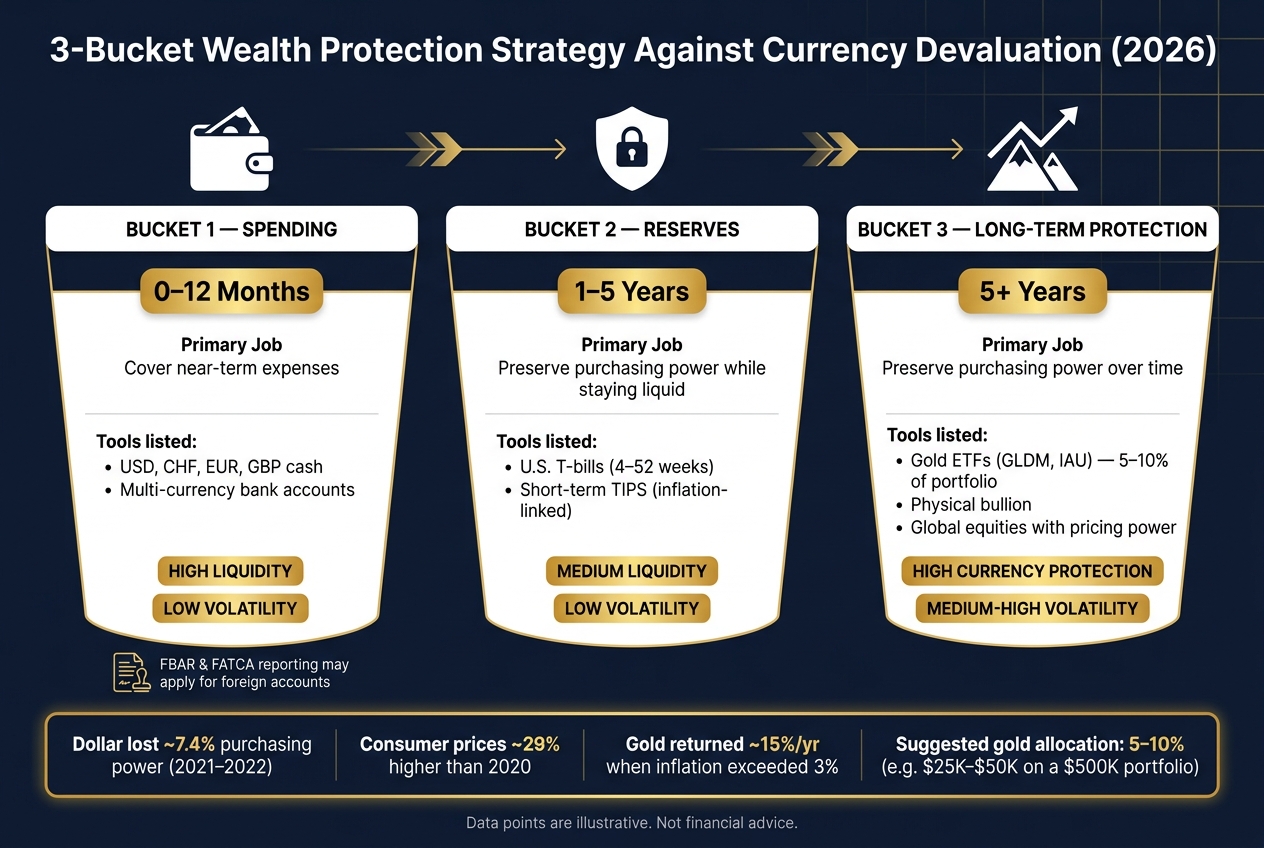
3-Bucket Wealth Protection Strategy: Tools, Time Horizons & Assets
Quick comparison
| Bucket | Main job | Common tools | Time frame |
|---|---|---|---|
| Spending | Cover bills and near-term needs | USD, CHF, EUR, GBP cash; multi-currency accounts | 0–12 months |
| Reserves | Hold purchasing power with access to funds | T-bills, short-term TIPS | 1–5 years |
| Long-term protection | Help protect buying power over time | Gold, global equities | 5+ years |
What I like about this approach is that it avoids the usual mistake: going all in on one “hedge.” The point is not to guess the next move in currencies. The point is to give each dollar a job, keep enough liquidity, and avoid having all of your wealth tied to one currency, one country, or one custody setup.
sbb-itb-39d39a6
Step 1: Map your currency exposure before moving any money
Before you move money, map where your purchasing power is exposed. If you skip this step, you can end up hedging the wrong risk.
List your assets, accounts, and income by currency and jurisdiction
Start by listing every account, asset, and income source. Then tag each one by currency and legal jurisdiction. Include checking accounts, brokerage accounts, rental income, business operating accounts, and any foreign holdings.
This simple exercise often shows how much of your financial life sits in one currency and one legal system.
That map also helps you sort money by function. Some funds need to stay easy to reach. Other funds can be positioned with more care.
Label each item as liquid, semi-liquid, or locked. That makes it clear what you can move fast and what you can’t.
Separate emergency reserves, operating cash, and long-term capital
Different cash needs call for different tools.
Keep emergency reserves and operating cash – rent, payroll, living costs, and near-term business expenses – liquid and stable. Volatile assets or funds that are hard to access are a poor fit for near-term cash needs.
Long-term capital can handle more complexity. That’s where international structures, hard assets, and inflation-resistant instruments tend to fit best – not to chase returns, but to protect real value across currencies and jurisdictions. Mixing short-term cash with long-term protection assets is a common and expensive mistake.
Once you’ve separated the short-term cash pool, the next move is to give each dollar a job.
Set a target allocation across protection buckets instead of going all in on one hedge
Once you know your exposure and time horizon, set target buckets instead of making one big bet on a single hedge. The main risk here is too much concentration in any one currency.
Use three buckets:
- Cash in strong currencies for near-term needs
- Reserve funds in stable instruments for medium-term protection
- Long-term protection assets to preserve purchasing power over time
Size each bucket based on your liquidity needs and risk tolerance.
| Bucket | Primary Function | Time Horizon |
|---|---|---|
| Cash in strong currencies | Cover near-term expenses in a stable currency | Near-term |
| Reserve funds | Protect medium-term savings from devaluation | Medium-term |
| Long-term protection assets | Preserve purchasing power and diversify currency exposure | Long-term |
Next, fill the liquid-protection bucket with stronger currencies and reserve instruments.
Step 2: Build liquid protection with hard currencies and reserve instruments
Once your exposure map is done, the next step is to protect the liquid layer – money you may need within the next 12 months. This bucket is about stability and access, not chasing return. That matters, because the layer after this uses a different set of tools for money you can leave alone longer.
Hold strong foreign currencies and multi-currency bank accounts for cash you may need soon
For cash you may need soon, stick to currencies tied to your spending or reserve needs, such as USD, CHF, EUR, or GBP. In plain English: use the currency you actually spend in, or a reserve currency you trust, for near-term cash.
If your income comes in one currency and your bills go out in another, convert only what you need on a set schedule.
A multi-currency account makes that much easier. These accounts let you hold, receive, and convert several currencies inside one account setup, often with local banking details attached. That means you can receive and keep foreign payments without getting forced into a bad conversion rate.
There’s a catch, though. Foreign currency balances move with exchange rates. If the U.S. dollar jumps, your EUR or CHF balance is worth less in USD terms when you convert it back. So keep these balances tied to your actual spending needs in those currencies – not as a bet on where exchange rates might go.
For U.S. residents, there’s also paperwork to think about. If you hold foreign accounts above certain thresholds, you may need to file an FBAR (FinCEN Form 114) and possibly Form 8938 under FATCA. Any interest earned, plus any FX gains, may also be taxable in the U.S. That reporting load is worth weighing before you open accounts abroad.
Add short-term sovereign bonds, T-bills, and inflation-linked government debt
Short-term Treasuries can add yield while keeping price risk low and liquidity high. Because the duration is short, price swings tend to stay limited, which makes T-bills a practical place to park reserves that still need to stay within reach. This is money for the reserve bucket – not cash you’ll need tomorrow morning.
You can buy T-bills directly through TreasuryDirect in amounts as low as $100, or through a regular brokerage account at auction or on the secondary market. Treasury money market funds usually offer same-day or next-day settlement. Treasuries held in a brokerage account can usually be sold within one to two business days, which is fast enough for near-term reserves.
TIPS add inflation protection. Their principal adjusts with inflation, which helps protect purchasing power over time. For this layer, short- to intermediate-duration TIPS usually make more sense. Longer-dated TIPS can still move around a lot when real yields change, and that works against the whole point of keeping this bucket liquid and steady. After that, the long-term bucket can move into harder assets.
Here’s a simple way to think about the liquid protection layer:
| Instrument | Primary Role | Liquidity | Key Tradeoff |
|---|---|---|---|
| Foreign currency cash (EUR, CHF) | Reduce single-currency concentration | High | FX rate moves against you |
| Multi-currency account | Manage cross-border income and spending | High | Compliance reporting (FBAR, FATCA) |
| U.S. T-bills (4–52 weeks) | Stable, liquid USD reserve with yield | High | Reinvestment risk when rates fall |
| Short-term TIPS | Protect real purchasing power from inflation | Moderate to high | Price volatility from real yield changes |
With liquid reserves in place, the long-term layer can shift into gold, hard assets, and select equities.
Step 3: Add hard assets and select equities to protect long-term purchasing power
Once your liquid reserves are in place, put the next layer into assets meant to hold real value over years, not months. That’s where gold, other hard assets, and inflation-resistant stocks come in. They support your cash and bonds. They don’t replace them.
Hold gold and other hard assets as a currency shock reserve
Gold is not a tool for tracking inflation month by month. It works better as monetary insurance when trust in a currency starts to slip. When inflation runs above 3%, gold has historically returned about 15% per year. Treat that as a data point, not a promise.
For most investors, a 5–10% allocation is a sensible range inside a long-term portfolio. On a $500,000 portfolio, that works out to about $25,000–$50,000. Low-cost ETFs such as GLDM or IAU make this simple to set up in a brokerage account, with tight spreads and no storage hassle. Physical bullion cuts out financial intermediary risk, but you pay for that with storage costs and less day-to-day liquidity.
Use companies with pricing power through internationally spread brokerage accounts
Look for companies with pricing power and revenue that comes from more than one currency. If the U.S. dollar or your home currency weakens, foreign-currency earnings can help soften the blow.
Then there’s the access issue. Picking the right business matters, but so does where and how you hold it. Spread brokerage custody across more than one well-regarded jurisdiction to lower single-system custody risk.
Comparison table: liquidity, currency protection, volatility, and cross-border complexity
| Asset | Liquidity | Currency Protection | Volatility | Cross-Border Complexity |
|---|---|---|---|---|
| Strong foreign currency cash (EUR, CHF) | High | High | Low | Low |
| Multi-currency bank accounts | High | High | Low | Medium |
| Short-term sovereign bonds | High | Medium | Low | Low |
| Short-term TIPS | Medium to high | High (vs. inflation) | Low to medium | Low |
| Gold (ETF: GLDM, IAU) | High | High | Medium to high | Low to medium |
| Gold (physical/vaulted) | Medium | High | Medium to high | High |
| Companies with pricing power (global) | High | Variable | High | Medium |
Use the table to match each asset with the role it should play in your portfolio.
Step 4: Put the plan together and review it in 2026
Assign each tool a specific job: spending, reserves, or long-term protection
The easiest way to pull this together is to split your holdings into three buckets. Each bucket should have one clear job.
| Bucket | Time Horizon | Tools | Primary Job |
|---|---|---|---|
| Spending | 0–12 months | Hard-currency cash, multi-currency accounts | Cover near-term expenses |
| Reserves | 1–5 years | T-bills, TIPS | Preserve purchasing power while staying liquid |
| Long-term protection | 5+ years | Gold, global equities | Preserve purchasing power over time |
Size each bucket around your own spending, reserve, and long-range needs.
The spending bucket is for liquid accounts you can use for day-to-day costs. The reserve bucket can hold short-term T-bills and TIPS sized around core expenses. The long-term bucket can hold gold and globally diversified equity funds through accounts in more than one jurisdiction.
That one-job-per-tool mindset matters. It helps you avoid a common problem: treating every asset like a hedge and turning the whole plan into a bet.
Once those buckets are in place, the next step is deciding where to hold each one.
Use cross-border account structure where it supports flexibility and risk separation
After you assign the buckets, split them by custody and jurisdiction. Where an asset sits can matter almost as much as the asset itself.
Use domestic accounts for local cash flow. Use foreign accounts for reserve or investment assets when separate jurisdictional exposure helps, such as in Switzerland, Singapore, or a stable EU jurisdiction.
Try not to pile too much exposure into any one country or currency. If you have a business or major assets across multiple countries, talk with a tax and legal professional before setting up offshore entities or accounts. That’s especially important for U.S. reporting rules such as FBAR and FATCA.
Conclusion: Protect wealth by spreading currency exposure, custody, and liquidity
Start by mapping your currency exposure. Then keep liquid funds in hard currencies and short-term reserve tools, add gold and select equities for longer-range purchasing power, and place each bucket in the account type and jurisdiction that fit its job best.
The point is simple: protection comes from spreading exposure across asset classes, currencies, and custody locations. Review the structure once a year and after any major move, sale, or tax change.
FAQs
How much should I keep in each bucket?
It comes down to your goals, how much you spend, and how much risk you can live with.
A simple way to think about it: keep 70%–80% in stable currencies, 20%–30% in emerging-market currencies, and hold another 5%–10% as a buffer for volatility.
Your time horizon matters too. For short-term needs, keep 3–6 months of must-pay expenses in cash you can access without hassle. For medium-term money, line it up with upcoming bills or other known liabilities. For long-term assets, spread them across stable reserve currencies and growth assets that can hold up better during inflation.
One more practical move: use a natural hedge by matching the currencies of your assets to the currencies of your future expenses.
Which currencies make sense for U.S. investors?
For U.S. investors, a balanced approach is to spread money across a few major stable currencies, then keep a smaller slice in emerging market currencies.
A common mix looks like this:
- 70%–80% in CHF, EUR, GBP, and JPY
- 20%–30% in CAD, AUD, SGD, NOK, and NZD
It also helps to line up your currency holdings with future spending plans. If you expect to pay for retirement or education abroad, holding part of your money in those currencies can make things simpler later.
Multi-currency accounts may help cut conversion costs, which can add up faster than many people expect. And if you’re a U.S. citizen with offshore accounts, you still need to follow FBAR and FATCA reporting rules.
What tax filings apply to foreign accounts?
U.S. citizens may need to report foreign financial accounts to avoid penalties.
The main filing is the FBAR (FinCEN Form 114). You generally need to file it if the total value of all foreign accounts goes over $10,000 at any point during the calendar year. That threshold applies to the combined total, not each account by itself.
You may also need IRS Form 8938 under FATCA if your foreign financial assets pass the filing threshold. For example, that can mean $50,000 for single filers or $100,000 for joint filers, depending on your filing status and situation.
Other forms may come into play too. Form 3520 or Form 5471, for instance, can apply based on how the assets are set up and held.