
Here’s the short answer: a golden visa gives you residency, not a passport, in exchange for an investment. And in 2026, the main routes still open are Portugal, Greece, Italy, Malta, the UAE, Singapore, and the U.S. EB-5. Spain is closed to new applicants.
If I were narrowing the list fast, I’d sort it like this:
- Want EU residence with a path to citizenship? Look at Portugal
- Want Schengen access at a lower entry point in some cases? Look at Greece
- Want more than one investment route? Look at Italy
- Want Malta residence or a separate citizenship route under heavy review? Look at Malta
- Want a tax-friendly base? Look at the UAE
- Want permanent residence through business investment? Look at Singapore
- Want a U.S. green card? Look at EB-5
A few points matter right away:
- Portugal: from €500,000
- Greece: from €250,000 to €800,000, based on area and project type
- Italy: from €250,000
- Malta: from €600,000+ plus property
- UAE: from about $545,000
- Singapore: from about $1.8 million
- EB-5: $800,000 to $1.05 million
And one more thing: 2026 is tighter than 2024. Prices are up in some places, property routes are under more pressure, and KYC checks now mean more documents and longer wait times.
Quick Comparison
| Program | Starting Point | Main Outcome | Good Fit For |
|---|---|---|---|
| Portugal | €500,000 | EU residence | Low-stay EU path |
| Greece | €250,000 to €800,000 | EU residence | Schengen access |
| Italy | €250,000 | EU residence | Business and startup investors |
| Malta | €600,000+ | Residence, with a separate citizenship route | High-vetting EU route |
| UAE | About $545,000 | 10-year renewable residence | Tax planning |
| Singapore | About $1.8 million | Permanent residence | Active business owners |
| U.S. EB-5 | $800,000 to $1.05 million | U.S. green card | U.S. residence |
If you’re comparing programs, I’d keep one rule in mind: don’t pick by price alone. Stay rules, family rules, due diligence, and the end goal matter more than the headline number.
sbb-itb-39d39a6
What a golden visa is and what it is not
A golden visa is residency tied to a qualifying investment. You place capital into an approved option, like a regulated fund, a business, or a government-approved project. In return, you receive legal residence in that country.
That residence is usually renewable, not permanent on day one. And it does not give you citizenship.
In Europe, that residence may also come with Schengen access: 90 days of visa-free travel within any 180-day period across member states. That’s the line that matters most here: a golden visa gives you residence, not nationality.
Golden visa vs. citizenship by investment
These two paths can look close at first glance. They are not the same.
A golden visa gives you residency first. Citizenship may come later, but only after years of keeping that residency and meeting naturalization rules. A citizenship-by-investment (CBI) program works differently. It skips the long wait and grants nationality and a passport directly, often within 12 to 36 months.
| Feature | Golden Visa (Residency) | Citizenship by Investment |
|---|---|---|
| Primary outcome | Legal residence permit | Nationality and passport |
| Timeline to passport | 5 to 10 years of residency | Direct or fast-tracked, usually within 12 to 36 months |
| Physical presence | Often minimal | Often none required, except Malta |
| Investment structure | Funds, real estate, or business capital | Government donations, bonds, or real estate |
| Family inclusion | Yes, typically includes dependents | Yes, typically includes dependents |
So the main point is simple: a golden visa is a residence route, not a direct passport route.
Golden visa vs. standard immigration
Standard immigration is usually built for people who plan to move full-time. That can mean coming through work, family, study, or retirement. In most cases, you need to spend a lot of time in the country each year to keep your status.
Golden visas turn that setup on its head.
Portugal is a good example. It requires only 7 days of physical presence per year to keep residency active. For many investors, that kind of flexibility is the whole draw. You don’t need a local paycheck. You don’t need a local job. And you don’t need to rely on a local sponsor.
| Feature | Golden Visa | Standard Immigration |
|---|---|---|
| Qualification basis | Capital investment | Employment, family ties, or enrollment |
| Flexibility | High; no full-time relocation required | Low; usually requires full-time relocation |
| Local income | Not required; must be self-sufficient | Often tied to local salary or sponsorship |
| Processing speed | Fast-tracked in most programs | Subject to standard quotas and wait times |
With that groundwork in place, the next step is figuring out which golden visa programs are still open in 2026.
Which golden visa programs are still open in 2026
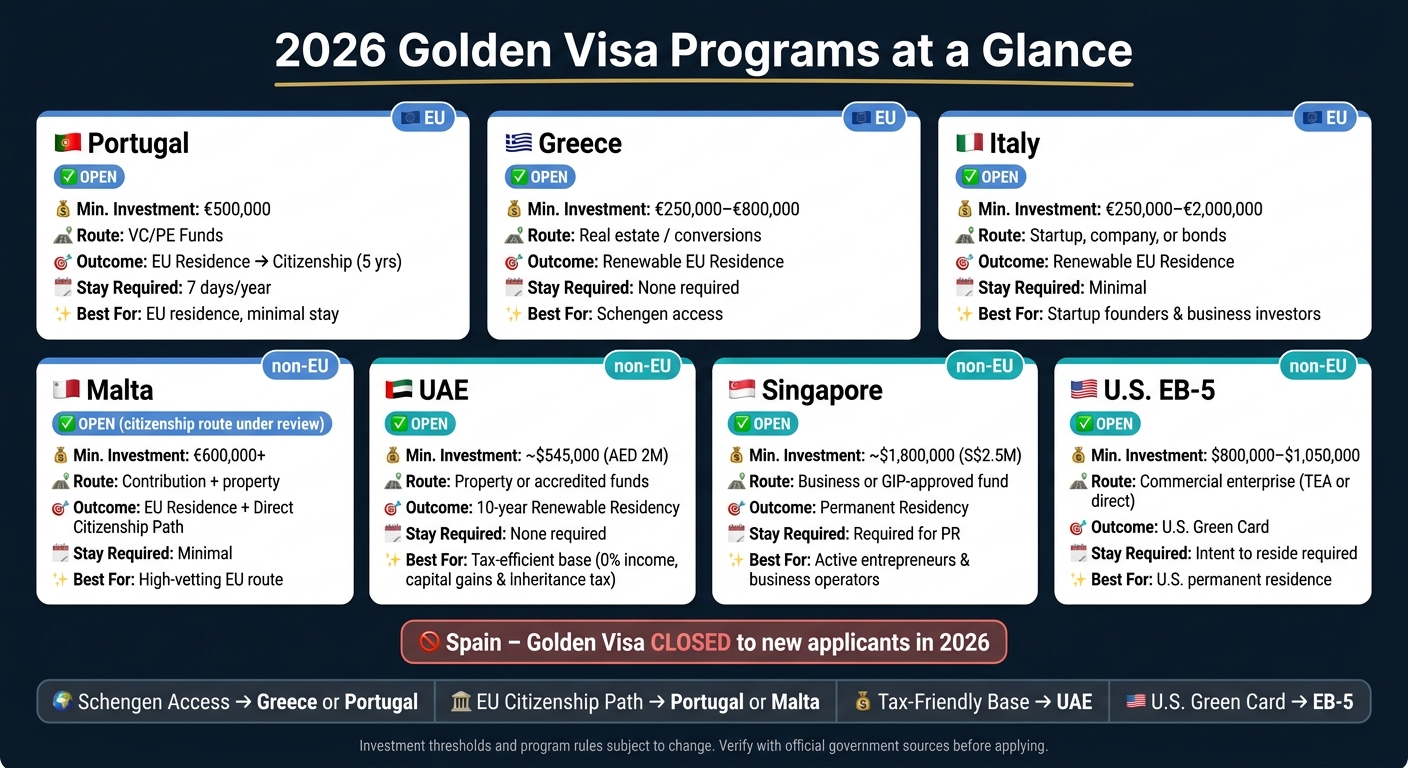
2026 Golden Visa Programs Compared: Cost, Outcome & Best Fit
In 2026, these are the main residency-by-investment routes that are still open. For most investors, the big question is pretty simple: which option fits the goal best? Some want EU residence. Others want a tax-friendly base. And some are focused on a U.S. green card.
Important: Residency-by-investment policies change quickly. Always verify current requirements directly with official government sources before filing any application.
Open European options: Portugal, Greece, Italy, and Malta
These programs are the main picks for investors who want EU residence and Schengen access.
Portugal is still open through fund investments starting at €500,000, which appeals to people who want an EU route without the hassle of managing property.
Greece now uses tiered pricing. The minimum is €800,000 in Athens and the islands, while certain industrial-to-residential conversion projects can still qualify at €250,000.
Italy gives investors a few different ways in. The minimum is €250,000 for innovative startups, €500,000 for investment in an Italian limited company, or €2 million in government bonds. (For those seeking a lower-cost entry, the Italy digital nomad visa is an alternative for remote workers.)
Malta starts at €600,000 or more, plus a property lease or purchase. It also offers a direct-to-citizenship path, though that route is still under regulatory review.
Open non-European options: UAE, Singapore, and the U.S. EB-5 route
Outside Europe, the strongest open routes serve very different goals.
The UAE Golden Visa requires at least AED 2 million – about $545,000 – in property or accredited funds. It grants 10-year renewable residency and comes with no personal income tax, no capital gains tax, and no inheritance tax. For investors who care more about tax treatment than EU access, this is often the clear fit.
Singapore’s Global Investor Programme (GIP) requires S$2.5 million, or about $1.8 million, placed into a new business, a business expansion, or a GIP-approved fund. This route is built for active business investors, not passive buyers.
The U.S. EB-5 program is aimed at investors who want a path to a U.S. green card. The minimum is $800,000 in a Targeted Employment Area (TEA), or $1.05 million for a direct commercial enterprise investment.
| Program | 2026 Minimum Investment | Primary Route | Best For |
|---|---|---|---|
| Portugal | €500,000 | VC/PE Funds | EU residence |
| Greece | €250,000 to €800,000 | Real estate / conversions | Schengen access |
| Italy | €250,000 to €2 million | Startup, company, or bonds | EU residence |
| Malta | €600,000+ | Contribution + property | EU residence, direct-to-citizenship path |
| UAE | ~$545,000 | Property or funds | Tax efficiency |
| Singapore | ~$1.8 million | Business or GIP fund | Business hub, permanent residence |
| U.S. EB-5 | $800,000 to $1.05 million | Commercial enterprise | U.S. green card |
Programs closed or heavily restricted: Spain and real estate route limits
The programs that are now closed or restricted say a lot about where things are going.
Spain’s golden visa is closed to new applicants in 2026. More broadly, property-based residency routes face more pressure across Europe. The EU is moving away from investment-for-residence models tied to passive real estate, and due diligence rules have tightened in 2026 as well.
How the main 2026 options compare
Now that the open programs are clear, the next step is simple: pick based on the outcome you want.
That matters more than the lowest buy-in. One program may help with Schengen travel. Another may fit a tax-efficient base. Another may point toward permanent residence or a U.S. green card. Same broad category, very different end goals.
| Program | End Result | Physical Presence | Family Included | Best For |
|---|---|---|---|---|
| Portugal | EU residence and a citizenship path after 5 years | 7 days/year | Spouse and dependents | EU residence with minimal stay |
| Greece | Renewable EU residence | None required | Spouse and dependents | Low-cost Schengen access |
| Italy | Renewable EU residence | Minimal | Spouse and dependents | Startup founders and business investors |
| Malta | Permanent residence; separate citizenship route | Minimal | Spouse and dependents | High-vetting route to EU residence |
| UAE | 10-year renewable residency | None required | Spouse and dependents | Tax-efficient base |
| Singapore | Permanent residency | Required for PR | Varies by route | Established entrepreneurs |
| U.S. EB-5 | U.S. green card | Required (intent to reside) | Spouse and children under 21 | U.S. permanent residence path |
Portugal, Greece, Italy, and Malta: best for EU residence
If your target is EU residence, these four sit in the same lane, but they don’t work the same way.
Portugal stands out because the stay requirement is low: 7 days per year. That helps investors stay on track for citizenship after 5 years. The fund route also gives a cleaner exit, since the fund can be liquidated after the five-year hold period. The trade-off in 2026 is timing. Processing has slowed, and due-diligence timelines are longer because of stricter KYC checks.
Greece works well for people focused on Schengen access, but the pricing now depends heavily on location. In 2026, the €250,000 option applies only to strategic industrial-to-residential conversions in certain zones. Prime areas, including Athens and the islands, are now at €800,000. So the headline number can be misleading if you’re set on a top market.
Italy gives investors the broadest menu of choices here. You can invest through a startup stake, a limited company, or government bonds. That makes it a good fit for startup founders and business investors who want more than a one-track structure.
Malta sits in a class of its own in this group. It’s the only EU program here with a separate direct citizenship path, but it also comes with the toughest due diligence and vetting. For some investors, that’s a feature, not a drawback.
UAE, Singapore, and U.S. EB-5: best for business hubs, permanent residence, or a U.S. green card
These three are best viewed as different tools for different jobs.
The UAE is built for investors who want a regional tax-efficient base. Its 10-year Golden Visa is renewable and doesn’t require a minimum physical presence, which makes it a practical setup for people who move around often. If flexibility is the main goal, this one is hard to ignore.
Singapore is a different animal. The Global Investor Programme is aimed at active business operators, not passive investors, and it requires a three-year entrepreneurial track record. The capital can go into a new business, a business expansion, or a GIP-approved fund. So this route tends to suit operators who are already running something substantial.
U.S. EB-5 is the only option on this list that leads to a U.S. green card. Applicants must show intent to reside in the United States. If the main goal is U.S. permanent residence, this is the clearest match in the group. That point alone does a lot of the sorting when you’re deciding what fits your residence, travel, and wealth plan.
How to choose the right golden visa and what to do next
Choose based on your actual goal, not just the lowest entry price
Once you’ve mapped the open programs, the next step is simple: pick the route that lines up with what you want in practice, not just the one with the lowest starting number.
A good way to narrow the list is by outcome:
- Schengen access: Greece
- EU citizenship path: Portugal
- Tax-friendly base: UAE
- U.S. permanent residence: EB-5
That matters because the cheapest option on paper isn’t always the best deal. A low minimum can come with a higher threshold in the location you want, a longer hold period, or a slower approval process.
Before you file anything, do an independent source-of-wealth review. Clean, well-documented files tend to move through vetting with less friction. And use counsel that represents only you through each step.
Final takeaway: the best 2026 golden visa fits your residence and wealth plan
The right route is the one that matches your residence, tax, and family goals.
Several strong options are still open in 2026, but the market is more selective than it was two years ago. The programs that are still available often come with higher thresholds and tighter documentation standards. And this choice doesn’t sit in a vacuum. Your visa route can shape tax residency, entity structure, and asset protection planning.
So start with your residence plan first. Then check the rules before you apply.
Use the summary below to match each program with the result you want.
| Goal | Best Fit | Key Reason |
|---|---|---|
| Schengen mobility | Greece, Portugal, Malta | Unrestricted EU/Schengen access |
| Future EU citizenship | Portugal, Malta | Portugal: 5-year path with a 7-day-per-year stay rule; Malta: direct EU path |
| Tax-friendly base | UAE | 0% personal income tax, 0% capital gains tax, and 0% inheritance tax |
| U.S. permanent residence | U.S. EB-5 | Only route to a U.S. green card |
| Business hub access | UAE, Singapore, U.S. | Tax neutrality and major market access |
FAQs
How long do I need to keep the investment?
You’ll usually need to keep the investment in place for as long as you want to keep your residency status. In many programs, that same investment also matters when you renew your permit or later apply for citizenship.
Some programs require you to hold the asset for at least five years. The exact rule depends on the country and the type of investment, so it’s smart to check your program’s terms closely. That helps you stay compliant and avoid putting your status at risk.
Can my parents or adult children be included?
Rules for adult children vary by country, and in most cases, they’re pretty strict. Most Golden Visa programs treat eligible children as dependents, usually up to age 21.
Some programs also let you include a spouse and dependent parents. But once children are no longer considered dependents, they usually don’t qualify. That’s why it’s smart to check the exact age limits and dependency rules for the country you’re looking at.
Does a golden visa make me a tax resident?
Not automatically. A golden visa can change your tax obligations based on how much time you spend in the country and that country’s tax rules.
Some countries offer tax incentives for new residents. Others may treat you as a tax resident once you hit a minimum stay threshold.
If you’re a U.S. citizen or green card holder, there’s another layer to think about: you still owe U.S. tax on your worldwide income, even if you live abroad.