
My short answer: yes for residency, maybe no for the passport. If I want EU residency with low stay rules, Portugal can still work. But if my main goal is citizenship fast, the deal looks much less attractive now.
Here’s the article in plain English:
- I now need to think about $555,000+ (€500,000) in a qualifying fund, not property
- I can keep the visa with just 7 days a year in Portugal
- I still get Schengen travel and can add close family
- The passport path may be closer to 8 to 10 years in practice, even if the legal track starts at 5 years
- Greece fits people who want property and no stay rule
- Malta fits people who want permanent residence up front
- Italy fits people who care more about living there than getting a passport soon
If I strip it down to one line, it’s this: Portugal still makes sense if I want a low-presence EU backup plan and I’m fine locking up money for years. It makes less sense if I want my passport soon or I want direct property ownership.
Quick Comparison
| Option | Main Cost | Asset Type | Stay Rule | Citizenship Angle | Best Fit |
|---|---|---|---|---|---|
| Portugal | €500,000 | Regulated fund | 7 days/year | Possible without moving full-time, but slow in practice | Low-presence EU residency + passport plan |
| Greece | €250,000 to €800,000 | Property | None | Hard without living there full-time | Property-focused residency |
| Malta | €600,000+ | Contribution + property | None for PR | Separate route, faster but costly | Permanent residence now |
| Italy | €250,000 to €2 million | Startup, bonds, other routes | None for visa | About 10 years for naturalization | Lifestyle move, not passport-first |
So if I’m judging Portugal today, I wouldn’t ask, “Is the golden visa dead?” I’d ask: “Are the residency perks worth the cost and the long wait?” That’s the whole decision.
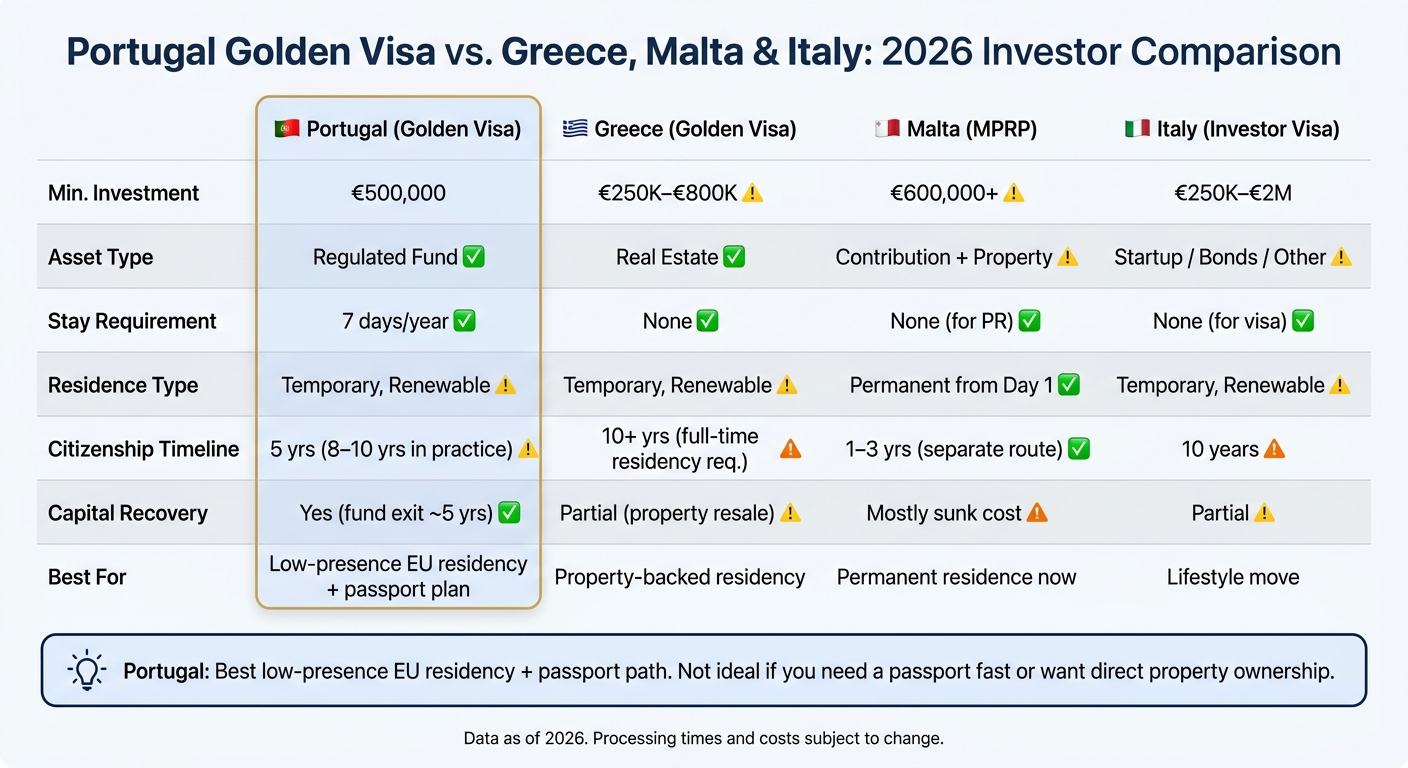
Portugal Golden Visa vs. Greece, Malta & Italy: 2026 Comparison
Portugal’s Golden Visa today: benefits, costs, and the 10-year citizenship reality
Portugal still offers real residency perks. But the program looks different now, and the main issue is pretty simple: do those perks make sense if citizenship may take much longer than 5 years in practice? That’s the lens that matters most.
What investors still get: residency, Schengen access, family inclusion, and low stay requirements
The visa still gives investors Portuguese residency, access across the Schengen Area, and coverage for family members, with a stay requirement of just 7 days per year in Portugal. That’s a light-touch setup, which is a big deal for people who want mobility without having to move full-time.
For many families, that’s the main draw. You keep a legal foothold in Portugal, you get travel flexibility across Schengen, and you can include family under the same route. If your top goal is freedom of movement and optionality for your household, those points still carry weight.
There can also be tax upside for nonresidents. Under the IFICI regime, eligible Portuguese income may be taxed at a 20% flat rate for up to 10 years, and Portugal does not impose inheritance tax between direct family members.
What changed: no real estate route, a longer citizenship wait, and processing-time risk
The program no longer includes the real estate option. Today, it is centered on investment funds, which changes both the profile of the investor and the type of capital commitment involved.
As of 2026, the main eligible routes are:
- A €500,000 investment in a CMVM-regulated Venture Capital or Private Equity fund
- A €250,000 cultural donation
That shift matters. In the past, many applicants were drawn to Portugal because they could pair residency goals with a property purchase. Now, the program is much more of a financial allocation decision.
The other big change is timing. While eligibility can begin at 5 years, backlogs and processing delays may push the practical passport timeline closer to 10 years. On paper, 5 years sounds one way. In day-to-day planning, the wait can look very different.
Cost structure and opportunity cost for U.S.-based investors
For U.S.-based investors, the main cost is not hard to spot: you may need to tie up €500,000 in a fund while residency starts right away, but citizenship may take far longer to arrive.
That creates a plain trade-off. You get residency benefits from day one, but the passport outcome may sit much farther out than many people first expect. For some investors, that’s fine. For others, that gap between residency now and citizenship later is the whole story.
sbb-itb-39d39a6
Portugal vs. Greece: fund-based residency vs. real-estate-driven residency
Portugal is the fund-based, citizenship-oriented route. Greece is the real-estate, residency-first route.
So the core trade-off is pretty simple: citizenship options vs. property exposure.
Investment structure, stay rules, and processing differences
Here’s where the two programs split in day-to-day terms:
| Feature | Portugal Golden Visa | Greece Golden Visa |
|---|---|---|
| Minimum Investment | €500,000 in qualifying funds | €250,000 (Approved Conversion Projects) / €800,000 (Prime) |
| Eligible Asset Type | CMVM-regulated VC/PE Funds | Real Estate |
| Minimum Stay | 7 days per year | None |
| Path to Citizenship | Realistic with low stay | Requires full-time residence |
| Processing Time | Slower | Variable |
| Opportunity Cost | Fund management fees | Property taxes, maintenance, notary fees |
Greece’s zero-day stay rule makes residency easier to keep. But there’s a catch: citizenship is much harder to reach unless the investor actually lives there full time.
Portugal asks for at least some physical presence, but the path to citizenship is more workable for people who don’t plan to move right away. At the same time, enhanced due diligence has slowed approvals in both programs.
Who fits Portugal better and who fits Greece better
Portugal leans toward passport planning. Greece leans toward property ownership.
If your goal is an EU passport without relocating, Portugal is the clearer pick. If citizenship matters less and you want direct exposure to real estate, Greece starts to look more appealing.
Put another way, Greece works well if you want:
- tangible property
- Schengen access
- no stay requirement
For U.S. investors, the split is pretty clear. Portugal is the better low-presence citizenship path. Greece is the better property-backed residency play.
That trade-off shifts again when Portugal is stacked up against Malta and Italy.
Portugal vs. Malta and Italy: residence certainty vs. capital recovery vs. passport potential
Malta and Italy shift the trade-off in very different ways. If you line them up against Portugal, three things stand out fast: how secure the residence status feels, how much money you can get back, and how long the passport path takes. Portugal’s fund route sits in a very different spot from both.
Portugal vs. Malta: temporary residence vs. permanent residence structure
Malta’s main draw is simple: you get permanent residence from day one. For some investors, that matters more than whether the money comes back later. Portugal works differently. Its €500,000 fund route is tied to an investment that can usually be exited after 5+ years, while Malta asks for a €600,000+ government contribution plus a property lease or purchase, and most of that spend is not recoverable.
| Feature | Portugal Golden Visa | Malta (MPRP) |
|---|---|---|
| Program Type | Temporary Renewable Residence | Permanent Residence; separate citizenship route |
| Capital Outlay | €500,000 (Fund) | €600,000+ (Contribution + Property) |
| Cost Nature | Recoverable (Investment) | Mostly Sunk (Contribution/Fees) |
| Physical Stay | 7 days per year | No stay required for PR |
| Family Inclusion | Spouse, children, and parents | Spouse, children, and parents |
| Citizenship Timeline | 5 years, plus 12–18 months processing | 1 to 3 years (Direct path) |
In plain English, Malta tends to suit people who want permanence up front and are comfortable treating much of the cost as the price of entry. Portugal tends to suit people who care more about keeping their capital in an asset they may recover later, while also keeping the annual stay burden light.
Portugal vs. Italy: passport timeline vs. lifestyle priorities
Italy changes the picture again. While the Italy digital nomad visa serves remote workers, the investor visa offers more entry points, from €250,000 for startups to €2 million in government bonds. On paper, that range can look attractive. But the passport path is much slower. Italy generally requires 10 years of residency before naturalization, while Portugal keeps the path at 5 years.
| Feature | Portugal (Fund Route) | Italy (Investor Visa) |
|---|---|---|
| Min. Investment | €500,000 in regulated funds | €250,000 (Startup) to €2M (Bonds) |
| Stay Requirement | 7 days per year | None for the visa itself |
| Citizenship Wait | 5 years | 10 years |
| Investor Profile | Seekers of EU passport flexibility | Lifestyle investors not prioritizing a passport |
That difference shapes the buyer profile. Portugal makes more sense for investors who want a low-touch EU residence route with capital tied to an investment rather than a pure fee. Italy, by contrast, often appeals more to people who care about living in Italy, spending time there, or building a life around that choice, without putting passport timing at the top of the list.
That leaves one final question: which investor profile still justifies Portugal under the new timeline?
Verdict: when Portugal’s Golden Visa still makes sense, and when it does not
After comparing Portugal with Greece, Malta, and Italy, the main issue is pretty simple: does flexibility matter more to you than speed or direct property ownership?
Investor profiles that still fit the program under the new rules
Portugal’s Golden Visa still works well for investors who want EU residency without moving there full time. The 7-day-per-year stay rule makes that workable in day-to-day life. A U.S.-based entrepreneur, for example, can keep residency with one short trip each year and remain under Portugal’s 183-day tax residency threshold.
It also makes sense for families thinking across generations. Portugal’s favorable family transfer treatment and the lack of a general wealth tax give it extra appeal for households focused on passing assets to the next generation.
The program is also a solid match for investors who are comfortable with a fund-based setup. The €500,000 fund route offers a cleaner 5-year exit than property-based routes and suits people who want residency rights without owning property directly.
In plain English, eligibility is only part of the story. Investment structure, family goals, and exit timing matter just as much.
That said, the same flexibility can turn into a downside when the main goal is getting a passport fast.
Signs that Portugal may not be the right choice
Portugal is a weak fit when speed matters most. The passport path can stretch toward 10 years, and processing in 2026 still brings delays. If you have little patience for waiting, or you need your money back soon, the mix of capital lockup and slow processing is likely a poor match for your plans.
For cross-border tax and asset-protection planning, it helps to see Portugal as one part of a bigger setup, not the full answer. If passport timing is the deciding factor, Portugal is no longer the easy choice.
FAQs
Can I still buy property through Portugal’s golden visa?
No. You can no longer buy residential real estate to qualify for Portugal’s Golden Visa, as the government removed that route.
Instead, current options include:
- A €500,000 investment in government-regulated venture capital or private equity funds
- A €250,000 donation that supports cultural heritage, research, or artistic production
How long will my money likely be tied up?
With the Portugal Golden Visa, you’ll usually need to keep your capital in place until you can apply for citizenship, which is five years. On top of that, the first stage of processing often takes around 12 to 24 months before your residency is officially approved.
So in plain English, your money is often tied up for about six to seven years from the day you start the application. If you’re weighing your options, fund-based investments can also give you a clearer path to exit than real estate.
Who benefits most from Portugal’s Golden Visa now?
Portugal’s Golden Visa is a strong fit for investors who want a steady long-term route to EU access without needing to spend much time in the country. It’s especially well suited to high-net-worth individuals from places like the U.S. or U.K. who want a secure, professionally managed Plan B residency and can meet the 7-day annual stay rule.
It also continues to appeal to investors focused on tax planning, including those who may qualify for the IFICI regime. For families, Portugal stands out as a stable jurisdiction with no wealth tax and no inheritance tax on transfers between direct relatives.