
If you want the short answer: Latvia is the cheapest entry point in Europe in 2026 at about €60,000 before legal and advisory fees. After that, Greece, Hungary, and Portugal start at €250,000, while Malta starts near €100,000 in direct contributions but costs more once property, due diligence, and legal fees are added.
Here’s how I’d frame it if you want the fast take:
- Cheapest overall entry: Latvia at about €60,000
- Cheapest property route: Greece at €250,000
- Lowest route to long-term permanent status: Malta
- Best path if you want citizenship later: Portugal
- Main catch across all five: fees, hold periods, and slower 2026 processing can change the total by a lot
The big point is simple: the lowest advertised number is not always the lowest total cost. You need to look at fees, how long your money is tied up, stay rules, and whether the route leads only to residence or also to citizenship.
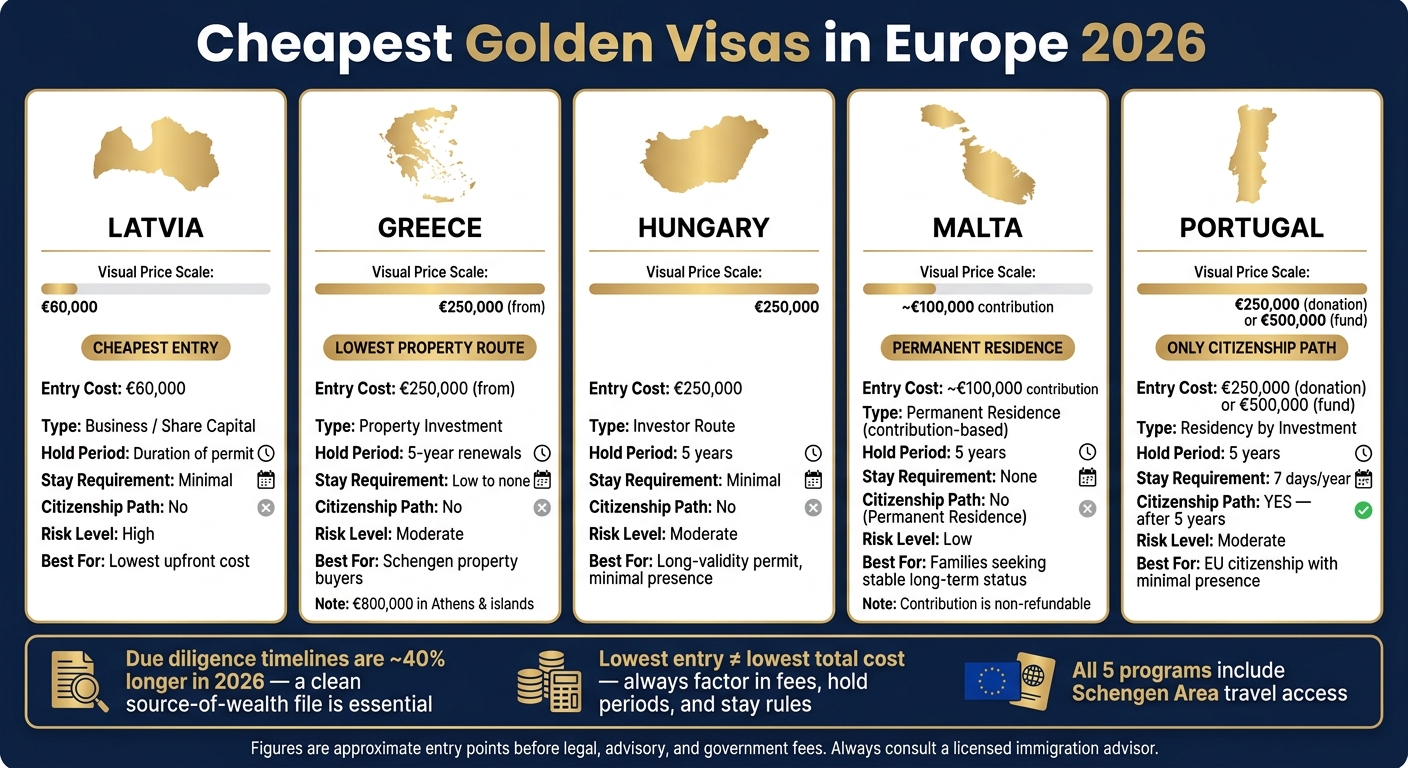
Cheapest Golden Visas in Europe 2026: Cost, Stay Rules & Citizenship Path
Quick Comparison
| Program | Entry Point | Main Type | Hold Period | Stay Rule | Main End Goal |
|---|---|---|---|---|---|
| Latvia | €60,000 | Business/share capital | Keep investment during permit period | Low | Low-cost residency |
| Greece | €250,000 | Property | 5-year renewals tied to holding asset | Low to none | Schengen access |
| Hungary | €250,000 | Investor route | 5 years | Low | Residence with low presence |
| Malta | ~€100,000 contribution + other costs | Permanent residence route | 5 years for property/commitments | None | Permanent residence |
| Portugal | €250,000 donation or €500,000 fund | Residency by investment | 5 years | 7 days/year | Citizenship path |
So if you’re comparing these options, I’d keep one question front and center: Are you buying the lowest upfront price, the lowest total cost, or the best long-term outcome?
sbb-itb-39d39a6
1. Latvia Residency by Investment (Business/Share-Capital Route)
Latvia sets the floor on price, so the main question is simple: how little can you invest and still get usable residency rights?
At about €60,000 before professional fees, Latvia’s business/share-capital route is the lowest-cost entry point in Europe in 2026. Investors need to keep the qualifying investment in place for the full residency period to keep the permit valid. The stay rules are light, which sounds good at first. But there’s a trade-off: the permit gives you less day-one flexibility if your goal is to relocate right away.
So yes, Latvia is the cheapest way in. But it fits a pretty specific buyer – someone focused more on keeping upfront cost down than on moving quickly with fewer limits. That’s why Latvia sits at the bottom of the price ladder, while Greece becomes the next point of comparison once you look at total cost and what the residency is actually worth in day-to-day use.
2. Greece Golden Visa
After Latvia, Greece is the next cheapest path for buyers who want Schengen access through property. It sits in a middle ground: the headline buy-in can look low, but taxes and closing costs push the total up.
Entry cost and added fees
The minimum investment depends on what you buy and where it is. The lowest threshold is €250,000 ($278,000) for strategic industrial-to-residential conversions, while properties in Athens and the Greek islands now start at €800,000 ($890,000).
And that sticker price isn’t the whole bill. You also need to budget for property taxes, notary fees, legal fees, and maintenance. So while Greece costs more upfront than Latvia, it still comes in far below Portugal’s fund route and below Greece’s own top property tiers.
Required holding period
The residency permit can be renewed every five years as long as you keep the investment in place. In plain English, this is not a quick in-and-out deal. Holding costs and maintenance stay with you for years, which means the day-one purchase price is only one part of the total spend.
Physical stay rules
Greece asks for little to no physical presence to keep or renew the permit.
Residency value
The permit gives you Schengen travel rights. It can also cover close family members, including spouses, dependent children, and parents. That’s a big part of the draw for many buyers.
The trade-off is simple: the Golden Visa does not give you a direct path to Greek citizenship.
"Greece is the ‘Deep Value’ play of 2026. For HNWIs from Australia or North America, it serves as a permanent insurance policy against future Western travel restrictions." – Iqbal Hossain, Founder and Lead Strategist, Global Investment Reviews
Processing usually takes 3 to 12 months, and stricter KYC checks have stretched reviews in 2026.
Hungary is next if you want a different low-cost route with fewer property requirements.
3. Hungary Guest Investor Program
Hungary’s Guest Investor Program is an investor route to Hungarian residence. The big things to look at are the entry cost and the five-year hold. That puts Hungary above Latvia on price, but it still sits in the lower-cost group.
Minimum all-in cost
The program starts at €250,000, plus application, legal, and filing fees. So the headline number is one part of the picture. You also need to weigh that starting amount against the required five-year lockup.
Required holding period
Your capital must remain committed for five years. In plain English, this is a medium-term commitment, not a fast in-and-out option.
Physical stay rules
Hungary does not require major physical presence to keep the permit valid. That can matter a lot if you want residence rights without spending much time in the country.
Residency rights and limits
A Hungarian residence permit gives access to the Schengen Area, which means holders can travel across member states with ease. But there’s an important limit: it does not offer a direct path to citizenship.
Malta then shows how much the cost jumps when the route moves from residency to permanent residence.
4. Malta Permanent Residence Programme
Malta’s Permanent Residence Programme (MPRP) gives applicants permanent residence through a contribution-based route. In plain English, this isn’t a recoverable investment. You’re paying for the path to status, not placing money into an asset you can later sell.
Minimum contribution
The minimum contribution is €100,000. That total includes a €98,000 government contribution plus a €2,000 NGO donation, before legal, due diligence, and property-related costs.
One thing matters here: this contribution is non-refundable. So Malta stands apart from other lower-cost routes. The appeal isn’t just the lower starting figure. It’s the mix of permanent status, Schengen access, and a process built around meeting the rules.
Required holding period
Applicants should plan to keep the qualifying property and meet the required commitments for an initial 5-year period.
Physical stay rules
Malta has no minimum stay requirement.
Long-term residence value
Malta offers permanent residence and Schengen access, but processing is slower in 2026 because due diligence is stricter.
Portugal is the next comparison point for buyers weighing a higher entry price against a more familiar investment structure.
5. Portugal Golden Visa
Portugal costs more than the lower-entry options above, but it stands out for one big reason: citizenship access with very light stay rules. The program offers a 5-year path to Portuguese citizenship, and you only need to spend 7 days per year in Portugal to keep the residence permit active.
It’s not the cheapest way in. But among the programs in this group, Portugal offers the strongest long-term mobility outcome.
Minimum all-in cost
The lowest qualifying investment is €250,000 through the cultural donation route. That said, the more common path is a €500,000 investment in qualifying CMVM-approved venture capital or private equity funds.
On top of the base investment, applicants should also budget for:
- Government application and renewal fees
- Legal fees
- Notary fees
- Taxes
As of 2026, the main routes are cultural donations and fund investments.
Required holding period
Minimum hold: 5 years.
Physical stay rules
Portugal requires just 7 days per year in the country to maintain the residence permit and remain on the citizenship track.
Long-term residence value
After 5 years, applicants can apply for Portuguese citizenship, and then gain EU mobility rights. In 2026, processing times are estimated at 12 to 18 months.
The fund route is usually easier to exit after the 5-year hold. That’s a big reason Portugal appeals to buyers who are fine with a higher entry cost in exchange for a path to citizenship. For families that want flexibility without moving full-time, Portugal remains a strong long-term option.
That makes Portugal the best fit for buyers who care more about eventual citizenship than the lowest upfront cost.
Cost, Risk, and Lifestyle: How Each Program Compares
Now that each route is clear, the next step is simpler: figure out which mix of cost, risk, and mobility lines up with your plan.
Price matters, but it doesn’t tell the whole story. Latvia has the lowest entry cost, but it also comes with more business and compliance risk. So yes, it’s the cheapest way in, but the trade-off is weaker flexibility. Greece fits buyers who want a property-based route, and the investment tiers can change a lot depending on the location. Hungary tends to suit investors who want a long-validity residence permit without much physical presence. Its overall cost and day-to-day usability put it in a practical middle spot. Malta is the most heavily vetted option in this group, and its permanent residence status gives it long-term use that can help balance out the non-refundable contribution. Portugal isn’t the cheapest starting point, but its limited-stay structure and 5-year citizenship path make it the strongest long-term mobility play of the five.
All five give you Schengen mobility, so the biggest differences come down to cost, stay rules, and long-term goals.
There’s another point that matters more than many applicants expect. Across all five programs, due diligence timelines have extended by 40% in 2026 because of enhanced KYC forensics. In plain terms, a clean and well-documented source of wealth matters just as much as the amount you invest.
Here’s the side-by-side view:
| Program | Risk Level | Stay Requirement | Best Suited For |
|---|---|---|---|
| Latvia | High | Minimal | Lowest upfront cost, business-oriented investors |
| Greece | Moderate | Low | Real estate buyers seeking Schengen access |
| Hungary | Moderate | Minimal | Long-validity residence permit, minimal presence |
| Malta | Low | None | Structured permanent residence for families |
| Portugal | Moderate | 7 days/year | Eventual EU citizenship, limited-stay access |
Malta can also extend eligibility to parents in some cases, which makes it a strong fit for families thinking beyond just spouses and children. And Portugal’s low stay rule gives families room to keep their current base while still moving along the citizenship track.
Next, the pros and cons show which trade-offs matter most for each route.
Pros and Cons of Each Program
The main comparison isn’t just the sticker price. What matters more is how much money you can get back, how much is simply spent, and what kind of status you end up with.
| Program | Pros | Cons | Best For | Main Cost Caveat |
|---|---|---|---|---|
| Latvia | Lowest entry point in Europe at €60,000 | High non-refundable government fee compared with the entry amount | Buyers focused on keeping upfront cost as low as possible | Capital is tied to the qualifying business/share-capital investment |
| Greece | Lowest-entry property route in the EU at €250,000; Schengen access | No citizenship path; €800,000 threshold applies in Athens and the islands | Buyers seeking lower-cost Schengen access | The €250,000 level is limited to specific strategic conversions |
| Hungary | Schengen access; minimal physical presence required | Five-year capital lockup; no direct citizenship path | Investors who want long-validity residence without frequent travel to Hungary | €250,000 committed for five years |
| Malta | Permanent residence status; no minimum stay requirement | Most of the cost is non-refundable | Families seeking stable long-term status | A status purchase rather than an investment play |
| Portugal | The only passport path in this group with minimal presence; 7 days per year | Capital locked in qualifying funds for five years | Investors focused on eventual EU citizenship | €500,000 minimum locked into qualifying funds |
So the last piece is pretty simple: which option is cheapest in practice once you count fees, lockup periods, and the kind of residence rights you get?
That choice comes down to what matters most to you: the lowest entry cost, money you may recover later, or a route that can lead to citizenship.
Conclusion
In 2026, Latvia’s business/share-capital route is the cheapest way into European residency, with a starting investment of about €60,000 before legal and advisory fees. In this comparison, it has the lowest entry cost.
That said, the cheapest way in isn’t always the cheapest option once you add fees and account for how long your money stays tied up. Greece is the lowest-cost property route at €250,000 for qualifying industrial-to-residential conversions, with Schengen access included. Malta’s Permanent Residence Programme ends up costing more once fees and property-related expenses are added. Portugal keeps two main options on the table: a €250,000 cultural donation route and a €500,000 fund route, while still offering a five-year path to citizenship with only 7 days of stay per year.
The right fit depends on your budget, how long you’re willing to keep capital committed, your family setup, and what you’re aiming for in the long run. If your main goal is the lowest-cost Schengen access, Latvia comes out first. If you want the lowest-cost property route, Greece is the pick. In plain English, it’s a trade-off between a low entry cost, travel access, and long-term status.
If citizenship with very little physical presence is the goal, Portugal is the only route here with a direct citizenship path.
Due diligence timelines are about 40% longer in 2026, so a clean source-of-wealth file matters.
FAQs
What is the real all-in cost beyond the minimum investment?
The real all-in cost goes well beyond the minimum investment. In most cases, you’re not just paying the headline amount. You may also need to cover government fees, legal fees, due diligence and admin charges, family member fees, and renewal costs.
If real estate is part of the route, the bill can climb even more. Add transfer taxes, notary fees, and maintenance costs on top of the property purchase.
Some options also come with costs that don’t stop after approval. For example, Latvia’s route includes a €10,000 state fee and minimum annual tax contributions from the invested company.
Which option is best if I want citizenship later?
If citizenship is your main goal, Portugal stands out as the strongest option in Europe. Its Golden Visa gives you a clear path to EU citizenship after five years of residency, and the stay requirement is light: just seven days per year.
If you want a faster route without a residency period first, Malta offers a direct path. But there’s a catch: the price starts at €600,000+, so the cost is much higher.
Can I include my spouse, children, or parents?
Yes. Most European golden visa programs let you include your spouse and dependent children in the application.
Some programs cast a wider net. Greece, for example, also allows children up to age 21 and both sets of parents.
Adding family members usually comes with extra government processing and due diligence fees. The fine print can change from one country to another, especially around age limits for children and whether parents qualify, so it’s smart to check the rules for your chosen program.