
If I travel to most of Europe on a visa-free passport, I now need ETIAS before I board. That means an online approval, a €7 fee (about $7.50 USD at recent exchange rates), and the same 90 days in any 180-day period limit as before.
Here’s the short version:
- ETIAS is not a visa
- It applies to visa-free non-EU travelers, like many U.S., U.K., and Canadian passport holders
- It covers 30 European countries
- Airlines and ferry companies check it before boarding
- Most approvals are expected within minutes, but some cases can take up to 96 hours or, in some cases, up to 30 days
- One approval can last up to 3 years, or until the passport expires
What changes for me in 2026-2027 is simple: I can’t treat Europe travel as “just bring my passport” anymore. I need to apply ahead of time, make sure my passport details match exactly, and watch my total days in Europe so I don’t go over the 90/180 rule.
Quick comparison
| Topic | Before ETIAS | With ETIAS |
|---|---|---|
| What I need to board | Passport | Passport + approved ETIAS |
| When I handle it | At trip booking, mainly passport checks | Before travel, online |
| Cost | $0 ETIAS cost | €7 |
| Validity | Passport rules only | Up to 3 years or passport expiry |
| Time limit in Europe | 90/180 rule | Same 90/180 rule |
| Border entry guarantee | No | No |
The main point: ETIAS adds a pre-trip approval step, not more travel days and not visa rights. If I plan ahead, it should be a small admin task. If I forget it, my trip can stop at check-in.
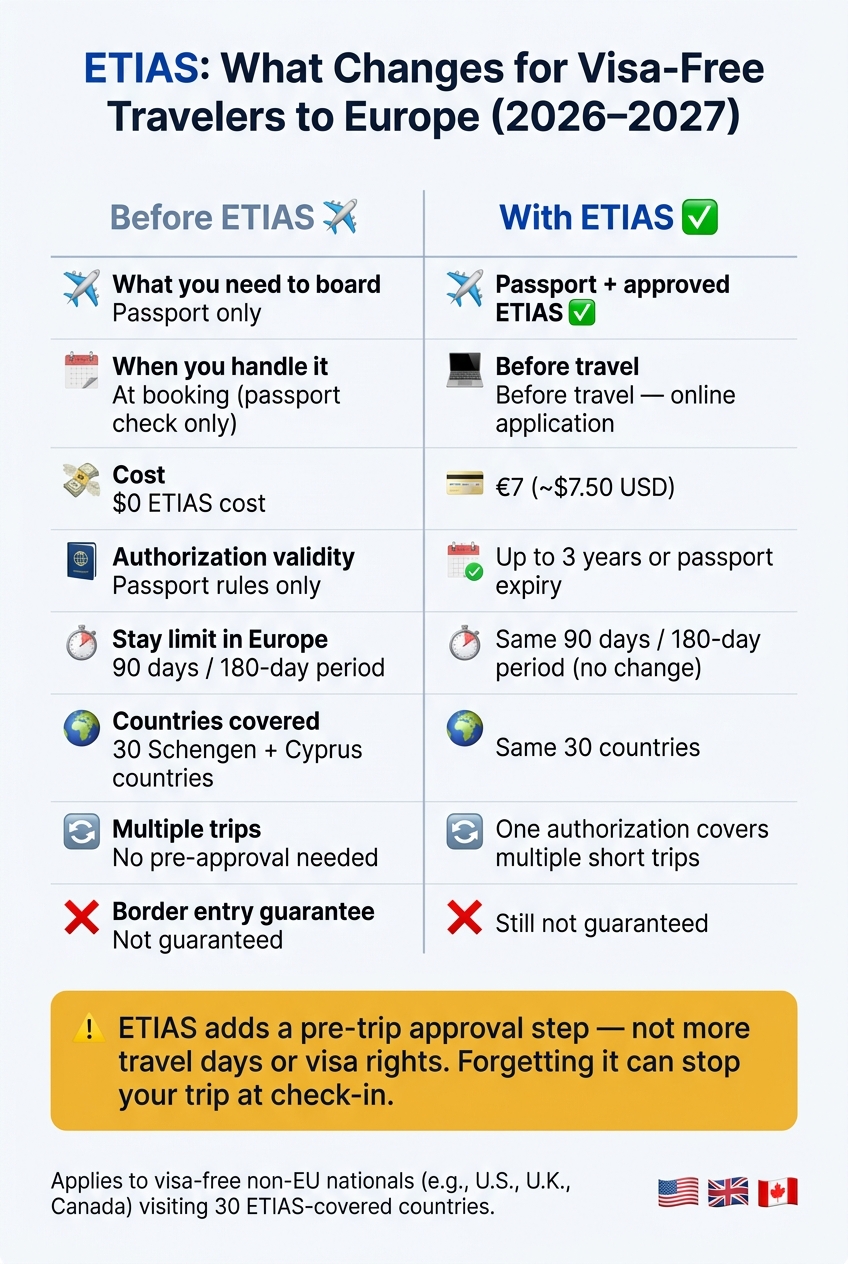
ETIAS vs. No ETIAS: What Changes for Visa-Free Travelers in 2026-2027
What ETIAS is, when it starts, and where it applies
ETIAS is the EU’s pre-travel screening step for visa-free visitors. It does not change your visa-free status. It simply adds a screening step before you depart.
That’s an important distinction. You still follow the same 90/180-day limit as before. ETIAS doesn’t give you extra time in Europe, and it doesn’t turn visa-free travel into a visa process. It just adds an approval step ahead of travel.
Why does that matter? Because one valid authorization can cover several countries on the same trip. So if you’re visiting places like Spain, France, Germany, and Italy in one go, you won’t need a separate ETIAS approval for each stop.
The launch timeline travelers need to watch in 2026-2027
The timing matters because booking travel before approval is in place can lead to boarding issues. The EU’s Entry/Exit System (EES), which sets up the biometric base for ETIAS, became fully operational on April 10, 2026.
That said, this timeline has changed before. So before you book flights or lock in plans, check the latest official EU updates directly. A small date shift can turn into a big airport headache.
The 30 European countries covered by ETIAS
ETIAS applies across 30 countries, including the Schengen Area and Cyprus. For many travelers, that’s the big takeaway: one approval can work across a large part of Europe.
If your ETIAS authorization is valid, you can use it for multiple short trips across all 30 countries. Your passport still needs to stay valid, and you still need to remain within the 90 days in any 180-day period rule.
| ETIAS at a Glance | Details |
|---|---|
| Type | Pre-travel authorization (not a visa) |
| Applies to | Visa-exempt non-EU nationals (e.g., U.S., U.K., Canadian passport holders) |
| Countries covered | 30 (Schengen Area + Cyprus) |
| Stay limit | 90 days within any 180-day period |
| Trips allowed | Multiple entries with one valid authorization |
sbb-itb-39d39a6
Who needs ETIAS and who does not
Now that the coverage area is settled, the next step is simple: who actually has to get ETIAS?
ETIAS applies to visa-free non-EU travelers visiting ETIAS-covered countries for short stays. That includes citizens of more than 60 visa-free countries, such as the United States, United Kingdom, and Canada. If you already need a Schengen visa, ETIAS does not apply to you.
When U.S., U.K., and Canadian passport holders need ETIAS
For most short-term travelers, the rule is pretty straightforward.
If you’re a visa-free traveler entering an ETIAS-covered country for a short stay, you need ETIAS before you travel. So a U.S. tourist, a U.K. business traveler, and a Canadian visiting family all fall into that group.
There’s also a practical side to this. Airlines and ferry operators must check that visa-free travelers have a valid ETIAS before boarding. No valid ETIAS can mean no boarding.
Who is exempt from ETIAS or follows different rules
The exceptions are just as important.
EU, EEA, and Swiss citizens are exempt. They can keep traveling with their national passports or identity cards, just as they do now.
Two other groups often trip people up. First, non-EU travelers with a valid residence permit or long-stay visa issued by an ETIAS country do not need ETIAS. For example, a U.S. citizen living in Spain with a valid residence permit can move within ETIAS-covered countries without filing a separate ETIAS application.
Second, certain non-EU family members of EU citizens with valid residence cards are also exempt.
One part is worth stating plainly: ETIAS is not a substitute for a Schengen visa. If your nationality requires a visa, you apply for a visa. ETIAS is only for travelers who are already visa-free.
Comparison table: who needs ETIAS vs. who is exempt
| Traveler Profile | Nationality or Status | ETIAS Required | Visa Required | Key Note |
|---|---|---|---|---|
| U.S. Tourist | United States | Yes | No | Required for vacation or short stays up to 90 days within any 180-day period |
| U.K. Business Traveler | United Kingdom | Yes | No | Needed for meetings or conferences in ETIAS-covered countries |
| Canadian Family Visitor | Canada | Yes | No | Necessary for visiting relatives in Europe |
| EU Dual National | EU Member State + Non-EU | No | No | Enter using the EU passport to remain exempt |
| Non-EU Residence Permit Holder | Non-EU (e.g., U.S. expat in Spain) | No | No | Valid residence permit or long-stay visa from an ETIAS country exempts the traveler |
| Visa-required nationality | e.g., India, China | No | Yes | Must obtain a standard Schengen visa; ETIAS does not apply |
How the ETIAS application process works
If ETIAS applies to your passport, the next step is a fast online application. You’ll apply online using your passport, identity, and trip details, then pay the €7 fee and wait for a decision.
Application steps, fee, and how long approval takes
You’ll need to enter your passport details, identity information, and trip details. Most applications are approved within minutes, but some are flagged for manual review, which can make the wait longer.
How long ETIAS is valid and how multiple trips work
An approved ETIAS is valid for up to three years or until your passport expires, whichever comes first. It also covers multiple short trips during that period, as long as each stay follows the 90/180-day rule. In plain English, one authorization can cover several short visits instead of forcing you to apply each time.
Comparison table: trip planning before ETIAS vs. with ETIAS
| Trip-Planning Step | Before ETIAS | With ETIAS |
|---|---|---|
| What you need | Valid passport only | Valid passport plus approved ETIAS |
| Approval lead time | None required | Usually minutes, but manual review can take longer |
| Frequent-traveler benefit | None | One authorization, multiple short trips |
Even simple applications can get delayed if your details don’t match exactly or if there’s an issue with your passport.
Problems ETIAS can cause and how to avoid them
ETIAS is a compliance step, and mistakes here can slow down approval, stop you from boarding, or lead to trouble at the border. That matters even more if you travel to Europe often. If you’re moving in and out of ETIAS countries on a regular basis, this adds one more thing that can throw off your plans if you overlook it.
Common reasons for delays, refusals, or border problems
Most ETIAS issues come down to a few common problems.
Data mismatches are one of the biggest ones. A typo in your name, the wrong date of birth, or an incorrect passport number can push your application into manual review instead of instant approval. Passport issues can cause even bigger trouble. If your passport is expired, damaged, lost, or stolen, your application can be refused outright.
Past overstays or deportations can also lead to extra review. And if ETIAS asks you for more documents, you need to respond within 10 days or the application is refused.
One thing many travelers miss: ETIAS approval does not guarantee entry. Border officers can still deny entry if your passport is damaged, if you can’t show proof of funds or accommodation, or if your stated reason for travel doesn’t match your short-stay status. So don’t rely only on your authorization number. Bring your supporting documents with you.
Trip-planning examples for tourists, business travelers, digital nomads, and frequent visitors
Different travel habits bring different ETIAS risks.
Repeated short trips still count toward the same rolling 90/180-day limit across all ETIAS countries. That means a U.S. investor flying in for frequent brief visits, or a Canadian or U.K. passport holder mixing vacations with business travel, runs into the same problem: days add up across countries and trip types until the limit is hit, and the next trip has to wait.
Digital nomads face a different issue. ETIAS works only for short stays under 90 days. If you plan to stay longer or use Europe as a base for an extended stretch, you’ll need a national visa or residence permit instead.
How to prepare for ETIAS before your next trip to Europe
Before you book, check three things: your passport validity, your travel dates, and the documents you may need at the border.
Apply before you pay for nonrefundable travel. Some applications go into manual review, which can take up to 96 hours for an initial response and up to 30 days if an interview is required. If you book too early, you’re taking a direct financial risk.
If your passport is close to expiring, renew it before you apply. ETIAS is tied to that specific travel document, so getting a new passport means getting a new authorization too.
It also helps to track your Schengen days with a calculator before every trip. If you keep getting close to the 90-day cap, that’s a sign your travel pattern may fit a visa or residence route better.
FAQs
When should I apply for ETIAS before my trip?
Apply for your ETIAS well before your trip. Carriers must check your authorization before boarding, so if you don’t have it, you could be denied travel.
Processing times aren’t specified, so it’s smart to apply as soon as your travel plans are set. That gives you extra time in case there are administrative delays.
Do I need a new ETIAS if I renew my passport?
Yes. If you renew your passport, you must apply for a new ETIAS.
Your ETIAS is electronically linked to the exact passport you used in your application. Once that passport expires or gets replaced, the authorization stops being valid. That means you’ll need to submit a new application with your new passport details before you travel to the Schengen Area.
Does ETIAS let me stay in Europe longer than 90 days?
No. ETIAS is only a pre-travel authorization for short-term visits. It is not a visa or a residency permit.
Under Schengen rules, non-EU citizens are usually limited to 90 days within any 180-day period.
If you want to stay longer than 90 days, you’ll need to apply for a long-stay visa or a residency permit, such as a digital nomad visa.