
Form 5471 is a mandatory IRS filing for U.S. taxpayers with ownership or control in certain foreign corporations. It’s not about taxes owed but rather providing detailed information about foreign business interests. Missing or incorrect filings can result in penalties starting at $10,000 per form, per year. Here’s what you need to know:
- Who Must File: U.S. persons owning 10% or more of a foreign corporation.
- Why It Matters: Penalties for late or incomplete filings are steep, and errors can reduce foreign tax credits.
- Key Documents Required:
- Company Info: Formation documents, bylaws, shareholder details.
- Financial Records: Income statements, balance sheets, foreign tax returns.
- Ownership/Transaction Records: Stock transactions, related-party dealings.
- Schedules to Prepare:
- Schedule A: Stock ownership details.
- Schedule C: Income statement (including currency conversions).
- Schedule E: Taxes paid or accrued.
Staying organized year-round is critical. Use digital tools for recordkeeping, track ownership changes, and document exchange rates. For complex cases, consulting a tax professional can save time and help ensure compliance.
Required Documents for Form 5471 Filing
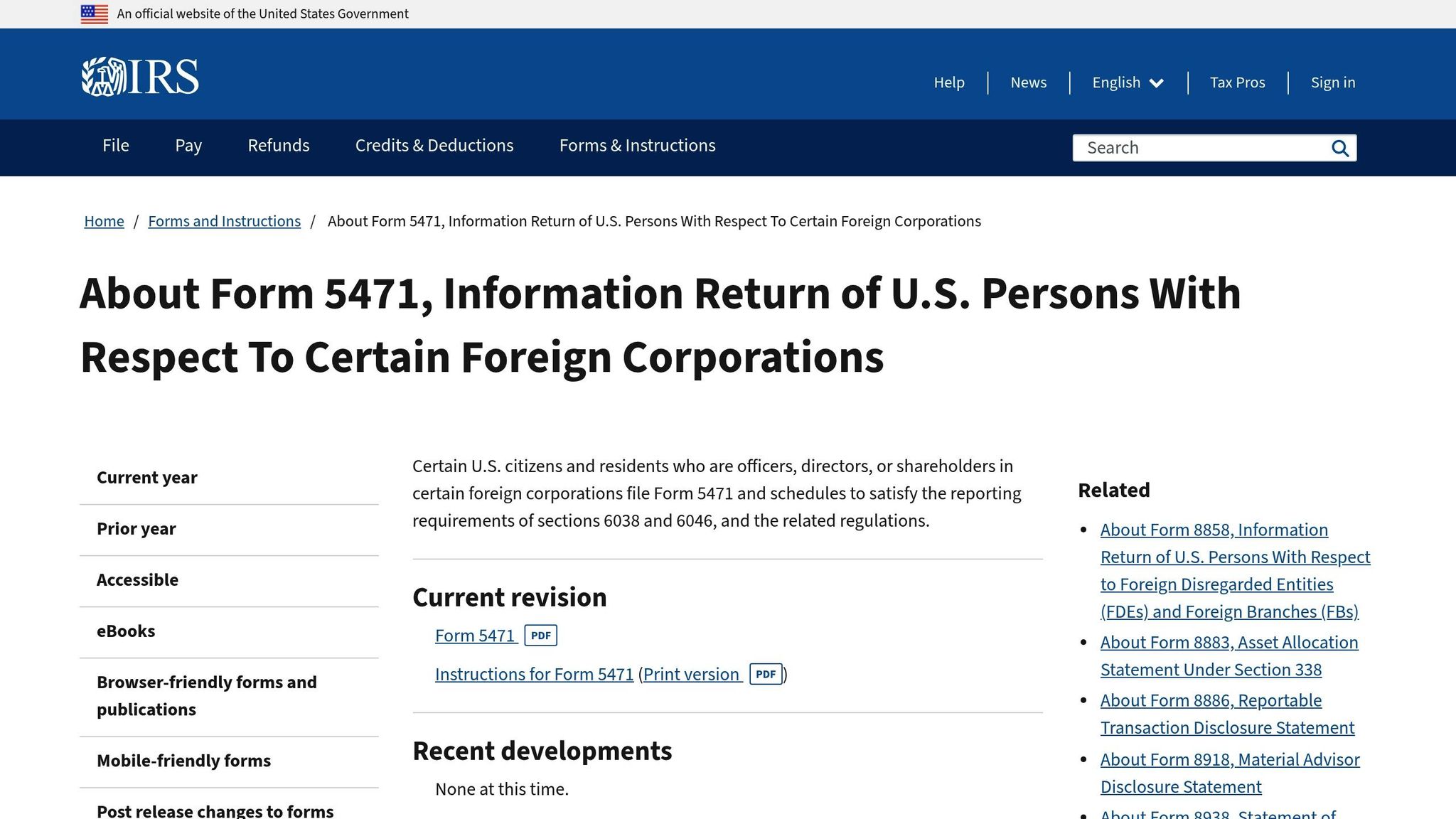
Filing Form 5471 requires gathering specific records across three key areas. Having the right documentation ensures you can accurately complete the required schedules and meet reporting obligations.
Company Information and Organizational Documents
Start by collecting your corporation’s formation documents, such as articles of incorporation. These confirm the legal existence of your entity and provide critical details like the company’s official name, registration date, and authorized share capital.
You’ll also need corporate bylaws or operating agreements. These outline governance policies, voting rights, and the management structure. Additionally, maintain a record of shareholder information, including names, addresses, and ownership percentages.
Financial Statements and Tax Records
Accurate financial records are the backbone of Form 5471. Begin with audited financial statements, as they serve as the basis for most schedules within the form.
- The income statement (or profit and loss statement) should include all revenue, expenses, and net income for the tax year. This supports the figures reported on Schedule C of Form 5471.
- A balance sheet showing year-end assets, liabilities, and equity is also essential. This helps the IRS assess your corporation’s financial standing and cross-checks other reported data.
Additionally, keep copies of foreign tax returns and payment receipts, which are necessary for completing Schedule E.
Shareholder and Transaction Records
Maintain detailed records of stock transactions, including purchases, sales, transfers, or gifts. Update ownership records with dates and the parties involved in each transaction.
For related-party transactions, document the nature of the transaction, amounts involved, and the business purpose. These records are crucial for completing Schedule M, which focuses on transactions between the corporation and its shareholders or other related entities.
Form 5471 Schedules and Supporting Documents
Let’s dive into the specific schedules required for Form 5471 and the supporting documents you’ll need to keep things in order. Each schedule has its own set of documentation requirements, and having these records ready can help you avoid compliance headaches.
Schedule A: Stock Ownership
Schedule A focuses on stock ownership details and requires thorough shareholder documentation. You’ll need to gather current ownership records that list each U.S. shareholder’s name, address, and exact ownership percentage in the foreign corporation.
If there were any ownership changes during the tax year, make sure to document them. This includes noting transaction dates and identifying the involved parties, as the IRS uses this data to monitor shifts in voting power and corporate control.
Stock certificates or electronic ownership records should clearly specify the number of shares, class of stock, and any associated voting rights. If your corporation has multiple share classes, include details about the rights and restrictions tied to each class.
Schedule C: Income Statement
Schedule C serves as a version of a U.S. corporate income statement but tailored for international tax rules. The key document you’ll need is an audited financial statement prepared under U.S. Generally Accepted Accounting Principles (GAAP).
The income statement should show figures in both the functional currency and U.S. dollars. It’s also essential to keep records of exchange rates, including their source and date, to substantiate foreign income figures. Accurate currency conversion is critical for correctly reporting foreign income.
For Subpart F income calculations, ensure you have documentation for passive income, related-party transactions, and any income subject to Controlled Foreign Corporation rules. Supporting materials like invoices, contracts, and transaction records can validate the revenue and expense numbers reported on Schedule C. Note that Schedule E, which we’ll discuss next, has its own set of documentation needs.
Schedule E: Taxes Paid or Accrued
Schedule E covers income taxes, war profits taxes, and excess profits taxes paid or accrued by the foreign corporation. To back up the amounts reported, retain documentation that shows precise currency conversion records.
You’ll also need to document the conversion methodology and the exchange rates applied to each tax amount. Since all foreign tax figures must be converted to U.S. dollars using the correct rates, these records are crucial for ensuring accuracy.
Documentation Management Tips
Managing documentation effectively is key to staying prepared for all Form 5471 filing requirements. A well-organized system not only simplifies the process but also helps reduce stress when tax season rolls around. Since Form 5471 requires extensive documentation, having a clear and structured approach can make all the difference.
Organizing and Storing Records
The foundation of efficient recordkeeping lies in selecting a system that works best for your business. According to the IRS, your recordkeeping system should clearly show your income and expenses. This is especially important for Form 5471 filers, as tracking international transactions can be intricate.
Digital organization is a practical choice for managing international documentation. The IRS accepts electronic records, allowing you to digitize financial and tax documents by scanning them or opting for a paperless workflow from the beginning. Cloud-based accounting software can be a game-changer, as it categorizes transactions and retains audit trails for easy reference.
For physical storage, it’s wise to back up digital records at an off-site location to ensure dual protection. This way, both digital threats and physical disasters are accounted for.
Retention periods depend on your specific tax situation. Here’s a quick breakdown:
- General records: Keep for three years.
- Income threshold issues: Retain for six years.
- Claims related to worthless securities or bad debt: Hold onto these for seven years.
- Non-filing or fraudulent returns: Keep records indefinitely.
By following these methods, you can create a solid organizational framework that minimizes common documentation errors.
Common Documentation Mistakes
Errors in Form 5471 documentation can lead to hefty penalties, with the IRS imposing a minimum $10,000 fine for failure to file. Avoiding common mistakes is critical to staying compliant.
One frequent issue is currency translation errors. Filers often use inconsistent exchange rates or fail to document the methodology behind their currency translations. Stick to IRS-approved exchange rates and document how you applied them to each transaction.
Another common pitfall is incomplete ownership tracking. Missing indirect or constructive ownership changes can result in incorrect classifications. To avoid this, keep cap tables updated and use real-time systems to track stock transfers and ownership changes. Regularly review your corporate structure, especially if it’s complex.
Omitting related party transactions is another area of concern. Instead of scrambling to reconstruct these transactions during filing season, track them throughout the year. Keep intercompany agreements current and document any changes in business relationships.
Inconsistent reporting year-over-year can also draw IRS attention. Before filing, compare your current forms with previous years and provide clear explanations for any significant changes. Detailed records of earnings and profits are essential, as these figures often build on prior data.
Getting Professional Help
If documentation feels overwhelming, seeking professional assistance can be a smart move. Form 5471 is complex, and even experienced filers often benefit from expert guidance.
When to seek help depends on your situation. If you’re managing multiple foreign entities, dealing with large intercompany transactions, or handling complex calculations like GILTI, consulting a tax professional is highly recommended. Experts in international tax can simplify the process and help you navigate the intricacies of Form 5471.
Costs for professional assistance vary. Simple filings with minimal transactions typically range from $1,500 to $2,500. Cases involving multiple shareholders or controlled foreign corporations may cost between $2,500 and $3,000. For highly complex filings requiring multiple schedules, GILTI calculations, and detailed transaction analysis, fees can exceed $5,000.
Choosing the right professional is crucial. Look for tax experts with experience in international startup taxation and foreign corporation reporting. Firms like Global Wealth Protection specialize in helping entrepreneurs and investors optimize taxes while ensuring compliance with international regulations. Their expertise can streamline your Form 5471 process, saving time and reducing stress.
Working with a skilled professional ensures your financial records stay organized year-round, eliminating the last-minute scramble to compile required documentation.
sbb-itb-39d39a6
Conclusion
Keeping accurate documentation is the backbone of staying compliant with Form 5471 requirements. With penalties increasing significantly, the price of neglecting proper records far outweighs the effort of maintaining them.
Failing to file Form 5471 can lead to serious, long-term consequences. For example, you could lose access to foreign tax credits, and your entire tax return may remain open to scrutiny indefinitely. These risks highlight why maintaining detailed and accurate records is crucial to safeguarding your financial well-being.
The best way to avoid these issues is by putting solid systems in place. Start by identifying your filing category, keeping thorough stock records, and monitoring ownership changes as they happen. Consistent currency translation, precise earnings and profits calculations, and detailed records of related party transactions are all critical steps for ensuring compliance. Following the checklist provided earlier can help streamline the process and reduce unnecessary stress during the tax year.
Remember, Form 5471 must be filed even for inactive entities. Many people mistakenly assume that dormant corporations don’t require reporting, but overlooking this obligation can lead to hefty penalties that are entirely avoidable.
The IRS estimates that completing Form 5471 takes over 30 hours. Investing in strong documentation practices and seeking professional advice isn’t just helpful – it’s essential. International tax compliance is complex and demands far more attention than basic bookkeeping can provide.
FAQs
What happens if I don’t file Form 5471 on time or make mistakes in the filing?
Failing to file Form 5471 on time – or submitting incorrect details – can lead to serious financial consequences. The IRS imposes a $10,000 penalty per tax year for each instance of non-compliance. If the issue isn’t addressed, additional penalties may be added each month, potentially climbing to $60,000 per return.
But it’s not just about the fines. Late or inaccurate filings can draw extra attention from the IRS, increasing the chances of audits and creating further headaches. To steer clear of these problems, double-check that your Form 5471 is complete, accurate, and submitted by the deadline.
How can digital tools help ensure accurate and efficient Form 5471 recordkeeping?
Digital tools are essential for keeping Form 5471 records accurate and organized. They take care of tasks like collecting, organizing, and storing data, which reduces the chance of human error and ensures all necessary information is properly documented.
Cloud-based systems, such as secure document management platforms, let you store and access records from anywhere, making the process more flexible. Meanwhile, specialized tax software simplifies data entry and supports electronic filing, helping you save time and lower the risk of compliance issues.
When should a U.S. taxpayer hire a professional to file Form 5471, and what factors affect the cost?
U.S. taxpayers should hire a professional for Form 5471 filing when they own 10% or more of a foreign corporation, have complex ownership structures, or face potential penalties of $10,000-$60,000 for non-compliance. Professional fees typically range from $2,500-$15,000 depending on factors including the number of foreign entities, complexity of transactions, required schedules (A through O), and whether catch-up filings are needed. The cost is justified considering that DIY mistakes can trigger severe IRS penalties, and professionals ensure proper compliance with controlled foreign corporation (CFC) rules and Subpart F income calculations.
Why Consider Professional Help for Form 5471?
Filing Form 5471 can feel overwhelming, especially if you’re unsure about your obligations or find the process too complicated. Mistakes or late submissions can lead to hefty penalties, so many U.S. taxpayers turn to professionals for assistance. Plus, completing this form isn’t quick – it often takes more than 30 hours. This makes hiring a professional not just helpful but a time-saver.
How Much Does It Cost?
The cost of professional services for Form 5471 varies depending on several factors, such as:
- The complexity of your foreign holdings
- The number of foreign entities involved
- The specific filing category you fall under
- Whether extra forms or bookkeeping adjustments are needed
Typically, fees start at $2,500 for basic preparation and increase with more complex filing requirements.
