
Próspera, a semi-autonomous zone in Honduras, offers a low-tax environment designed for digital nomads and entrepreneurs. With a 5% effective personal income tax and 1% business tax on gross revenue, it appeals to those seeking tax efficiency. However, its benefits come with legal and political uncertainties, and its tax residency status may not be recognized globally. Here’s what you need to know:
- Tax System: Territorial taxation with no taxes on foreign income, capital gains, or inheritance.
- Residency Options: Visitor Pass (free, limited access), e-Residency ($130/year, business privileges), and Full Residency ($130/year + insurance, full access).
- Key Risks: Political instability in Honduras and potential non-recognition of tax residency by home countries.
- Best Fit: Entrepreneurs with genuine business activities in Próspera or as part of a broader tax strategy.
Próspera works best when integrated into a well-planned international tax approach. Consulting a cross-border tax advisor is essential to avoid complications.
Próspera: Legal Framework and Governance
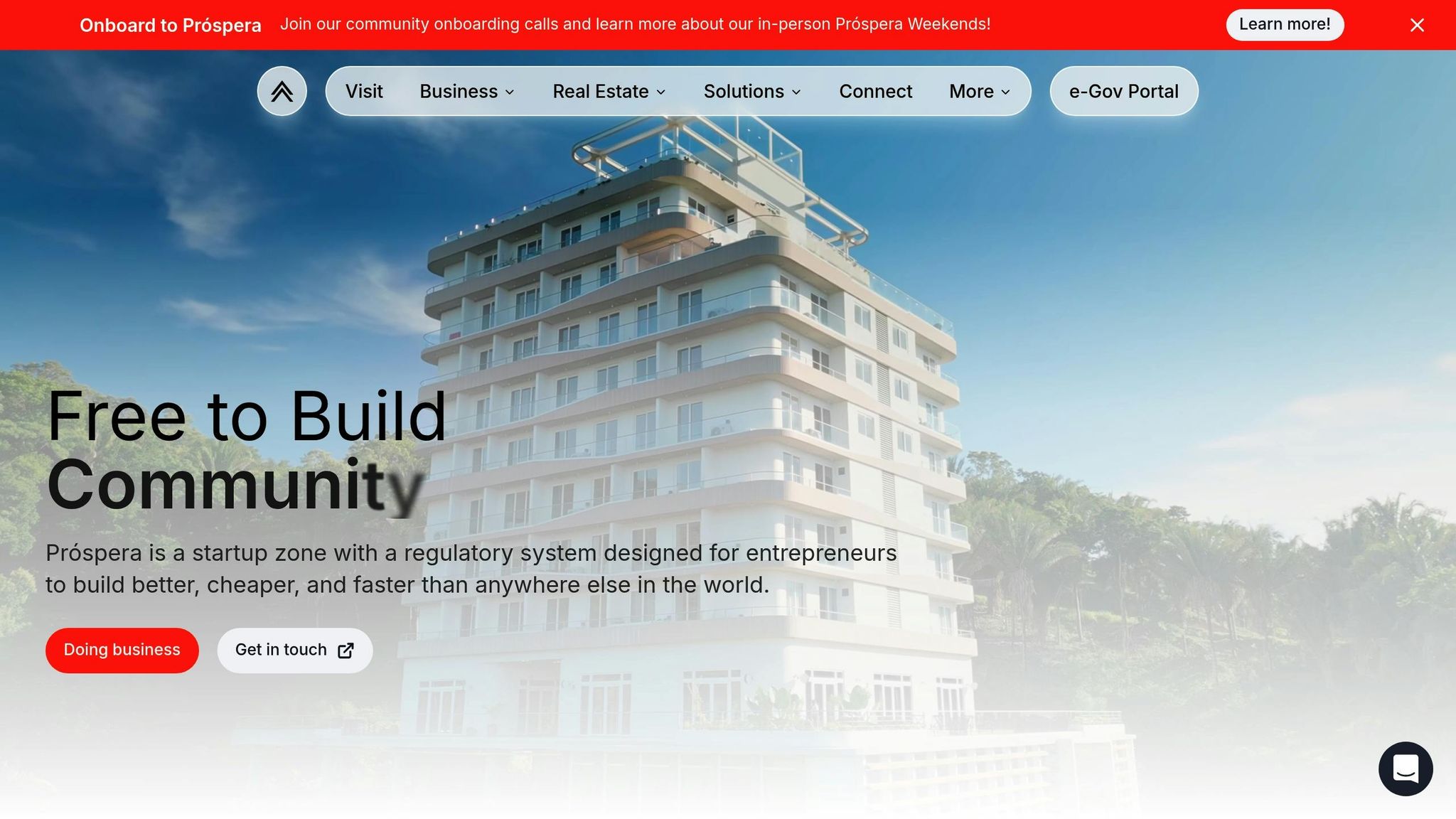
What is a ZEDE?
A ZEDE, or Zone for Employment and Economic Development, is more than just a free trade zone. It operates as a local government entity with extensive regulatory powers. Unlike traditional free trade zones that mainly focus on customs benefits, ZEDEs function as political and administrative subdivisions of Honduras, similar to municipalities but with significantly more autonomy.
The ZEDE framework was created through amendments to the Honduran Constitution and the ZEDE Organic Law, passed by the Honduran Congress in 2013. This legal foundation gives ZEDEs, including Próspera, the ability to establish their own regulations in critical areas while remaining under Honduran sovereignty. The Honduran Supreme Court has twice upheld the constitutionality of this framework, most recently in June 2021. Próspera ZEDE officially came into existence in December 2017, initially named the "ZEDE Village of North Bay", through an administrative act by CAMP (Committee for the Adoption of Best Practices). Leveraging this legal framework, Próspera has developed its own tax and regulatory systems to operate with a high degree of independence.
Legal Autonomy and Tax Code
Próspera’s semi-autonomous status allows it to establish its own commercial and civil legal systems. For commercial activities, it uses U.S. common law instead of Honduras’ traditional civil law. The zone has the authority to create regulations in areas such as commerce, industry, finance, labor (aligned with ILO standards), and environmental policies. However, all local rules must be approved by CAMP to ensure they align with national oversight.
One of Próspera’s key features is its independent tax regime, which offers competitive rates: a 5% effective personal income tax and a 1% effective business tax. The Honduran Supreme Court has also established a dedicated ZEDE judicial division (Accord No. CSJ-01-2021) to handle disputes. Businesses in Próspera have the flexibility to select their regulatory framework from three options: U.S. common law liability principles, regulations from 35 other countries with comparable or better systems, or even propose new rules tailored to their specific needs. These legal tools not only shape Próspera’s tax structure but also reinforce its operational independence, positioning it to navigate potential political hurdles.
Political and Legal Stability
While Próspera operates within a solid legal framework, it faces political and legal uncertainties. The ZEDE system has sparked political debate in Honduras. Although the ZEDE Organic Law was repealed through legislative action, the repeal has not been fully ratified in the 2023 legislative session, leaving the constitutional amendments that support ZEDEs intact. Adding to the complexity, a narrow 8-7 ruling by the Honduran Supreme Court on September 3, 2024, declared both the ZEDE Organic Law and the constitutional amendments unconstitutional. However, the retroactive implications of this decision are still under review, leaving the long-term legal status of ZEDEs uncertain.
Despite these challenges, Próspera emphasizes strong investor protections. Existing ZEDEs like Próspera are shielded from changes to the ZEDE regime for at least 50 years, thanks to acquired rights, international treaties, and legal guarantees. This 50-year protection aims to provide a stable environment for investors, even amid ongoing political and legal debates.
Personal Taxation in Próspera
Presumed Income Model for Individuals
Próspera uses a straightforward presumed income model to simplify personal tax calculations while maintaining low rates. Here’s how it works:
Taxes are calculated in two steps. First, a 10% statutory personal income tax rate is applied to just 50% of the gross income earned within Próspera. This means individuals effectively pay only 5% of their total gross income. The other 50% is automatically treated as covering business expenses and deductions, removing the need for detailed tracking or documentation.
This approach eliminates the hassle of itemizing deductions for business costs, travel, or other expenses. Instead, individuals simply pay a flat 5% on their gross income earned in Próspera. This simplicity aligns with Próspera’s broader territorial taxation framework.
Territorial Taxation System
Próspera’s taxation system is strictly territorial, meaning it taxes only income earned within its jurisdiction. Any income generated outside Próspera is completely exempt from its taxes.
This territorial approach covers more than just employment income. Returns on foreign investments, rental income from properties outside Próspera, and profits from overseas business operations are not taxed. This setup is particularly appealing for digital nomads and entrepreneurs with income streams from various global sources.
Additionally, Próspera eliminates all non-income taxes, such as capital gains, estate, and payroll taxes. Import duties are fully exempt, and while VAT applies to gasoline and alcohol, there are no traditional excise taxes on these items.
| Tax Type | Próspera Rate |
|---|---|
| Personal Income Tax (Effective) | 5% on gross income |
| Capital Gains Tax | 0% |
| Estate Tax | 0% |
| Inheritance Tax | 0% |
| Wealth Tax | 0% |
| Payroll Tax | 0% |
| Gift Tax | 0% |
| Import Duties | 0% (fully exempt) |
Tax Calculation Examples
Here are a few examples to show how this system works in practice:
Example 1: Digital Marketing Consultant
A digital marketing consultant earns $80,000 annually from clients within Próspera. Under the presumed income model, only half of this amount, $40,000, is taxable. The tax owed is $40,000 × 10%, which equals $4,000. This represents exactly 5% of the consultant’s total gross income.
Example 2: Software Developer with Mixed Income
A software developer earns $120,000 annually, with $70,000 from Próspera-based projects and $50,000 from international clients. Only the Próspera-sourced income is taxed. Of the $70,000, half – $35,000 – is considered taxable. The tax comes to $35,000 × 10%, or $3,500. The $50,000 earned outside Próspera remains untaxed.
Example 3: High-Income Entrepreneur
An entrepreneur generates $300,000 annually from business activities within Próspera. Half of this, $150,000, is treated as taxable income. The tax liability is $150,000 × 10%, which equals $15,000. This reflects the same effective 5% tax rate on the entrepreneur’s gross income.
These examples illustrate how Próspera’s tax system offers clarity and predictability. Unlike some tax havens with complex rules and hidden costs, Próspera provides a transparent framework that makes it easy to calculate and plan for tax obligations.
Business Taxation in Próspera
Corporate Tax Rates
Próspera’s business tax system is built for simplicity and efficiency, offering a unique presumed income model. Here’s how it works: the statutory Business Income Tax rate is set at 10%, but it only applies to 10% of a company’s gross revenue. This means businesses effectively pay just 1% of their gross revenue in taxes. For example, a software company generating $500,000 in annual revenue would have $50,000 considered taxable. At the 10% rate, that results in a tax bill of $5,000 – an effective rate of 1%.
The tax system follows a territorial approach, meaning only income earned within the ZEDE (Zone for Employment and Economic Development) is taxed. For instance, a consulting firm earning $200,000 in local revenue and $300,000 from international clients would pay taxes solely on the local income. At 1%, this amounts to $2,000 in taxes.
Additionally, businesses in Próspera are exempt from many common taxes, including those on dividends, capital gains, and excise taxes. This streamlined approach allows companies to focus on growth rather than navigating a maze of tax regulations.
Other Business-Related Taxes
- Value Added Tax (VAT): The VAT rate is 5%, but only 50% of the final retail price is treated as value added. This effectively reduces the sales tax rate to 2.5%. For example, on a $100 sale, only $50 is taxable, resulting in a $2.50 VAT.
- Land Value Tax: A 1% tax applies to the fair market value of land, excluding improvements. For example, land valued at $200,000 would incur an annual tax of $2,000.
- Import Duties: Companies are completely exempt from import taxes and duties, enabling them to bring in equipment and materials without extra customs costs.
- Bitcoin as a Unit of Account: Próspera is the first jurisdiction globally to officially recognize Bitcoin as a Unit of Account. This allows businesses to use cryptocurrency for accounting and tax payments, offering flexibility in financial operations.
Tax Savings for Entrepreneurs
Próspera’s low tax rates and incentives translate to substantial savings for entrepreneurs. Take an e-commerce business with $1,000,000 in annual revenue: it would pay roughly $10,000 in Business Income Tax (1% of revenue), plus minimal VAT on local sales and potentially a Land Value Tax if it owns property. Notably, 12% of the tax revenue collected in Próspera is remitted to the Honduran national government as part of the fiscal framework.
For a technology startup generating $250,000 in revenue, corporate taxes would amount to just $2,500 – a stark contrast to the higher rates in many traditional jurisdictions.
Here’s a quick comparison of corporate tax rates across different locations:
| Business Tax Comparison | Próspera | Cayman Islands | Delaware |
|---|---|---|---|
| Corporate Tax Rate | 1% effective (10% on 10% of gross revenue) | 0% | 21% federal + 8.7% state on Delaware-sourced income |
"Tax returns are a one-page-thing and took me less than 5 minutes. This is how it should be done in every country."
- Dusan Matuska, Founder of AmityAge
With its low tax rates, straightforward compliance process, and clear territorial rules, Próspera provides entrepreneurs with a tax-friendly environment that simplifies financial planning and boosts savings.
Residency Options: Visitor, e-Residency, and Full Residency
Próspera provides three residency pathways, catering to varying levels of involvement with the ZEDE. Whether you’re just curious, a digital entrepreneur, or planning to live there full-time, these options offer flexibility. Currently, the jurisdiction boasts 1,793 individual residents across these categories, reflecting its growing appeal among entrepreneurs and digital nomads worldwide.
To apply, you’ll need to confirm eligibility, sign the Agreement of Coexistence, and complete identity verification. Most applications are processed within 1–3 days.
Visitor Pass and Short-Term Stays
The Visitor Pass, which is completely free, is ideal for those who want to explore Próspera without making a commitment. It allows daily visits and limits overnight stays to 30 nights per year.
However, this pass comes with notable restrictions. You cannot register businesses, own property, or engage in substantial work activities. Work is limited to specific types with capped revenue, making it unsuitable for those looking to earn significant income. Currently, 1,271 individuals hold Visitor Passes, indicating that many are testing the waters before opting for a paid residency.
e-Residency for Digital Nomads
Priced at just $130 per year, e-Residency became more accessible after a fee reduction on September 3, 2024, which lowered the annual cost from $1,300 for foreign applicants. This option is tailored for remote entrepreneurs seeking Próspera’s business advantages.
With e-Residency, you can spend up to 30 days per year in Próspera while enjoying full business privileges. This includes the ability to register companies, own property, and conduct business within the ZEDE. Currently, 443 individuals have e-Residency, highlighting its popularity among digital professionals who prefer flexibility.
| Feature | Visitor Pass | e-Residency | Full Residency |
|---|---|---|---|
| Physical Access | 30 nights/year | 30 days/year | 365 days/year |
| Business Registration | No | ✔️ | ✔️ |
| Real Estate Ownership | No | ✔️ | ✔️ |
| Annual Cost | Free | $130 | $130 + Insurance |
| Work Restrictions | Limited/capped | Full business rights | Full business rights |
Full Residency for Physical Presence
Full Residency is for those who plan to live in Próspera year-round. The base cost is $130 annually, but mandatory residency insurance adds to the total expense.
Currently, 79 individuals hold Full Residency, as it requires a higher level of commitment compared to the more flexible e-Residency. Full Residents benefit from Próspera’s complete tax advantages, including a 5% effective personal income tax rate on locally sourced income. Employers, instead of paying traditional social security taxes, contribute at least 10% of gross compensation to the Próspera Labor Benefit Fund. This fund covers retirement, healthcare, education, legal services, or emergency housing needs.
The application process includes stringent KYC checks, identity verification, and screenings against criminal databases. Applicants working in regulated industries may need to make additional regulatory disclosures.
Regardless of the residency type, all applicants must sign the Agreement of Coexistence. This contract ensures residents understand and agree to Próspera’s laws, governance, and tax obligations while granting legal protections and discounted access to dispute resolution services.
sbb-itb-39d39a6
Tax Residency Recognition and International Implications
Expanding on the residency options already discussed, this section dives into how Próspera’s residency statuses align – or don’t align – with global tax regulations. While Próspera provides appealing tax advantages, most countries do not recognize its residency as sufficient to exempt you from their tax obligations.
Difference Between Residency and Tax Residency
Próspera’s e-Residency and Full Residency grant you legal status within the ZEDE, allowing you to conduct business and own property in the zone. However, these statuses aren’t the same as internationally recognized tax residency. Tax authorities, like the IRS in the United States, determine tax residency based on factors such as physical presence and economic connections, not just legal residency in a specific location.
Global Tax Residency Rules
Many countries define tax residency using criteria like the "183-day rule", which establishes residency based on the number of days spent in a country. Beyond that, they often consider economic ties, such as family relationships, bank accounts, and business operations. In practical terms, even if you hold Próspera residency, your home country may still classify you as a tax resident if your personal and financial connections remain there.
Other rules, such as controlled foreign corporation (CFC) laws and the management and control test, also play a role. For example, a U.S. citizen running a business registered in Próspera could still have the company’s profits taxed by the IRS as part of their personal income. These rules highlight the challenges of relying solely on Próspera’s residency for tax purposes.
Risks of Using Próspera as Sole Tax Home
Using Próspera as your only tax home comes with significant risks. U.S. citizens, for instance, must file tax returns on their worldwide income, regardless of where they reside. Similarly, individuals from other countries may face tax liabilities if they maintain strong economic or familial ties to their home jurisdictions. Without meeting physical presence requirements or severing substantial connections to another country, Próspera residency may not protect you from tax obligations elsewhere.
Additionally, listing a Próspera address could raise red flags with tax authorities. Political or legal changes in Honduras could further complicate the recognition of Próspera residency, leaving you vulnerable to tax claims from multiple countries. On top of that, international banks might limit account access due to unfamiliarity with Próspera’s framework. Many nations now require actual physical presence and meaningful economic activity to recognize tax residency, which e-Residency alone cannot provide. In short, holding only e-Residency is unlikely to satisfy the stringent requirements set by foreign tax authorities.
When Próspera Tax Residency Works Best
Próspera shines when it’s part of a carefully crafted tax strategy. To make the most of it, you need to understand its strengths, limitations, and how it fits into a broader tax planning framework.
Ideal Scenarios for Próspera
Próspera is particularly appealing to entrepreneurs who can establish genuine business activities within its jurisdiction. With a 1% effective corporate tax rate and a territorial taxation system, it’s especially beneficial for those whose businesses generate income locally. Under the territorial tax system, only income earned within Próspera is taxed, while earnings from clients outside the jurisdiction remain untaxed by local authorities.
This setup is especially advantageous for tech entrepreneurs and digital service providers. These industries often require minimal physical infrastructure, making it easier to operate within Próspera’s compact geographic area. However, the benefits of Próspera are most pronounced when it’s part of a diversified tax strategy rather than a standalone solution.
Challenges and Limitations
Próspera does come with some challenges. For instance, it doesn’t exempt you from tax obligations in countries with strict enforcement of worldwide income taxation. U.S. citizens, for example, are still required to pay taxes on their global income, regardless of their residency in Próspera.
Political uncertainty is another concern. On September 20, 2024, the Honduran Supreme Court ruled 8-7 that the ZEDE Organic Law and Constitutional Amendments were unconstitutional. While Próspera offers contractual guarantees for legal stability for at least 50 years, the political environment raises questions about the long-term viability of the ZEDE framework. This uncertainty might deter more cautious tax planners.
Additionally, Próspera has restrictions on residents from certain countries, including China, Russia, Iran, and Venezuela. This limits its accessibility for entrepreneurs from these regions.
How to Integrate Próspera into a Broader Tax Plan
Despite its limitations, Próspera can be a powerful tool when integrated into a well-rounded international tax strategy. Pairing it with a primary tax residency in a widely recognized jurisdiction can help address concerns about international recognition. Próspera can then serve as a secondary base for specific business activities, offering flexibility and tax efficiency.
To fully benefit from Próspera, meeting substance requirements is essential. This means establishing real business operations, employing local staff, and maintaining a tangible economic presence in the zone. Entrepreneurs might also consider gradually increasing their physical presence and business activities to better assess the practical advantages of operating in Próspera.
Collaborating with cross-border tax advisors is key to seamlessly integrating Próspera into a global tax structure. Many successful users combine it with other strategies, such as holding companies in established jurisdictions or trusts for asset protection. This approach creates a resilient and adaptable tax plan that leverages Próspera’s unique advantages while mitigating its risks.
Political and Regulatory Risks of Próspera
While Próspera offers appealing tax advantages, the political and legal uncertainty surrounding Honduras’s ZEDE program introduces potential risks for both investors and entrepreneurs. This uncertainty raises important questions about governance and long-term stability.
Controversies Surrounding ZEDEs
The ZEDE framework has been a source of heated debate in Honduras. Critics argue that creating semi-autonomous zones could undermine traditional governance structures and spark concerns about national sovereignty. Issues like democratic oversight and the protection of local community interests are at the center of these discussions.
Investor Protections and Guarantees
To address these concerns, Próspera has established legal and contractual safeguards aimed at protecting investors. These measures are designed to provide a sense of stability, but their long-term reliability remains untested and uncertain.
Future Risks and Considerations
Despite these protections, the landscape is far from predictable. Shifts in political leadership, regulatory changes, and economic fluctuations all contribute to the uncertainty. Entrepreneurs operating within Próspera must plan for these challenges by developing contingency strategies and exploring alternative structures to reduce potential risks.
Conclusion: Is Próspera Right for You?
Próspera offers a compelling low-tax environment with its 5% effective personal income tax rate and 1% business tax on gross revenue, but it’s not a one-size-fits-all solution. Its benefits depend heavily on your specific circumstances.
This setup works best for individuals living and earning income within the zone. Entrepreneurs with businesses that generate revenue genuinely sourced in the ZEDE can take advantage of the straightforward 1% corporate tax rate. That said, these local tax benefits don’t cancel out your obligations under international tax laws.
It’s important to remember that your home country’s tax rules, like the 183-day residency test, still apply. For most people, Próspera e-residency alone won’t be enough to establish tax residency in the eyes of foreign tax authorities. This can lead to complications, including the risk of double taxation.
Additionally, there’s the question of political stability in Honduras. While Próspera has legal protections for investors, the long-term reliability of these guarantees has yet to be proven. These uncertainties make it even more essential to approach this option with care.
If you’re considering Próspera, consulting a qualified cross-border tax advisor is a must. A professional who understands both Próspera’s tax system and your home country’s laws can help you determine if this option aligns with your goals. They can also assist in creating backup plans and integrating Próspera into a more extensive international tax strategy if it makes sense for you.
Ultimately, Próspera isn’t a quick fix or a standalone solution. It’s best suited as part of a broader, well-thought-out tax plan. For entrepreneurs with real business activities in the zone or those looking to complement an existing tax residency, it offers genuine benefits. However, jumping into e-residency without proper planning could result in costly tax complications.
FAQs
What are the potential legal and political risks of obtaining tax residency in Próspera, and how could they impact its long-term stability?
The legal and political challenges tied to obtaining tax residency in Próspera largely stem from the contentious nature of ZEDEs (Zones for Employment and Economic Development) in Honduras. While Próspera emphasizes its guarantees of legal stability, the ZEDE framework has faced significant domestic pushback, leaving questions about its long-term viability.
Recent decisions by the Honduran Supreme Court have added to these concerns, highlighting the potential influence of political pressures and the possibility of retroactive changes to laws governing ZEDEs. Such shifts could impact the rights of individuals and businesses that depend on Próspera’s tax and residency benefits. If you’re considering Próspera, it’s crucial to carefully weigh these risks and seek expert advice to safeguard your long-term tax strategy.
How does Próspera’s tax residency compare to traditional tax havens in terms of global recognition and compliance?
Próspera boasts a low-tax territorial system, featuring a 5% personal income tax and a 1% business tax, making it an attractive option for entrepreneurs and digital nomads. However, it’s important to note that its tax residency status isn’t universally treated like that of traditional tax havens. Most countries base tax residency on factors like where you physically reside, your personal connections, and their own domestic tax laws.
While Próspera’s e-Residency program allows you to set up companies and hold assets within its jurisdiction, it doesn’t automatically shield you from tax responsibilities in your home country or other places where you spend a significant amount of time. To navigate these complexities, consulting a qualified cross-border tax advisor is crucial for staying compliant with global tax regulations.
How can I effectively use Próspera tax residency as part of my international tax strategy?
To weave Próspera tax residency into your overall tax strategy, start by exploring the available residency options: visitor passes for short stays, e-Residency for remote workers spending 30 days or less annually in Próspera, and full residency for those living and working there year-round. Each choice carries distinct tax implications, so understanding these is key.
Keep in mind, e-Residency usually doesn’t meet the criteria for tax residency under most countries’ regulations, which often rely on physical presence or other substantial connections. To steer clear of any complications, it’s wise to consult a cross-border tax advisor who is well-versed in both Próspera’s framework and the tax laws of your home country. This ensures your approach stays compliant with international tax rules while minimizing potential risks.
Próspera can be particularly appealing for individuals earning income within the zone or entrepreneurs looking for a low-tax jurisdiction to base their business. However, its benefits are most effective when integrated into a broader, carefully thought-out tax plan – especially if you maintain a primary tax residency elsewhere.
