
If you’re weighing residency options between Paraguay and Uruguay, here’s the quick takeaway:
- Paraguay is simpler, faster, and cheaper. It’s ideal for those prioritizing low taxes, minimal bureaucracy, and flexibility. No income proof is required, and you only need to visit once every three years to maintain residency.
- Uruguay offers a higher standard of living, better infrastructure, and dual citizenship. It’s suited for families and retirees who can meet stricter income and presence requirements.
Key Points:
- Paraguay: Tax-free on foreign income, low cost of living, straightforward process, minimal physical presence (visit once every 3 years).
- Uruguay: 11-year tax exemption on passive foreign income, quality healthcare, and infrastructure, but requires 183 days/year presence and proof of income.
Quick Comparison:
| Feature | Paraguay | Uruguay |
|---|---|---|
| Foreign Income Tax | None | 11-year exemption or 7% fixed rate |
| Residency Cost | ~$10,000 (with legal fees) | $1,000+ (higher overall costs) |
| Processing Time | 2–6 months | 6–12 months |
| Physical Presence | Visit once every 3 years | 183 days/year |
| Income Requirement | None | ~$1,500/month |
| Dual Citizenship | Limited | Fully allowed |
| Cost of Living | Lower | Higher |
| Healthcare | Affordable private care | High-quality public/private systems |
Paraguay is best for financial freedom and simplicity. Uruguay suits those seeking modern amenities and dual citizenship.
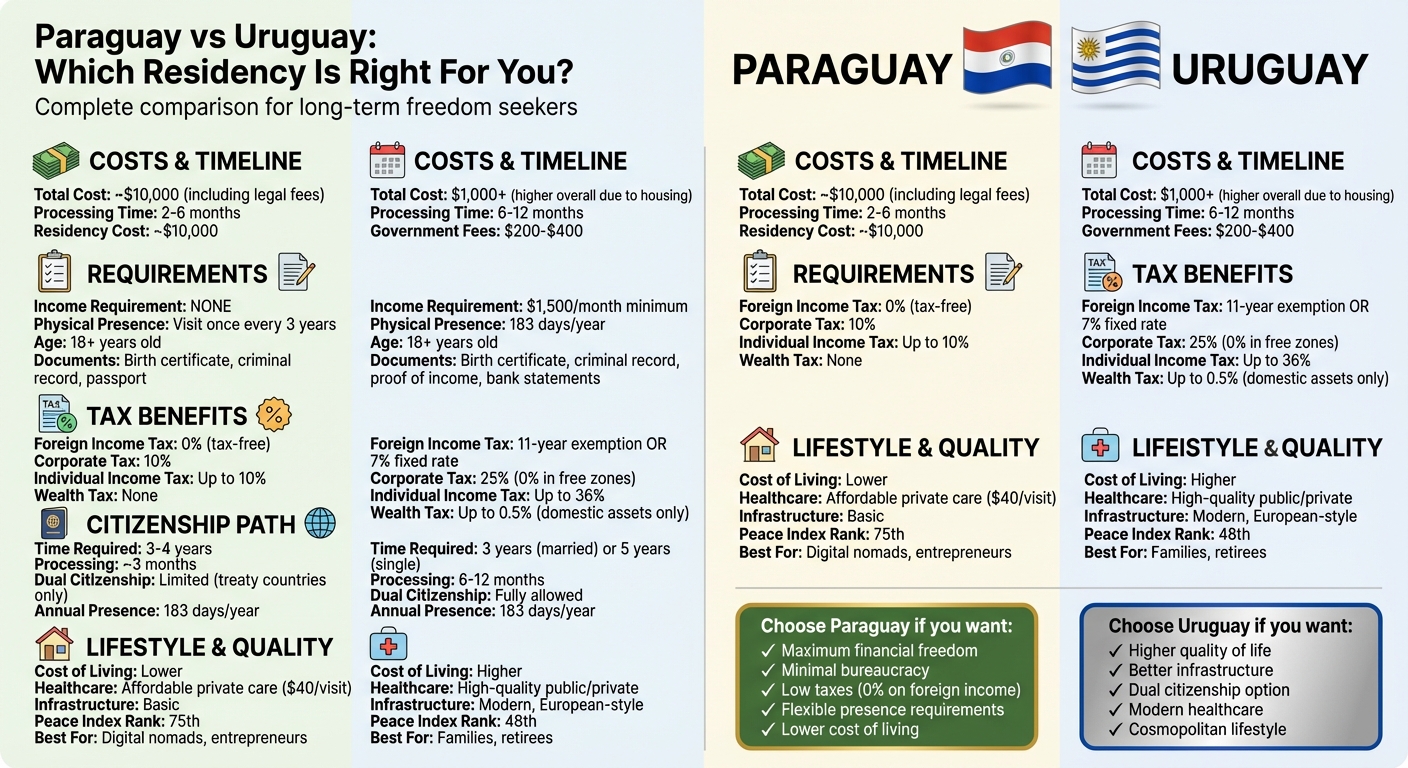
Paraguay Residency Requirements and Application Process
In November 2022, Paraguay introduced significant changes to its residency system with the enactment of Law No. 6984/2022. This law replaced the old bank deposit option for direct permanent residency with a more structured, two-step process. These updates apply to all new residency applications.
Who Can Apply for Paraguay Residency
As of December 2025, Paraguay does not require a minimum investment or bank deposit for its standard temporary residency program. The eligibility criteria are straightforward: applicants must be at least 18 years old, have a clean criminal record from their home country, and not be listed on any international watch lists. There are no income or asset requirements for this basic residency pathway.
For those looking for a quicker option, Paraguay offers the SUACE Investor Residency program. This route allows applicants to skip the two-year temporary residency phase and obtain permanent residency directly through an approved investment. Regardless of the pathway chosen, all applicants must provide biometric data in person as part of the process.
Steps to Apply for Paraguay Residency
Applying for residency in Paraguay requires applicants to be physically present throughout the process. It begins with gathering essential documents from the applicant’s home country, such as a birth certificate, criminal background check, and copies of the passport. These documents must be apostilled before submission. Once in Paraguay, applicants work with local authorities to submit their paperwork to the immigration office (Dirección General de Migraciones).
The standard process starts with obtaining Temporary Residency, which is valid for two years and comes with a temporary identity card (Cédula). The Cédula allows holders to live and work in Paraguay. After the two-year period, applicants can apply for Permanent Residency. On the other hand, the SUACE investor route skips the temporary phase altogether, granting permanent residency immediately upon approval.
Biometric registration is a mandatory step for all applicants. While the process can be complex, proper preparation or legal assistance can make it more manageable.
Costs and Timeline for Paraguay Residency
The costs associated with Paraguay residency include government fees, document authentication expenses, and optional legal assistance fees. For the standard Temporary Residency pathway, the fees are moderate, but additional expenses may arise for apostille services and translating non-Spanish documents.
The traditional route requires holding Temporary Residency for two years before applying for Permanent Residency. Meanwhile, the SUACE investor program offers a faster option, granting permanent residency right away, without the need for an interim period.
Next, we’ll explore how these requirements compare to Uruguay’s residency process.
Uruguay Residency Requirements and Application Process
Uruguay’s residency system is designed to prioritize financial self-sufficiency rather than requiring specific investments, making it relatively straightforward for qualified applicants. The country’s immigration authority generally approves applications from individuals who meet the necessary permanent residency criteria, with a low rate of rejection.
Who Qualifies for Uruguay Residency
To qualify for residency in Uruguay, applicants need to demonstrate a stable foreign income. For the Independent Means Visa (commonly referred to as the Rentista Visa), single applicants typically need a passive monthly income of around $1,500. For families, the required income increases – for example, a family of four might need approximately $3,000 per month.
Additional requirements include:
- A clean criminal record from the applicant’s home country and any other countries where they have lived in the past five years.
- Proof of intent to reside in Uruguay, such as a rental agreement or property deed.
- For non-MERCOSUR applicants, a valid health card and vaccination records are mandatory.
- Applicants must be at least 18 years old.
For those with significant financial resources, the Investor Visa offers another pathway. This option involves:
- A real estate investment of at least $510,000, with a requirement to spend at least 60 days per year in Uruguay.
- Alternatively, a $2,180,000 real estate investment, which waives the 60-day residency requirement.
- A business investment of $2,180,000 that creates at least 15 full-time jobs also qualifies.
Citizens from MERCOSUR countries (Argentina, Brazil, Paraguay, and Venezuela) enjoy a simplified process that does not require proof of income.
How to Apply for Uruguay Residency
Residency applications must be submitted in person in Uruguay, as biometric registration is required to obtain the national ID card (Cédula de Identidad). The process begins with gathering and apostilling essential documents like birth certificates, criminal background checks, and passport copies from the applicant’s home country.
Once in Uruguay, applicants work with the Dirección Nacional de Migración (National Immigration Office) to submit their paperwork. This includes:
- Bank statements, pension records, or investment documentation to confirm income.
- Notarized income certificates and official translations for any documents not originally in Spanish.
- Medical examinations and other necessary registrations.
While some applicants choose to hire immigration consultants to ensure their documentation is accurate and complete, it is also possible to handle the process independently.
Uruguay Residency Costs and Timeline
The government charges 557.30 indexed units (U.I.) per applicant for residency, with an additional 55.7 U.I. for the Migratory Certificate needed to obtain the national ID card. These fees generally translate to $200–$400 in total government and processing costs. The Immigration Office’s application fee is approximately $90. Brazilians and Paraguayans are exempt from these fees.
Other expenses include:
- Notary fees for income certificates, official translations, medical exams, and registrations, which typically range from $300 to $800 for a single applicant.
- For couples, these costs can increase by 40% to 100%.
- Optional immigration consultant services, which range from $700 to over $2,000 for single applicants, with couples paying 25% to 90% more.
The timeline for obtaining temporary residency through the Independent Means Visa is about 6–12 months. After securing temporary residency, applicants can apply for permanent residency, which may take an additional 4 months to 2 years depending on individual circumstances. During this period, applicants should budget around $40 for re-entry fees each time they leave Uruguay while their permanent residency application is being processed.
These details provide a clear picture of the residency process in Uruguay, setting the stage for comparisons with other countries like Paraguay.
Costs, Processing Times, and Required Documents Compared
When deciding between Paraguay and Uruguay for residency, it’s important to examine the practical aspects like costs, timelines, and paperwork. Paraguay stands out as a more budget-friendly option, with total expenses averaging $10,000 per person, including legal fees. In contrast, Uruguay’s program is pricier, driven by higher living expenses and property requirements – renting a typical apartment in Montevideo can easily cost over $1,200 per month.
The time it takes to process residency applications also varies significantly. Paraguay’s system is relatively quick and efficient, with residency granted in 2 to 6 months, and some cases wrapping up in just 90 days. Uruguay, however, has longer timelines, requiring 6 to 12 months for permanent residency. Temporary residency in Uruguay is faster, often approved in 2 to 3 weeks, but transitioning to permanent status takes additional time. The Uruguayan government emphasizes that processing times depend on the specifics of each case and the completeness of the submitted documents.
Documentation requirements between the two countries are also quite different. Paraguay has a simpler process, requiring basic civil documents like birth and marriage certificates, without demanding proof of income or medical exams. In fact, Paraguay eliminated mandatory medical checkups in November 2022 and does not require bank deposits for general residency. Uruguay, on the other hand, enforces stricter requirements. Applicants must provide proof of stable income – at least $1,500 per month – through bank statements, pension records, or similar documentation, along with criminal background checks. Both countries require foreign documents to be apostilled or legalized and translated into Spanish when necessary. These differences highlight the contrasting levels of bureaucracy and preparation required for each country.
Paraguay vs Uruguay Comparison Table
| Category | Paraguay | Uruguay |
|---|---|---|
| Total Application Costs | ~$10,000 per person (including legal fees) | $1,000+ for temporary cedula; higher overall due to housing requirements |
| Processing Time | 2–6 months (as fast as 90 days) | 6–12 months for permanent residency |
| Income Requirement | None | $1,500+ per month per applicant |
| Core Documents | Birth certificate, marriage certificate, criminal records | Birth certificate, criminal records, proof of stable income |
| Medical Checkup | Not required since November 2022 | Not explicitly stated |
| Bank Deposit | Not obligatory | Not required, but income proof mandatory |
| Bureaucracy Level | Simpler, fewer hurdles | More bureaucratic, extensive paperwork |
Physical Presence and Maintenance Requirements
Understanding the ongoing physical presence requirements is essential after navigating the initial application process for residency. Each country has its own rules, and these can vary widely.
In Paraguay, the requirements are incredibly lenient. To maintain permanent residency, you only need to visit the country once every three years. Some sources even suggest that a single day per year might be sufficient. Additionally, the residency permit is valid for five years and doesn’t require formal renewal during that time. This makes Paraguay an attractive option for individuals seeking legal residency without being tied to a specific location.
Uruguay, on the other hand, has stricter expectations. Residents must demonstrate habitual residence by spending approximately 183 days per year in the country. This must be supported by evidence that Uruguay serves as their primary center of life, such as property ownership, family connections, or employment ties. These requirements are strictly enforced, making Uruguay less appealing for those who prioritize geographic flexibility.
The path to citizenship further highlights the differences between the two countries. In Paraguay, you must spend 183 days per year over a three-year period to qualify for citizenship. Uruguay requires habitual residence for three years if married to a citizen, or five years if single. If you fail to meet Uruguay’s presence requirements, it can delay both the conversion to permanent residency and the citizenship process.
Maintenance Requirements Comparison Table
| Requirement | Paraguay | Uruguay |
|---|---|---|
| Physical Presence for Residency | Visit once every 3 years | ~183 days per year |
| Status Renewal Frequency | No renewal needed | ID card renewed periodically |
| Permit Document Validity | 5 years | ID card renewed as needed |
| Proof of Residence | Not required for maintenance | Must prove "center of life" |
| Citizenship Physical Presence | 183 days/year for 3 years | Habitual residence for 3-5 years |
| Flexibility Level | Very high – minimal time required | Low – significant presence expected |
sbb-itb-39d39a6
Permanent Residency and Citizenship Options
Both Paraguay and Uruguay provide pathways to citizenship, but the processes differ significantly in terms of timelines, requirements, and overall structure.
Getting Citizenship in Paraguay
In Paraguay, you can apply for citizenship after three to four years of combined temporary and permanent residency. Once your application is submitted, the approval process typically takes about three months.
To qualify, you must maintain a physical presence in Paraguay for at least 183 days per year during the required residency period and demonstrate continuous residence for one year before applying. Additionally, you’ll need to prove Spanish language proficiency at the A1 level or higher.
Paraguay has strict rules regarding dual citizenship. It is generally not permitted unless an international treaty, such as those with Spain or Italy, applies. U.S. citizens, for example, are usually not eligible for dual Paraguayan citizenship. Furthermore, naturalized citizens risk losing their Paraguayan nationality if they acquire another citizenship outside of treaty exceptions or remain outside Paraguay for more than three years.
Getting Citizenship in Uruguay
Uruguay offers a more structured and dual citizenship-friendly approach. You can apply for citizenship after three years of residency if you are married or five years if you are single. Importantly, the residency clock starts on your first day in Uruguay, not when your residence permit is issued. Once the residency requirement is met, the application process usually takes between six and 12 months.
During the required residency period, you must live in Uruguay for at least 183 days (six months) per year. Applicants are also expected to show social integration through activities like community involvement, property ownership, or obtaining a local language certificate.
Uruguay allows dual citizenship without requiring you to renounce your original nationality. As Elena Ruda from Immigrant Invest explains:
Second citizenship is allowed in Uruguay. There is no need to give up the first passport to get a Uruguayan one unless the country of origin also allows multiple citizenship.
This policy makes Uruguay an appealing choice for those who want to retain their original citizenship while gaining a second one.
Citizenship Pathways Compared
Here’s a side-by-side look at the key differences between Paraguayan and Uruguayan citizenship processes:
| Feature | Paraguay | Uruguay |
|---|---|---|
| Years of Residency Required | 3–4 years | 3 years (if married) or 5 years (if single) |
| Application Processing Time | About 3 months | 6–12 months |
| Annual Physical Presence | Minimum of 183 days/year | Minimum of 183 days/year |
| Language Requirement | Spanish proficiency (A1 level or higher) | Evidence of social integration |
| Dual Citizenship | Limited to treaty agreements | Fully allowed |
| Process Transparency | More discretionary; involves several ministries | Clear and predictable |
Uruguay’s citizenship process stands out for its clarity and the flexibility of dual citizenship, making it a strong option for those who want to keep their original nationality. While Paraguay’s process might be quicker once you apply, its restrictions on dual citizenship and less predictable procedures can be challenging for those seeking long-term freedom and flexibility.
Tax Policies, Asset Protection, and Lifestyle Compared
Tax Systems in Paraguay vs Uruguay
Both Paraguay and Uruguay operate under territorial tax systems, meaning residents are generally taxed only on income earned within the country.
In Paraguay, the tax setup is particularly lenient for those earning internationally. If your income comes from outside Paraguay, you can essentially live tax-free. With the right business structure, earnings from abroad are completely exempt from taxation. Paraguay also doesn’t require residents to report overseas assets and avoids implementing PE or CFC rules. The corporate tax rate is a modest 10%, with an additional 8% withholding tax. Individual income tax is progressive, maxing out at 10% for income exceeding PYG 150,000,001 (roughly $19,400). If your gross income from personal services is below PYG 80 million (around $10,300), you owe no individual tax. Local dividends and interest are taxed at 8%, while foreign dividends and interest remain untaxed. Paraguay also skips wealth taxes entirely. For those prioritizing financial independence, these tax policies provide a significant advantage.
Uruguay, on the other hand, offers new residents a tax holiday. You can choose between an 11-year exemption on foreign passive income or a permanent 7% fixed rate from the start. After the 11-year period, foreign dividends and interest are taxed at 12%. Uruguay’s corporate tax rate is higher at 25%, but businesses in free zones may qualify for a 0% rate under stricter conditions. Individual income tax on labor earnings can climb to 36%, while capital and other income are taxed at flat rates of 7% to 12%. Uruguay also imposes an annual wealth tax of up to 0.5% on domestic assets, though foreign assets are excluded. Like Paraguay, Uruguay doesn’t require general reporting of foreign assets unless the income is taxable or falls under specific agreements.
Paraguay stands out for its business-friendly environment, offering minimal regulation and fewer bureaucratic hurdles. Uruguay, while more structured, comes with stricter rules and more red tape for establishing businesses. These differences not only affect tax burdens but also influence how assets are protected.
Asset Protection Features
Paraguay offers strong privacy for international earners by not requiring foreign asset reporting, which enhances flexibility for global business operations. Uruguay also ensures privacy for foreign assets, only requiring reporting when income becomes taxable. Its robust banking system and established legal framework further support wealth preservation. Importantly, Uruguay’s wealth tax applies solely to domestic assets, leaving foreign assets untouched.
Lifestyle and Quality of Life
Beyond taxes and asset protection, lifestyle plays a key role in choosing between these two countries. Each offers unique benefits that cater to different preferences.
Paraguay is ideal for those seeking a lower cost of living and geoarbitrage opportunities. For instance, a high-quality private hospital visit in Asunción can cost as little as $40. The country provides a peaceful, nature-centric lifestyle with traditional values and straightforward governance. However, its infrastructure and public services are more basic compared to Uruguay.
Uruguay, by contrast, offers a higher standard of living with better infrastructure and a cosmopolitan feel, particularly in coastal areas like Punta del Este. Uruguay ranked 48th on the Global Peace Index in 2025, compared to Paraguay’s 75th position. Around 60% of Uruguay’s population is middle class, a notable contrast to the U.S., where that figure is closer to 50%. The country boasts a well-developed healthcare system, with high-quality public services and private options. Uruguay also offers vibrant cultural experiences, including beach life, wine regions, and proximity to Buenos Aires. These features contribute to both comfort and the long-term financial and personal freedom sought by expats.
Benefits Summary Table
| Feature | Paraguay | Uruguay |
|---|---|---|
| Corporate Tax Rate | 10% | 25% (0% in free zones) |
| Individual Income Tax | Up to 10% (progressive) | Up to 36% on labor income; 7%-12% on capital income |
| Foreign Income Taxation | Not taxable | 11-year exemption or 7% fixed rate; after exemption, 12% |
| Capital Gains Tax | 8% on local gains | 12% on local gains; foreign gains generally exempt |
| Wealth Tax | None | Up to 0.5% on domestic assets only |
| Foreign Asset Reporting | No requirement | No general requirement |
| Cost of Living | Significantly lower | Higher, but supported by better infrastructure |
| Healthcare Quality | Affordable private care | High-quality public and private systems |
| Global Peace Index Rank | 75th | 48th |
| Business Environment | Minimal regulation, high flexibility | More bureaucracy, stricter rules |
Choosing Between Paraguay and Uruguay
Matching Your Goals to the Right Country
Pick Paraguay if your top priorities include low taxes, minimal red tape, and a quick, affordable residency process. Thanks to its territorial tax system, foreign-sourced income is essentially tax-free. Plus, there’s no wealth tax or need to report overseas assets. Residency in Paraguay is typically faster – completed in about 2 to 6 months – and costs less, with minimal requirements for physical presence. For digital nomads and entrepreneurs who work from anywhere, Paraguay’s business-friendly environment and low government interference make it an attractive choice.
On the other hand, choose Uruguay if you value high-quality healthcare, strong infrastructure, and a cosmopolitan lifestyle. New residents enjoy an 11-year exemption on foreign passive income or a permanent 7% flat rate, but domestic taxes are higher, and regulations can be more demanding. Uruguay also offers better public services and a European-style atmosphere, though these perks come with a higher cost of living and stricter obligations. This country is a great fit for families, retirees, or anyone seeking stability and modern amenities alongside tax advantages.
These key differences can help you decide which country aligns better with your goals.
Final Recommendations
The choice between Paraguay and Uruguay ultimately depends on what matters most to you – financial savings or lifestyle quality.
Go with Paraguay if financial freedom is your main goal. It offers the lowest tax burden, minimal government involvement, and a straightforward residency process. While the infrastructure may be simpler, it’s perfect for those looking for cost efficiency and a low-maintenance lifestyle.
Choose Uruguay if you’re ready to spend more for a higher standard of living. You’ll enjoy access to top-tier healthcare, strong infrastructure, and a sophisticated, cosmopolitan environment. This option suits those who value a balanced mix of lifestyle benefits and financial considerations.
Both countries offer stable banking systems and lack exchange controls. Your decision should reflect whether you prioritize maximum financial savings or a well-rounded lifestyle with modern conveniences.
FAQs
How do tax policies for expats differ between Paraguay and Uruguay?
Paraguay’s tax setup is a big draw for expats, thanks to its territorial tax system. Here’s how it works: only income earned within Paraguay is taxed, and it’s taxed at a flat 10% rate. The best part? Any income you earn from outside the country is completely tax-free. For individuals with international income streams, this is an appealing option.
On the other hand, Uruguay takes a different approach. While it taxes foreign income at a flat 7% rate, expats can enjoy a 10-year tax holiday on foreign income if they meet specific residency requirements. However, local income in Uruguay faces a higher tax rate of 12%. For those prioritizing tax efficiency, Paraguay stands out. But Uruguay may catch the eye of those who value a mix of tax perks and a more structured legal environment.
What are the differences in time and cost for obtaining residency in Paraguay versus Uruguay?
Paraguay stands out for its relatively quick and affordable residency process, typically wrapping up in about 60–90 days. To apply, you’ll need to make a $5,000 deposit, and the process is known for being straightforward. This simplicity has made Paraguay a popular choice for those looking for an efficient and budget-friendly path to residency.
Uruguay, on the other hand, presents a slightly more complex process. It usually takes around 90–120 days and comes with stricter requirements. Applicants must either show proof of stable income or make an investment in property, which can significantly increase costs due to higher living and housing expenses. While both countries offer attractive residency options, Paraguay often appeals to those seeking a simpler and less financially demanding route.
How do the lifestyle and infrastructure in Paraguay compare to those in Uruguay?
Uruguay is often recognized for its modern infrastructure, a higher quality of life, and a culture influenced by European traditions. Add to that its stunning beaches, and you’ve got a destination that offers a refined, cosmopolitan vibe. For those who value modern conveniences combined with a relaxed coastal way of living, Uruguay ticks all the boxes.
Paraguay, in contrast, is known for its warm tropical weather, a much lower cost of living, and a residency process that’s quicker and more straightforward. While its infrastructure isn’t as advanced, it offers a simpler, more laid-back way of life – perfect for anyone prioritizing affordability and an easy transition to a new home.
