
Want a safety net for uncertain times? European back-pocket residency permits offer a low-commitment solution for securing legal residency without uprooting your life. These permits provide:
- Mobility: Visa-free travel to 29 Schengen countries for up to 90 days per 180 days.
- Minimal Requirements: Some programs require little to no physical presence (e.g., Portugal: 7 days/year; Greece: none).
- Wealth Options: Access to European investments like venture funds and tax-friendly regimes (e.g., Italy’s $200,000 flat tax on foreign income).
Popular programs include Portugal’s Golden Visa, Greece’s real estate residency, and Latvia’s business investment route. Each has unique investment thresholds and benefits, such as family inclusion and pathways to citizenship. Recent changes prioritize investments in startups and funds over real estate, reflecting shifting European policies.
Why it matters: These permits not only safeguard your mobility and assets but also offer financial flexibility in a volatile world. They’re a practical Plan B for entrepreneurs, investors, and families looking to secure their future.
What Is a Back-Pocket Residency Permit?
A back-pocket residency permit is a type of European residency obtained through investment, often referred to as a Golden Visa. It’s designed for those who want a low-commitment option to secure legal residency without needing to relocate immediately. Unlike traditional residency pathways – which typically demand continuous living, stable income, and full integration over five years – this option requires minimal physical presence.
One of its standout features is its flexibility. For instance, Portugal’s program only requires residents to spend 7 days per year in the country, yet it still allows eligibility for citizenship after five years. This makes it an attractive choice for people who want to maintain their current lifestyle while having a legal residency in Europe as a backup for emergencies or future opportunities.
These permits also come with several practical perks:
- Global mobility: Visa-free travel to 29 Schengen countries for up to 90 days within any 180-day period.
- Personal security: A safety net in countries that rank higher than the U.S. on the Global Peace Index.
- Asset protection: Access to European banking systems, stable currencies, and regulated investment options.
The investment requirements for these permits have evolved over time. Programs now focus less on passive real estate purchases and more on "productive capital" investments, such as venture capital funds, startups, and restoration projects. As Global Investment Reviews puts it:
The era of easy real-estate-for-residency is largely in the rearview mirror, replaced by a sophisticated, capital-productive model favored by Brussels.
Investment thresholds vary across Europe, offering different entry points. For example, Latvia requires a minimum of €50,000 for business investments, while Portugal’s programs involve investments of €500,000 in qualifying venture capital or private equity funds. Many programs also allow family members to be included, enhancing their appeal as part of a broader strategy for asset protection and long-term flexibility. With a back-pocket residency permit, you can secure strategic options without uprooting your life.
sbb-itb-39d39a6
Benefits of Back-Pocket Residency Permits
Back-pocket residency permits provide a practical safety net, offering real advantages for those looking to enhance mobility and protect their wealth. For U.S.-based entrepreneurs and investors, a European residency permit delivers three key perks: unrestricted travel across Europe, minimal impact on your current lifestyle, and built-in wealth diversification that can extend to your family.
Schengen Zone Access
Holding a European residency card allows visa-free travel across all 29 Schengen Area countries – such as France, Germany, Italy, Spain, and the Netherlands – for up to 90 days within any 180-day period. What’s more, time spent under your residency permit doesn’t count toward this limit. This means you can keep your primary base in the U.S. while seamlessly conducting business or exploring opportunities throughout Europe, without the hassle of visa applications or border delays. Since there are no internal border controls within the Schengen Zone, traveling between these countries is as straightforward as domestic travel. This ease of movement ensures you can access European markets and opportunities without interruptions.
Minimal Stay Requirements
Many back-pocket residency programs come with little to no physical presence requirements. For instance, Portugal’s program requires only minimal time spent in the country, while Hungary’s Guest Investor Program doesn’t require any physical presence during its 10-year term. This flexibility allows you to maintain your primary residence and business operations in the U.S. without worrying about unintentionally becoming a tax resident. Most countries only consider you a tax resident after spending 183 days or more within their borders. Additionally, if you opt for fund-based investment routes, you sidestep the challenges of managing overseas property. This hands-off approach lets you secure your European residency without disrupting your current lifestyle or operations.
Family Inclusion and Wealth Diversification
These programs often extend to multiple generations within a single application. For example, Greece allows applicants to include their spouse, children up to age 21, and even both sets of parents. Beyond providing family security, modern residency programs focus on "productive capital" investments, such as regulated venture capital funds, private equity, or historical restoration projects, rather than relying solely on passive real estate investments. This shift helps diversify your portfolio across European markets while aligning with EU regulations, creating a strong foundation for long-term financial security. Some countries also offer tax optimization opportunities – Hungary has a 9% corporate tax rate, while Italy offers a flat tax of $200,000 annually on all foreign-sourced income for new residents. These advantages make these programs an effective tool for adapting to evolving financial needs and goals.
These benefits set the stage for the specific European residency programs outlined in the next section.
European Back-Pocket Residency Programs
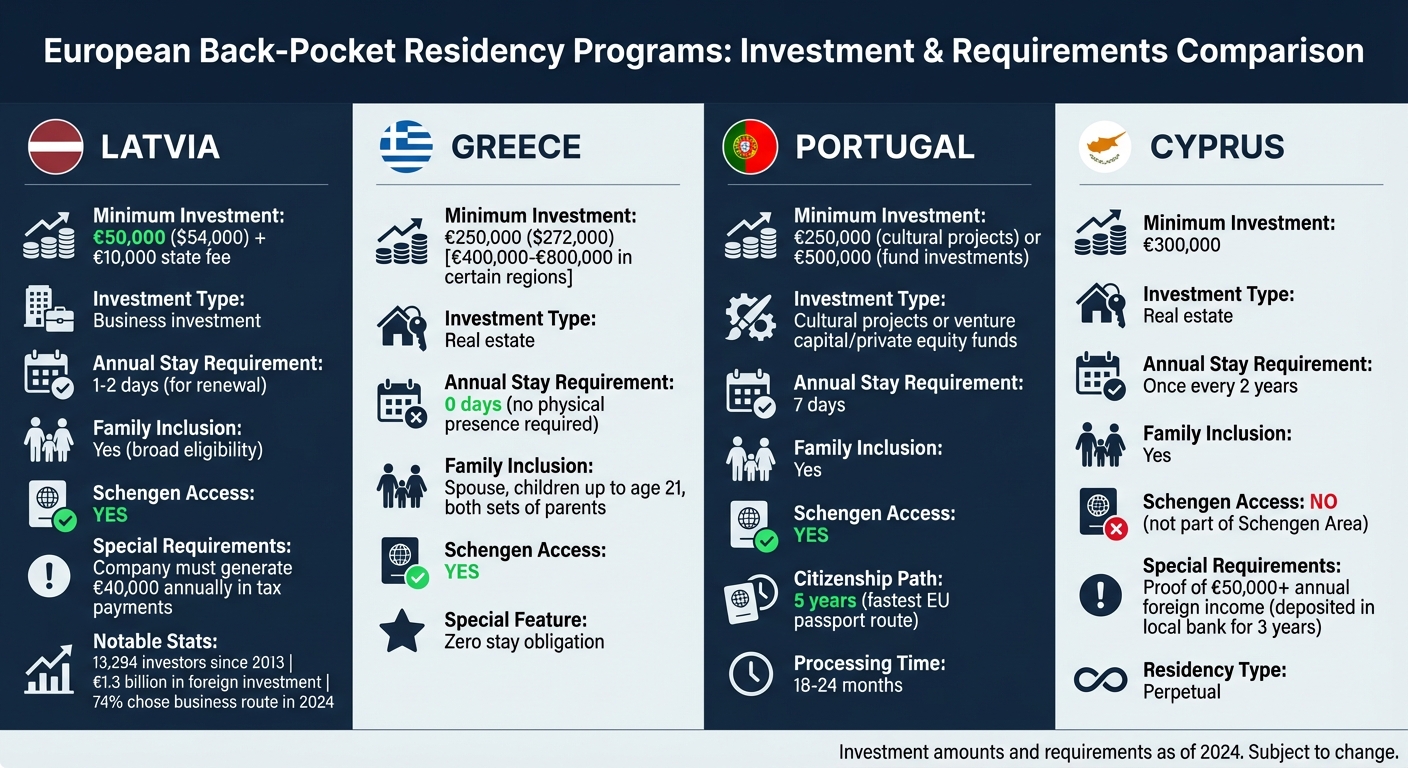
Several European countries provide residency programs tailored for investors who want flexibility without upending their current lifestyle. These programs are particularly appealing to U.S.-based entrepreneurs and high-net-worth individuals looking for a strategic backup plan. Let’s explore some standout options, each offering unique investment opportunities and benefits.
Latvia offers one of the most budget-friendly options, with a business investment route beginning at just €50,000 (about $54,000), plus a €10,000 state fee. In early 2024, an impressive 74% of Latvian Golden Visa applicants chose this business route. Since 2013, 13,294 investors and their families have secured Latvian residence permits, contributing over €1.3 billion in foreign investment. The program requires a minimal commitment – just one 1–2-day visit annually for renewal – and includes broad family eligibility. However, to retain a business-based permit, your invested company must generate at least €40,000 annually in tax payments, ensuring it aligns with asset protection goals.
Greece provides a real estate-based residency option starting at €250,000 (approximately $272,000), though certain regions now require investments between €400,000 and €800,000. What sets this program apart is its zero stay obligation – you’re not required to visit Greece to maintain your residency. This makes it an excellent choice for those prioritizing maximum flexibility. The program extends to your spouse and children up to age 21 and grants full access to the Schengen Zone, enhancing your mobility and asset strategies.
Portugal’s program is another compelling choice, with investment options starting at €250,000 for cultural projects or €500,000 for fund investments. It demands only a 7-day annual presence and offers a clear path to citizenship after 5 years, making it the fastest route to an EU passport among these options. However, applicants should be prepared for potential delays, as processing times can stretch to 18–24 months.
For a different approach, Cyprus provides perpetual residency through a €300,000 real estate investment. However, this program requires proof of an annual foreign income exceeding €50,000, which must be deposited in a local bank for three years. Unlike the other programs, Cyprus is not part of the Schengen Area, so its residency permit doesn’t grant visa-free travel across the zone. To maintain your residency, you’ll need to visit at least once every two years.
Combining Residency with Asset Protection
Pairing residency with smart wealth protection strategies can provide a powerful shield for your assets during uncertain times.
A residency permit becomes a much stronger tool when combined with well-structured wealth management solutions. For U.S.-based entrepreneurs and high-net-worth individuals, blending European residency with offshore trusts and LLCs creates a robust defense against potential risks.
At the heart of this approach is jurisdictional diversification – spreading your legal presence, banking connections, and asset holdings across multiple countries. Relying solely on U.S.-based structures can leave you vulnerable to domestic litigation, regulatory shifts, or economic instability.
Using Residency with Offshore Trusts and LLCs
European residency permits provide a strong foundation for building the business substance that banks and tax authorities increasingly require to validate offshore structures. For instance, residency in Andorra – offering a 10% maximum income tax rate and no wealth or inheritance taxes – can be paired with a holding company to add an additional layer of protection. However, it’s critical to establish trusts and LLCs before relocating to avoid unintended tax consequences on equity or capital gains.
Timing your physical relocation is equally important. Take Italy, for example – it offers new residents a $200,000 annual flat tax on foreign-sourced income, which can be a strategic advantage if planned correctly.
A dual-jurisdiction strategy maximizes flexibility. You can maintain a primary residency for lifestyle and stability while leveraging a secondary jurisdiction for targeted investments. This approach also opens doors to elite private banking services in financial hubs like Switzerland or Singapore – services often unavailable to non-residents. To stay compliant, ensure your financial records meet the strict KYC (Know Your Customer) standards required by these institutions.
These steps lay a strong foundation for integrating expert wealth protection measures into your residency strategy.
Working with Global Wealth Protection

Global Wealth Protection (GWP) specializes in merging these strategies into tailored solutions that align with your asset protection goals. Whether you’re focused on tax efficiency, succession planning, or litigation risk, GWP designs plans that combine residency programs with offshore structures.
Their services include forming offshore companies (with a focus on Anguilla), setting up offshore trusts and private interest foundations for high-net-worth clients, and creating U.S. LLCs with enhanced privacy features. Through the GWP Insiders membership program, clients gain access to exclusive resources on jurisdiction selection and tax reduction strategies.
The consultation process is streamlined, covering strategic planning, legal structure formation, and ongoing optimization. GWP also assists in establishing banking relationships in your chosen residency jurisdiction. Since many banks require in-person visits and extensive documentation, it’s best to start this process 6–12 months before relocating.
"The best residency strategies don’t just save taxes – they unlock new business, banking, and generational wealth opportunities." – Project Black Ledger
Conclusion
Back-pocket residency permits offer a sense of security, both personally and financially, in an unpredictable world. These programs grant access to stable governance, dependable healthcare systems, and the Schengen Zone, often without requiring significant physical presence.
With Spain’s Golden Visa set to end in April 2025, the focus of residency programs has shifted toward investments in venture funds, startups, and restoration projects. These options not only provide clearer exit strategies but also make the programs more adaptable to regulatory changes compared to the traditional real estate route.
"The global landscape of ‘Plan B’ residency has shifted decisively… it is a strategic maneuver involving asset allocation, tax optimization, and long-term family security in a volatile world." – Global Investment Reviews
This evolution highlights how residency permits have become active tools for safeguarding wealth and ensuring stability.
When combined with offshore trusts and LLCs, European residency programs create a robust strategy – offering benefits like tax optimization through Italy’s $200,000 flat-tax regime, multi-generational family inclusion in Greece, and Portugal’s five-year pathway to EU citizenship.
To make the most of these opportunities, consider entry and exit costs alongside tax planning to ensure residency aligns with your overall wealth management goals. In uncertain times, having a well-thought-out Plan B is no longer optional – it’s essential.
FAQs
Will a European residency permit make me a tax resident?
Holding a European residency permit doesn’t necessarily mean you’re a tax resident. Tax residency is determined by the specific rules of each country and factors such as where you live and your financial ties. It’s important to carefully review the residency and tax laws of the country involved to fully understand your responsibilities.
Can I keep the permit if I rarely visit the country?
In many cases, you can retain your permit even if you don’t visit frequently. However, the rules depend on the specific program. Some permits require you to maintain certain connections or meet minimum stay requirements, while others are more flexible and allow longer absences without jeopardizing your residency. Be sure to review the program’s guidelines to stay compliant.
What’s the fastest path from residency to EU citizenship?
The fastest route to move from residency to EU citizenship is usually through naturalization, which generally takes about 5 to 10 years. Some countries, like Malta and Spain, might offer shorter timelines under certain conditions, such as marriage or exceptional contributions. Since eligibility rules differ across nations, it’s crucial to carefully examine the specifics of each country’s program to find the option that aligns best with your circumstances.
