
Managing finances as a digital nomad can be a challenge, but some countries make it easier. Here are the key takeaways for hassle-free banking while living a location-independent lifestyle:
- Challenges for Nomads: High fees, poor exchange rates, strict residency requirements, and account freezes are common issues. U.S. citizens face additional tax reporting obligations like FBAR and FATCA, with penalties for non-compliance.
- Best Jurisdictions: Countries like Georgia (zero-tax on foreign income), Estonia (EU banking via e-Residency), Portugal (aligned with digital nomad visas), and the UAE (tax-free banking) offer tailored solutions. Privacy-focused options like Nevis are also worth exploring.
- Remote Account Setup: Many banks now offer online account opening, though requirements vary. You’ll typically need proof of identity, address, and funds. Look for banks with clear fee structures and multi-currency support.
- U.S. Tax Compliance: Stay organized with tools to track balances, meet filing deadlines, and claim tax benefits like the Foreign Earned Income Exclusion or Foreign Tax Credit. Non-compliance can result in steep penalties.
Pro Tip: Combine services like Wise for currency exchange with traditional banks or business accounts for a well-rounded setup. Always prioritize jurisdictions that align with your mobility and financial needs.
Common Banking Problems for Digital Nomads
Managing finances while living a location-independent lifestyle can be tricky, especially when traditional banks are designed with fixed addresses in mind. From steep fees to complex reporting requirements for U.S. citizens, digital nomads face unique hurdles that demand careful consideration when choosing banking solutions.
High Fees and Poor Exchange Rates
One of the biggest pain points is the cost of international transactions. Traditional banks often impose hefty fees and tack on unfavorable exchange rate markups, making it expensive to move money across borders. If you’re frequently converting currencies or withdrawing cash abroad, these hidden costs can add up quickly, eating into your savings.
Account Opening and Maintenance Challenges
Setting up and maintaining a bank account can be another headache. Many traditional banks require proof of residency, such as a utility bill or lease agreement – documents that are hard to provide when you’re constantly on the move. On top of that, strict Know Your Customer (KYC) protocols and enhanced due diligence measures often demand extensive documentation, which can feel like a roadblock for digital nomads.
Frequent international transactions can also raise red flags with banks, triggering security alerts. These alerts sometimes result in temporary account freezes or declined transactions, leaving you stranded without access to your funds.
U.S. Reporting Requirements
For U.S. citizens, the challenges are even more pronounced due to additional regulatory obligations. They must report foreign bank accounts through the Report of Foreign Bank and Financial Accounts (FBAR) and comply with the Foreign Account Tax Compliance Act (FATCA). If account balances exceed $10,000 (FBAR) or $50,000 (FATCA), reporting becomes mandatory.
"For US citizens and residents of other developed nations, it’s crucial to understand that holding foreign bank accounts is entirely legal, provided you comply with reporting requirements."
- Easy Global Banking
This means tracking account balances, converting them to U.S. dollars, and keeping meticulous records to satisfy multiple tax authorities. With over 100 jurisdictions now sharing account information, U.S. digital nomads face a maze of compliance requirements. Some countries have started to adapt by creating banking systems that cater to mobile lifestyles, making it essential to choose a jurisdiction that supports your needs rather than complicating your journey.
Best Banking Jurisdictions for Digital Nomads
Managing finances as a digital nomad can be tricky, but some countries have stepped up with banking systems designed to make life easier. These places not only simplify banking but also offer tax perks that help reduce the hassle of handling foreign income.
Georgia: A Haven for Zero-Tax Foreign Income
Georgia operates on a territorial tax system, meaning foreign income is exempt from local taxes. On top of that, the country provides an "Individual Entrepreneur" status, which comes with extra advantages tailored for small business owners and freelancers. It’s an appealing option for those looking to keep more of their hard-earned money.
How to Open Bank Accounts Remotely
Opening a bank account remotely has become a practical solution for many, especially for digital nomads who face hurdles like strict address requirements or the need for in-person verification. Thankfully, more banks and financial institutions worldwide now offer remote onboarding, allowing you to manage your money without ever stepping into a branch.
Required Documents for Account Opening
While the exact requirements depend on the bank and country, most institutions ask for a standard set of documents. These typically include:
- Proof of Identity: A valid, government-issued passport or ID card is usually required.
- Proof of Address: This can be a recent utility bill, bank statement, or official correspondence that shows your residential address. If you lack a permanent address, a trusted mailing address or virtual mailbox service may work, though many banks won’t accept a P.O. box.
- Proof of Funds: Some banks may ask for recent financial statements to verify your financial activity.
For business accounts, additional paperwork is often necessary, such as business registration certificates and legal documents. Certain countries even offer remote business registration programs, making it easier for entrepreneurs to set up accounts from afar. U.S. citizens may face extra steps due to regulatory requirements, often needing to provide a Social Security Number and complete specific forms.
Jurisdictions with Fully Remote Setup
A growing number of countries now allow fully online account opening. In these jurisdictions, you can submit documents and verify your identity using digital tools like video calls. However, it’s worth noting that some banks might still require an in-person visit at some stage. Always double-check the specific requirements of your chosen bank to avoid surprises.
Common Problems and Solutions
Even with streamlined processes, remote account opening can come with its own set of challenges. Here’s how to tackle the most common issues:
- Language Barriers: If you’re dealing with a non-English-speaking bank, consider using translation services to ensure smooth communication and document submission.
- Verification Delays: Banks might request additional documents or clarifications. To avoid delays, ensure all documents are clear, legible, and meet the bank’s standards. In some cases, having them notarized or officially certified can help.
- Minimum Balance and Fees: Some accounts require an initial deposit or a minimum balance to avoid monthly fees. Review the bank’s fee structure and account terms carefully to understand any financial obligations.
- Account Rejection: Applications can be denied for reasons like incomplete address verification or concerns about the source of funds. If this happens, review your documents, correct any issues, and consider reapplying after addressing the bank’s concerns.
- Transaction and Currency Conversion Costs: International transactions and currency exchanges often come with added fees. Familiarize yourself with the bank’s fee schedule to avoid unexpected charges.
sbb-itb-39d39a6
Compliance and Reporting for U.S. Digital Nomads
If you’re a U.S. citizen or resident, your tax obligations don’t stop at the border. The U.S. taxes its citizens and residents on their worldwide income, no matter where they live. For digital nomads, meeting these requirements is part of managing life across borders.
Understanding the key reporting rules and knowing how to use available tax benefits can make this process smoother and even reduce your tax liability. Let’s break it down.
FBAR and FATCA Requirements
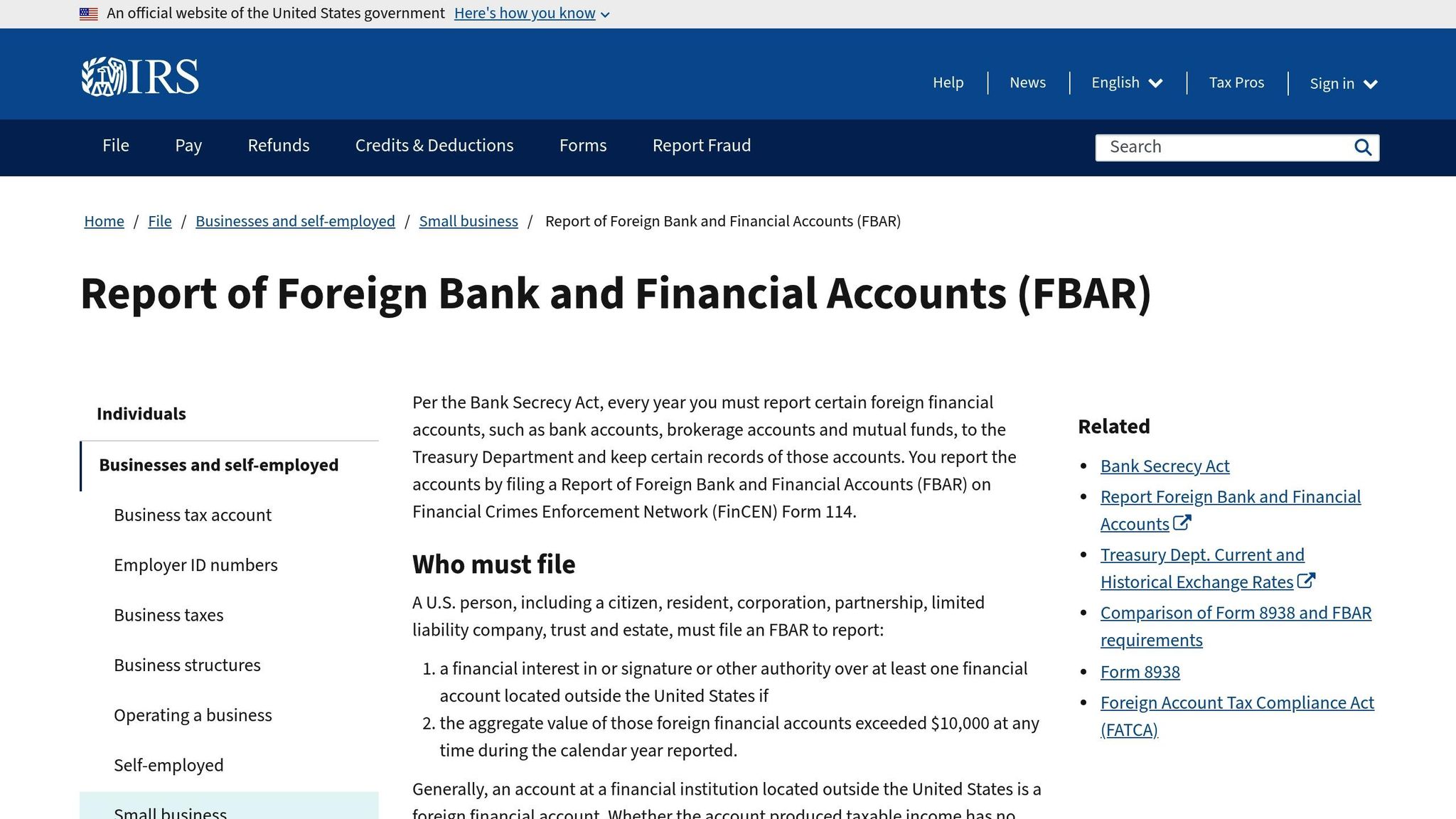
If you have foreign bank accounts, two major reporting rules apply: FBAR (Report of Foreign Bank and Financial Accounts) and FATCA (Foreign Account Tax Compliance Act).
FBAR requires you to file FinCEN Form 114 if the combined value of your foreign financial accounts exceeds $10,000 at any point during the year. This form is due April 15, with an automatic extension to October 15, and must be submitted electronically through the Financial Crimes Enforcement Network’s BSA E-Filing System.
FATCA, on the other hand, involves filing Form 8938 with your annual tax return. The reporting thresholds depend on where you live and your filing status. For example, if you’re single and living abroad, you must report if your foreign financial assets exceed $200,000 on the last day of the year or $300,000 at any time during the year. If you’re married and filing jointly, these thresholds double. For those living in the U.S., the thresholds are much lower – $50,000 on the last day of the year or $75,000 at any point for single filers.
Failure to comply comes with hefty penalties. For FBAR, non-willful violations can cost up to $10,000 per violation, while willful violations may result in penalties of $100,000 or 50% of the account balance, whichever is greater. FATCA violations start at $10,000, with additional penalties of $10,000 per month for continued non-compliance, capped at $50,000.
Keep in mind, these are reporting obligations – any income from these accounts is still taxable.
Using Tax Treaties to Ease the Burden
Tax treaties and exclusions can help U.S. citizens abroad avoid double taxation and reduce their overall tax load.
The U.S. has tax treaties with over 60 countries. These agreements often clarify which country has the primary right to tax specific types of income, such as wages, dividends, or royalties. If you pay taxes abroad, you may be eligible to claim a tax credit for those payments on your U.S. return.
The Foreign Earned Income Exclusion (FEIE) is another tool that can help. This allows you to exclude a portion of your foreign earned income from U.S. taxes. The exclusion limit adjusts annually, and you’ll need to meet either the Physical Presence Test (spending at least 330 days outside the U.S. in a 12-month period) or the Bona Fide Residence Test (establishing residency in a foreign country for an uninterrupted period that includes a full tax year). Note, this exclusion applies only to earned income – not to passive income like dividends or rental income.
Additionally, the Foreign Tax Credit lets you offset U.S. taxes dollar-for-dollar with foreign taxes paid on the same income. For example, if you pay income tax in a country like Georgia, you can likely claim those payments as a credit against your U.S. tax liability, ensuring you’re not taxed twice on the same income.
Staying Organized with Compliance
U.S. tax rules are complex, and staying organized is crucial to avoid penalties and unnecessary stress.
- Track your account balances: Use a spreadsheet to record each foreign account’s monthly balance. Include details like the account name, financial institution, country, currency, and the balance converted to U.S. dollars using the U.S. Treasury’s exchange rates.
- Mark key deadlines: FBAR is due October 15 (with an automatic extension from April 15). If you’re living abroad, your tax return – including Form 8938 for FATCA – is due June 15, with a possible extension to October 15. Set reminders well ahead of time.
- Keep digital records: Store bank statements, foreign tax receipts, and transaction records in secure cloud storage. Organize them by year and account to simplify tax preparation and audits.
- Use expat-friendly accounting tools: Many software options handle multiple currencies, calculate foreign tax credits, and generate reports for tax filing. Some even sync with foreign bank accounts for automatic updates.
- Maintain a travel log: If you’re claiming the FEIE, keep a detailed record of your travel dates. A simple spreadsheet noting your arrivals and departures can serve as proof of your eligibility if the IRS asks.
While managing U.S. tax compliance adds complexity to the digital nomad lifestyle, staying organized and understanding your obligations can make it more manageable – and help you avoid unnecessary headaches.
Conclusion
Choosing the best banking jurisdiction depends on factors like where your income originates, how often you move, and the types of accounts you need. This guide outlines several options, each with its own perks. For instance, Georgia offers zero-tax on foreign income and a simple account setup process. Estonia’s e-Residency program is a great fit for those wanting access to EU banking without living there. Portugal aligns its banking system with its digital nomad visa program, and the United Arab Emirates provides tax-free banking in a global financial hub. If privacy is your main concern, jurisdictions like Nevis and the Marshall Islands focus on asset protection. Weigh these factors to find the jurisdiction that aligns best with your goals.
It’s also a good idea to look beyond just the upfront costs. Consider fees, currency conversion rates, ATM withdrawal limits, and the time you’ll spend on administrative tasks. Sometimes, a bank with slightly higher fees can be a better choice if it offers strong customer support, solid security, and smooth multi-currency management. Many seasoned digital nomads use a mix of services – like pairing a currency exchange platform such as Wise with a traditional bank and a dedicated business account – to cover all their bases.
For U.S. digital nomads, regulatory compliance is non-negotiable. U.S. citizens must meet reporting obligations like FBAR and FATCA, no matter where they bank. While the right jurisdiction can simplify your banking experience, it won’t erase your tax responsibilities. The global banking landscape is also shifting, with over 100 jurisdictions now sharing account information under frameworks like the Common Reporting Standard. This trend toward transparency has made onshore banking more appealing, offering greater stability and practical advantages.
Before opening an account, take a close look at your needs. Think about where you’ll spend most of your time, the currencies you’ll use frequently, whether you need specialized business banking features, and how much complexity you’re willing to manage. The ideal banking setup is one that reduces daily hassles while safeguarding your assets for the future.
FAQs
What makes countries like Georgia and Estonia attractive for digital nomads when it comes to banking?
Georgia boasts one of the easiest banking systems for non-residents, making it a top pick for digital nomads. The country’s major banks are well-known for their straightforward account-opening process for foreigners. Plus, many even offer remote setup options, which is a big win for entrepreneurs and professionals constantly on the move.
Estonia, meanwhile, shines with its cutting-edge digital banking infrastructure, perfectly suited to a mobile lifestyle. That said, opening a traditional bank account there often requires stronger connections to the country, like a local address or an established business. Both Georgia and Estonia are recognized for their low banking fees and straightforward systems, making them great options for managing finances while living abroad.
What steps should U.S. digital nomads take to meet FBAR and FATCA reporting requirements while banking abroad?
U.S. digital nomads need to follow two important reporting rules when they have foreign financial accounts. If the combined value of these accounts goes over $10,000 at any point during the year, you’re required to file the FBAR (FinCEN Form 114). On top of that, to fulfill FATCA (Foreign Account Tax Compliance Act) requirements, you’ll need to include Form 8938 with your tax return if your foreign financial assets cross certain thresholds.
For FATCA, the reporting thresholds depend on your filing status and whether you live abroad. For instance, single filers must report assets if their total exceeds $200,000 at the end of the tax year or $300,000 at any point during the year. For married couples filing jointly, the limits rise to $400,000 at year-end or $600,000 at any time during the year.
To ensure compliance, maintain detailed records of your foreign accounts, keep an eye on account balances, and seek advice from a tax professional who understands expat tax rules if necessary. The penalties for failing to comply can be harsh, so staying ahead of these requirements is crucial.
How can digital nomads avoid high fees and unfavorable exchange rates when managing their money abroad?
Digital nomads looking to avoid hefty fees and bad exchange rates should focus on banks that offer no monthly account fees, 0% foreign transaction fees, and free ATM withdrawals worldwide. It’s also essential to choose banks that provide real-time exchange rates without sneaky markups. Remote account management features are another must-have, making it easier to handle your finances while traveling.
You might also want to explore online or international banks designed for people with global lifestyles. These banks often include perks like multi-currency accounts, which can simplify money management and help you save while constantly on the move.
