
U.S. citizens are taxed on their worldwide income, even if they live abroad. This unique system, called citizenship-based taxation, requires annual tax filings regardless of residency. Key points to know:
- Worldwide Income Reporting: All income, including foreign earnings, must be reported to the IRS.
- Double Taxation Relief: Tools like the Foreign Earned Income Exclusion (up to $130,000 in 2025) and Foreign Tax Credit help reduce tax burdens.
- Mandatory Forms: Expats must file Form 1040 yearly, along with additional forms like FBAR (for foreign accounts over $10,000) and FATCA disclosures.
- Penalties for Non-Compliance: Missing filings can lead to severe fines or even passport revocation.
- Planning is Key: Proper preparation before moving abroad can minimize tax liabilities and ensure compliance.
Understanding these rules is essential to avoid penalties and make informed financial decisions while living abroad.
Tax Compliance Requirements for U.S. Citizens Living Abroad
Living abroad doesn’t exempt U.S. citizens from their tax responsibilities. Regardless of where you reside, your obligations are tied to your citizenship, not your location. In fact, moving overseas can sometimes add to your reporting requirements. These include filing annual tax forms like Form 1040, as well as meeting FBAR and FATCA mandates, all of which ensure the IRS keeps tabs on U.S. citizens abroad.
It’s essential to understand these requirements to avoid penalties and maintain a clean record with the IRS.
Filing Form 1040 Each Year
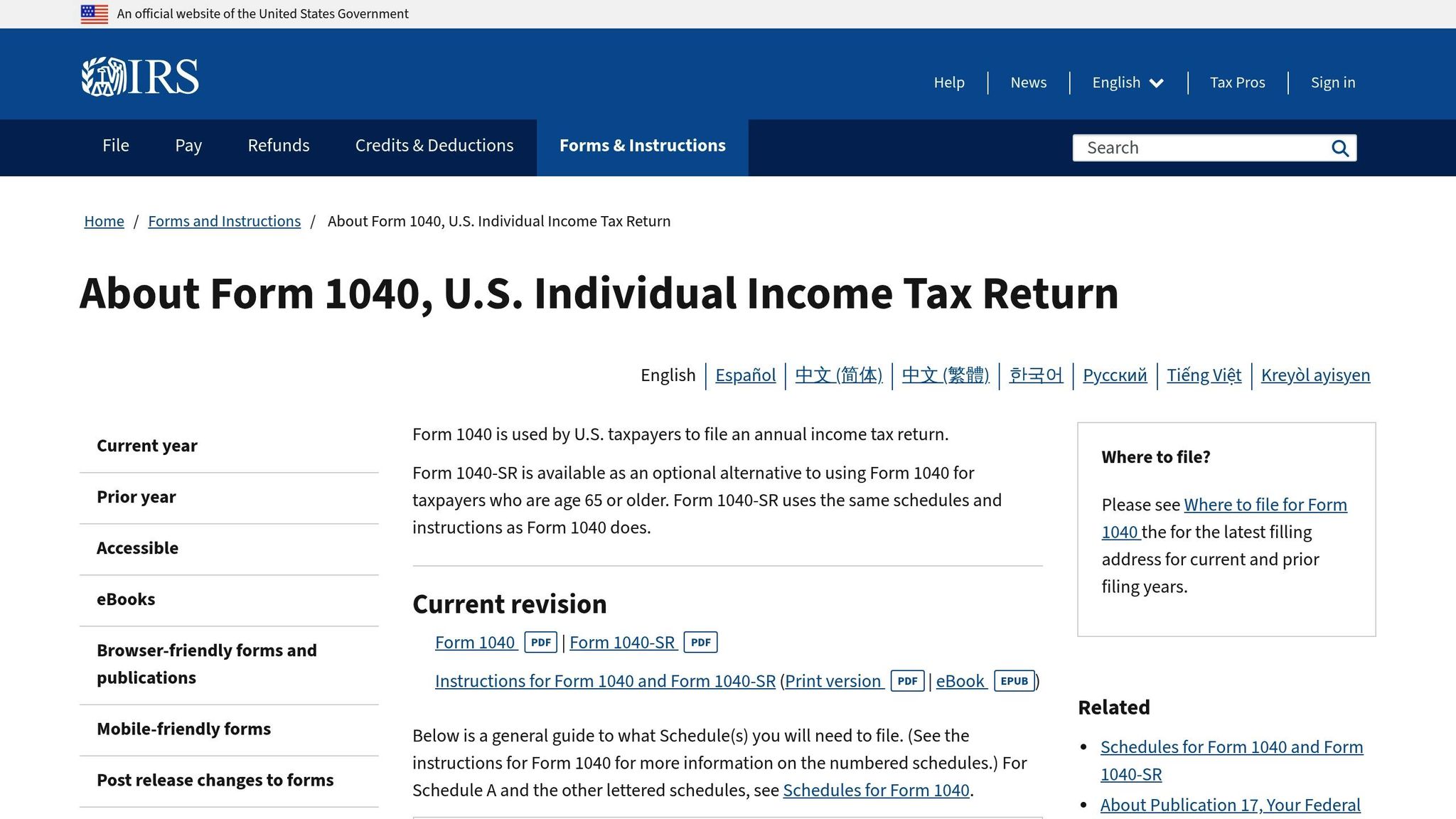
Every U.S. citizen living outside the United States must file Form 1040 annually. This rule applies whether you owe taxes or not – even if exclusions or deductions reduce your tax liability to zero. U.S. citizens and Green Card holders abroad are generally required to file income, estate, and gift tax returns, and in some cases, pay estimated taxes, just as those living in the U.S. do.
Expats benefit from an automatic two-month extension to file Form 1040, pushing the deadline from April 15 to June 16, 2025. However, any taxes owed must still be paid by April 15. Additional extensions can be requested, extending the filing deadline to October 15, or even December 15 in special cases.
Filing Form 1040 is also necessary to claim exclusions, deductions, and credits, even if your final tax bill is zero. Depending on your circumstances, you may need additional forms, like Form 2555 to claim the Foreign Earned Income Exclusion or Form 1116 for foreign tax credits. Beyond this, you’ll also need to address foreign account disclosure through FBAR.
Foreign Bank Account Reporting (FBAR)
If you hold foreign financial accounts, you’ll likely need to file FinCEN Form 114, commonly known as the Foreign Bank Account Report (FBAR). This requirement applies when the total value of your foreign accounts exceeds $10,000 at any point during the calendar year. FBAR covers a variety of accounts, including bank, investment, and certain retirement accounts held outside the U.S., and it must be submitted electronically through FinCEN‘s BSA E-Filing System.
The FBAR deadline is April 15, but expats automatically receive an extension to October 15. Be sure to maintain detailed records for each account, including the account name, number, type, the name and address of the foreign bank, and the account’s maximum value during the year. Keep in mind, FBAR obligations are separate from FATCA requirements, which involve additional reporting.
FATCA Reporting Requirements
The Foreign Account Tax Compliance Act (FATCA) introduces another layer of reporting through Form 8938. This form focuses on specified foreign financial assets and has higher thresholds than FBAR. For single U.S. citizens living abroad, FATCA reporting is required if your specified foreign financial assets exceed $200,000; the threshold is higher for married individuals. Form 8938 must be filed alongside your annual income tax return and sent to the appropriate IRS service center.
It’s important to note that FATCA reporting doesn’t replace FBAR. Some foreign accounts may need to be reported on both forms, although the information required for each differs. For instance, specified foreign financial assets held outside of accounts with financial institutions are reported on Form 8938 but not on the FBAR. Failing to comply with FATCA requirements can lead to hefty penalties.
How to Reduce Your U.S. Tax Liability While Living Abroad
If you’re a U.S. citizen living abroad, you have several strategies to help reduce your tax burden. By understanding and applying these options, you can potentially save thousands of dollars each year while staying compliant with IRS rules.
Foreign Earned Income Exclusion (FEIE)
The Foreign Earned Income Exclusion (FEIE) is one of the most valuable benefits for U.S. expats. For the 2025 tax year, eligible individuals can exclude up to $130,000 of foreign-earned income from their U.S. taxable income. If both spouses qualify, they can each exclude up to $130,000, effectively shielding up to $260,000 of combined income from U.S. taxes.
To qualify for the FEIE, you must meet three key criteria: earn income abroad, establish a foreign tax home, and satisfy either the Bona Fide Residence Test or the Physical Presence Test.
- Bona Fide Residence Test: Requires uninterrupted residency in a foreign country for a full tax year. Factors like your intention to stay, purpose of the move, and duration of your stay are considered.
- Physical Presence Test: Requires being physically present in a foreign country for at least 330 full days during any 12-month period. This test has no residency requirement.
For example, Sarah moved to London for an indefinite job on January 15, 2024, and only spent 30 days in the U.S. that year. She qualifies for the FEIE under the Bona Fide Residence Test. On the other hand, Robert moved to Tokyo on March 1, 2024, for a two-year assignment but returned to the U.S. on January 25, 2025, due to project changes. Since his foreign residence didn’t cover an entire tax year, he doesn’t qualify under the Bona Fide Residence Test.
The Physical Presence Test can also provide flexibility for shorter assignments. Karen, for instance, spent 345 days in France between July 1, 2023, and June 30, 2024, taking only two 10-day trips back to the U.S. She meets the 330-day requirement. However, Harry, who worked in the U.K. for all of 2024 but took four 20-day trips to the U.S. (totaling 80 days), fails the test because he exceeded the 35-day limit.
It’s important to note that the FEIE applies only to earned income, such as wages, salaries, commissions, and self-employment income. It does not cover passive income like dividends, interest, capital gains, or pensions. To claim the FEIE, you must file Form 2555 with your U.S. tax return.
If the FEIE alone isn’t enough to offset your tax liability, you can look into additional housing-related benefits.
Foreign Housing Exclusion and Deduction
The Foreign Housing Exclusion (FHE) and Foreign Housing Deduction (FHD) offer further relief by addressing the higher costs of living abroad. The FHE applies to employees, while the FHD is available to self-employed individuals.
- Foreign Housing Exclusion: Employees can exclude part of their foreign-earned income to cover qualifying housing expenses.
- Foreign Housing Deduction: Self-employed individuals can deduct qualifying housing costs from their taxable income.
Qualifying housing expenses include rent, utilities (excluding phone and TV services), essential repairs, and occupancy taxes. However, luxury expenses, mortgage payments, furniture, and non-essential improvements are not covered. To benefit, your housing costs must exceed a base amount equal to 16% of the FEIE limit.
For self-employed individuals, the FHD requires claiming the FEIE first. It’s also worth noting that the FHD doesn’t reduce self-employment tax, and once you deduct housing expenses, you can’t claim a foreign tax credit on the excluded income.
If you earn both employment and self-employment income, you can split your housing costs between the exclusion and deduction. However, these calculations can get complex, so it’s wise to consult a tax professional.
When housing benefits and exclusions don’t fully eliminate your U.S. tax liability, you can explore foreign tax credits and treaty provisions.
Foreign Tax Credits and Tax Treaties
The Foreign Tax Credit (FTC) and tax treaties are powerful tools to prevent double taxation. The FTC allows you to claim a dollar-for-dollar credit against your U.S. taxes for income taxes paid to foreign governments. Unlike exclusions, credits directly reduce the tax you owe rather than lowering your taxable income.
Tax treaties between the U.S. and other countries can also provide relief. These agreements may reduce withholding rates on specific income types, establish rules for determining tax residency, and address income categories like pensions or business profits. They are particularly helpful for retirees, business owners, or those earning investment income abroad.
Deciding between the FEIE and FTC depends on your circumstances. Generally, the FEIE is more advantageous in low-tax countries, while the FTC is better suited for expats in high-tax jurisdictions. Running the numbers for both options will help you determine the best strategy.
Keep thorough records of your foreign income, travel dates, and documentation to support your chosen tax benefits. The foreign housing exclusion or deduction is calculated in parts VI, VIII, and IX of Form 2555. Given the complexity of these provisions, working with a tax professional experienced in expat taxes is highly recommended.
Common Mistakes and How to Avoid Them
For U.S. expats, even minor reporting mistakes can lead to hefty penalties. The IRS takes foreign reporting requirements very seriously, and failing to comply can quickly become a costly headache. Knowing where others often go wrong can save you both money and stress. Below, we’ll cover some of the most frequent errors and how to steer clear of them.
Not Filing FBAR or FATCA Forms
One of the most common slip-ups is neglecting to report foreign financial accounts. Aside from your regular tax return, you may need to file additional forms, like the FBAR (Foreign Bank Account Report) and Form 8938 under FATCA, if your foreign accounts or assets exceed certain thresholds. Missing these forms – or even making small record-keeping errors – can result in severe penalties.
To avoid this, maintain detailed records of all your foreign accounts, including balances and account details. Set reminders for filing deadlines: FBAR is due by April 15 (with an automatic extension to October 15), and Form 8938 is filed alongside your tax return. Staying organized and proactive can save you from unnecessary fines.
Getting Exclusions and Deadlines Wrong
Mistakes when claiming tax benefits, like the Foreign Earned Income Exclusion (FEIE), can be expensive. One frequent error is miscalculating the Physical Presence Test, which requires you to spend at least 330 full days in foreign countries during any 12-month period. To avoid this, keep meticulous records of your travel, including boarding passes, hotel receipts, and a travel log. If you’re cutting it close to meeting the 330-day requirement, consider filing Form 2350 to request a deadline extension rather than risking your eligibility.
Also, be cautious when switching between FEIE and the Foreign Tax Credit (FTC). If you opt out of FEIE, you won’t be able to switch back for five years. For those living abroad part-time, make sure to prorate the FEIE based on the number of qualifying days.
Trying to Handle Complex Tax Issues Alone
U.S. expat taxes are notoriously challenging. Tackling complicated rules like PFIC (Passive Foreign Investment Company) and GILTI (Global Intangible Low-Taxed Income) on your own can lead to costly mistakes. For instance, PFIC rules can impose harsh tax consequences on certain foreign investments, while GILTI provisions might unexpectedly increase your tax bill if you hold interests in foreign corporations.
Tax treaties add another layer of complexity. While designed to prevent double taxation, they include intricate rules like tie-breaker provisions and savings clauses. Misinterpreting these details – or overlooking state tax obligations, especially from high-tax states – can result in penalties or additional taxes.
Given these challenges, working with a tax professional who specializes in expat issues is often the smartest move. They can help you meet all filing requirements while maximizing available exclusions and credits. If you’re behind on your filings, you might also consider the Streamlined Filing Procedures, which offer a penalty-free way to get back on track. Investing in expert advice can save you from costly errors and give you peace of mind.
sbb-itb-39d39a6
What to Do Before Moving Abroad
When preparing for a move abroad, it’s crucial to keep U.S. tax obligations in mind. By organizing your records, understanding your new country’s tax system, and carefully timing financial decisions, you can save money and stay on the right side of the IRS. Taking these steps before you relocate can make the transition smoother and help you avoid costly mistakes.
Gather Your Financial Records and Documents
Getting your financial paperwork in order now will make future tax filings much easier. The IRS holds expats to the same documentation standards as residents, so being prepared is key to claiming deductions, exclusions, or credits.
Start by collecting the following:
- Wage statements (e.g., W-2s, P60, P45, or foreign pay slips)
- Interest and dividend income statements (e.g., 1099-INT, 1099-DIV, or local equivalents)
- Capital gains or losses reports (e.g., 1099-B or brokerage summaries)
- Distribution records from IRAs, pensions, annuities, or profit-sharing plans (e.g., Form 1099-R or foreign equivalents)
- Social Security benefits statements (Form SSA-1099)
- Self-employment income records and rental income details, including related expenses
- Proof of foreign tax payments for calculating the Foreign Tax Credit
Additionally, gather documentation to support residency tests. For the Physical Presence Test, maintain a detailed travel log showing all dates you were inside and outside the U.S. For the Bona Fide Residence Test, collect residency permits, foreign ID cards, visas, lease agreements, and utility bills.
Learn Your New Country’s Tax Rules
Understanding the tax system in your new country is just as important as staying compliant with U.S. tax laws. Tax residency definitions and filing requirements vary widely, so thorough research is essential.
Start by reviewing the U.S. tax treaty with your destination. These treaties aim to prevent double taxation, though the details can be complex. They outline which types of income are covered and how treaty benefits are applied.
Key areas to research include:
- Tax residency rules in your new country
- Local income tax rates
- Filing requirements for residents and non-residents
For complicated situations, consider consulting a tax professional who understands both U.S. and local tax laws. They can provide tailored advice to help you plan your finances and avoid surprises.
Plan the Timing of Income and Asset Moves
The timing of financial transactions – like asset sales or fund transfers – can have a big impact on your tax obligations. Careful planning during the period before and after your move can open up opportunities to reduce taxes.
If possible, establish residency in a state with no income tax, such as Florida, Texas, or Nevada, before you move abroad. These states don’t impose state income taxes, which can lower your overall tax burden, especially if you plan to return to the U.S. in the future.
Other strategies to consider:
- Time asset sales to align with the most favorable tax rates in the U.S. and your new country.
- Take advantage of favorable exchange rates when transferring funds.
- Restructure or gift assets before establishing tax residency in your destination. Different countries treat gifted and inherited assets differently, and early planning can lead to significant savings.
Because these decisions can be complex, it’s wise to work with both a U.S. tax advisor and an international wealth manager. They can help you navigate income recognition, asset restructuring, and other financial moves to minimize your tax burden.
Planning ahead is critical. Rushed decisions close to your departure date can lead to missed opportunities or less-than-ideal tax outcomes. Take the time to prepare thoroughly to set yourself up for a smoother financial transition.
Key Points for U.S. Citizens Moving Abroad
If you’re a U.S. citizen planning to live abroad, it’s important to understand how your tax responsibilities will follow you. Unlike most countries, the U.S. operates on a citizenship-based taxation system. This means you’ll need to continue filing U.S. tax returns and reporting your worldwide income, no matter where you live or work. It’s a unique system that often surprises expats who aren’t familiar with these rules. Here’s what you need to know to navigate this aspect of your expat journey.
The silver lining? Most U.S. expats owe little to no taxes. According to IRS data from 2016 to 2021, nearly two-thirds of expats didn’t owe any U.S. taxes. This is largely due to provisions like the Foreign Earned Income Exclusion and the Foreign Tax Credit, which are designed to minimize double taxation.
That said, compliance is non-negotiable. Even if you don’t owe taxes, you must file Form 1040 by June 16, 2025, for your 2024 return. Additionally, don’t overlook FBAR and FATCA reporting requirements, as missing these deadlines can result in hefty penalties . Tax laws for expats are intricate and constantly evolving. Annual changes, including inflation adjustments to exclusions and new legislative proposals, make staying updated a challenge . This is where working with a tax professional experienced in expat taxation becomes invaluable. They can help you navigate the complexities, maximize benefits, and avoid costly errors.
To stay ahead, it’s critical to plan carefully. Familiarize yourself with both U.S. and local tax regulations, maintain detailed financial records, and strategically time major financial decisions. With thorough preparation and expert advice, you can embrace your international lifestyle while staying fully compliant with U.S. tax laws.
FAQs
What happens if I don’t meet U.S. tax reporting requirements while living abroad?
Failing to meet U.S. tax reporting requirements as an expat can lead to serious consequences. The IRS doesn’t take these matters lightly and may impose substantial penalties, particularly for unreported foreign income, accounts, or assets. For instance, if you willfully fail to report a foreign account, you could face fines as high as 50% of the account balance. On top of that, late filings and general non-compliance often result in added interest charges and additional penalties.
In extreme cases, ongoing non-compliance can escalate into legal trouble or even restrictions, such as issues with maintaining good standing under FATCA. To steer clear of these risks, it’s critical to understand your responsibilities and, if necessary, consult a professional to ensure you’re fully compliant.
How do I know if I qualify for the Foreign Earned Income Exclusion or the Foreign Tax Credit, and which option is best for me?
To qualify for the Foreign Earned Income Exclusion (FEIE), you need to have a tax home in a foreign country and meet one of two tests: the Bona Fide Residence Test (which requires living in a foreign country for an entire tax year) or the Physical Presence Test (spending at least 330 days in a foreign country within a 12-month period). The FEIE lets you exclude up to a specific amount of foreign earned income from U.S. taxes. This amount is adjusted annually for inflation – for example, the exclusion limit is around $130,000 for 2025.
The Foreign Tax Credit (FTC) works differently. It’s available if you pay taxes to a foreign government on income that’s also taxed by the U.S. This credit reduces or even eliminates double taxation by allowing you to offset your U.S. tax liability with the foreign taxes you’ve already paid.
Choosing between the FEIE and FTC depends on your financial situation. If your foreign income is under the FEIE limit, the exclusion might save you more. However, if you pay high foreign taxes or earn above the FEIE threshold, the FTC could be the better choice. Carefully comparing the potential tax savings from each option is key to making the right decision for your circumstances.
What do I need to know about U.S. tax obligations before relocating abroad?
As a U.S. citizen, you’re required to report and possibly pay taxes on your worldwide income, no matter where you reside. Before making the move abroad, it’s a good idea to gather all essential financial documents, such as income statements and information about any foreign accounts you hold. Get organized early by learning about important reporting requirements like FATCA (Foreign Account Tax Compliance Act) and FBAR (Foreign Bank Account Report), which mandate the disclosure of specific foreign financial assets.
It’s also worth consulting a tax professional who specializes in expatriate taxes. They can guide you through these responsibilities and suggest strategies to reduce your tax burden. Taking the time to prepare thoroughly will help you stay compliant, avoid penalties, and ease the transition to your new life overseas.
