
When choosing a business structure as a global entrepreneur, LLCs, IBCs, and Estonian e-Residency each offer distinct advantages. Here’s the breakdown:
- LLCs: Ideal for U.S. market entry with liability protection and flexible tax options. However, foreign entrepreneurs may face challenges with banking, compliance, and U.S. tax filings.
- IBCs: Offshore entities with low taxes, strong privacy, and global operational focus. They’re great for international trade but face increasing regulatory scrutiny and local operation restrictions.
- Estonian e-Residency: A fully digital option for running an EU-based business online. It’s perfect for remote entrepreneurs accessing the EU market but doesn’t grant physical rights or guaranteed banking access.
Quick Comparison
| Feature | LLC (U.S.) | IBC (Offshore) | Estonian e-Residency |
|---|---|---|---|
| Setup Costs | $100–$5,000 (varies by state) | Affordable, jurisdiction-dependent | €290 (approx. $315) |
| Taxation | U.S. tax rules apply | 0%-3% offshore tax | 0% on retained profits, 22% on distributions |
| Asset Protection | Strong | Strong offshore | Limited, EU-standard |
| Privacy | Moderate | High | Transparent (public registry) |
| Banking Access | Moderate to challenging | Challenging | Often relies on fintech solutions |
| Market Access | U.S.-focused | Global | EU-focused |
| Digital Management | Limited | Limited | Fully digital |
Each option fits specific goals: LLCs for U.S. presence, IBCs for global privacy, and e-Residency for digital-first EU operations. Your choice depends on your target market, tax preferences, and how you plan to manage your business.
Limited Liability Company (LLC)
What is an LLC?
A Limited Liability Company (LLC) is a business structure that combines features of corporations, partnerships, and sole proprietorships while protecting its owners from personal liability. Essentially, it creates a barrier between your personal assets and your business operations, safeguarding personal wealth from business-related risks.
One of the standout features of an LLC is pass-through taxation. This means the company’s profits and losses are reported directly on the owners’ personal tax returns, avoiding the double taxation that corporations often face. This setup is particularly appealing to international entrepreneurs looking for a simpler way to enter the U.S. market.
LLCs also offer flexible ownership options. They can be owned entirely by foreign individuals, corporations, or even other LLCs. To form an LLC, you’ll need to file articles of organization and create an operating agreement. Keep in mind that the specific process varies by state, but it’s generally less complicated than setting up a traditional corporation.
Benefits of an LLC
LLCs are a popular choice for small businesses in the U.S., and it’s easy to see why. Here are some of the main advantages:
- Asset Protection: Your personal assets, like your home or savings, are shielded from business liabilities. If the LLC faces financial troubles or lawsuits, creditors can only go after the business’s assets.
- Tax Benefits: LLCs avoid double taxation since business income is taxed only once on the owners’ personal tax returns. A Harvard Business Review study found that this structure can save owners up to 20% compared to traditional corporations.
- Management Flexibility: LLCs allow members to manage the business themselves or hire professional managers. With fewer formalities and record-keeping requirements than corporations, nearly 80% of new businesses choose LLCs for this reason.
- Better Financial Standing: LLCs tend to have stronger financial credibility. Banks approve about 30% more credit applications for LLCs compared to sole proprietorships. Additionally, sole proprietors face a higher audit risk – 2.5 times more than LLCs, according to IRS data.
- Affordable Setup Costs: Forming an LLC is relatively inexpensive, with filing fees and annual costs typically ranging from $50 to $500. This makes it an accessible option for both startups and established businesses.
Challenges of an LLC
While LLCs offer many advantages, they also come with challenges, particularly for international entrepreneurs:
- Tax Requirements: Foreign-owned LLCs must obtain a U.S. Taxpayer Identification Number (ITIN) if they operate in the U.S. They are also required to pay taxes on U.S.-sourced income and accurately file IRS Form 5472 to avoid penalties, which can range from $25,000 to $50,000 per violation. Additionally, a 30% withholding tax may apply to certain types of passive income for non-residents.
- Banking Complications: Opening a U.S. business bank account can be a hurdle for international owners. Strict documentation requirements and, in some cases, the need for physical presence can make the process difficult.
- Limited Financing Options: Without a U.S. credit history, securing loans or financing can be tough. Lenders often prefer borrowers with an established domestic credit profile.
- Regulatory Differences: State laws vary, which can complicate compliance. As Vincenzo Villamena, CPA and founder of Entity Inc., explains:
"Starting an LLC in the U.S. can involve what is sometimes complex admin and ongoing fees for compliance with varying state regulations."
- Operational Risks: Some states require LLCs to dissolve if a member dies or declares bankruptcy. Additionally, members might face self-employment taxes, and the LLC structure may not suit businesses aiming to go public.
- Other Barriers: International founders often encounter language differences, immigration challenges, and currency exchange issues. Obtaining an Employer Identification Number (EIN) without a Social Security Number (SSN) or ITIN can also be a significant obstacle.
The cost of forming an LLC for international entrepreneurs typically ranges from $500 to $5,000, depending on the state and any additional services needed. Balancing these challenges with the benefits is crucial when deciding if an LLC is the right fit for your business.
International Business Company (IBC)
What is an IBC?
An International Business Company (IBC) is a type of offshore entity created in jurisdictions that provide tax advantages or exemptions. Unlike LLCs, which can operate both locally and internationally, IBCs are specifically designed for international business activities and are generally prohibited from conducting operations within their country of incorporation. These entities are commonly registered in places like the Seychelles, Hong Kong, Belize, and the British Virgin Islands, where regulations are streamlined, and tax benefits are prevalent.
IBCs are structured around shares, with directors and shareholders overseeing ownership and management. They are particularly suited for activities such as international trade, managing global investments, and holding real estate. This setup offers unique operational and financial perks, which are explored below.
Advantages of an IBC
IBCs come with several benefits that make them appealing for international business:
- Tax Benefits: IBCs often enjoy low or zero tax rates on international income, typically ranging from 0% to 3%. While both IBCs and LLCs can avoid taxation on income generated outside their incorporation country, IBCs are often optimized for international operations.
- Asset Protection and Privacy: IBCs help protect personal assets by separating them from business holdings, reducing risks from lawsuits or creditor claims. Additionally, they maintain a high level of privacy, requiring minimal disclosure about their owners – ideal for those prioritizing discretion.
- Operational Flexibility: IBCs are versatile, capable of handling a variety of international activities such as trading, consulting, and investments. They can also operate in multiple currencies, making them suitable for global ventures.
- Simplified Compliance: IBCs are subject to fewer regulatory demands, often avoiding mandatory audits and extensive public filings. This translates to lower compliance costs and simpler management.
- Scalability: The rising number of registrations in many jurisdictions highlights the popularity and growth potential of IBCs.
- Ideal for Larger Enterprises: With features like privacy, limited liability, and minimal compliance requirements, IBCs are often a better fit for larger international businesses with multiple shareholders compared to LLCs.
Limitations of an IBC
While IBCs offer many advantages, they also come with challenges that businesses should consider:
- Local Operation Restrictions: IBCs are typically prohibited from conducting business or employing local personnel in their country of incorporation. This can necessitate additional entities for local operations.
- Increased Regulatory Oversight: Regulatory compliance is tightening worldwide. Only 13% of jurisdictions expect no changes in reporting requirements, while 43% anticipate new compliance rules in the near future. This can increase operational complexity and costs.
- Compliance Challenges: Global regulations, such as Know Your Customer (KYC) and Ultimate Beneficial Owner (UBO) reporting, are becoming stricter. Even with tax exemptions, IBCs often need to complete licensing paperwork, which can compromise privacy.
- Reputation Concerns: IBCs have faced criticism for their potential misuse in tax evasion and money laundering schemes. Their confidentiality has drawn scrutiny from regulators, which can complicate banking relationships and partnerships.
- Impact on Growth Plans: Stricter compliance requirements have led some companies to scale back expansion efforts. In fact, 31% of jurisdictions report that businesses are often unprepared for enhanced reporting obligations.
- Uncertain Legal Landscape: Legislative changes are common, with 14% of jurisdictions experiencing sudden shifts in regulations. This unpredictability can hinder long-term business planning.
- Global Push for Transparency: Organizations like the OECD are pressuring jurisdictions to increase transparency and combat offshore financial risks. Many regions with IBC frameworks are now adopting stricter anti-money laundering measures and other protocols aimed at reducing tax avoidance.
As compliance requirements grow more stringent and costs rise, businesses must weigh the evolving challenges of IBCs against their traditional benefits for international operations. Balancing these factors is crucial for making informed decisions about this corporate structure.
Estonian e-Residency
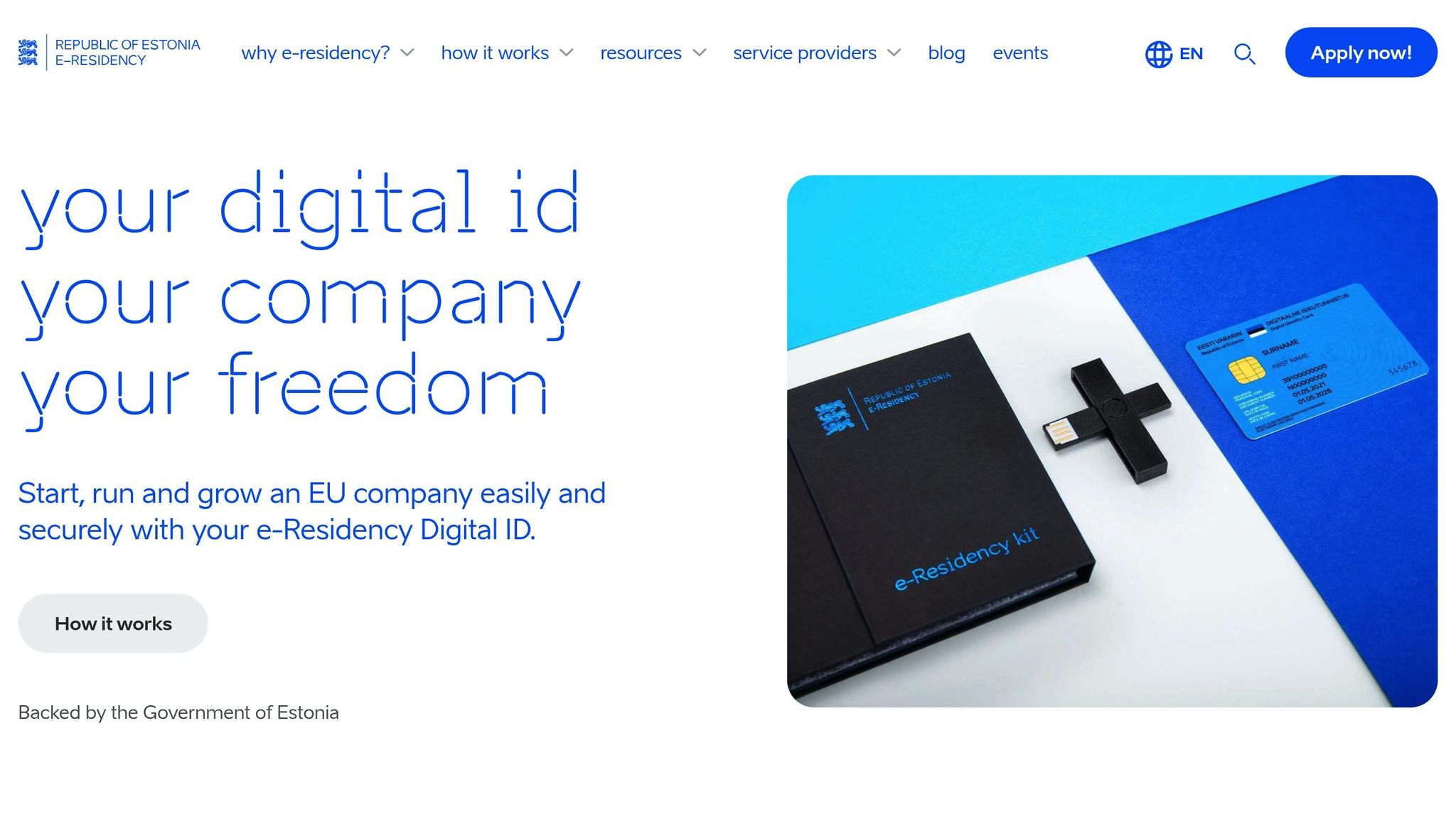
What is Estonian e-Residency?
Estonian e-Residency is a unique government program that provides a digital identity to non-residents, enabling them to establish and run an EU-based company entirely online, no matter where they are in the world. This program eliminates the need for physical presence or local representation, offering entrepreneurs access to Estonia’s advanced digital services platform.
With the help of Estonia’s digital ID card, e-residents can handle essential business tasks like incorporating companies, signing documents, filing taxes, and managing operations – completely online. This setup is particularly appealing to digital entrepreneurs who want the benefits of operating under the European Union’s regulatory framework while staying location-independent.
Since its launch, the program has gained significant global traction. By the end of 2023, more than 100,000 individuals from 181 countries had joined, resulting in the creation of over 27,000 companies. These digital tools provide businesses with efficiency and flexibility, which we’ll explore further.
"E-Residency has an ambitious mission to facilitate and advance the provision of Estonia’s unique digital services in order to empower entrepreneurs and transform business practices globally." – e‑Residency Team
Benefits of Estonian e-Residency
Estonian e-Residency offers a range of advantages for entrepreneurs looking to tap into the EU market and embrace digital-first business strategies.
Streamlined Online Business Management:
E-residents can remotely manage their companies with tools like digital signatures, online tax filing, and secure e-banking. For perspective, Estonians save an average of five working days annually just by using digital signatures.
Access to the EU Market:
Businesses registered through e-Residency gain the benefits of EU regulations, such as the free movement of goods and services. This makes scaling across European markets much simpler. Additionally, Estonia’s membership in the EU, NATO, OECD, and the eurozone enhances trust and stability in international dealings.
Tax Advantages:
Estonia consistently ranks first in the International Tax Competitiveness Index and offers a tax system designed to support business growth. Companies enjoy 0% corporate tax on reinvested profits, meaning taxes are only paid when profits are distributed. This approach can significantly improve cash flow for expanding businesses.
Access to Financial Tools and Funding Opportunities:
E-residents can use international payment services like PayPal and Braintree, which might not be accessible in their home countries. The program also opens doors to EU funding and grant programs, offering additional resources for business growth.
Minimal Bureaucracy and Transparency:
Estonia ranks 18th globally for ease of doing business and leads the EU in digital public services. Its transparent environment, where key company details are publicly available, fosters trust with clients and partners.
The program is also economically impactful, delivering a $7.60 return for every dollar invested and projected to significantly boost Estonia’s economy by 2025. However, there are some practical challenges to consider.
Challenges of Estonian e-Residency
While the program offers many benefits, it also has limitations that entrepreneurs should weigh carefully.
No Physical Rights or Guaranteed Banking Access:
E-Residency is strictly digital – it doesn’t serve as a physical ID, grant citizenship, or provide tax residency or visa privileges. Additionally, having e-Residency doesn’t guarantee access to banking services, which can complicate operations.
Tax Complexity:
E-Residency doesn’t exempt individuals from paying taxes in their home countries. Entrepreneurs must navigate international tax rules and may need professional advice to avoid double taxation.
Reliance on Digital Systems:
The program depends heavily on Estonia’s digital infrastructure and the entrepreneur’s ability to operate remotely. Technical issues, system outages, or policy changes could disrupt business activities.
Costs and Fees:
While fees for applications, renewals, and company registration are relatively low, they are ongoing expenses that some traditional business setups might not require. These fees are set to increase slightly in 2025.
Regulatory Compliance:
Businesses must adhere to EU regulations, data protection laws, and reporting requirements, which can be challenging – especially for smaller operations without dedicated legal resources.
Not Suitable for All Business Types:
E-Residency is ideal for freelancers, solopreneurs, and small to medium-sized businesses in fields like IT, marketing, publishing, and consulting. However, it’s less practical for businesses requiring a physical presence, local employees, or significant on-site operations.
"e-Residency is easy, and I mean stupid easy. Especially if you are a freelancer and have a smaller team, Estonian e-Residency is really good because you don’t have a lot of moving pieces." – Bostjan Belingar, e‑resident and founder of Hustler Marketing
Side-by-Side Comparison
When it comes to choosing between LLCs, IBCs, and Estonian e-Residency, each option shines in different areas like tax savings, privacy, and operational focus. The best fit for your business will depend on your priorities – whether that’s tax efficiency, flexible operations, privacy needs, or market access. Below is a breakdown of how these structures compare across key factors.
Comparison Table: LLC vs IBC vs Estonian e-Residency
| Factor | LLC (Wyoming) | IBC (Belize) | Estonian e-Residency |
|---|---|---|---|
| Setup Costs | $100–$152 (filing fees + annual report) | Affordable (varies by jurisdiction) | €290 company formation |
| Taxation | No state income tax; federal rules apply | Minimal tax on profits | 0% on retained profits; 22% on distributions |
| Asset Protection | Strong limited liability protection | Strong offshore protection | Limited EU-standard protection |
| Privacy | Moderate (varies by state) | High in most jurisdictions | Transparent (public registry) |
| Ease of Setup | Moderate | Easy | Very Easy (15 min 33 sec) |
| Operational Flexibility | High management flexibility | High for international operations | Moderate (EU regulations apply) |
| Compliance Requirements | Annual reports; varies by jurisdiction | Low ongoing requirements | High EU standards; annual documentation |
| Banking Access | Moderate to challenging for non-residents | Challenging offshore banking | 66% rely on fintech solutions |
| Market Access | US market focus | Global operations (excluding home country) | EU market access with regulatory benefits |
| Digital Management | Limited online capabilities | Limited digital infrastructure | Fully digital business management |
| Ongoing Costs | $50 annual report + registered agent fees | Low maintenance costs | €200+ annually for local contact |
This comparison highlights how each structure caters to different business goals. Whether you’re targeting domestic growth, global expansion, or seamless digital operations, there’s an option that aligns with your needs.
For instance, Estonia has consistently ranked number one on the Tax Competitiveness Index for 11 consecutive years. Its e-Residency program has attracted over 120,000 participants, resulting in the creation of more than 33,000 companies. This digital-first approach is a game-changer for entrepreneurs worldwide.
Wyoming LLCs, on the other hand, offer a tax-friendly environment at the state level, with no corporate income tax, personal income tax, inventory taxes, franchise taxes, occupation taxes, or value-added taxes. Belize IBCs are another attractive option, offering minimal taxes, which makes them ideal for reinvesting profits back into the business.
"Estonia is cool because it’s not shady: You own 100% of your company, and you’re the only managing director." – Oliver Eidel, Founder
Banking access is another area where these options differ. Offshore banking can be challenging for LLCs and IBCs, while Estonian e-residents often rely on fintech solutions, with 66% of e-resident companies using digital banking platforms.
Estonia also stands out for its administrative simplicity. Entrepreneurs can handle all tax matters online, and the fastest recorded company incorporation time is just 15 minutes and 33 seconds. This efficiency makes it a strong contender for businesses seeking a digital-first approach.
Ultimately, the right choice depends on your business strategy. Whether it’s the tax perks of a Wyoming LLC, the global privacy offered by a Belize IBC, or the streamlined digital operations of Estonian e-Residency, aligning your legal structure with your goals is key.
sbb-itb-39d39a6
Which Structure Fits Your Business
Choosing the right business structure is a decision that hinges on your goals, industry, and how you plan to operate. There’s no universal answer – it’s all about finding the fit that aligns with your objectives. Below, we break down the key strengths of each structure to help you make an informed choice.
LLC: Flexibility and Protection
An LLC stands out for its operational flexibility and strong personal asset protection. This structure is particularly appealing for businesses targeting U.S. markets or those that need adaptable management setups. If you’re entering the U.S. market, selecting a state with favorable tax policies can be a strategic move. LLCs also offer a flexible taxation system, letting you choose between pass-through taxation or corporate taxation depending on what works best for your situation. Plus, their ability to support custom management structures ensures you can maintain control, even as you scale across different regions.
If global confidentiality and international operations are your focus, an IBC might be a better match.
IBC: Privacy and Global Operations
For entrepreneurs prioritizing privacy and seamless global operations, IBCs are a compelling option. These structures are well-suited for businesses operating internationally, thanks to minimal reporting requirements and strong confidentiality protections. IBCs excel in areas like international trade, investment holding, and consultancy services. They’re particularly advantageous for location-independent entrepreneurs serving global clients through digital platforms.
Estonian e-Residency: Digital and EU Presence
If your business thrives on a digital-first model and you’re eyeing the EU market, Estonian e-Residency offers a forward-thinking solution. Designed for digital entrepreneurs and remote professionals, this program simplifies operations for those selling online services or digital products. It’s also a great fit for minimizing bureaucracy while accessing the EU market.
This program is especially popular among solopreneurs, micro-businesses, and small to medium-sized enterprises. Estonia’s vibrant startup ecosystem has been a launchpad for many tech startups. For instance, Glia became Estonia’s 10th unicorn, and its CEO credits e-Residency as a key factor in their success. Fabrice Amalan, founder and CEO of PayQin, also shared:
"e-Residency and Startup Wise Guys accelerator enabled us to gain access to an incredible network of investors and businesses, and create new opportunities for growth."
Freelancers, consultants, and solopreneurs looking to establish an EU-based limited liability company find this digital solution particularly appealing. It’s also a practical choice for U.K. business owners seeking a streamlined post-Brexit approach. With features like online company management, fintech tools, and low fees, Estonian e-Residency offers a cost-effective way to operate. The standard fee ranges from $109–$131 (or €100–€120), depending on the pickup location [28].
Conclusion
After examining the key differences and benefits of LLCs, IBCs, and Estonian e-Residency, it’s clear that the right choice depends on your business goals and priorities. For U.S.-focused ventures, LLCs provide operational flexibility and solid asset protection. If privacy and global operations are your focus, IBCs are a strong option. Meanwhile, Estonian e-Residency offers a unique digital gateway to the EU market.
Estonia’s e-Residency program, in particular, has garnered attention worldwide, with participation numbers showcasing its growing appeal. Each structure has its own set of benefits, so aligning your choice with your target market, operational needs, and growth objectives is critical.
When venturing into international business structures, navigating tax laws, compliance rules, and regulatory requirements can be complex. Seeking expert advice is not just helpful – it’s essential. Poor decisions in this area can lead to unnecessary tax liabilities, compliance headaches, or operational challenges that could slow your growth.
To make an informed decision, take the time to understand how each structure fits your business needs. Expert advice can simplify the process and ensure you’re making the best choice. Global Wealth Protection specializes in providing tailored guidance to help you evaluate your unique situation, goals, and operational requirements. Rather than tackling this decision alone, consulting with professionals who understand the intricacies of international business can save you time, money, and legal troubles in the long run.
Ready to take the next step? Contact Global Wealth Protection for personalized advice and ensure your business structure aligns with your global ambitions.
FAQs
What are the key tax considerations for global entrepreneurs choosing between an LLC, IBC, or Estonian e-Residency?
Estonian e-Residency offers compelling tax perks, including no corporate income tax on retained or reinvested profits. This means businesses can reinvest earnings without an immediate tax burden, making it an attractive option for entrepreneurs focused on long-term growth and scaling.
On the other hand, U.S. LLCs are taxed differently. They face federal and state taxes on worldwide income but can access various tax deductions and credits based on their structure and location. Meanwhile, International Business Companies (IBCs) are often used in global tax planning because they can take advantage of low or zero tax rates in certain jurisdictions. However, the tax benefits of IBCs depend heavily on the entrepreneur’s country of residence and the legal framework of the jurisdiction where the IBC is established.
Choosing the right option comes down to your business goals, tax residency, and how you plan to operate. Estonia might be ideal for reinvestment-focused growth, while LLCs and IBCs provide more tailored solutions depending on your specific needs.
How does Estonia’s e-Residency program help digital entrepreneurs access the EU market?
Estonia’s e-Residency: A Gateway for Digital Entrepreneurs
Estonia’s e-Residency program provides digital entrepreneurs with a secure, government-issued digital identity. This unique initiative allows individuals to establish and manage businesses within the European Union entirely online, no matter where they are in the world.
Through this program, entrepreneurs gain access to the European market, benefit from EU business regulations, and utilize a wide range of digital services – all without having to physically move to Europe.
With e-Residency, you can set up a company, handle administrative tasks, and manage finances remotely. It’s a game-changer for location-independent professionals looking for a simple way to operate within the EU framework.
What challenges do international founders face when forming a U.S. LLC?
International entrepreneurs often encounter several hurdles when forming a U.S. LLC. A major challenge lies in dealing with U.S. tax laws, which can be quite intricate. From federal and state tax obligations to filing requirements like IRS Form 5472, the tax landscape can feel like a maze. On top of that, there’s the risk of double taxation, which adds another layer of complexity. Without the right guidance, navigating these rules can become overwhelming.
Another significant obstacle is setting up banking and financial operations. U.S. banks often have strict requirements for foreign business owners, making it tricky to open a business bank account or maintain privacy. Additionally, understanding and complying with U.S. legal and financial systems requires careful attention and, in many cases, expert advice to steer clear of costly errors.
While these challenges might seem daunting, with thorough preparation and professional support, forming a U.S. LLC can open doors to the U.S. market and provide a strong foundation for international business growth.
