
Looking for the best luxury residency programs in Europe? Here’s a quick guide to the top options for entrepreneurs and investors in 2025. These programs offer a mix of financial benefits, global mobility, and lifestyle upgrades.
Key Highlights:
- Greece Golden Visa: Invest as little as €250,000 for residency, with minimal stay requirements and access to the EU market.
- Switzerland Residence Program: Exclusive residency with lump-sum taxation starting at CHF 250,000 annually.
- Portugal Golden Visa: Flexible investment options (starting at €250,000) and a clear path to citizenship in 5 years.
- Spain Golden Visa: Program ended in 2025, but previously popular for €500,000 real estate investments.
- Austria Private Residence: No property investment needed, but applicants must show financial independence (e.g., €50,000 in liquid funds).
Quick Comparison Table:
| Program | Minimum Investment | Processing Time | Citizenship Pathway | Key Features |
|---|---|---|---|---|
| Greece Golden Visa | €250,000 – €800,000 | 2–12 months | 7 years | Affordable entry, EU access |
| Switzerland Residence | CHF 250,000+ annually | 1–2 months | 12 years | Exclusive, low taxes |
| Portugal Golden Visa | €250,000+ | 10–14 months | 5 years | Flexible options, low stay required |
| Spain Golden Visa | €500,000+ (ended 2025) | N/A | 10 years | Quick processing (ended) |
| Austria Residence | €50,000 liquid funds | 3–5 months | No direct pathway | Focus on financial independence |
These programs cater to entrepreneurs aiming to expand globally, reduce tax burdens, and enjoy enhanced mobility. Each has unique requirements, so choose based on your goals and lifestyle preferences.
1. Greece Golden Visa Program
Greece’s Golden Visa program has become one of the easiest ways for U.S. entrepreneurs to gain European residency. Launched in 2013, it has attracted significant global interest, with more than 31,000 permits issued to main applicants and their families by 2023. This influx has brought over €2.6 billion (approximately $2.8 billion) in international investments into Greece’s economy.
In 2024, the program’s popularity grew even more, with 9,289 applications submitted – a 10% rise compared to the previous year. This steady increase highlights Greece as a prime destination for investors looking to establish a foothold in Europe.
Minimum Investment Amount
The program offers three main investment tiers:
- €250,000 (around $270,000): For converting commercial properties into residential use or restoring registered buildings.
- €400,000 (approximately $430,000): For properties in less densely populated areas with a minimum size of 120 square meters (1,291 square feet).
- €800,000 (about $860,000): For high-demand locations like Athens, Thessaloniki, Mykonos, and Santorini .
Other investment options include government bonds, capital contributions, or direct investments in Greek businesses. These choices cater to entrepreneurs seeking flexible ways to access European markets while diversifying their portfolios.
Processing Time
The application process usually takes 2–3 months. However, due to current backlogs, it may stretch to 6–12 months. Ensuring all documentation is complete and seeking legal advice can help streamline the process .
"The application typically takes up to 12 months to process, depending on the completeness of your application and investment type."
Eligibility Requirements
To qualify, applicants need to demonstrate sufficient financial resources and provide a clean criminal record from their home country. There are no language requirements or long-term residency obligations, aside from a brief annual visit. The application fee is €2,000 per adult applicant. These straightforward conditions, paired with Greece’s appealing lifestyle, make this program an attractive choice.
Family Inclusion
The Golden Visa program also covers the investor’s immediate family, including their spouse, dependent children under 21, and dependent parents of both the investor and their spouse.
Key Lifestyle and Tax Benefits
Greece’s prime location, connecting Europe, Asia, and Africa, makes it a strategic hub for entrepreneurs. Residents enjoy access to a healthcare system ranked 14th globally by the World Health Organization, as well as excellent educational opportunities. The cost of living remains affordable compared to other Western European nations.
For property investors, Greece’s thriving tourism sector – drawing around 30 million visitors annually – offers lucrative opportunities for property value growth, especially in popular areas. Additionally, the economy is expected to grow by 2.1% in 2025, further boosting real estate potential.
Pathway to Citizenship
While the Golden Visa provides long-term residency, those interested in Greek citizenship must meet additional criteria, such as spending a specific amount of time living in Greece and demonstrating language proficiency. However, the residency permit itself requires minimal physical presence – sometimes as little as one day per year. This flexibility makes it an excellent option for entrepreneurs with global business interests who want easy access to Europe.
2. Switzerland Residence Program
Switzerland’s residency program stands out as one of Europe’s most prestigious, built around a distinctive lump-sum taxation system tailored for affluent entrepreneurs. With only 496 individuals holding a Swiss Golden Visa, it’s clear that this program is among the most exclusive in Europe. This exclusivity sets the stage for a unique investment structure, which we’ll explore further.
"For the wealthy elite seeking stability, prestige and financial discretion, Switzerland’s residency-by-investment program stands among the most selective in the world." – Nomad Capitalist
The program primarily attracts applicants from countries like Russia, China, the United Kingdom, and Canada. Its appeal lies in offering European access combined with exceptional tax benefits, making it a prime choice for international entrepreneurs.
Minimum Investment Amount
Switzerland provides two main routes for residency through investment. The first is the Lump Sum Taxation scheme, where applicants commit to annual tax payments ranging from CHF 250,000 to CHF 1 million (approximately $303,000 to $1.21 million), depending on their profile and the canton they choose. In some cases, the tax can begin at CHF 200,000 (about $242,000).
For EU citizens, a minimum taxable income of CHF 400,000 is required, while non-EU citizens need to prove an income of at least CHF 1 million. Those opting for active business investments must allocate approximately CHF 1 million annually.
Eligibility Requirements
This program is designed for financially independent individuals who do not intend to engage in employment within Switzerland. Applicants must demonstrate significant financial resources and maintain a clean legal record. It’s worth noting that certain cantons, like Zurich, do not participate in the lump-sum taxation system. Additionally, tax bases vary by canton, making the choice of location a critical factor for maximizing benefits.
Family Inclusion
Switzerland allows family reunification for spouses and children under 18, provided dependents meet basic language and residency requirements. Dependents must achieve an A1 proficiency level in one of Switzerland’s official languages (German, French, Italian, or Romansh) or show proof of enrollment in a language course. They are also required to reside in the selected canton for more than six months per year. For EU nationals, children from previous relationships can be included with proper consent, while non-EU nationals undergo a discretionary review by Swiss authorities.
Key Lifestyle and Tax Benefits
Swiss residency offers more than just investment opportunities – it provides access to a superior quality of life. Switzerland topped the 2024 U.S. News Best Countries Ranking, excelling in areas like economic influence, stability, education, and overall quality of life. It also ranks 9th on the 2024 Happiness Index and boasts a GDP per capita of $92,000 as of 2022. On the security front, Switzerland is ranked 6th out of 163 countries on the 2024 Global Peace Index and 9th out of 180 on the 2024 Environmental Performance Index.
The program’s tax benefits are equally compelling. Cantonal corporate tax rates can drop as low as 11.80%. The lump-sum taxation model offers predictability, wealth preservation, and flexibility for foreign nationals who qualify. Additionally, Swiss residency grants visa-free travel within the Schengen Area, and its central European location, combined with a multilingual environment, makes it an excellent base for international business.
Pathway to Citizenship
While Swiss residency delivers exceptional perks, the journey to citizenship is a long-term commitment. Unlike Portugal’s Golden Visa, which allows for naturalization in five years, Switzerland requires up to twelve years for citizenship. This extended timeline reflects the program’s focus on deeper integration, making it ideal for entrepreneurs who prioritize long-term European residency over a fast-track to citizenship.
3. Portugal Golden Visa Program
Introduced in October 2012, Portugal’s Golden Visa program has been a popular choice for international investors, granting over 20,000 passports and generating more than €7.5 billion in revenue . Recent updates to the program have removed real estate purchases and capital transfers as qualifying investments. Instead, the program now emphasizes alternative options like contributions to cultural initiatives and fund investments, continuing to draw interest from global entrepreneurs.
Minimum Investment Amount
Portugal’s Golden Visa offers several investment pathways, each with its own minimum requirement:
| Investment Option | Minimum Amount |
|---|---|
| Cultural donation | €250,000 |
| Fund subscription | €500,000 |
| Reconstruction of national cultural heritage | €250,000 |
| Scientific research | €500,000 |
| Share capital and job creation | €500,000 |
For the cultural donation, funds must go to approved organizations preserving Portuguese heritage. The fund subscription option requires at least 60% of the investment to be in government-regulated Portuguese funds. Investors targeting low-density areas – defined as regions with fewer than 100 residents per square kilometer or a GDP per capita below 75% of the national average – can benefit from a 20% reduction in these minimum amounts.
Processing Time
The average processing time for Golden Visa applications is currently between 10 and 14 months, depending on the workload of the Serviço de Estrangeiros e Fronteiras (SEF). Efforts are underway to streamline the process, with the Portuguese government aiming to reduce timelines to 12–15 months by 2025. Meeting eligibility criteria and submitting complete documentation can help avoid delays.
Eligibility Requirements
The program is open to non-EU, non-Swiss, and non-EEA nationals who can demonstrate sufficient financial resources and maintain a clean legal record. Applicants must commit to keeping their investment for at least five years and spend an average of seven days annually in Portugal. For entrepreneurs, there are specific options, such as creating 10 jobs (or 8 in low-density areas) or investing €500,000 in a business that generates five full-time jobs for a minimum of three years.
Pathway to Citizenship
After maintaining residency for five years, Golden Visa holders can apply for Portuguese citizenship. This grants them full EU citizenship rights, including visa-free travel to over 180 countries.
Family Inclusion
The program extends its benefits to immediate family members, such as spouses and dependent children. Individual applications start at €256,650, while family applications for up to four members begin at €276,600. These costs include government fees, legal expenses, and the required minimum investment.
Key Lifestyle and Tax Benefits
Portugal combines a high standard of living with relatively affordable costs, making it an attractive option for investors and their families. The Non-Habitual Resident (NHR) tax regime offers potential exemptions on foreign-sourced income for up to ten years, adding to the program’s appeal. Golden Visa holders gain the right to live, work, and study in Portugal, along with visa-free travel within the Schengen Area. The country’s modern infrastructure, strategic location, and growing tech ecosystem further enhance its attractiveness for entrepreneurs.
4. Spain Golden Visa Program
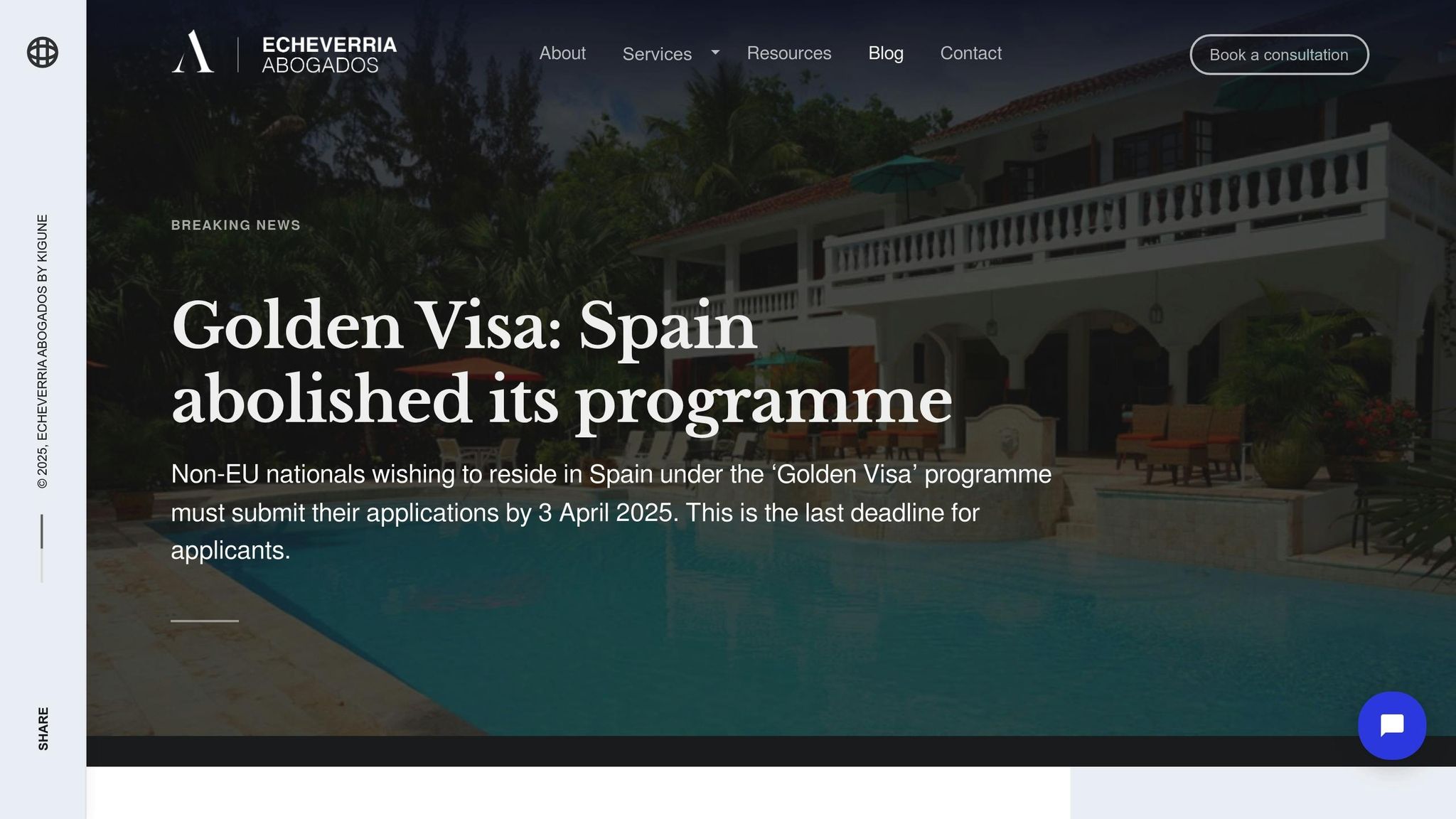
Important Update: Spain’s Golden Visa program officially ended on April 3, 2025. However, understanding its structure can provide useful insights when comparing it to similar residency programs across Europe. Here’s a breakdown of its key features.
Minimum Investment Amount
Spain’s Golden Visa offered several investment options, with real estate being the most popular. The minimum investment for real estate was set at €500,000, which was relatively low compared to other European programs. Here’s a quick look at the options:
| Investment Option | Minimum Amount |
|---|---|
| Real Estate (commercial or residential) | €500,000 |
| Spanish public debt securities | €2,000,000 |
| Shares in Spanish companies | €1,000,000 |
| Investment funds or venture capital | €1,000,000 |
| Bank deposits | €1,000,000 |
A staggering 94% of applicants chose the real estate route, with the average investment reaching €657,204.
Processing Time
Spain was known for its quick processing times compared to other European residency programs. Standard applications were typically processed within 20–30 days. If no decision was made within 20 days, approval was automatically granted. Complex cases, however, could take up to 10 months to resolve.
Eligibility Requirements
The program welcomed non-EU, Swiss, and EEA nationals who could demonstrate sufficient financial resources. Applicants could choose from standard investment options or propose business projects deemed to be of general interest. This flexibility made it particularly appealing for entrepreneurs with innovative ideas.
Pathway to Citizenship
Golden Visa holders could apply for Spanish citizenship after 10 years of continuous residency. To qualify, applicants needed to pass basic tests in Spanish language and civics.
Family Inclusion
The program extended residency rights to immediate family members, including spouses, dependent children, and parents, without requiring additional investments.
Key Lifestyle and Tax Benefits
Spain consistently ranked high for its quality of life and healthcare. Its Mediterranean climate, boasting around 3,000 hours of sunshine annually, and an affordable cost of living further added to its appeal. For example, a family of four could live comfortably on about €2,500 per month (excluding rent), while a three-bedroom apartment in city centers averaged €1,500 per month.
From a tax perspective, non-resident investors were only taxed on income sourced within Spain. Those spending more than 183 days per year in Spain became tax residents and were subject to worldwide income taxation. However, special regimes like the Beckham Law offered potential tax advantages for qualifying individuals.
This comprehensive snapshot of Spain’s Golden Visa program serves as a useful benchmark for evaluating other European residency options.
sbb-itb-39d39a6
5. Austria Private Residence Program
Austria’s Private Residence Program stands out for its focus on financial independence rather than requiring property investment. Applicants need to demonstrate they have sufficient liquid funds and meet specific income thresholds to qualify.
Minimum Investment Requirement
Austria prioritizes financial stability for applicants. According to Henley & Partners, individuals must show approximately €50,000 (around $53,000) in liquid funds in a bank account. The exact amount varies depending on family size.
In addition to liquid funds, applicants must meet annual income requirements based on their household composition:
| Family Composition | Required Annual Income |
|---|---|
| Single applicant | $34,500 (€32,000) |
| Married couple | $53,900 (€50,000) |
| Each additional minor child | $5,400 (€5,000) |
| Family of four | $64,700 (€60,000) |
These financial benchmarks must be verified annually through recent bank statements or other proof of assets. Austria’s emphasis on financial stability ensures a streamlined application process with thorough eligibility checks.
Processing Time
The program operates under a strict quota system, with only about 450 residence permits issued annually. To improve their chances, applicants should start preparing their documents by late summer, finalize them by late November or mid-December, and submit their applications during the first two weeks of January.
Eligibility Requirements
Given the limited number of permits, meeting the program’s criteria is crucial. It is open to third-country nationals (non-EU, EEA, or Swiss citizens) who can demonstrate financial independence without needing employment in Austria. The key requirements include:
- Financial Independence: Applicants must show sufficient income or assets, typically set at twice Austria’s minimum pension amount.
- Housing Arrangements: Proof of suitable accommodation, either through renting or purchasing property, is required.
- Language Proficiency: Main applicants and dependents aged 14+ must achieve A1-level German proficiency.
- Health Insurance: Comprehensive Austrian health insurance covering all risks is mandatory.
- Background Checks: Applicants and dependents must pass due diligence and background screenings.
This program combines strict eligibility standards with a streamlined process, making it an attractive option for individuals seeking European residency.
Family Inclusion
Spouses and minor children can be included in the application, ensuring the program benefits the entire family.
Lifestyle and Tax Benefits
Austria is consistently ranked among the top 10 countries for quality of life. Its passport allows visa-free travel to 189 destinations as of 2024. For non-domiciled residents, Austria also offers favorable tax policies, including potential exemptions on foreign income.
Beyond financial perks, Austria boasts a rich cultural scene, with world-class arts, music, festivals, and historic landmarks. Paired with excellent healthcare and education systems, the country offers an unmatched living experience .
This program is an excellent choice for those who prioritize financial flexibility and access to the European Union and Schengen Area without the need for property investment.
Program Comparison Chart
Here’s a quick comparison of key features across these programs:
| Program | Minimum Investment | Processing Time | Citizenship Pathway | Key Benefits |
|---|---|---|---|---|
| Greece Golden Visa | $265,000 ($850,000 in prime areas) | 1–8 months | 7 years (183+ days/year required) | EU access, lower entry cost |
| Switzerland Residence | $212,000 annual tax or $1.06M business investment | 1–2 months | Limited pathway | Quick processing, premium lifestyle |
| Portugal Golden Visa | $265,000 (cultural donations) | 10–14 months | 5 years (7 days/year average) | Simple residency requirements |
| Spain Golden Visa | $530,000 (real estate) | N/A | 10 years (substantial residency) | Strong real estate opportunities |
| Austria Private Residence | $2.12M liquid funds required | 3–5 months | No direct pathway | Focus on financial independence |
Citizenship timelines vary widely across these options. Switzerland stands out with the fastest processing time (1–2 months), while Portugal offers a streamlined path requiring just 7 days of presence per year for five years . Greece and Spain fall in the middle range, with Greece requiring seven years and over 183 days annually, while Spain mandates 10 years of substantial residency.
This comparison helps entrepreneurs weigh their options and choose a program that aligns with their financial goals and lifestyle preferences.
What Entrepreneurs Should Know
Luxury residency programs in Europe go beyond simply offering residency benefits – they play a pivotal role in shaping tax strategies and safeguarding assets. For entrepreneurs, these programs present unique opportunities to streamline global business operations. By understanding the tax structures, asset protection mechanisms, and regulatory landscapes tied to these programs, entrepreneurs can turn a good investment into a strategic business advantage.
Tax Optimization Strategies
These programs are particularly appealing for entrepreneurs aiming to minimize tax burdens. Many offer lump-sum taxation systems, where a fixed annual payment replaces traditional income-based taxation. This approach not only simplifies tax planning but can also lead to significant savings.
For example:
- Greece imposes a flat €100,000 ($106,000) annual tax on foreign income.
- Italy offers a similar system with a €200,000 ($212,000) annual tax.
- Malta uses a remittance-based system, requiring just €5,000 ($5,300) annually on foreign income exceeding €35,000.
- Monaco eliminates personal income tax altogether.
- Switzerland provides lump-sum taxation, typically ranging from CHF 150,000 to 350,000 ($165,000–$385,000) annually.
"The concept of lump-sum taxation – where individuals pay a fixed annual amount regardless of their actual income – has emerged as an attractive alternative to conventional progressive taxation. These regimes offer predictability, simplicity, and often significant tax savings for those with substantial wealth." – Sofia Meier, Head of Private Clients
Asset Protection and Wealth Structuring
Residency programs also serve as a gateway to sophisticated wealth management. They enable entrepreneurs to reorganize assets, ensuring greater flexibility and security while minimizing future tax risks. This is especially valuable for those managing complex international portfolios.
Trusts, for instance, are a popular tool for wealth transfer and tax efficiency. However, their effectiveness depends on jurisdiction-specific rules, underscoring the importance of expert advice. Global Wealth Protection, for example, specializes in services like offshore company formation, trust management, and tax optimization, helping entrepreneurs navigate the intricacies of international regulations.
Business Environment Considerations
The business climate varies across residency programs, offering different advantages depending on your operational needs. Cyprus, for instance, boasts a corporate tax rate of just 12.5%, one of the lowest in Europe, making it an attractive destination for entrepreneurs establishing a European base.
For digital entrepreneurs, Estonia stands out with its e-Residency program. By 2024, over 117,000 individuals from more than 170 countries had applied for this program, which emphasizes a digital-first approach. This setup is particularly appealing to tech-driven businesses and location-independent professionals, providing a clear regulatory framework for online operations.
Strategic Planning Considerations
Timing and proper planning are essential when leveraging these programs. Unlike traditional immigration routes, these residency options allow entrepreneurs to proactively align their residency and tax status with broader wealth management goals. This foresight helps avoid unexpected tax liabilities while maximizing benefits.
Additionally, the required investments for these programs often align with portfolio diversification strategies. Entrepreneurs can gain residency while simultaneously expanding their investment holdings.
Given the complexity of these decisions, professional advice is crucial. Collaborating with legal and financial advisors who understand both your home country’s tax rules and those of your target residency ensures compliance while fully utilizing favorable tax systems.
Conclusion
European luxury residency programs offer more than just a change of address – they’re powerful tools for accessing international markets, increasing mobility, and safeguarding wealth. These programs provide three key advantages that can reshape global operations: international reach, enhanced travel flexibility, and financial security.
The international reach alone is a game-changer. Gaining European residency means tapping into a market of over 450 million people across 27 EU countries. For entrepreneurs, this isn’t just about market entry; it’s about establishing a base in one of the world’s most advanced business environments. From access to skilled professionals and innovation hubs to funding opportunities, the benefits are immense.
Mobility is another critical advantage. With EU residency, you can travel visa-free across the 26-country Schengen Area. This eliminates the usual bureaucratic hurdles, saving time and opening doors to more business opportunities.
Wealth protection is equally compelling. For example, Greece saw a 34% increase in Golden Visa applications in 2023, highlighting the growing demand for these programs.
"In today’s world, a second residency isn’t a luxury – it’s a financial firewall against uncertainty."
– Project Black Ledger
Flexibility is another major draw for entrepreneurs. Many programs, like Portugal’s Golden Visa, don’t require continuous physical presence, allowing business owners to manage their ventures while enjoying the long-term benefits of residency.
Investment thresholds vary, making these programs accessible to a range of investors. Many also offer a pathway to permanent residency or citizenship, with countries like Portugal granting citizenship after just five years. This opens up opportunities for generational wealth preservation, along with access to top-tier healthcare, education, and social security systems.
These programs not only simplify global operations but also strengthen your competitive position. For entrepreneurs focused on international growth and wealth planning, they provide a unique mix of immediate benefits and long-term potential. Collaborating with experienced advisors who specialize in residency planning, tax strategies, and asset protection – like those at Global Wealth Protection – can maximize these advantages.
Ultimately, European luxury residency programs are about more than where you reside. They’re about how you position yourself for success in an increasingly connected global landscape.
FAQs
What are the key differences in investment requirements and benefits among Europe’s top luxury residency programs?
In 2025, Europe offers a range of luxury residency programs, each with its own investment thresholds and perks. Let’s take a closer look at three standout options:
Greece’s Golden Visa requires a minimum real estate investment of €500,000 (roughly $530,000). It provides visa-free access to the Schengen Area and opens the door to citizenship after seven years. The program is known for its smooth application process and Greece’s appealing lifestyle.
Portugal’s Golden Visa is another compelling choice, offering flexibility with investments starting at €280,000 (about $296,000) for renovation projects or €500,000 ($530,000) for real estate. It’s particularly attractive for those aiming for EU residency without stringent stay requirements.
Switzerland takes exclusivity to another level, demanding an investment of approximately CHF 1 million (around $1.1 million). While significantly more expensive, it delivers a top-tier residency experience, exceptional living standards, and financial advantages. Greece and Portugal may be more accessible, but Switzerland offers unparalleled prestige for those willing to invest at a higher level.
What tax strategies can entrepreneurs use to optimize their finances when applying for European residency?
Entrepreneurs aiming for European residency have several ways to lower their tax obligations. For U.S. citizens, one key tool is the Foreign Earned Income Exclusion (FEIE), which allows them to exclude a significant portion of their foreign income from U.S. taxes. Pair that with the Foreign Tax Credit (FTC), and they can offset taxes paid to European governments, avoiding double taxation on the same income.
Choosing to establish residency in low-tax European countries, such as Malta or Cyprus, can also help entrepreneurs bring down their effective tax rates. These approaches not only simplify tax compliance but also free up more funds for reinvestment and business growth. For many entrepreneurs, European residency becomes a smart financial strategy.
What steps can entrepreneurs take to successfully apply for a luxury residency program in Europe and maximize its benefits?
To navigate the process of applying for a luxury residency program in Europe and make the most of its perks, entrepreneurs should follow a few essential steps.
Start by exploring the residency options in countries like Portugal, Spain, or Greece. These programs often involve investments in areas such as real estate or local businesses. It’s crucial to understand the specific requirements and benefits each program offers to determine which aligns best with your goals.
Once you’ve identified a suitable program, work with experienced legal and financial advisors who specialize in immigration and investment. Their expertise can help you navigate the application process, meet eligibility requirements, and organize the necessary documentation. Staying compliant with local laws – especially regarding taxes and residency obligations – is equally important to avoid complications.
By following these steps, entrepreneurs can enjoy the many benefits luxury residency programs offer, including visa-free travel within the Schengen Area and access to high-quality healthcare and education.
