
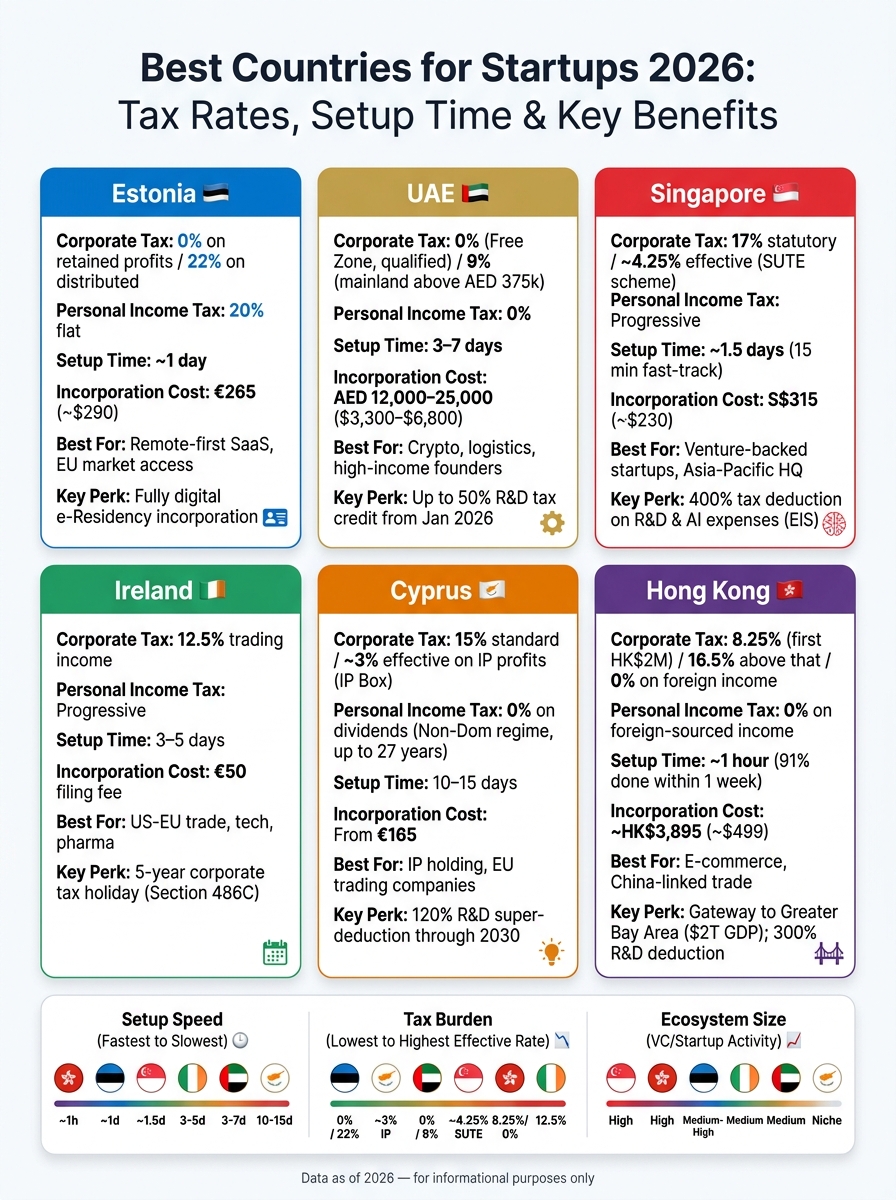
Choosing the right country for your startup can impact taxes, investor confidence, market access, and growth potential. This guide covers six leading options: Estonia, UAE, Singapore, Ireland, Cyprus, and Hong Kong. Each offers unique benefits depending on your business model and goals.
Key Takeaways:
- Estonia: 0% tax on reinvested profits, fully digital incorporation in 1 day.
- UAE: 0% personal income tax, free zones with 0% corporate tax (if qualified).
- Singapore: Low effective tax (~4.25%) for early-stage startups, strong VC access.
- Ireland: 12.5% corporate tax, 5-year tax relief for startups.
- Cyprus: ~3% effective tax on IP profits, 0% tax on dividends (Non-Dom regime).
- Hong Kong: 0% tax on foreign income, fast incorporation, gateway to China.
Quick Comparison:
| Country | Corporate Tax | Personal Income Tax | Setup Time | Best For |
|---|---|---|---|---|
| Estonia | 0% (retained) | 20% flat | ~1 day | Remote-first, EU market access |
| UAE | 0%/9% | 0% | 3–7 days | High-income, crypto, logistics |
| Singapore | 17% (4.25%*) | Progressive | ~1.5 days | Venture-backed, SE Asia HQ |
| Ireland | 12.5% | Progressive | 3–5 days | US-EU trade, tech, pharma |
| Cyprus | 15% (3% IP) | 0% (Non-Dom) | 10–15 days | IP holding, EU trading |
| Hong Kong | 8.25%/16.5% | 0% (foreign) | ~1 hour | E-commerce, China-linked trade |
(*Effective rate under Startup Tax Exemption in Singapore)
Your decision should align with your growth strategy, funding needs, and operational priorities. Let’s dive into the details for each country.
1. Estonia
Estonia might be small in size, but it has made a big name for itself as a thriving startup hub. It holds the top spot globally for unicorns per capita and leads Europe in startups per capita.
A tax system designed for growth. One of Estonia’s standout features is its business-friendly tax structure. Corporate profits aren’t taxed until they’re distributed as dividends, at which point a 22% tax applies. Journalist and e-resident Maya Middlemiss explains it well:
"Estonia doesn’t tax you for making a profit, only when you pay it out to yourself."
This approach allows entrepreneurs to reinvest profits into their businesses without worrying about annual corporate taxes.
Quick and fully digital incorporation. Thanks to Estonia’s e-Residency program, non-EU entrepreneurs can establish an EU-based company entirely online. The process is fast – often completed in just one day – and costs a one-time fee of €265 (around $290). With a government-issued digital ID, founders can handle everything from signing contracts to filing taxes remotely. The ongoing costs are also manageable, ranging from €200 to €400 annually for a virtual address and local contact person.
A thriving startup ecosystem. Estonia’s startup-friendly environment includes a venture capital market managing €3.08 billion as of early 2026, supporting 750 active companies and over 60 accelerator programs. Double taxation agreements with 65 countries simplify international operations, and many founders rely on EEA-based neobanks for seamless financial management that integrates with the e-Residency system.
| Feature | Details |
|---|---|
| Corporate Tax (Retained Profits) | 0% |
| Corporate Tax (Distributed Profits) | 22% |
| Personal Income Tax | 20% flat |
| Incorporation Time | ~1 day |
| Incorporation Cost | €265 (~$290) |
| Annual Maintenance Cost | €200–€400 |
| Double Tax Treaties | 65 countries |
These advantages make Estonia a standout destination for startups looking for tax efficiency and effortless digital incorporation.
Estonia also offers a Startup Visa for non-EU founders who want to relocate, making it easier to hire global talent and tap into the local ecosystem. For remote-first startups aiming to enter the EU market, Estonia presents a compelling option. Next, let’s explore another jurisdiction that’s quickly becoming a global business hotspot.
sbb-itb-39d39a6
2. United Arab Emirates
The UAE has built a reputation as one of the world’s most business-friendly environments, and the statistics back it up. For the fourth year in a row, it ranked No. 1 globally in the Global Entrepreneurship Monitor (GEM) 2024/2025 report, scoring 930 out of 1,000 in a 2025 analysis of entrepreneurial appeal. This reflects deliberate policy decisions aimed at creating an attractive startup ecosystem.
When it comes to taxes, the UAE offers a competitive setup. There’s 0% personal income tax on salaries, dividends, and capital gains. For corporations, a 9% federal tax only applies to profits exceeding AED 375,000 (roughly $102,000). Startups may qualify for 0% corporate tax as a Qualifying Free Zone Person (QFZP), provided they meet substance requirements and maintain audited financials. However, as ASY Legal notes:
"The 0% corporate tax rate still exists, but it is no longer automatic. It is now contingent on a complex set of new rules." – ASY Legal
Adding to the appeal, the UAE recently introduced R&D incentives. Starting January 1, 2026, companies can access a tiered R&D tax credit of up to 50% on qualifying expenditures, capped at AED 5 million per entity. To qualify for the full 50%, businesses need at least 14 R&D staff, over AED 2 million in qualifying costs, and pre-approval from the R&D Council before starting.
Incorporation Options
Setting up a business in the UAE is quick, but the choice of incorporation route matters. Founders can either:
- Choose the Mainland route: This allows access to UAE consumers and government contracts but comes with a 9% tax on profits above the threshold.
- Opt for a Free Zone: Free zones offer a 0% corporate tax rate on qualifying income (subject to substance rules) but restrict onshore trade.
Entry-level free zones like IFZA or RAKEZ can issue licenses within 3–7 business days, with first-year costs ranging from AED 12,000 to AED 25,000 (about $3,300 to $6,800). Since 2021, 100% foreign ownership has been allowed in most sectors, removing the need for a local sponsor.
Startup Support Programs
The UAE’s startup ecosystem is further bolstered by various support initiatives. For example:
- Hub71 in Abu Dhabi: Provides subsidies worth around AED 200,000 (approximately $54,500) for housing, office space, and insurance over two years, without taking equity.
- NextGen FDI program: Speeds up licensing and residency processes for relocating tech teams.
- Golden Visa: Founders recognized by accredited accelerators like Hub71 can secure a 10-year Golden Visa, offering long-term residency and self-sponsorship.
| Key Features for UAE Startups | Details |
|---|---|
| Corporate Tax (below AED 375k) | 0% |
| Corporate Tax (above AED 375k) | 9% |
| Personal Income Tax | 0% |
| Free Zone Qualifying Tax Rate | 0% (with substance requirements) |
| R&D Tax Credit (max rate) | Up to 50% of eligible spend |
| Foreign Ownership | 100% (most sectors) |
| Free Zone Setup Cost (Year 1) | AED 12,000–AED 25,000 ($3,300–$6,800) |
| Mainland Setup Cost (Year 1) | AED 20,000–AED 40,000 ($5,400–$10,900) |
Practical Considerations
One common hurdle for startups is opening a corporate bank account, which typically takes 2–6 weeks. Digital-first banking solutions like Wio and Mashreq NeoBiz can help speed up the process for early-stage businesses.
Next, we’ll look at another Asian hub that’s drawing the attention of global entrepreneurs.
3. Singapore
After the fast-paced environment of the UAE, Singapore emerges as Asia’s top destination for business efficiency. It consistently ranks #1 worldwide for ease of doing business and leads Asia’s innovation index. For startups, this means tangible benefits: incorporating a company takes as little as 1.5 days through ACRA‘s fully digital BizFile+ platform, with routine applications approved in just 15 minutes. The government fee is a flat S$315 (approximately $230), and you can get started with as little as S$1 in paid-up capital.
Tax Structure for Startups
Singapore’s corporate tax rate is a flat 17%, but many startups enjoy a much lower effective rate. Through the Startup Tax Exemption (SUTE) scheme, qualifying companies pay an effective rate of just 4.25% on their first S$100,000 of income during the first three Years of Assessment. Additionally, they receive a 50% exemption on the next S$100,000 of income. Over three years, this can result in up to S$125,000 in tax savings. On top of that, Singapore does not impose capital gains tax or dividend tax, making it easier for founders to manage exits and distribute profits.
"The SUTE scheme aims to lower the effective tax rate for early-stage companies… founders can reinvest capital into growth rather than taxes." – Elisha Yap, Corporate Advisory Specialist
For YA 2026, startups can also benefit from a 40% corporate income tax rebate, capped at S$30,000. Even if a company’s tax bill is minimal, employing at least one local worker guarantees a minimum cash grant of S$1,500.
Innovation and Growth Incentives
Singapore actively supports innovation through programs like the Enterprise Innovation Scheme (EIS), which offers a 400% tax deduction on qualifying expenses related to R&D, intellectual property registration, training, and AI adoption. For AI investments specifically, startups can claim a 400% deduction on up to S$50,000 of qualifying expenses annually, aligning with the government’s push for AI integration in businesses. For startups that aren’t yet profitable, the EIS allows them to convert up to S$100,000 of qualifying expenses into a 20% cash payout (up to S$20,000), providing much-needed cash flow in the early stages.
For startups looking to expand internationally, the Double Tax Deduction for Internationalisation (DTDi) offers a 200% deduction on expenses related to overseas market development. The automatic expense cap for this program will increase to S$400,000 in 2026. Additionally, the Startup SG Equity program, which received a S$1 billion boost in 2026, co-invests alongside private venture capital to support deep-tech and growth-stage companies.
Key Requirements at a Glance
| Requirement | Details |
|---|---|
| Minimum Paid-up Capital | S$1 |
| Corporate Tax Rate | 17% flat (effective ~4.25% under SUTE) |
| Resident Director | At least one required |
| Foreign Ownership | 100% permitted |
| Incorporation Timeline | 15 minutes to 3 days |
| First-Year Cost (Foreign Founder) | S$3,000–S$8,000 |
Foreign founders are required to appoint a local resident director, which typically costs between S$1,500 and S$4,500 annually if using a nominee service. Additionally, applications to ACRA must be submitted through a registered filing agent, so it’s wise to budget for these additional fees.
Singapore’s combination of tax advantages, fast incorporation processes, and support for innovation makes it a prime choice for startups planning their global growth strategy.
4. Ireland
When it comes to European destinations for startups, Ireland shines with its mix of a familiar business culture and a tax-friendly environment. The country is home to over 1,800 major global companies, including 16 of the world’s top 20 tech firms. Add to that the fact that more than 70% of foreign direct investment comes from US companies, and it’s clear why Ireland is a top choice for American entrepreneurs looking to establish a European presence.
Tax Structure for Startups
Ireland boasts a 12.5% corporate tax rate on trading income, one of the lowest among developed nations and well below the OECD average of about 23%. For startups, the Section 486C Startup Relief offers a complete corporate tax holiday for the first five years of trading, as long as the annual tax liability doesn’t exceed €40,000. Additionally, the Knowledge Development Box (KDB) provides a reduced tax rate of 10% on profits from qualifying intellectual property.
However, it’s important to note that not all income qualifies for the 12.5% rate. Passive income, like royalties or rental earnings, is taxed at 25%, while capital gains face a 33% tax rate. As Ciarán Kelly, a Business Tax & Structures Analyst at Eunomist, points out:
"The 12.5% rate… only makes economic sense when CIT savings are substantial – i.e., when the business is profitable at scale."
Incorporating in Ireland
Setting up a company in Ireland is straightforward. The Private Company Limited by Shares (LTD) is the go-to structure for startups and can be registered in just 3–5 working days through the Companies Registration Office (CRO) CORE portal. The flat filing fee is €50, and there’s no minimum share capital requirement, making it accessible for new businesses.
Non-European founders should be aware of the director residency rule: at least one director must reside in the European Economic Area (EEA). If all founders are US-based, you’ll need to appoint a local director or purchase a Section 137 bond, which typically costs between €2,000 and €2,500. Additionally, you’re required to register beneficial owners with the Central Register of Beneficial Ownership (RBO) within five months of incorporation. These steps ensure compliance while positioning your business to take advantage of Ireland’s growth incentives.
Growth Programs and Incentives
Ireland offers a variety of supports to help startups thrive. The R&D Tax Credit is particularly attractive, covering 35% of qualifying expenditure starting in 2026, with a first-year payable threshold of €87,500, as outlined in Budget 2026. For startups not yet turning a profit, this can provide much-needed cash flow.
Enterprise Ireland plays a key role in nurturing startups. Through its High Potential Start-Up (HPSU) program, it offers equity co-investments of up to €800,000 for companies developing groundbreaking technologies. Early-stage entrepreneurs can also explore the Pre-Seed Start Fund (up to €100,000) or the Feasibility Study Grant (up to €30,000) to test their business ideas. Meanwhile, the SURE scheme allows founders who were previously salaried employees to reclaim up to €980,000 in income taxes paid over the last six years, providing a significant boost to their new ventures.
| Program / Incentive | Max Benefit | Who It’s For |
|---|---|---|
| Section 486C Startup Relief | 5-year tax holiday | Early-stage trading companies |
| Knowledge Development Box | 10% effective rate | IP-driven startups |
| R&D Tax Credit | 35% of qualifying spend | Innovative companies |
| Innovative HPSU Fund | €800,000 (equity) | High-potential tech startups |
| Pre-Seed Start Fund | €100,000 | Startups with an MVP |
| SURE Scheme | €980,000 (relief) | Former PAYE entrepreneurs |
5. Cyprus
After exploring Estonia, the UAE, Singapore, and Ireland, Cyprus emerges as another strong contender for startups. Once known for its low-tax appeal, the island has transformed into a prominent European tech hub. Major players like Semrush, Wargaming, and Exness have set up shop here, and the local startup ecosystem secured $450 million in venture capital funding in 2025. With 548 active startups and Limassol’s impressive leap of 192 spots in global startup city rankings, Cyprus is clearly gaining momentum.
Tax Structure for Startups
Cyprus has adjusted its corporate tax policies to align with international standards. Starting January 1, 2026, the corporate income tax rate increased from 12.5% to 15%, meeting BEPS Pillar Two requirements. However, startups centered on intellectual property (IP) can significantly lower their effective tax rate to about 3% using the IP Box regime, which exempts 80% of profits from qualifying intangible assets like software and patents.
Founders relocating to Cyprus can also take advantage of the Non-Domiciled (Non-Dom) regime, which offers 0% tax on dividends and interest for up to 17 to 27 years. On top of that, the country provides a 120% R&D super-deduction through 2030, turning every dollar spent on eligible research into more than a dollar in tax relief.
As Daniel Verblovski from Obtained.com explains:
"Cyprus in 2026 is not the old 12.5% story. It is a more mature and, in many respects, more investable story."
Incorporating in Cyprus
Setting up a company in Cyprus is straightforward and entirely remote, thanks to video KYC and e-signatures. The process takes 10–15 working days, with government fees as low as €165. There’s no statutory minimum share capital requirement – most companies start with €1,000 – and businesses can be 100% foreign-owned without restrictions on nationality or residency.
However, there are some requirements to keep in mind. All companies must undergo an annual statutory audit, which typically costs between €900 and €2,500. Additionally, to access treaty benefits or the IP Box regime, businesses must demonstrate genuine economic substance. This means having a physical presence, appointing local directors, and holding board meetings within Cyprus.
Growth Programs and Incentives
Cyprus supports startups with various funding and growth initiatives. The Cyprus Entrepreneurship Fund (CYPEF) offers working capital and investment loans for small and medium enterprises, while the Cyprus Business Angels Network (CYBAN) connects startups with early-stage funding, backed by 45 members who have invested €4.75 million so far. The Research and Innovation Foundation (RIF) also manages the Iris Portal, a one-stop platform for R&D and innovation grants.
For founders aiming to establish personal tax residency quickly, Cyprus’s 60-day rule allows qualification by spending just 60 days in the country, as long as you maintain a permanent residence and conduct business locally.
| Program / Incentive | Key Benefit | Who It’s For |
|---|---|---|
| IP Box Regime | ~3% effective tax rate on IP profits | Software and patent-driven startups |
| Non-Dom Regime | 0% tax on dividends/interest for up to 27 years | Relocating foreign founders |
| R&D Super-Deduction | 120% deduction on qualifying R&D spend through 2030 | Innovation-focused companies |
| CYBAN | Angel network with €4.75M invested | Fast-growing startups |
Next, we’ll look at what makes Hong Kong an attractive destination for startups.
6. Hong Kong
Hong Kong stands out as one of the most tax-friendly locations for startups. The city operates on a territorial tax system, which means only profits earned within Hong Kong are subject to taxation. If your business activities occur entirely outside the city, you can file an offshore profits claim and enjoy 0% tax on those earnings – an appealing option for startups with global income streams.
For profits earned locally, Hong Kong employs a two-tiered tax system: corporations pay 8.25% on the first HK$2 million (about $256,000) of assessable profits, and 16.5% on any amount above that. On top of this, there’s no VAT, no GST, no capital gains tax, and no withholding tax on dividends or interest. Startups involved in research and development can benefit from tax deductions of up to 300% on eligible R&D expenses. As of March 2026, Hong Kong has signed Comprehensive Double Taxation Agreements (CDTAs) with 57 jurisdictions, making cross-border operations more seamless.
Incorporating in Hong Kong
Setting up a company in Hong Kong is quick and entirely online. Applications submitted through the Companies Registry’s e-Services Portal are often processed in under an hour, with 91% of entrepreneurs completing incorporation within a week. Government fees for electronic filing start at approximately HK$3,895 (around $499). There are no residency restrictions for directors or shareholders, and foreigners can own 100% of the company.
That said, every company must appoint a Hong Kong-resident company secretary and maintain a physical registered address in the city (P.O. boxes are not allowed). Annual audits by a Hong Kong-certified CPA are mandatory, regardless of company size, with costs ranging from HK$5,000 to HK$30,000+, depending on the complexity. Founders should also budget around HK$15,000–$25,000 per year ($1,920–$3,200) for core compliance needs.
"Hong Kong is not a tax shelter you set up and forget. It is an operating jurisdiction – one of the few places in the world where you can incorporate, open a multi-currency account, and begin receiving international payments within two weeks, entirely remotely." – Sneha Patwari, Corporate Secretary Lead, Statrys
Growth Programs and Incentives
Hong Kong’s startup ecosystem is thriving, with 4,694 active startups in 2024. A variety of government-backed programs support this growth. InvestHK‘s StartmeupHK initiative offers tailored advisory services and connections to local networks. Additionally, the Hong Kong Science and Technology Parks (HKSTP) and Cyberport run incubation and acceleration programs, providing funding and office space. For startups looking to expand into mainland China, the BUD Fund offers up to HK$7 million (around $897,000) for branding and market entry efforts.
Perhaps the most strategic advantage of Hong Kong is its role as a gateway to the Greater Bay Area, a megaregion with a combined GDP of about $2 trillion. This gives startups unparalleled access to one of the world’s largest consumer markets.
"Hong Kong’s most singular advantage is its geographic and economic proximity to mainland China, the world’s second-largest economy and a vast market for any ambitious startup." – Harm Hoonstra, Director, MSA
These features make Hong Kong an attractive choice for startups aiming to scale internationally while benefiting from a business-friendly environment.
Pros and Cons
When deciding where to establish your startup, understanding the trade-offs between jurisdictions is crucial. Factors like tax efficiency, ease of incorporation, and scalability can vary significantly depending on your business model and growth stage. Below is a comparison table summarizing the pros and cons of some popular locations for startups.
| Country | Advantage | Disadvantage | Best For |
|---|---|---|---|
| Estonia | 0% tax on retained/reinvested profits; fully digital incorporation in 1 day | 22% tax on dividend distributions; small local VC market | Remote-first SaaS founders, solo operators |
| UAE (Dubai) | 0% personal income tax; 0% corporate tax in Free Zones | 9% mainland corporate tax on profits above AED 375,000; high cost of living | Crypto, logistics, high-income founders |
| Singapore | Effective ~4–8% tax rate for early-stage startups; top-tier VC access | High wages; at least one resident director required | Venture-backed startups, Asia-Pacific HQ |
| Ireland | 12.5% corporate tax; English-speaking EU gateway | Highest price level index in the EU (126 vs. 100); 25% tax on non-trading income | Tech and pharma companies needing EU access |
| Cyprus | 12.5% corporate tax; full EU membership | Smaller startup ecosystem compared to major hubs | European trading companies, IP holding structures |
| Hong Kong | 0% tax on foreign-sourced income; gateway to Greater Bay Area | Political uncertainty; mandatory annual audits; high operational costs | E-commerce, China-linked trade |
Each option offers distinct benefits and challenges, making the choice highly dependent on your business’s specific needs.
For instance, Estonia is ideal for remote-first founders focused on reinvesting profits, thanks to its 0% tax on retained earnings. However, the limited local VC market might be a drawback for those seeking significant funding. On the other hand, Singapore provides an attractive tax rate for early-stage startups and unparalleled access to venture capital, though the higher cost of wages and residency requirements could pose challenges.
Founders often separate incorporation from hiring to strike a balance between credibility and cost. For example, incorporating in Singapore or Ireland can enhance investor appeal, while building your team in more affordable regions like Eastern Europe or India helps manage expenses.
Ultimately, your choice should align with your revenue streams, investor expectations, and tolerance for operational complexity. For businesses generating offshore income, Hong Kong or Cyprus might be favorable. Meanwhile, startups reinvesting profits could benefit from Estonia’s tax structure. There’s no one-size-fits-all solution – your decision should reflect your startup’s unique strategy and goals.
Conclusion
No single country is perfect for every startup. The best choice depends entirely on your specific business needs and goals.
Looking at the data, some trends stand out. Singapore scores an impressive 93/100, thanks to its clear regulations, access to venture capital, and its location near Southeast Asia’s massive market of 680 million consumers. Estonia, on the other hand, is ideal for remote-first, bootstrapped founders looking to reinvest profits without triggering a tax bill. Meanwhile, the UAE is a strong contender for entrepreneurs seeking zero personal income tax and the benefits of free zones.
"The critical question, therefore, is not ‘Where is tax lowest?’ but: Where will this company operate most effectively and grow most sustainably?" – SIGTAX
One trend gaining momentum in 2026 is separating your legal structure from your team’s physical location. As Savory & Partners put it, "The HQ decision is about structure, not geography".
Before making a decision, take the time to check banking access and substance requirements. For instance, opening a bank account can take weeks, and maintaining tax benefits often requires some level of local economic activity. Staying compliant with anti-avoidance rules under OECD BEPS is also crucial to keeping your tax advantages intact. Addressing these details early can save you from headaches down the road and help align your startup’s growth with the right jurisdiction.
FAQs
Do I need to live in the country where I incorporate?
No, you don’t need to live in the country where your business is incorporated. Many places allow businesses to be managed remotely, meaning founders aren’t required to live locally. This setup gives you the freedom to run your company from anywhere while taking advantage of incorporation-friendly policies.
How do “substance requirements” affect my tax rate?
Substance requirements influence your tax rate by ensuring your business conducts genuine economic activities within a specific jurisdiction. This means your company must have a tangible presence, like employees, offices, or operations, to comply with local laws. Adhering to these rules not only helps you avoid penalties but also minimizes the risk of being flagged for profit-shifting practices, which could result in higher taxes. By meeting these standards, your business shows compliance and might qualify for lower tax rates or other favorable policies.
Which country is easiest for startups to open a bank account?
Hong Kong stands out as one of the simplest places for startups to set up a bank account. Entrepreneurs can typically wrap up the process in just three business days, and in many cases, there’s no need for an in-person visit.
