
Want to save on taxes while living abroad? Territorial taxation might be the answer. Here’s the deal: most countries tax only the income earned within their borders, leaving your foreign income untouched. This system is a game-changer for digital nomads, remote workers, and entrepreneurs earning globally.
Key Takeaways:
- Territorial Taxation: You’re taxed only on income earned locally.
- Worldwide Taxation (e.g., U.S.): Taxes global income, even if you live abroad.
- Top Territorial Tax Countries: Panama, Hong Kong, Malaysia.
- Residency Rules: Typically require 183+ days in-country or other ties.
- Benefits: Lower taxes, simpler compliance, no double taxation.
Quick Comparison:
| Country | Residency Requirement | Tax on Foreign Income | Individual Tax Rate | Highlights |
|---|---|---|---|---|
| Panama | 183+ days | Exempt | 0%-25% progressive | Full foreign income exemption |
| Hong Kong | Source-based | Exempt | 2%-17% progressive | Advanced banking, no residency focus |
| Malaysia | 182+ days | Exempt (until 2026) | 0%-30% progressive | Temporary foreign income tax break |
Why It Matters:
Territorial taxation simplifies your tax obligations and reduces costs, but it’s not automatic. You’ll need to establish tax residency, structure your income properly, and comply with local rules. U.S. citizens face extra hurdles due to global tax obligations but can use tools like the Foreign Earned Income Exclusion to ease the burden.
Next Steps: Plan carefully, consult a tax expert, and explore countries with systems that align with your lifestyle and financial goals.
How Territorial Taxation Works
Territorial taxation revolves around a simple principle: a country taxes income earned within its borders, while foreign-sourced income is generally exempt. This system can be a key tool for managing tax liabilities effectively.
Income Sourcing Rules
At its heart, territorial taxation is all about where the work happens. Income is categorized as either domestic or foreign based on the physical location of the work. For example, if a Panama resident works remotely for a U.S.-based company, the income earned in Panama is subject to Panama’s taxes. Similarly, if you run a business in Costa Rica but serve clients abroad, Costa Rica may tax your income because the work is performed locally.
The rules can get more complex when it comes to investment returns, royalties, or income from digital services. Some countries only tax investment income generated from local assets, while others may tax any income managed within their jurisdiction.
Eligibility Requirements
To take advantage of territorial taxation, you need to establish tax residency in a country that offers this system. Residency rules vary by country but often rely on physical presence and other ties. For instance:
- Costa Rica, Malta, and Panama: Require 183 days in-country during the tax year.
- Malaysia: Sets the threshold at 182 days.
- Thailand: Requires 180 days.
- Singapore: Typically expects either 183 days or a consistent pattern of residence.
Some countries offer alternative paths to residency. Paraguay requires obtaining a residency permit and tax ID, along with an annual visit. Uruguay allows for either 183 days of presence or proof that your primary interests are in the country. Georgia also has a 183-day rule but offers special arrangements for high-net-worth individuals, while the Philippines requires relocation under a long-term visa.
Meeting these residency requirements is crucial to access the tax benefits of territorial systems.
Mixed Income Sources
Not all income is straightforward. Many people earn a mix of local and foreign income, and territorial tax systems often address this by focusing on where the work is done or how funds are brought into the country. For instance, even if your income is paid through an offshore entity, tax authorities will still assess where the work was physically performed to determine your tax obligations.
Take Malta, for example. While tax residency requires 183 days in the country, non-domiciled residents are only taxed on income earned locally or foreign income that is brought into Malta. Simply funneling income through an offshore account won’t necessarily shield it from local taxes – what matters is where the work is actually carried out.
Tax advisors often recommend keeping your primary banking outside the territorial tax country to clearly separate local and foreign income. However, given the ever-changing rules around pensions, investments, and digital services, consulting a tax expert is essential when planning your financial setup.
Top Countries with Territorial Tax Systems
Several countries are recognized for their territorial tax systems, which can help reduce your tax obligations when approached strategically. Each offers distinct benefits based on factors like income sources, lifestyle preferences, and long-term objectives.
Panama
Panama operates a simple territorial tax system, taxing only income earned within its borders. This setup is particularly appealing for remote workers and digital entrepreneurs.
The personal income tax rates in Panama are progressive:
- 0% for income up to $11,000
- 15% for income between $11,001 and $50,000
- 25% for income over $50,000
Corporate income tax is set at 25%, alongside an annual Corporate Flat Tax of $300.
To establish tax residency in Panama, you need to either spend more than 183 days in the country within a calendar year or demonstrate significant local ties. Panama also offers the "Friendly Nations" visa program, simplifying residency for citizens of certain countries. This program requires either ownership of Panamanian property valued at a minimum of $200,000 or an equivalent fixed-term deposit with a national bank.
In comparison, Hong Kong takes a different approach, focusing on the origin of income rather than residency status.
Hong Kong
Hong Kong’s territorial tax system is centered on the source of income, not residency. Both residents and non-residents pay salaries tax only on income sourced within Hong Kong.
The salaries tax rates are progressive, ranging from 2% to 17% on net taxable income. However, the maximum tax is capped at a standard rate:
- 15% on the first HK$5 million of net income
- 16% on any amount above that
What sets Hong Kong apart is that residency status plays a minimal role. The primary consideration is whether your income is classified as Hong Kong-sourced, allowing for flexible structuring of business or employment arrangements to minimize local tax liability.
As a global financial hub, Hong Kong offers world-class banking services and investment opportunities, making it an attractive choice for international businesses and traders.
Malaysia
Malaysia provides another compelling option with its modern amenities and expanding economy, making it especially suitable for digital professionals. To qualify as a tax resident, you must spend at least 182 days in the country.
For individuals, Malaysia applies progressive tax rates from 0% to 30% for residents, while non-residents are taxed at a flat 30% on Malaysian-sourced income. Notably, foreign-sourced income is exempt from tax for residents until 2026, creating a temporary but valuable opportunity for international earners.
Malaysia’s Labuan jurisdiction offers additional benefits for businesses, including a 3% tax on audited net profits or an annual flat tax of 20,000 ringgit (around $4,476).
The country also runs the Malaysia My Second Home (MM2H) program, which provides tax exemptions on foreign income under certain conditions. For knowledge workers, Malaysia offers special tax incentives in designated economic zones, making it an attractive destination for tech professionals and consultants.
| Country | Tax Residency Requirement | Individual Tax Rate | Key Advantage |
|---|---|---|---|
| Panama | 183+ days | 0-25% progressive | Full exemption on foreign income |
| Hong Kong | Source-based (residency less critical) | 2-17% progressive | Advanced banking and financial services |
| Malaysia | 182+ days | 0-30% progressive | Foreign income tax-free until 2026 |
When deciding among these jurisdictions, it’s important to weigh more than just tax rates. Panama offers strong privacy protections, Hong Kong boasts a highly developed financial system, and Malaysia combines affordability with modern infrastructure, making it a great choice for digital nomads.
How to Use Territorial Tax Systems
Making the most of territorial tax systems involves careful planning in three key areas: establishing tax residency, structuring your business, and staying compliant with local regulations. It’s not just about relocating – it’s about creating a solid framework for managing your tax obligations effectively.
Establishing Tax Residency
The first step in optimizing territorial taxes is securing tax residency in your chosen country. Residency rules vary, but many jurisdictions require you to spend over 183 days in the country each year. However, simply being physically present isn’t always enough. Authorities may also look at factors like your economic ties, family connections, and whether you maintain a permanent home there.
"Tax residency is a crucial concept that determines an individual’s tax obligations to a specific country." – Global Wealth Protection
Some countries offer residency through investment programs, which can reduce or eliminate physical presence requirements.
Before making the leap, it’s equally important to understand how to exit your current tax residency. This ensures you won’t face double taxation or unexpected financial obligations. Additionally, you’ll need to clearly demonstrate that most of your income comes from foreign sources rather than local activities [2].
Once your residency is in place, the next step is structuring your business to align with your new tax strategy.
Business Structure Planning
How you set up your business can have a big impact on your tax savings. Strategic planning around where you live, work, invest, and incorporate is key to reducing your overall tax burden. One common approach is to register your business in a zero-tax jurisdiction while living in a country that doesn’t tax foreign-sourced income. This combination can significantly lower your tax liability on certain types of income.
It’s also a good idea to keep your primary banking outside the country where you’re benefiting from territorial taxation. This helps clearly separate local and foreign income. Keep in mind that the type of work you do and where you perform it can directly affect your tax responsibilities. Companies are often taxed based on their residency status and where their operations take place. Check if your specific type of income qualifies for exemptions under local rules, as these can vary widely.
Once your business is set up, staying compliant with both local and international tax laws is crucial to preserving your benefits.
Compliance and Reporting
Staying compliant with territorial tax laws means keeping up with reporting requirements and maintaining accurate documentation. For U.S. citizens, this is especially important because you’re required to report worldwide income, no matter where you live. Filing U.S. tax returns is mandatory, and you may need to claim benefits like the Foreign Earned Income Exclusion to avoid being taxed twice.
Another area to watch is foreign financial accounts. U.S. taxpayers must report these accounts through the Report of Foreign Bank and Financial Accounts (FBAR), even if they don’t generate taxable income. If you deal in virtual currencies, those transactions must also be reported to the IRS.
Many countries with territorial tax systems have economic substance requirements. This means you need to show actual business activity within the jurisdiction to qualify for the tax benefits. Simply setting up a company without real operations won’t cut it.
"Each country has its own playbook for territorial taxation. Missing even small requirements can jeopardize those tax benefits you moved for." – Lincoln Global Partners [2]
It’s essential to document all financial transactions and business activities to support your compliance position. Tax authorities may audit your income classifications and residency claims, so having detailed records is critical. Given the complexity of international tax systems, working with a tax advisor who specializes in this area can save you a lot of headaches. For example, U.S. citizens living abroad are eligible for an automatic two-month filing extension, giving you extra time to prepare your taxes – but this doesn’t eliminate your underlying obligations.
Failing to stay compliant can lead to penalties, interest charges, and even the loss of your territorial tax benefits. Regularly reviewing your setup and obligations can help you avoid costly mistakes and keep your tax strategy on track.
sbb-itb-39d39a6
US Citizens and Green Card Holders
For US citizens and green card holders, navigating taxes while living abroad comes with its own set of challenges. Unlike residents of countries with territorial taxation systems, these individuals must report their worldwide income to the IRS, even if they live in a country that taxes only local income. Fortunately, there are strategies to reduce your US tax burden, one of which is the Foreign Earned Income Exclusion (FEIE).
Foreign Earned Income Exclusion (FEIE)
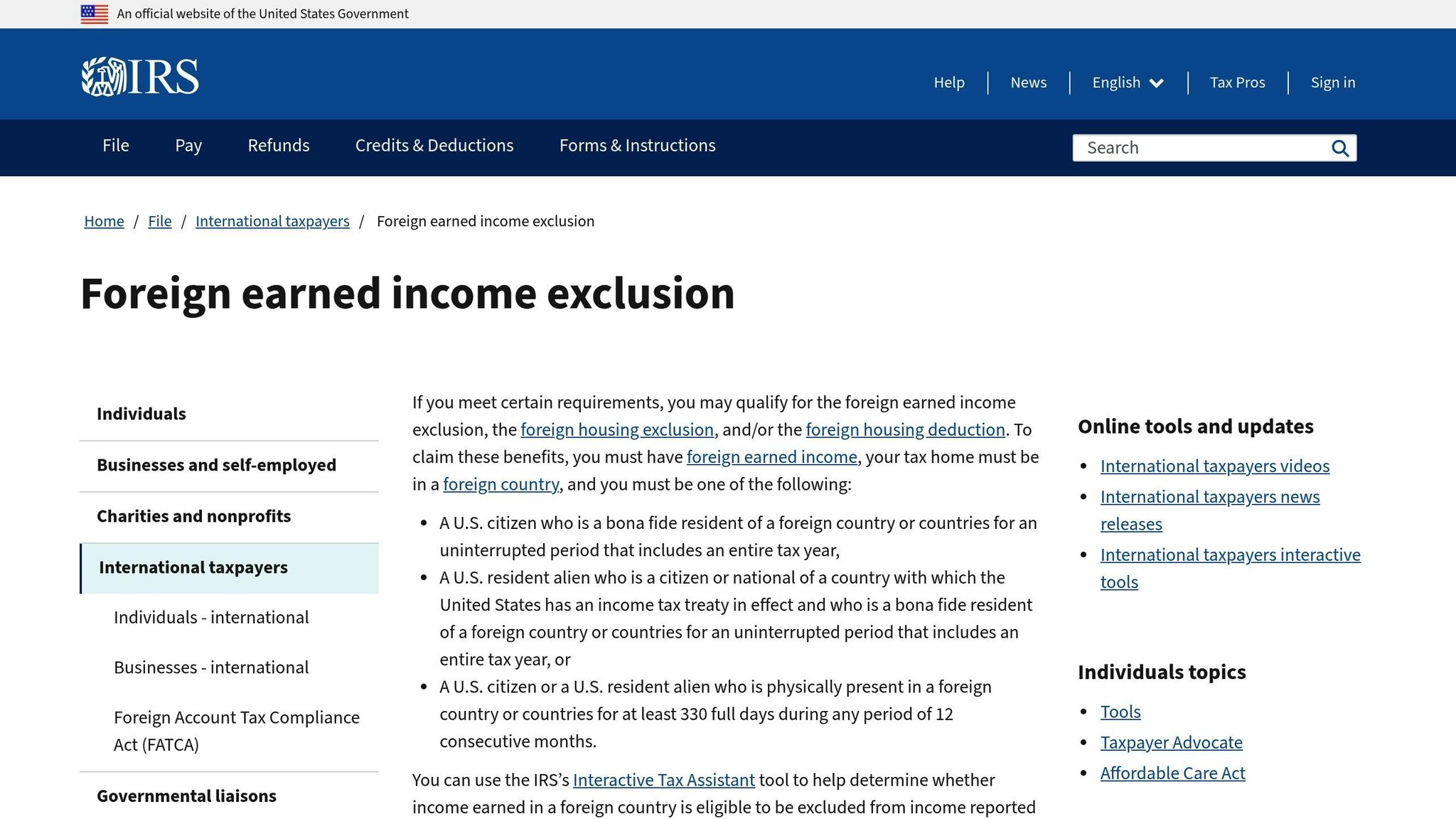
The FEIE is a powerful tool for US expats, allowing them to exclude a significant portion of their foreign-earned income from US taxation. In 2024, the exclusion limit is $126,500, increasing to $130,000 in 2025. Married couples filing jointly can exclude up to $253,000 combined in 2024.
To qualify, you must meet specific criteria. First, you need to establish a tax home in a foreign country. Then, you must satisfy either the Physical Presence Test – spending at least 330 full days in a foreign country within a 12-month period – or the Bona Fide Residence Test, which evaluates whether you’ve genuinely made your home abroad.
The FEIE applies only to income earned through active work performed overseas, such as wages, salaries, and self-employment income. It does not cover passive income like interest, dividends, rental income, or Social Security benefits.
"The Foreign Earned Income Exclusion (FEIE) is one of the most valuable tax benefits available to US citizens and resident aliens who live and work abroad. By excluding foreign-earned income from US taxation, the FEIE can help expats significantly reduce their US tax liability." – TFX
For instance, if Monica earns $127,800 working for a foreign company in Switzerland in 2024, she could exclude $126,500 through the FEIE, leaving just $1,300 subject to US taxes. However, it’s important to note that the FEIE does not reduce self-employment tax. Additionally, once you elect to use the FEIE, you’re generally required to continue claiming it annually unless you formally revoke the election. If revoked, you cannot claim it again for five years without IRS approval.
While the FEIE provides valuable relief for individuals, those operating businesses abroad face additional rules under corporate taxation laws.
Controlled Foreign Corporations (CFC) Rules
If you own a foreign corporation, the IRS may classify it as a Controlled Foreign Corporation (CFC) if US persons collectively own more than 50% of the entity and you personally own at least 10% of its shares. Under CFC rules, you may be required to report and pay US taxes on certain types of undistributed foreign income, such as Subpart F income and Global Intangible Low-Taxed Income (GILTI), even if the income hasn’t been distributed to you. This means that setting up a business in a low- or zero-tax jurisdiction may not shield you from US tax obligations unless the income qualifies as active business income.
FATCA and CRS Requirements
The Foreign Account Tax Compliance Act (FATCA) imposes strict reporting requirements on US persons with foreign financial assets. If your specified foreign financial assets exceed certain thresholds, you must file Form 8938. For expats, the thresholds are $200,000 at the end of the year or $300,000 at any time during the year for single filers, and $400,000 and $600,000 respectively for married couples filing jointly. These assets include foreign bank accounts, mutual funds, stocks held outside US brokerages, foreign trusts, and pensions.
Although many countries have adopted the Common Reporting Standard (CRS) for automatic exchange of financial information, the US relies solely on FATCA to track foreign assets.
"FATCA requires foreign financial institutions (FFIs) such as local banks, stock brokers, hedge funds, insurance companies, and trusts to report the accounts of all US citizens (living in the US and abroad), US ‘persons,’ green card holders." – American Citizens Abroad
Failure to comply with FATCA can result in steep penalties, including a $10,000 initial fine and additional fines for continued non-compliance. It’s also worth noting that FATCA is separate from FBAR (Foreign Bank Account Report). While FBAR focuses on foreign bank accounts exceeding $10,000 at any point during the year, FATCA covers a broader range of financial assets. With around 400,000 global institutions registered under FATCA, chances are your foreign bank is already reporting your account details to the IRS.
If you’ve missed FATCA filings in the past, the IRS offers Streamlined Filing Compliance Procedures to help taxpayers who acted non-willfully catch up without facing the harshest penalties.
For US citizens and green card holders living abroad, the interplay between US tax laws and territorial taxation creates a complex landscape. Careful planning and professional advice are essential to manage these obligations effectively while taking advantage of available benefits.
Conclusion
Territorial taxation presents a compelling option for those looking to legally minimize their tax obligations while working across borders. By understanding how these systems function and crafting a well-thought-out plan, you can shield a significant portion of your income from excessive taxation while enjoying the flexibility of a global lifestyle.
Key Points
Relocating to a territorial tax country offers the freedom to decide where you live, work, invest, and incorporate – choices that can enhance both your financial outcomes and personal well-being. This approach not only reduces your tax burden but also simplifies your global living experience.
Instead of juggling tax filings across multiple jurisdictions, territorial systems focus on taxing only local income. This streamlined approach minimizes administrative headaches and allows you to serve clients worldwide without the risk of double taxation.
However, achieving success with territorial taxation isn’t automatic. It requires thoughtful planning and precise execution. You’ll need to document your income sources clearly, establish tax residency by spending sufficient time in your chosen country, and fully understand the specific rules that apply to your situation. Missing even one requirement could jeopardize your tax benefits.
For U.S. citizens and green card holders, the process is more complex due to citizenship-based taxation. While tools like the Foreign Earned Income Exclusion can ease the burden, you’ll still need to navigate rules around Controlled Foreign Corporations (CFCs), FATCA reporting, and other U.S. tax obligations that follow you no matter where you live.
Next Steps
With these insights in mind, here are some practical steps to consider as you explore territorial taxation. This decision requires careful thought, as the options vary widely. By 2025, 27 of the 34 OECD member countries are expected to have adopted some form of territorial tax system, each with its own set of rules, advantages, and challenges.
"When you add it all up, moving to a territorial tax country can protect most of your income, give you a place to call home (even if it’s not all the time), and let you enjoy the benefits of travel."
- Nomad Capitalist
Before making any moves, take a close look at your financial situation. Assess your income sources, lifestyle priorities, and long-term goals. Different jurisdictions offer varying residency options, each with unique timelines and conditions that will influence your planning.
Seeking professional advice is crucial when dealing with the complexities of international taxation. The interplay between territorial tax systems, treaty networks, compliance requirements, and your personal circumstances can be overwhelming. Expert guidance can help you avoid costly errors and ensure your strategy is both effective and compliant.
Global Wealth Protection specializes in creating tailored international tax strategies for individuals and businesses. Our team can help you evaluate territorial taxation opportunities, navigate regulatory requirements, and structure your financial affairs to optimize tax efficiency while ensuring full compliance across borders.
Work with professionals to design a strategy that maximizes your tax savings and aligns with your global lifestyle goals.
FAQs
What’s the difference between territorial taxation and worldwide taxation?
The main distinction between these systems lies in how they handle income earned outside their borders. Territorial taxation focuses solely on income generated within the country. In this setup, foreign income is generally exempt from taxes. This approach is often designed to attract international businesses and ease the tax load on individuals earning abroad.
In contrast, worldwide taxation applies to a resident’s total income, no matter where it’s earned. To prevent double taxation, countries using this system typically offer credits for taxes already paid to foreign governments. These differences are especially important for expats, digital nomads, and entrepreneurs aiming to manage their tax responsibilities effectively while living or working overseas.
How can U.S. citizens living abroad manage their taxes under a territorial tax system?
U.S. citizens living overseas need to be aware that the U.S. operates under a system that taxes its citizens on their worldwide income. Unlike countries with territorial tax systems, which only tax income earned within their borders, the U.S. requires you to report all income to the IRS, no matter where it’s earned.
To lighten this tax burden, there are provisions you can use. The Foreign Earned Income Exclusion (FEIE) allows you to exclude up to a specific amount of foreign income (adjusted each year) if you meet certain residency or physical presence criteria. Additionally, the Foreign Tax Credit lets you offset taxes you’ve paid to a foreign government against your U.S. tax obligations, which can be a valuable tool for reducing double taxation.
It’s also crucial to stay updated on any legislative changes that might affect Americans living abroad. For example, some proposals aim to introduce non-resident tax status for U.S. citizens overseas. To navigate these complexities and ensure you’re compliant while minimizing your tax liability, consulting a tax professional who specializes in international tax laws is highly recommended.
How can I establish tax residency in a country with a territorial tax system?
To establish tax residency in a country with a territorial tax system, there are a few key steps you’ll typically need to follow. Most countries require you to spend at least 183 days within their borders during the tax year. Beyond that, you’ll usually need a permanent address or residence permit, along with proof of economic ties – this could include local employment, running a business, or making investments in the country.
Since tax laws differ from one country to another, it’s important to understand the specific rules of the country you’re considering. Working with a qualified tax professional can make the process smoother and ensure you’re meeting both local and international tax requirements. By taking these steps, you can better manage your tax obligations while living abroad.
