
Think being a digital nomad means freedom from taxes? Think again. Without proper planning, you could face double taxation, compliance issues, or even legal trouble. Here’s what you need to know:
- Tax Residency Rules: Staying under 183 days in a country doesn’t guarantee you’re tax-free. Different countries have unique criteria for determining tax residency.
- Low-Tax Destinations: Countries like Panama, UAE, and Malta offer tax-friendly options for nomads. Choose wisely based on your lifestyle and financial goals.
- U.S. Citizens Beware: U.S. citizens must file taxes no matter where they live. Use tools like the Foreign Earned Income Exclusion (FEIE) to reduce your tax burden.
- Avoid Double Taxation: Leverage tax treaties and the Foreign Tax Credit (FTC) to prevent paying taxes twice on the same income.
- Offshore Business Structures: Setting up in places like Anguilla or the British Virgin Islands can provide tax benefits and asset protection.
- Stay Compliant: Track your travel days, keep detailed records, and file necessary forms like FBAR and FATCA to avoid penalties.
Action Plan: Establish a clear tax residency, use tax treaties to your advantage, and consult a tax professional to stay compliant with international tax laws.
How to Choose Your Tax Residency
Selecting your tax residency is a critical decision for anyone living as a perpetual traveler. The country where you establish residency determines the tax laws you’ll follow, how much you’ll owe, and the compliance requirements you’ll need to meet. Ideally, you want a jurisdiction that reduces your tax burden while fitting your lifestyle and offering solid legal protections. For digital nomads, destinations that combine favorable tax policies with good living conditions are especially appealing, as outlined below.
Tax Residency Rules Explained
Tax residency is generally determined by two main tests: the Physical Presence Test and the Bona Fide Residence Test.
- The Physical Presence Test evaluates how many days you spend in a country. A common threshold is 183 days, but the specific rules can vary by jurisdiction.
- The Bona Fide Residence Test goes a step further. It looks at whether you’ve established deeper ties to the country, such as owning or renting a home, paying local taxes, setting up bank accounts, or participating in the community. This test focuses on the nature of your connection, not just the number of days spent there.
To maintain your desired tax residency, it’s essential to track your travel dates, economic activities, and ties to avoid crossing into high-tax jurisdictions. These guidelines help you stay compliant while optimizing your tax residency strategy.
Countries with Low Tax Rates for Nomads
If you’re looking for tax-friendly destinations, you’ll generally come across two types of systems: territorial taxation and zero-tax jurisdictions.
- Territorial Tax Systems: In these countries, only income earned within their borders is taxed.
- Panama: Foreign-sourced income is exempt, and domestic income is taxed at 25%. You can gain residency through the Friendly Nations Visa program.
- Malaysia: Only income brought into the country is taxed. Residency is available through programs like Sarawak My Second Home (S-MM2H) and MM2H.
- Zero-Tax Jurisdictions: These countries impose no income tax at all.
- United Arab Emirates (UAE): No income tax (though a 9% corporate tax was introduced in 2023). Residency can be obtained through various investment-based visa options.
- Bahamas and Vanuatu: Both offer complete income tax exemptions, with residency or citizenship available through investment programs.
Some countries also offer special tax arrangements:
- Greece: A flat tax of €100,000 per year is available for qualifying individuals who invest at least €500,000 in property or business.
- Malta: Through the Malta Permanent Residency Program (MPRP), residents can enjoy personal tax breaks and exclusions on certain types of income.
The table below provides a quick comparison of key residency criteria, tax rates, and benefits.
Residency Requirements by Country
| Country | Tax Rate | Residency Requirement | Key Benefits |
|---|---|---|---|
| Panama | 0% on foreign income | Friendly Nations Visa | Territorial taxation; strong banking system |
| Malaysia | 0% on foreign income | MM2H program | Remittance-based taxation |
| Costa Rica | 0% on foreign income | $2,500/month income or $60,000 deposit | Territorial system; stable democracy |
| UAE | 0% income tax | Investment visas | No tax on worldwide income |
| Bahamas | 0% income tax | Investment visas | Complete tax exemption |
| Malta | Special rates available | €500,000+ investment | EU residency benefits |
| Greece | Capped at €100,000 annually | €500,000 investment | EU access; capped tax liability |
Considerations for U.S. Citizens
If you’re a U.S. citizen, it’s important to remember that you must file U.S. tax returns no matter where you live. However, establishing residency in a low-tax country could allow you to take advantage of provisions like the Foreign Earned Income Exclusion (FEIE). For example, in 2025, qualifying U.S. citizens living abroad can exclude up to $130,000 of foreign-earned income from federal income tax.
Choosing the right tax residency means looking beyond just tax rates. You’ll also need to assess how easily you can establish ties in the country and how it fits into your overall lifestyle. With careful planning and diligent record-keeping, you can align your residency status with both your financial goals and your international travel plans. This approach ensures compliance with global tax laws while optimizing your situation.
Using Tax Treaties to Reduce Double Taxation
Double taxation can be a major headache for perpetual travelers, as it happens when two countries tax the same income. Luckily, the United States has tax treaties with over 60 countries to help reduce this burden and lower your overall tax liability. These agreements work alongside U.S. tax rules to ensure you’re not paying taxes twice on the same earnings. They cover a range of income types, including wages, pensions, dividends, interest, royalties, and business profits. To take advantage of these treaties, you’ll need to meet specific filing requirements. Together with other tax relief options, these treaties can help streamline your tax planning.
Foreign Earned Income Exclusion (FEIE) Rules
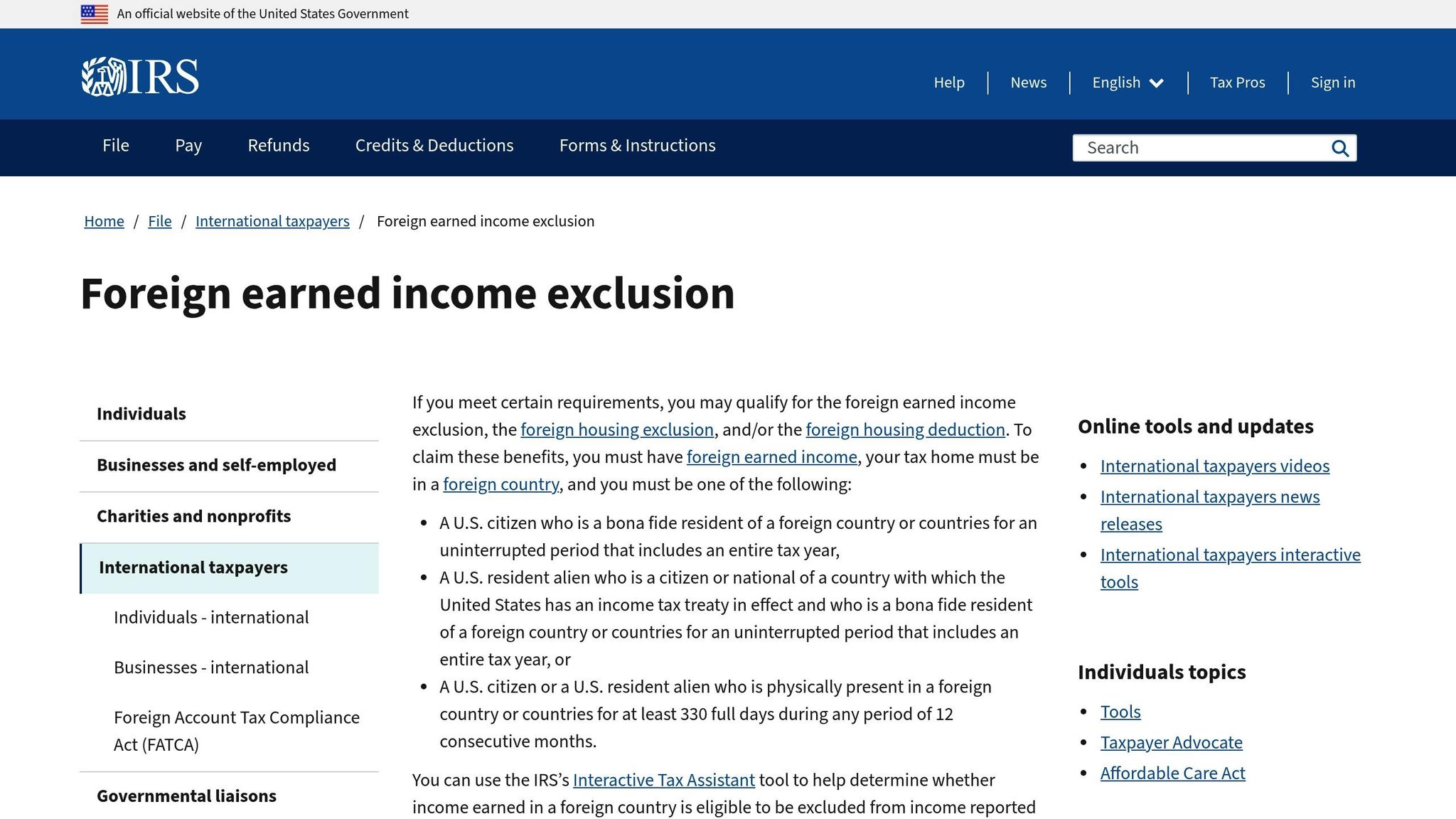
The Foreign Earned Income Exclusion (FEIE) is a valuable option for U.S. citizens living abroad. For the 2024 tax year, it allows you to exclude up to $126,500 of foreign-earned income from federal taxes. This amount adjusts annually for inflation, making it especially helpful for travelers with moderate earnings.
To qualify for the FEIE, you’ll need to meet one of two requirements:
- Physical Presence Test: Spend at least 330 full days abroad within a 12-month period.
- Bona Fide Residence Test: Establish residency in a foreign country for an entire tax year.
It’s important to note that FEIE applies only to earned income, like wages or self-employment income, and cannot be combined with Foreign Tax Credit benefits. For perpetual travelers, keeping detailed records of your entry and exit dates is crucial to meet the eligibility criteria.
Foreign Tax Credit (FTC) Benefits
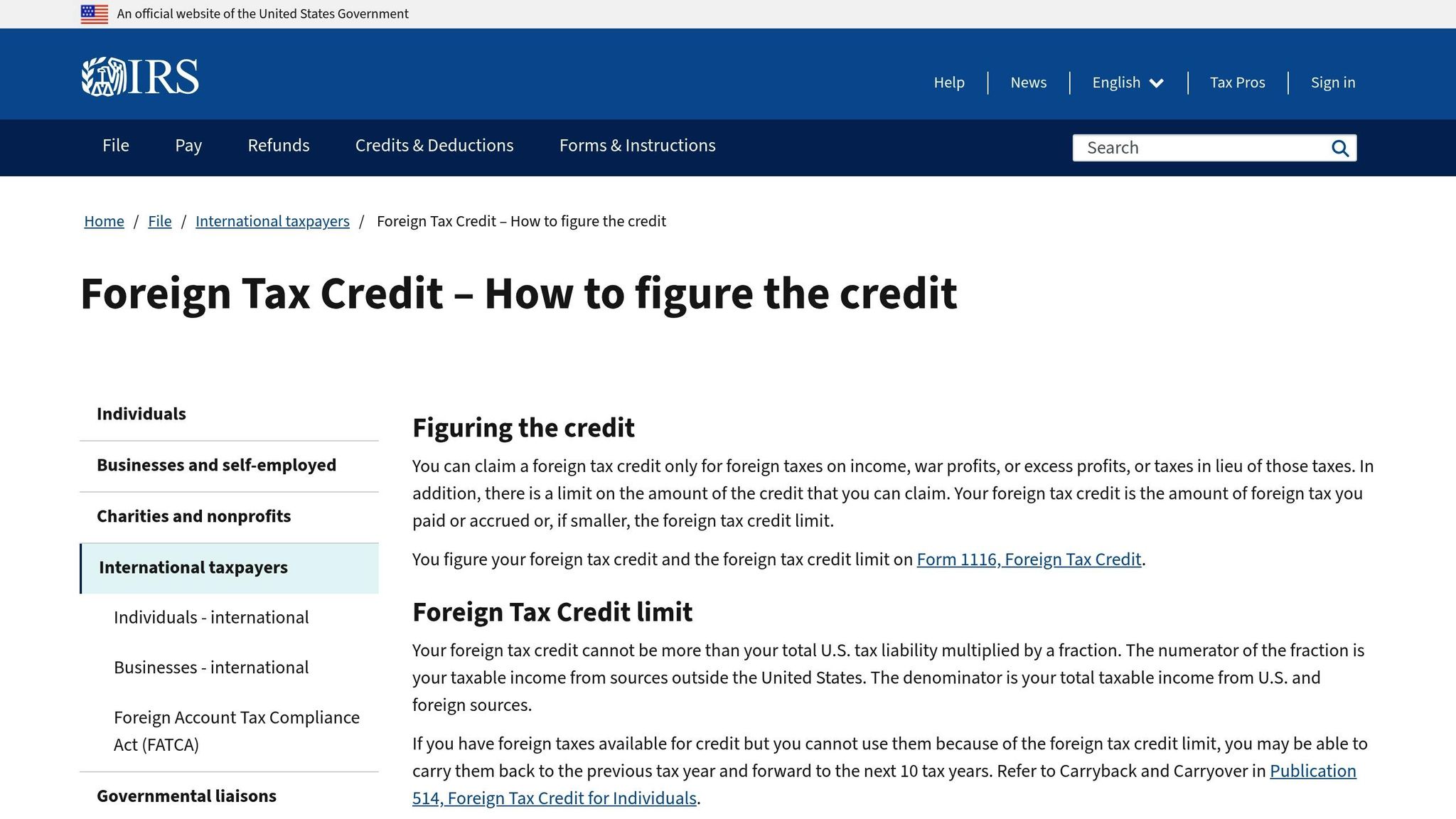
The Foreign Tax Credit (FTC) offers another way to reduce your tax liability, especially if you’re paying higher tax rates abroad. The FTC allows you to offset U.S. taxes on foreign income by claiming a credit for the taxes you’ve paid overseas. Unlike the FEIE, there’s no income cap, which makes it a great option for higher earners. Plus, the FTC covers both earned and passive income, which is ideal for travelers with diverse income sources.
However, there’s a catch: the credit is limited to the amount of U.S. tax owed on your foreign income. In other words, you can’t use foreign taxes to offset U.S. taxes on domestic income. To calculate this, you’ll need to use Form 1116, which requires you to separate your income by country and type.
Tax Treaty Benefits Explained
When combined, FEIE, FTC, and tax treaties create a well-rounded strategy to minimize double taxation. Tax treaties often provide benefits beyond what FEIE and FTC offer. The U.S. has agreements with nearly 70 countries, each with unique provisions tailored to their relationship with the U.S.. For example:
- Some treaties reduce or eliminate withholding taxes on dividends, interest, and royalties.
- The U.S.-U.K. treaty caps the withholding tax on dividends at 15% for portfolio investors.
- The U.S.-Canada treaty ensures certain pension payments are taxed only in the recipient’s country of residence.
However, most treaties include a "Saving Clause", which allows the U.S. government to tax its citizens as if the treaty didn’t exist. Exceptions to this clause often apply to students, teachers, and certain types of foreign-sourced passive income.
To claim treaty benefits, you’ll need to meet specific conditions, like proving residency in the treaty country and demonstrating beneficial ownership of the income. This often involves submitting documentation to both U.S. and foreign tax authorities.
Krystal Pino Leeds, Founder of Nomadtax, emphasizes the importance of professional advice:
"A lot of nomads will read these treaties and attempt to make them fit their situation… It’s important to understand how [the treaty] is used in practice, so speaking with someone who is well-versed in these treaties is helpful."
Navigating tax treaties requires a detailed look at your personal circumstances. Review the treaty between the U.S. and your country of residence, focusing on the provisions that apply to your income. Consulting with a tax expert familiar with both U.S. and foreign tax systems can help you maximize the benefits available to you.
FEIE, FTC, and treaty provisions together offer a powerful way to manage taxes as a perpetual traveler. But with complex rules and potential penalties, careful planning and professional guidance are essential to avoid missteps and align your tax strategy with your financial goals.
Setting Up Offshore Business Structures
Creating offshore business structures can offer perpetual travelers tax benefits, asset protection, and operational flexibility. However, success hinges on selecting the right jurisdiction, structure type, and adhering to international regulations. These structures complement earlier strategies, helping travelers manage their global tax obligations while safeguarding their assets.
Forming Offshore Companies
The choice of jurisdiction is the cornerstone of any offshore strategy. Each jurisdiction provides unique advantages depending on your business goals and tax situation. For example:
- The British Virgin Islands (BVI) is home to the largest number of registered offshore companies worldwide.
- Cyprus boasts one of the EU’s lowest corporate tax rates at 12.5%.
- Anguilla imposes no taxes on foreign-sourced income.
To incorporate an offshore company, you’ll need to work with professional service providers. The process typically involves preparing key documents such as proof of identity, proof of address, and a business plan. Many jurisdictions also require appointing local directors and securing a registered address. Reliable incorporation services are essential to navigate these requirements effectively.
Here’s a quick comparison of popular offshore jurisdictions:
| Jurisdiction | Tax Advantages | Privacy Protections | Notable Limitations |
|---|---|---|---|
| Anguilla | No corporate tax, no income tax, no capital gains tax | Strong | Lesser known jurisdiction (can be a positive or a negative) |
| British Virgin Islands (BVI) | No corporate tax, income tax, or capital gains tax | Strong | Viewed as less transparent by some regulators |
| Singapore | Competitive tax rates; no capital gains tax | Limited | Strict regulations and reporting requirements |
| Belize | No tax on foreign-sourced income; no capital gains tax | Strong | Smaller economy can attract scrutiny |
| Hong Kong | No tax on foreign-sourced income; 8.25%–16.5% local tax rates | Limited | Requires local reporting and auditing |
| Panama | No corporate tax, no capital gains tax, and no local taxation | Strong | Compliance with Know Your Customer (KYC) rules and challenging bank account setup for U.S. citizens |
When it comes to company structures, options like Limited Liability Companies (LLCs) offer tax flexibility and operational control, while International Business Companies (IBCs) simplify compliance. The best choice depends on your business activities and long-term objectives. These structures also provide a solid platform for integrating advanced asset protection tools.
Tax-Deferred Structures for Asset Protection
Beyond standard corporate setups, advanced tools likeAnguilla private foundations and trusts can strengthen asset protection and estate planning. For instance, Anguilla is renowned for their robust asset protection laws, though the costs and complexity are higher than traditional structures.
Nevis offers a compelling alternative, combining zero personal or corporate income tax with strong privacy protections. While company records in Nevis are public, trust details remain confidential, offering discretion to those who prioritize privacy.
These structures work particularly well for high-net-worth individuals aiming to shield assets from creditors while retaining operational control. By separating legal ownership from beneficial control, they create a strong defense against legal claims.
Multi-Currency Banking Setup
Managing international cash flows efficiently often requires multi-currency banking. Setting up these accounts involves choosing a reputable bank and submitting necessary documents, including formation papers, director identification, and a business plan. Banks will then conduct due diligence, verifying your information and business details – a process that can take several weeks.
Multi-currency accounts simplify transactions and reduce exchange costs, with many offshore banks supporting USD, EUR, GBP, and regional currencies. Diversifying banking relationships across jurisdictions spreads risk and ensures access to financial services.
Tax policy changes also play a role in shaping offshore strategies. For example, the UAE introduced a 9% corporate tax in 2023, though certain types of income remain tax-free. Similarly, Hong Kong offers a reduced corporate tax rate of 8.25% on the first HKD 2 million in profits, providing savings for smaller businesses. When combined with a well-structured offshore setup, multi-currency banking can streamline global financial management and mitigate exposure to local tax changes.
To fully benefit from these strategies, it’s crucial to maintain accurate financial records and comply with annual reporting requirements specific to each jurisdiction. This ensures you remain compliant and can take advantage of the benefits these structures offer.
sbb-itb-39d39a6
Staying Compliant with Tax Laws
Navigating tax compliance across multiple countries can feel like a juggling act. It demands precise tracking, thorough record-keeping, and a solid understanding of filing requirements. The challenge grows when you have income from abroad, but setting up the right systems can help you avoid costly errors.
After planning your tax strategy, sticking to strict compliance ensures you maximize any benefits available to you.
Tracking Your Travel Days
Where you spend your time directly impacts your tax responsibilities. Relying on spreadsheets or calendars can lead to errors, especially compared to automated travel tracking apps. These apps monitor border crossings and generate accurate reports on how long you’ve stayed in each country, making it easier to maintain precise records.
When selecting an app, consider features like automatic alerts as you near a country’s stay limit and detailed travel reports for specific timeframes. Some apps also include tools like Schengen calculators and passport indexes, which are particularly helpful for planning travel within Europe. To ensure your records are complete, manually input past trips when setting up the app. This step creates a comprehensive travel history to support your tax residency claims. Keep in mind that apps requiring only manual entries may lack the robust reporting features found in automated options.
Accurate travel logs form the foundation of effective record-keeping.
Record Keeping for Digital Nomads
For digital nomads, staying on top of international tax rules hinges on maintaining well-organized records. The key is to use methods that capture all necessary details without becoming overwhelming, even while constantly on the move.
Store receipts and invoices for business expenses digitally using cloud storage. Keep detailed logs of your business activities, including mileage and the purpose of each expense, to validate your claims. When dealing with multiple currencies, adopt a consistent approach to documenting exchange rates. Specialized expense-tracking software can simplify this process with features like automatic categorization, currency conversion, and integration with banking apps.
Finally, learn the documentation requirements for each country where you operate. This ensures you neither over-document nor miss critical details.
U.S. Filing Requirements for Citizens Abroad
Once your tracking and record-keeping systems are in place, meeting U.S. filing requirements becomes much more manageable.
U.S. citizens and permanent residents living abroad must meet the same filing obligations as those living stateside, regardless of where they earn their income. Filing thresholds are relatively low. For example, in the 2024 tax year, single filers must file if their gross income exceeds $14,600, and self-employed individuals are required to file if their net earnings are $400 or more.
| Form | Description | Filing Threshold (for expats) | Filing Deadline |
|---|---|---|---|
| Form 1040 | U.S. Individual Income Tax Return | Based on income level and filing status | June 16 (automatic extension), October 15 (with Form 4868) |
| FinCEN Form 114 (FBAR) | Report of Foreign Bank and Financial Accounts | Total foreign account value exceeds $10,000 at any time during the year | April 15 (automatic extension to October 15) |
| Form 8938 (FATCA) | Statement of Specified Foreign Financial Assets | Foreign assets exceed $200,000 (single) or $400,000 (married filing jointly) at year-end | Same as Form 1040 |
Expats are required to report foreign bank accounts, assets, investments, and business interests. The FBAR (FinCEN Form 114) tracks where money is held, while FATCA (Form 8938) focuses on how the money is invested. FBAR is filed with FinCEN to combat money laundering, while FATCA is submitted to the IRS to enforce tax compliance.
You must file FinCEN Form 114 if the total value of your foreign accounts exceeds $10,000 and Form 8938 if your foreign assets surpass $200,000 (single) or $400,000 (married). Expats automatically receive a two-month extension for filing their federal tax return, moving the deadline to June 16. If you need more time – for instance, to gather foreign tax documents – you can request an extension until October 15 using Form 4868.
Failing to comply can lead to hefty penalties. Late filing penalties for unpaid taxes can reach up to 25% of the amount owed. Non-willful FBAR violations may result in fines of up to $10,000 per unreported account each year. If you’ve unintentionally fallen behind, the Streamlined Filing Compliance Procedures might help reduce penalties.
The Foreign Earned Income Exclusion allows eligible individuals to exclude up to $126,500 in 2024 (increasing to $130,000 in 2025) from their taxable income using Form 2555. Additionally, the Foreign Tax Credit, claimed with Form 1116, can offset U.S. taxes by the amount of foreign taxes paid.
Lastly, keep documents like lease agreements, utility bills, and employment contracts that show your move abroad was intended to be permanent. These records can be crucial if your residency status is ever questioned.
Staying Updated on Tax Law Changes
Tax laws for perpetual travelers are in constant flux, and keeping up with these changes is essential to avoid compliance issues and potential penalties. The global tax landscape is evolving quickly, with international agreements and regulations for the digital economy reshaping how nomads handle their tax obligations. One key example is the OECD Global Tax Deal, which has introduced new frameworks that could impact tax residency rules.
The OECD Global Tax Deal is one of the most impactful changes in recent years. It includes a 15% Global Minimum Corporate Tax and updated rules for reallocating taxing rights among nations[18]. For digital nomads, this could mean that countries revise their tax residency definitions, potentially broadening the criteria for who is considered taxable under these new guidelines[18].
In the U.S., a 2025 memorandum clarified that the Global Tax Deal does not apply domestically. For American nomads, this highlights the continued control of U.S. tax policy over domestic income. However, as other countries adopt the OECD standards, U.S. nomads may face additional complexity when navigating international tax rules.
Globally, tax authorities are stepping up their cooperation, improving data sharing, and tightening enforcement measures[18]. Governments are closing loopholes to ensure remote workers and digital businesses contribute their share, placing the once-flexible nomadic lifestyle under increased scrutiny[20].
To stay ahead of these changes, it’s crucial to use reliable resources for tax updates. Subscribe to newsletters from organizations like the OECD and IRS to stay informed about policy developments. For instance, the OECD’s "Tax Policy Reforms 2024" report, published in September 2024, covered reforms across 90 jurisdictions and addressed how tax policies are being used to tackle inflation and structural challenges.
Engaging with professional networks can also provide valuable insights. Online forums, tax-focused webinars, and international taxation conferences often offer early analysis of proposed changes. Tools like tax management software, which updates automatically with new laws, and AI-powered research platforms from Bloomberg Tax and Thomson Reuters can simplify compliance by linking directly to primary materials. This is especially important for navigating complex areas like cryptocurrency taxation, as many countries are updating their reporting requirements and tax treatments for digital assets.
Hiring a specialized tax advisor or consulting firm is another effective strategy. Experts familiar with the challenges of digital nomads can clarify confusing situations, help you manage residency thresholds, and navigate tax treaties to reduce stress.
Regularly checking government and legal databases for legislative updates is essential. Setting quarterly reminders to review your tax obligations in both your home country and current location can help you avoid last-minute filing issues. Incorporating these updates into your residency and asset protection planning ensures a more comprehensive approach to tax management.
Tracking your income sources carefully is equally important. Keep records of client locations and the time spent in each country, as this information can affect your tax liability under changing rules[18]. Understanding tax treaties can also help you avoid double taxation, even as these agreements evolve over time[18].
As governments continue to adapt to the digital economy, digital nomads must be proactive. Adjusting travel plans, business structures, or residency strategies in response to new tax policies is essential. Staying informed and flexible will help you build a solid tax management plan that aligns with these ongoing changes.
Conclusion: Your Tax Planning Action Steps
Steer clear of the nomad tax pitfalls by securing a well-defined tax residency, keeping thorough records, and consulting with professionals who understand the intricacies of international tax laws.
Start by establishing tax residency in a jurisdiction that aligns with your financial and travel objectives. Once your residency is in place, take advantage of legal tools like the Foreign Earned Income Exclusion (FEIE) and Foreign Tax Credit (FTC) to reduce your tax obligations.
Keep meticulous records of your travel, income, and expenses. These details are crucial for proving your residency and claiming exclusions. Staying organized also ensures you file on time and avoid penalties. Don’t overlook important forms like FBAR and FATCA, which carry hefty fines for non-compliance.
Finally, seek professional advice to navigate the complexities of international tax rules. A tax expert can help you adjust your strategy as laws change, ensuring you stay compliant while optimizing your financial position.
FAQs
What’s the best way for digital nomads to track their travel days and stay compliant with tax residency rules?
To ensure compliance with tax residency rules, digital nomads should meticulously track their travel history, noting entry and exit dates for each country they visit. Tools like spreadsheets or specialized travel-tracking apps can make this task more manageable and help you keep an eye on critical thresholds, such as the 183-day rule often used to determine tax residency.
Equally important is maintaining thorough records of your income sources, tax payments, and any correspondence with tax authorities. Staying organized not only helps you meet legal requirements but also simplifies handling potential questions or audits down the line.
What’s the difference between the Foreign Earned Income Exclusion (FEIE) and the Foreign Tax Credit (FTC), and how can U.S. citizens decide which one works best for them?
The Foreign Earned Income Exclusion (FEIE) lets U.S. citizens exclude up to $130,000 of foreign-earned income from U.S. taxes starting in 2025. This exclusion applies strictly to earned income, like wages or self-employment income. Meanwhile, the Foreign Tax Credit (FTC) provides a dollar-for-dollar credit on U.S. taxes for foreign taxes paid, covering all types of income – including passive income like dividends or interest.
FEIE tends to work well for individuals earning below the exclusion limit and living in countries with low tax rates. On the flip side, FTC is often more advantageous for those with higher incomes or significant foreign tax liabilities. To qualify for FEIE, you must meet either the Bona Fide Residence Test (proving residency in a foreign country) or the Physical Presence Test (spending at least 330 days outside the U.S. within a 12-month period). FTC, however, doesn’t have these residency requirements.
Deciding between FEIE and FTC depends on factors like your income level, the foreign taxes you pay, and your living arrangements. In some situations, you might even be able to use both. To make the best choice for your circumstances, it’s a good idea to consult a tax professional who can help tailor the strategy to your needs.
How can perpetual travelers set up an offshore business, and what are the key benefits and challenges?
Setting up an offshore business as a perpetual traveler involves a few important steps. First, select a jurisdiction that offers tax-friendly policies and minimal regulatory hurdles – places like Belize or the Cayman Islands are popular choices. Once you’ve picked your location, the next step is to register your business. Many opt for an International Business Corporation (IBC) because it aligns with the legal requirements of these jurisdictions. Lastly, you’ll need to open an offshore bank account to securely manage your finances. Make sure to keep detailed records to meet international and U.S. tax compliance standards.
There are some clear advantages to establishing an offshore business. These include lower tax obligations, stronger asset protection, and increased financial privacy. That said, U.S. citizens are required to report all global income to the IRS and adhere to strict tax rules, which can make the process a bit more complex. To navigate this effectively and take full advantage of an offshore setup, working with a tax professional is highly recommended.
