
Living as a digital nomad doesn’t mean you have to pay excessive taxes. If you’re a U.S. citizen, you’re taxed on worldwide income, but there are legal ways to reduce or even eliminate your tax bill while staying compliant. Here’s how:
- Foreign Earned Income Exclusion (FEIE): Exclude up to $130,000 of foreign-earned income in 2025. Qualify by meeting the Physical Presence Test (330+ days abroad) or Bona Fide Residence Test.
- Foreign Tax Credit (FTC): Offset U.S. taxes with credits for foreign taxes paid. Ideal for high-tax countries.
- Choose Tax-Friendly Countries: Some countries, like Panama and Malaysia, only tax local income, meaning foreign income can be tax-free. Others, like the UAE or Monaco, have no income tax at all.
- Digital Nomad Visas: Countries like Croatia, Spain, and Turkey offer visas with tax perks for remote workers.
- Offshore Business Structures: Setting up an offshore company or U.S. LLC can optimize taxes, but compliance with international reporting rules is essential.
- Avoid State Taxes: Establish residency in a no-income-tax U.S. state (e.g., Florida or Texas) before moving abroad.
- Stay Compliant: File FBAR and FATCA forms if foreign accounts exceed $10,000. Keep detailed records of income, travel, and residency.
Tax Residency Rules and Exit Planning
Tax residency is a critical factor in legally reducing your tax obligations. It determines where you need to report and pay taxes, and it operates independently of your citizenship. This distinction opens up opportunities for strategic tax planning.
How Tax Residency Works
Tax residency rules differ from country to country, but many share similar principles. One common standard is the 183-day rule: if you spend more than 183 days in a country during a tax year, you are typically considered a tax resident there. Beyond time spent, other factors like economic ties (such as owning property or maintaining bank accounts), personal relationships, and the location of your permanent home or primary interests also play a role in determining tax residency.
Things can get complicated if you qualify as a tax resident in multiple countries. For instance, take Sarah, a U.S. citizen and freelance graphic designer. In 2024, she spent six months in Spain, four months in Mexico, and two months in Bali. Because she was in Spain for over 183 days, she became a Spanish tax resident and had to report her worldwide income to Spanish authorities. At the same time, she retained U.S. tax obligations and might have faced additional tax requirements in Mexico, depending on her income sources.
For digital nomads, keeping track of how much time you spend in each location is essential. Without careful monitoring, you could unintentionally trigger tax residency in a high-tax country. Understanding the nuances of tax residency is an important first step, especially if you’re considering formal exit procedures to simplify your tax situation.
Exit Requirements for US Citizens
For U.S. citizens, tax residency rules come with an added layer of complexity. The U.S. taxes its citizens on their worldwide income, no matter where they live or work. While you can’t completely avoid filing requirements, there are legal ways to lower your tax liability, such as using the Foreign Earned Income Exclusion or the Foreign Tax Credit.
If you’re self-employed and earn $400 or more, you’re also subject to a 15.3% self-employment tax, regardless of where the income is earned. Although expatriation is an option for those seeking a permanent solution, most digital nomads manage their tax burden through these exclusions and credits. For those considering expatriation, the IRS has a detailed process for exiting the U.S. tax system. This includes filing all tax returns for the five years prior to expatriation, certifying compliance on Form 8854, and paying a $2,350 consular fee. High-net-worth individuals may also face an exit tax.
In 2024, the IRS considers someone a "covered expatriate" if their average annual net income tax liability exceeds $201,000 or if their net worth is over $2 million. Covered expatriates are subject to an exit tax on the deemed sale of worldwide assets, though there is an exclusion amount of $866,000 for 2024.
How to Avoid Residency Mistakes
Leaving the U.S. doesn’t automatically end your tax residency. Residency is determined by tax treaties and tie-breaker rules, not just physical absence.
Good record-keeping is essential. Keep evidence of your travel (like entry and exit stamps, flight records, and receipts) and track your income and bank accounts. Pay close attention to state tax rules, as some states aggressively pursue former residents for taxes.
Also, remember foreign financial account reporting requirements. If the total value of your foreign accounts exceeds $10,000, you must file an FBAR (Foreign Bank and Financial Accounts Report). Failing to do so can lead to severe penalties.
Because international tax laws are complex, working with a tax professional who specializes in expatriate taxation is highly recommended. Strategic planning is key – map out your goals before making any moves. Consider why you’re changing jurisdictions, the scope of your income and assets, and whether relocating is necessary. Research the tax laws of potential countries carefully, weighing the pros and cons of each.
Tax-Friendly Countries for Digital Nomads
Choosing a country with favorable tax policies can make a huge difference for digital nomads. The right location not only helps reduce your tax obligations but also provides a comfortable and supportive environment for your work and lifestyle.
Countries That Only Tax Local Income
Some countries operate on a territorial tax system, meaning they only tax income earned within their borders. This can be a major advantage for digital nomads earning income from abroad.
Panama is a prime example. Since it uses the U.S. dollar, financial planning is easier for American nomads. Take Alex, a software developer earning $100,000 annually from U.S.-based clients while living in Panama. Thanks to the country’s tax system, he pays $0 in local taxes on his foreign income. Panama also offers a Digital Nomad Visa, which requires an annual income of $50,000 and costs about $300 to apply.
Malaysia is another great option, offering programs like the DE Rantau Digital Nomad Pass and the MM2H (Malaysia My Second Home) program. For example, Sarah, a digital marketing consultant, runs a UK-based business generating $120,000 annually. While living in Kuala Lumpur, she pays no personal tax on her foreign income due to Malaysia’s exemption policy. The DE Rantau program requires a $50,000 annual income, while MM2H demands assets worth RM 1.5 million.
Here’s how Panama and Malaysia compare:
| Factor | Panama | Malaysia |
|---|---|---|
| Duration | 2 years (renewable) | 2 years (DE Rantau) / 10 years (MM2H) |
| Income Requirement | $50,000 annually | $50,000 (DE Rantau) / RM 1.5M (MM2H) |
| Tax on Foreign Income | 0% (territorial system) | 0% (exemption policy) |
| Processing Time | 2–3 months | 3–4 months (DE Rantau) / 6–12 months (MM2H) |
| Currency | USD | Malaysian Ringgit |
| Time Zone Advantage | Americas-focused | Asia-Pacific focused |
Other countries with similar tax systems include Paraguay, Costa Rica, Nicaragua, Uruguay, Singapore, Malta, Georgia, and Hong Kong [10]. To take full advantage, ensure most of your income originates from outside the country where you reside [10].
Now, let’s look at places where there’s no income tax at all.
Countries With No Income Tax
Zero-tax countries don’t impose personal income taxes, but they might have other taxes or higher living costs. These destinations are worth considering if your financial situation aligns with their requirements.
The United Arab Emirates (UAE) has become a popular choice for digital nomads. Cities like Dubai and Abu Dhabi boast excellent infrastructure, top-tier internet connectivity, and straightforward remote work visa options. The UAE imposes no personal income tax, and visa costs range from $81 to $287. To establish tax residency, you’ll need to meet specific criteria, often including physical presence.
Monaco, known for its luxury and privacy, offers a tax-free haven for residents. However, living here comes with steep costs, especially for real estate. You’ll also need to stay at least 183 days annually to qualify as a tax resident.
Other zero-tax options include Caribbean nations like the Bahamas and Vanuatu. Bahrain is another possibility, where a 90-day stay establishes tax residency. While Bahrain offers lower living costs compared to Monaco, some areas may lack modern infrastructure.
Beyond tax advantages, many of these countries make it easier for remote workers to settle in through digital nomad visa programs.
Digital Nomad Visas and Residency Programs
Digital nomad visas are designed to attract remote workers by simplifying residency requirements while offering tax perks.
Turkey introduced its Digital Nomad Visa in April 2024. It’s available to remote workers aged 21–55 from 36 countries, including the U.S., Canada, and the EU. Applicants must earn at least $3,000 per month ($36,000 annually), hold a university degree, and either work for a foreign employer or be self-employed. The visa costs $190.
Croatia waives local income tax for digital nomads during their stay. The visa costs about $73, with an additional $66 for the permit. Applicants need to show a monthly income of $2,658 for stays ranging from six to twelve months.
Spain offers a digital nomad visa with an initial term of one year, renewable for up to three years. The application costs around $73 for the consular fee and $80 for the NIE (foreigner identification number). To qualify, you’ll need to demonstrate a monthly income of about $2,762.
When choosing a program, think about factors like internet reliability, time zone compatibility with your clients, cost of living, and visa processing times. For instance, Michael, a freelance designer earning $135,000 annually from clients in Europe and the U.S., maintains tax residency in Panama. Thanks to its territorial tax system, he pays $0 in local taxes, a setup that perfectly aligns with both his business and lifestyle needs.
Strategic planning and thoughtful decisions can make a world of difference for digital nomads seeking the right balance between tax savings and quality of life.
Using Tax Treaties and Double Taxation Agreements
Tax treaties can be incredibly useful for digital nomads, as they aim to prevent individuals from being taxed twice on income earned across multiple countries. However, U.S. citizens face specific challenges when leveraging these agreements.
What Double Taxation Agreements Do
Tax treaties are designed to clarify which country has the right to tax certain types of income. They often include provisions for reduced tax rates or exemptions. For instance, a treaty might state that business income is taxable only in your country of residence or that withholding rates on investment income are lowered. These agreements help determine whether taxes are owed to the United States, your host country, or both.
That said, most U.S. tax treaties include a "saving clause", which allows the U.S. to tax its citizens as if the treaty didn’t exist. This significantly limits the benefits for digital nomads. While exceptions exist for specific groups like students, trainees, educators, researchers, and diplomats, they rarely apply to digital nomads. As a result, many find alternatives like the Foreign Earned Income Exclusion (FEIE) or the Foreign Tax Credit (FTC) more practical than relying on tax treaties alone.
How to Claim Treaty Benefits
Tax treaties can still offer advantages in certain scenarios, but claiming these benefits requires careful steps:
- Check for an existing treaty: Confirm that a tax treaty exists between the U.S. and your country of residence, as provisions can differ widely.
- Obtain a taxpayer ID: Ensure you have a U.S. Social Security number or an Individual Taxpayer Identification Number (ITIN).
- Complete the necessary forms: For income not tied to personal services, submit Form W-8BEN to the withholding agent. For income linked to personal services, use Form 8233 instead.
- File Form 8833: If claiming treaty benefits that modify IRS rules, include Form 8833 (Treaty-Based Return Position Disclosure) with your tax return. You’ll also need to certify that you’re a resident of a treaty country, the beneficial owner of the income, and meet the treaty’s limitation on benefits provision.
Keep thorough records of your residency and any supporting documentation for your claims. Be aware that some U.S. states don’t honor treaty provisions, meaning you might still owe state taxes even if your federal tax liability is reduced.
By following these steps, you can assess which treaties offer the most practical benefits for your circumstances.
Best Tax Treaties for U.S. Digital Nomads
Some tax treaties stand out for offering specific advantages to U.S. digital nomads. For instance:
- Canada: The U.S.-Canada treaty includes reciprocal tax exemptions for pensions and annuities, favorable taxation of Social Security benefits, and deferred taxes on retirement distributions. For example, a U.S. citizen living in Canada who receives a $20,000 CAD annual pension might have $2,000 CAD exempt from both Canadian and U.S. taxes.
- United Kingdom: This treaty allows tax-free lump-sum pension withdrawals and offers favorable treatment of Social Security benefits.
- France: The U.S.-France treaty provides relief from double taxation for businesses and offers favorable treatment of Social Security contributions, which can be especially helpful for digital nomads running consulting or service-based operations.
That said, for many working-age digital nomads, the Foreign Tax Credit (FTC) often proves more beneficial – especially if you’re living in a high-tax country. The FTC lets you offset foreign taxes paid against your U.S. tax liability, simplifying your situation compared to navigating treaty provisions.
Tax treaties can be complicated, particularly for those frequently moving between countries. Many digital nomads find that combining the Foreign Earned Income Exclusion with strategic business planning provides more consistent tax savings than relying solely on treaties.
Consulting a tax professional is essential to fully understand your tax obligations and ensure compliance. Tax laws and treaties evolve, so staying informed about changes is critical.
sbb-itb-39d39a6
US Tax Exclusions and Credits for Expats
US expats have specific tools at their disposal to help manage their tax obligations. Two key options provided by the IRS – the Foreign Earned Income Exclusion (FEIE) and the Foreign Tax Credit (FTC) – are designed to ease the burden of double taxation on foreign income. While these provisions work differently, they share the same goal: ensuring you’re not taxed twice on the same income.
Foreign Earned Income Exclusion (FEIE)
The FEIE lets eligible US taxpayers exclude up to $130,000 of foreign-earned income from US taxes for the 2025 tax year. This exclusion applies strictly to earned income, such as wages, fees, or self-employment income. It does not cover investment income, rental income, pensions, Social Security, or wages from the US government.
To qualify for the FEIE, you must meet these criteria:
- Have foreign-earned income.
- Maintain a tax home in a foreign country.
- Pass either the Physical Presence Test or the Bona Fide Residence Test.
The Physical Presence Test requires you to spend at least 330 full days in a foreign country within a 12-month period. This test is particularly popular with digital nomads since it’s easier to meet by carefully tracking travel days. Even a single day in the US can affect eligibility, so precision is key. Alternatively, the Bona Fide Residence Test involves establishing residency in a foreign country for an entire tax year.
For married couples where both spouses qualify, the benefits can double, allowing up to $260,000 of combined income to be excluded in 2025.
Foreign Tax Credit (FTC)
The FTC is another powerful tool, allowing taxpayers to offset their US tax liability by claiming credits for taxes paid to foreign governments. Unlike the FEIE, which applies only to earned income, the FTC can be used for all types of income – wages, business earnings, dividends, rental income, and more.
The IRS calculates your FTC limit based on the ratio of your foreign income to your total income, then applies this proportion to your US tax liability. If you have excess credits, you can carry them back one year or forward for up to ten years.
To claim the FTC, you’ll need to file Form 1116. However, if your total foreign taxes paid are $300 or less ($600 for married couples filing jointly) and your foreign income is passive and fully taxed, you may skip Form 1116 and claim the credit directly on Schedule 3 of Form 1040.
| Feature | Foreign Tax Credit (FTC) | Foreign Earned Income Exclusion (FEIE) |
|---|---|---|
| How it works | Reduces US tax liability dollar-for-dollar for foreign taxes paid | Excludes foreign-earned income from US taxation |
| Best for | Expats in high-tax countries with significant foreign tax obligations | Expats in low-tax or no-tax countries |
| Annual limit | No strict limit, but tied to US tax owed | $130,000 (2025 tax year) |
| Applies to | All income types (wages, business, dividends, rental) | Only earned income (e.g., wages, salary, self-employment) |
Choosing between the FTC and the FEIE depends on your specific circumstances. Expats in high-tax countries often benefit more from the FTC, while those in low-tax or no-tax countries may find the FEIE more advantageous. Keep in mind, though, that you can’t apply both benefits to the same income, so strategic planning is critical.
FBAR and FATCA Reporting Requirements
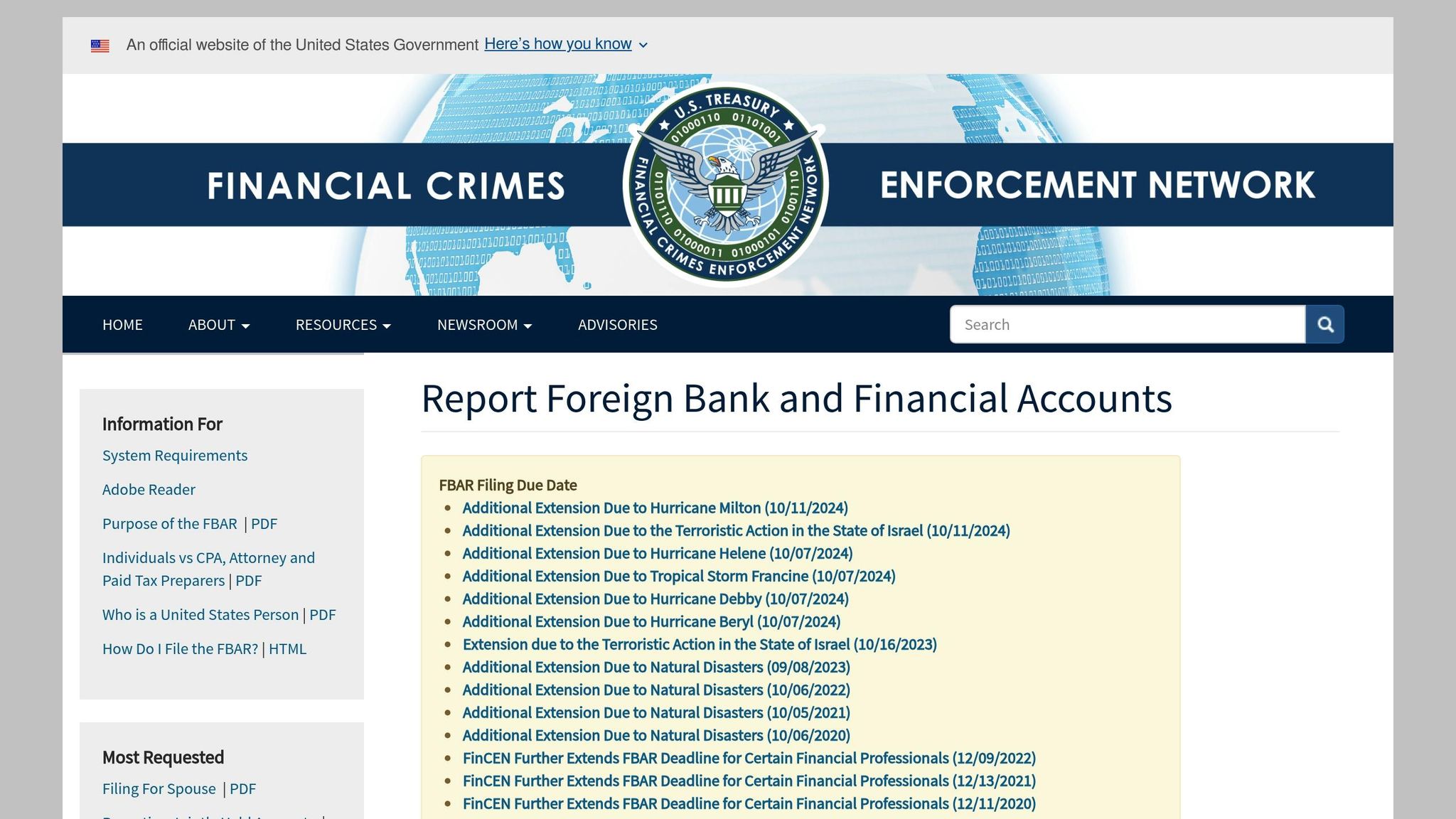
In addition to leveraging these tax benefits, US citizens living abroad must comply with strict foreign account reporting rules. If the total value of your foreign accounts exceeds $10,000 at any point during the year, you’re required to file an FBAR (FinCEN Form 114) by April 15, with an automatic extension to October 15 available.
Under FATCA, you’ll also need to file Form 8938 if your foreign financial assets exceed specific thresholds. For unmarried individuals, the thresholds are:
- $200,000 on the last day of the tax year.
- $300,000 at any time during the year.
Married couples filing jointly have higher thresholds. Penalties for failing to comply with FBAR or FATCA requirements can be severe, so it’s essential to maintain detailed records, including account statements, opening and closing dates, and the highest balances throughout the year.
Setting Up International Business Structures
Setting up your business internationally is a key step toward achieving legal, zero-tax status as a digital nomad. While personal tax strategies are important, establishing the right business structure can further optimize your tax position. For digital nomads, these structures not only help reduce taxes but also safeguard assets while staying within legal boundaries.
Offshore Company Formation
Creating an offshore company is one of the most effective ways to optimize taxes and protect assets. The process involves selecting the right jurisdiction, preparing incorporation documents, filing necessary forms, and setting up banking relationships. Some jurisdictions stand out for their advantages:
- British Virgin Islands: No corporate tax, strong confidentiality, and incorporation can be completed in as little as 24 hours.
- Cayman Islands: No direct taxes, though compliance costs can be higher.
- Seychelles: Offers quick registration, low annual fees (ranging from $100–200), and minimal reporting requirements.
- UAE: 0% corporate tax, excellent banking access, and long-term residency options.
- Singapore: Only taxes local-source income, making it ideal for businesses with diverse international operations.
"It is the duty of everyone to minimize their taxes within the bounds of the law." – Judge Learned Hand
When setting up an offshore company, it’s crucial to consider how it aligns with your personal tax residency. If you’re based in a high-tax country, Controlled Foreign Corporation (CFC) rules may apply, potentially leading to unexpected tax liabilities. Additionally, the "management and control" principle is critical: if major business decisions are made in a high-tax jurisdiction, your offshore company could be classified as having a permanent establishment, making it subject to local taxes.
Private US LLCs and Offshore Trusts
In addition to offshore companies, combining a US LLC with an offshore trust can provide extra protection and flexibility. US LLCs, particularly in states like Delaware, Wyoming, and Nevada, are popular for their privacy protections, business-friendly laws, and favorable tax treatment. Income from LLCs is only taxed at the member level.
LLCs also offer options for tax treatment. For instance, filing Form 2553 lets an LLC elect S Corporation status, which can help reduce self-employment taxes on distributions exceeding a reasonable salary.
Offshore trusts add another layer of asset protection and tax efficiency. When paired with strategic tax residency planning, they can be a powerful tool for long-term wealth management.
International Compliance Requirements
Governments worldwide are increasingly cracking down on tax avoidance. Over 120 countries now participate in the Common Reporting Standard (CRS), enabling the automatic exchange of financial account information. Offshore companies must meet transparency standards and adhere to reporting obligations across multiple jurisdictions.
Economic substance requirements are becoming more common. Many jurisdictions now require companies to demonstrate actual business activities – such as employing local staff, maintaining offices, or generating income within the country – to validate their incorporation claims. Additionally, compliance with Know Your Customer (KYC) and anti-money laundering regulations is mandatory, requiring detailed documentation on ownership and the source of funds.
Non-compliance can lead to severe penalties. For example, US individuals who fail to report foreign assets may face fines of up to $50,000, plus an additional 40% penalty on unreported income for willful violations. Similarly, US companies with foreign subsidiaries that fail to keep proper records of related-party transactions can be fined $25,000.
"Today’s offshore companies must be structured for tomorrow’s regulations, not yesterday’s." – Manar, Legal Expert at OVZA
Given the complex and ever-changing nature of international tax laws, professional advice is essential. Regular compliance reviews and a flexible approach to structuring your business can help ensure it remains effective and fully compliant.
Conclusion: Your Path to Legal Tax Optimization
Legal tax optimization for digital nomads revolves around understanding key concepts like tax residency, international treaties, U.S. exclusions, and effective income structuring. For U.S. citizens and Green Card holders, filing annual tax returns is mandatory, no matter where they live.
One of the most effective tools for reducing U.S. tax liability is the Foreign Earned Income Exclusion (FEIE), which allows you to exclude a significant portion of foreign-earned income from taxation. Additionally, the Foreign Tax Credit (FTC) ensures you’re not taxed twice by letting you claim credits for taxes paid to other countries. Pairing these strategies with residency in nations that only tax local income can create highly efficient tax scenarios.
Freelancers should also consider self-employment tax, which is roughly 15.3%. However, some Totalization Agreements may exempt you from this tax. If you’re planning to go abroad, establishing residency in a no-income-tax state like Texas, Florida, or Nevada can streamline your overall tax strategy.
Compliance with reporting requirements is critical to avoid harsh penalties. International tax laws are complex, with ever-changing rules around tax treaties, controlled foreign corporations, and economic substance requirements. Because of this, professional guidance is not just helpful – it’s essential. The right strategies for one digital nomad may not work for another, as individual circumstances and income sources vary widely.
For those seeking tailored solutions, Global Wealth Protection offers services designed specifically for location-independent entrepreneurs. From forming private U.S. LLCs to creating offshore company structures and offering strategic consultations, they provide the tools to help you stay compliant while optimizing your financial freedom.
FAQs
What are the requirements to qualify for the Foreign Earned Income Exclusion under the Physical Presence Test or Bona Fide Residence Test?
To qualify for the Foreign Earned Income Exclusion (FEIE), you can use one of two tests: the Physical Presence Test or the Bona Fide Residence Test.
- The Physical Presence Test requires you to spend at least 330 full days in a foreign country (or countries) during any 12-month period. These days don’t need to be consecutive, but they must fall within the same 12 months.
- The Bona Fide Residence Test involves proving that you were a resident of a foreign country for an entire tax year (January 1 to December 31). This test also looks at factors such as your visa type, connections to the foreign country, and whether you maintain a home in the U.S. Importantly, you must demonstrate no intention of permanently leaving the foreign country during that year.
Both tests demand meticulous tracking of your time abroad and solid documentation to support your claim. To ensure you meet IRS requirements and make the most of your tax benefits, consult a tax professional.
What should digital nomads consider when selecting a tax-friendly country?
When choosing a tax-friendly country, digital nomads need to weigh several essential factors. Start by examining the country’s tax residency rules and whether it imposes taxes on income earned abroad. Countries with territorial taxation systems or those offering double taxation agreements can help you avoid paying taxes on the same income twice.
You should also think about the cost of living, quality of life, and whether the country provides perks like digital nomad visas or tax breaks specifically designed for remote workers. For instance, Panama is a popular option because it doesn’t tax foreign income, while Portugal’s non-habitual resident tax regime offers appealing benefits. Make sure to stay compliant with both local laws and international tax regulations to steer clear of any legal or financial issues.
How can tax treaties help U.S. digital nomads avoid double taxation while working abroad?
Tax treaties are a crucial tool for U.S. digital nomads aiming to avoid double taxation. These agreements define how income is taxed between the U.S. and other countries, often including provisions for tax credits, exclusions, or deductions. This ensures you’re not taxed twice on the same income. They also clarify tax residency rules and may address whether remote work establishes a permanent establishment (PE), which could lead to local tax obligations.
A key benefit for U.S. citizens working abroad is the Foreign Earned Income Exclusion (FEIE). This allows eligible individuals to exclude a portion of their foreign income from U.S. taxes. Properly understanding and applying treaty benefits can help you lower your tax burden while staying compliant with both U.S. and international tax laws. To make the most of these treaties, it’s essential to consult a tax professional who can guide you through the specific terms and optimize your situation.
