
Offshore banking privacy in 2025 is about protecting your financial information while complying with global regulations like FATCA and CRS. This guide explains how offshore accounts offer privacy, flexibility, and security for assets, while also ensuring legal compliance. Key takeaways:
- Why It Matters: Offshore banking shields assets from risks like identity theft or political targeting and supports international investments.
- Regulatory Landscape: FATCA and CRS require transparency but allow privacy within legal limits.
- Choosing a Jurisdiction: Factors include banking secrecy laws, political stability, and compliance with global standards. Top options include Switzerland, Singapore, Nevis, Belize, and the Cayman Islands.
- Best Practices: Use legal structures like trusts, maintain accurate records, and work with advisors to stay compliant.
Quick Comparison of Key Jurisdictions
| Jurisdiction | Strengths | Privacy Features | Best For |
|---|---|---|---|
| Switzerland | Wealth management | Strong banking secrecy | High-net-worth individuals |
| Singapore | Access to Asian markets | Advanced data protection | Tech-savvy investors |
| Nevis | Asset protection | Anonymous company formation | Trust structures |
| Belize | Cost-effective solutions | Strong confidentiality laws | Cost-conscious clients |
| Cayman Islands | Institutional banking hub | No public ownership registries | Complex financial arrangements |
Offshore banking is no longer about secrecy alone. It’s about balancing privacy with compliance while safeguarding your assets. Read on for a deeper dive into regulations, jurisdictions, and strategies.
Legal and Regulatory Requirements
Offshore banking operates within a complex regulatory framework that separates lawful privacy practices from illegal concealment. Regulations like FATCA and CRS, alongside KYC and AML rules, set the standards for compliance, ensuring transparency while maintaining a balance between privacy and accountability. Below, we break down these key elements and their implications.
FATCA, CRS, and Reporting Requirements
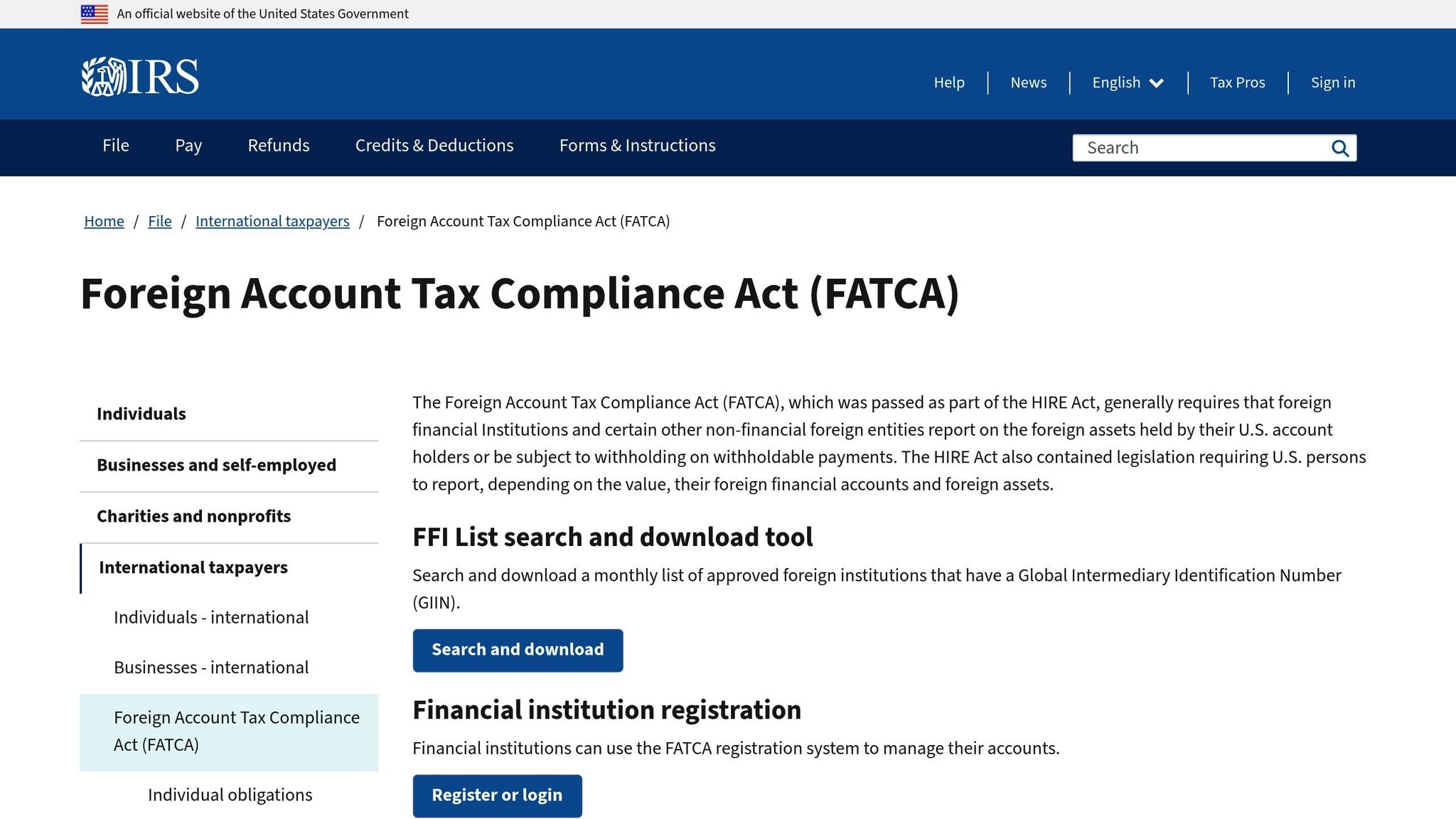
The Foreign Account Tax Compliance Act (FATCA), introduced by the U.S. in 2010, focuses on U.S. taxpayers with foreign accounts. It enforces compliance by imposing a hefty 30% withholding tax on non-compliant financial institutions. On a global scale, the Common Reporting Standard (CRS), developed by the OECD in 2014, has become the leading framework for tax transparency, with over 100 countries participating in automatic information exchange programs.
For U.S. taxpayers living in the United States, offshore accounts must be reported to the IRS if their total value exceeds $50,000 at the end of the tax year or $75,000 at any point during the year. Additionally, the Financial Crimes Enforcement Network (FinCEN) mandates reporting for accounts with an aggregate value of $10,000 or more.
| Regulation | Scope | Individual Reporting | Institutional Enforcement |
|---|---|---|---|
| FATCA | U.S.-Specific | Form 8938 filing required | 30% withholding tax on non-compliant institutions |
| CRS | Global (100+ countries) | Automatic reporting by financial institutions | Local tax authority compliance audits |
| FBAR | U.S. taxpayers | Required for accounts exceeding $10,000 aggregate | FinCEN enforcement and penalties |
Failing to file Form 8938 can lead to penalties starting at $10,000, with additional fines reaching up to $50,000 for continued non-compliance. Moreover, a 40% penalty may apply to tax understatements linked to undisclosed assets.
"The Foreign Account Tax Compliance Act (FATCA) and the Common Reporting Standard (CRS) have reshaped the landscape of international finance and tax compliance by promoting greater transparency and information exchange." – Globalfinances.net
Next, let’s delve into the KYC and AML rules that further define compliance in offshore banking.
KYC and AML Rules
Know Your Customer (KYC) and Anti-Money Laundering (AML) regulations are central to offshore banking compliance. These rules require banks to verify customer identities, evaluate risks, and monitor transactions to detect and prevent illegal activities.
Money laundering, which accounts for an estimated 2–5% of global GDP (roughly $800 billion to $2 trillion annually), underscores the importance of these measures. KYC processes involve Customer Due Diligence (CDD) and Enhanced Due Diligence (EDD) steps, such as verifying beneficial ownership, tracing the source of funds, and maintaining ongoing transaction oversight.
Compliance comes with significant costs. By 2028, financial institutions are projected to spend $51.7 billion on AML and KYC technologies and operations. In 2024 alone, U.S. regulators issued over $4.3 billion in penalties related to these requirements. While these rules enhance transparency, they also demand the disclosure of detailed financial information, including beneficial ownership, challenging banks to uphold client confidentiality within regulatory limits.
Legal Privacy vs. Illegal Concealment
Understanding the fine line between legal privacy and illegal concealment is essential. Offshore banking is lawful when used for legitimate purposes like asset protection, international transactions, or investment diversification – provided all tax laws are followed. However, using offshore accounts to hide income, evade taxes, or enable money laundering is illegal.
To remain compliant, account holders must report offshore income and account details, keep accurate records, and file an FBAR for accounts exceeding $10,000 in aggregate value during a calendar year. Non-compliance can result in severe penalties, including fines, asset seizure, or even imprisonment.
For those seeking legal offshore banking solutions, it’s critical to work with reputable institutions that follow international AML and KYC standards. Assessing the political and economic stability of the jurisdiction and consulting qualified legal and tax professionals are also key steps. Offshore banking, when approached transparently, can serve as a legitimate financial strategy while meeting all regulatory obligations.
For personalized guidance on staying compliant while safeguarding your financial privacy, reach out to the experts at Global Wealth Protection.
How to Choose Offshore Banking Jurisdictions
Once you’ve grasped the regulatory and legal frameworks, the next step is deciding on a jurisdiction that fits your privacy and financial goals. Picking the right offshore banking jurisdiction isn’t just about convenience – it’s about ensuring your assets are secure, accessible, and protected. In today’s world of heightened financial transparency, this decision carries even more weight.
Factors for Choosing a Jurisdiction
Several key considerations can help you evaluate which jurisdiction aligns best with your needs:
- Banking Secrecy Laws: These laws dictate how much of your account information can be disclosed without your approval. Jurisdictions like Switzerland, with its Article 47, and Nevis, under its International Exempt Trust Ordinance, are known for their strong confidentiality protections.
- Political and Economic Stability: Stability in a jurisdiction’s government and economy is essential for safeguarding your wealth. A stable environment ensures that your funds remain accessible and secure, even during global financial upheavals.
- Regulatory Environment: This involves balancing transparency with privacy. Look for jurisdictions that comply with international standards like FATCA and CRS but still maintain meaningful privacy protections.
"A predictable, investor-friendly legal environment safeguards shareholder rights, reduces transactional risk and reassures counterparties that contracts will be enforced." – Icaza Law | Legal Insider
- Accessibility for Account Holders: Consider factors like capital controls, time zone differences, and the availability of digital banking services. Easy access to your funds, especially in emergencies, is a must.
- Data Protection Laws: These laws add another layer of security for your personal and financial data, minimizing the risk of unauthorized access.
- Reputation and Transparency Ratings: Evaluate how a jurisdiction is perceived globally by reviewing FATF lists, OECD ratings, and indicators from organizations like the IMF and World Bank.
"Legitimate privacy protects competitive information and personal security; clear compliance rules ensure continued access to banking and capital markets." – Icaza Law | Legal Insider
- Efficiency and Costs: Assess the speed, cost, and administrative ease of setting up accounts. Jurisdictions with streamlined digital systems and transparent fees can save time and reduce hassle.
Jurisdiction Comparison Chart
Here’s a quick breakdown of some top offshore jurisdictions and their strengths:
| Jurisdiction | Key Strengths | Privacy Features | Best For | Considerations |
|---|---|---|---|---|
| Switzerland | Manages 25% of global cross-border assets | Banking Secrecy Law (Art. 47), Data Protection Act | Private wealth, valuables, foreign-law trusts | Traditional approach; higher minimum deposits |
| Singapore | Fintech integration; appeals to Asian markets | Strong data protection; regulatory transparency | Tech-savvy investors; Asian market access | Modern digital services; CRS compliant |
| Nevis | Strong foreign judgment protection; bond and burden of proof required | International Exempt Trust Ordinance | Trust structures, personal asset protection, crypto | Smaller banking infrastructure |
| Belize | Cost-effective; strong anti-foreign enforcement | Trusts Act, Data Protection Act | Cost-conscious clients with diverse assets | Edges out on infrastructure vs. Seychelles |
| Cayman Islands | Manages over $1.5 trillion in banking assets | Strong trust firewall; STAR regime | Funds, IP, global business structures | Higher minimum deposits; more complex requirements |
When narrowing down your options, consider creating a weighted decision matrix to score jurisdictions based on the factors most important to you. Consulting professionals who specialize in both international and local banking laws can also help you navigate disclosure rules, which can vary depending on the jurisdiction and your home country.
For those with substantial assets, a diversified approach may be the best strategy. For example, you could establish a Nevis LLC to hold assets, open a Swiss or Singaporean bank account for investments, and set up specialized trust structures for inheritance planning. Experts like Global Wealth Protection can guide you through this process, tailoring a strategy that aligns with your privacy and financial objectives.
Top Jurisdictions for Offshore Banking Privacy in 2025
Offshore banking privacy hinges on finding jurisdictions that strike a balance between strong confidentiality measures and adherence to global regulations. These financial hubs cater to both U.S. citizens and international clients, offering privacy-focused frameworks while ensuring compliance with international standards. Below are some of the leading jurisdictions that exemplify this delicate balance.
Switzerland
Switzerland remains the gold standard in offshore banking privacy, managing roughly 25% of global cross-border assets. Its reputation for discretion is rooted in Article 47 of the Swiss Federal Banking Act of 1934, which criminalizes the unauthorized disclosure of client information.
Despite adapting to global regulations like CRS and FATCA, Switzerland has managed to uphold its privacy principles. Information-sharing under these frameworks is conducted through government-to-government exchanges, ensuring that client data remains shielded from public access and commercial exploitation.
For U.S. citizens, Swiss banks provide FATCA-compliant services, reporting to the IRS while maintaining discretion in other areas. Clients benefit from anonymous card options, advanced digital tools, and multi-currency accounts. However, opening an account often requires substantial minimum deposits and involves rigorous due diligence.
Regulated by FINMA (Swiss Financial Market Supervisory Authority), Swiss banks adhere to strict confidentiality standards established by the Swiss Bankers Association. These factors make Switzerland a top choice for private wealth management and complex trust structures.
Singapore
Singapore offers a unique blend of access to Asian markets and adherence to Western banking standards. Its confidentiality laws, outlined in Section 47 of the Banking Act, provide robust legal safeguards for client information.
Known for its advanced fintech ecosystem, Singapore has become a hub for digital banking innovation. Its banks are among the safest globally, offering sophisticated online platforms tailored to tech-savvy clients. This combination of stability and privacy attracts investors and entrepreneurs alike.
For U.S. clients, Singapore banks typically focus on savings accounts rather than full-fledged investment services. The jurisdiction’s strategic location also makes it an ideal entry point for investments in Asia. With a strong commitment to privacy and cutting-edge banking solutions, Singapore continues to appeal to modern investors seeking secure and forward-thinking financial services.
Nevis
Nevis stands out for its exceptional asset protection and privacy measures. The jurisdiction allows for anonymous company formation, with no public disclosure of shareholders or beneficial owners. This structure ensures maximum confidentiality.
The International Exempt Trust Ordinance further strengthens privacy by making it difficult for foreign judgments to affect assets held in Nevis. This legal framework provides multiple layers of protection for trust and corporate structures.
Nevis banks maintain high confidentiality standards while adhering to global KYC protocols. They offer tax neutrality on offshore income and allow remote account openings, typically completed within two to four weeks.
For U.S. citizens, Nevis offers a compelling mix of privacy and compliance. Its English common law system and political stability make it particularly appealing for trust structures, personal asset protection, and even cryptocurrency holdings.
Belize
Belize combines affordability with robust privacy protections. Governed under English common law and regulated by the Central Bank of Belize, it provides a familiar legal environment for English-speaking clients.
Key privacy safeguards come from the Trusts Act and Data Protection Act, which ensure strong confidentiality for account holders. Belize also provides tax neutrality for non-resident companies, a feature that enhances its appeal to international clients.
Account opening in Belize is straightforward, with remote options available. The jurisdiction welcomes foreign entities, complies with AML standards, and prioritizes client privacy. Costs are competitive, with setup fees typically around $3,999.
For U.S. citizens, Belize offers accessible and compliant banking services in English. Its streamlined processes and cost-effective approach make it particularly attractive for individuals seeking reliable privacy without the high costs of more traditional offshore centers.
Cayman Islands
The Cayman Islands is a global leader in institutional offshore banking, hosting forty of the world’s top 50 banks. This concentration of financial institutions creates a world-class infrastructure for international clients.
Confidentiality is a cornerstone of Cayman banking. The jurisdiction does not have public registries for company or trust ownership, and while it operates a Beneficial Ownership Register, this is not accessible to the public. This ensures privacy from commercial scrutiny and data mining.
With no direct taxation on foreign income, the Cayman Islands is particularly attractive for complex financial arrangements. Its STAR trusts and other advanced structures are ideal for fund management, intellectual property, and global business operations.
For U.S. citizens, Cayman banks offer full compliance with international standards while maintaining high levels of discretion. However, clients should be prepared for higher minimum deposits and more complex requirements. The jurisdiction’s stability and advanced regulatory framework make it a preferred choice for high-net-worth individuals and institutional investors seeking secure and sophisticated banking solutions.
The Cayman Islands’ reputation for reliability and privacy ensures its continued position as a leading offshore banking destination. Its robust infrastructure and client-focused services make it an excellent option for those with significant assets and complex financial needs.
sbb-itb-39d39a6
Best Practices for Offshore Banking Privacy
Protecting your privacy in offshore banking while staying within legal boundaries calls for a careful mix of discretion and transparency. Achieving this balance often hinges on smart legal structuring and keeping thorough documentation.
Setting Up Offshore Accounts and Entities
The first step to safeguarding privacy in offshore banking is selecting the right legal structures. Whether you go with a private US LLC, an offshore company, or a trust, the goal is to limit ownership exposure while serving legitimate business purposes.
Using multiple jurisdictions can enhance privacy protections and spread risk. Trusts and foundations, for example, are excellent tools for separating assets from personal ownership. These structures are especially useful for high-net-worth individuals focused on long-term asset protection and estate planning. However, their purpose must be legitimate, and they should be backed by proper substance.
Modern offshore setups demand transparency and forward-thinking. As Manar, a legal expert at OVZA, puts it:
"Today’s offshore companies must be structured for tomorrow’s regulations, not yesterday’s."
This means setting up clear ownership structures and maintaining accessible records of ultimate beneficial ownership. Once your structures are in place, keeping detailed documentation is key for staying compliant.
Documentation and Compliance Requirements
Accurate record-keeping is essential for meeting requirements like FBAR (Foreign Bank Account Report) and FATCA (Foreign Account Tax Compliance Act). For US persons, FBAR filings are mandatory for foreign accounts totaling $10,000 or more in a year. These filings must be submitted electronically through FinCEN’s BSA E-Filing System by April 15, with an automatic extension to October 15.
To stay compliant, ensure you maintain detailed records for each account, including the account name, number, bank details, type of account, and its maximum value during the year.
Failing to comply can result in hefty penalties. Non-willful violations of FBAR rules can lead to fines of up to $10,000, while willful violations may result in penalties as high as $100,000 or 50% of the account balance.
| Document Type | Required Details |
|---|---|
| Proof of Identity | Passport, national ID card, or driver’s license |
| Proof of Address | Recent utility bill, bank statement, or rental agreement (issued within 3 months) |
| Source of Funds | Business contracts, tax returns, payslips, or sales agreements |
| Business Activity | Certificate of incorporation, company profile, or financial statements |
| References | Personal or professional references from banks or legal representatives |
Even in jurisdictions where public filing of financial statements isn’t mandatory, maintaining accurate financial records is critical. If there are any gaps in past reporting, a voluntary disclosure can help reduce penalties.
Working with Professional Advisors
Navigating the complexities of offshore banking is much easier with the help of seasoned professionals. International tax attorneys and financial advisors can craft personalized strategies that align privacy goals with compliance requirements. Their expertise covers areas like international tax law, asset protection, regulatory compliance, and choosing the right jurisdictions.
Professional advisors not only assist in structuring but also ensure that all documentation meets regulatory standards. Firms like Global Wealth Protection specialize in these services, offering support in private US LLC formation, offshore company setups, and offshore trusts tailored for entrepreneurs and investors.
Perform due diligence on offshore banks to ensure they meet both privacy and compliance needs. Strong governance practices are equally important, such as appointing independent trustees, setting clear protocols for asset management, and keeping transparent records of transactions and meetings.
Angel Gurría, former Secretary-General of the OECD, emphasized the shift in global financial transparency:
"Offshore tax evasion is over. Countries are now exchanging financial account information automatically."
To further protect sensitive financial data, use encryption and other privacy technologies. And for Americans, the most critical step is adhering to tax reporting requirements. Nomad Capitalist advises:
"The most important thing for Americans is complying with tax reporting requirements. This means finding a reputable offshore bank in a stable jurisdiction that’s compliant with the Foreign Account Tax Compliance Act (FATCA)."
Conclusion: Offshore Banking Privacy in 2025
Offshore banking privacy in 2025 demands a shift in perspective. It’s no longer just about avoiding scrutiny from tax authorities; the focus has expanded to safeguarding financial details from public exposure, corporate data tracking, and cyber threats. The most reputable jurisdictions strike a balance by ensuring confidentiality while collaborating with authorities on tax and legal compliance.
Choosing the right jurisdiction remains a cornerstone of effective offshore banking. Locations like Switzerland, the Cayman Islands, and Luxembourg collectively manage trillions of dollars in assets. When evaluating jurisdictions, consider factors such as their data protection laws, tax reporting frameworks, bank-client confidentiality policies, and modern banking features like online accessibility, multi-currency transfers, and advanced investment tools.
As digitization accelerates and regulatory frameworks tighten, offshore banks are adapting their privacy measures to align with global standards. This often involves implementing cutting-edge systems that uphold confidentiality while meeting international requirements. Legal structures such as trusts or holding companies continue to play a critical role in this evolving landscape.
In this complex environment, professional advice is more essential than ever. Experienced advisors can tailor strategies to optimize wealth management while ensuring compliance with both local and international tax laws. They also help clients navigate jurisdictional risks by diversifying assets across multiple regions and providing ongoing guidance to adapt to shifts in global regulations or personal circumstances. As offshore banking evolves, this expertise is key to staying ahead of the curve.
FAQs
How can I make sure my offshore banking stays compliant with regulations like FATCA and CRS?
To comply with global regulations such as FATCA and CRS, it’s crucial to prioritize precise reporting practices and maintain thorough documentation. Start by ensuring that all necessary account details are reported to the relevant tax authorities and that self-certifications are completed accurately.
It’s also wise to routinely review your compliance processes to account for any changes in these regulations. Seeking advice from a legal or tax expert who specializes in offshore banking can provide valuable guidance, helping you manage complex requirements and steer clear of potential penalties.
What should I consider when selecting an offshore banking jurisdiction for privacy in 2025?
When selecting an offshore banking jurisdiction for privacy in 2025, it’s essential to consider key factors like privacy laws, banking secrecy, political stability, and data protection regulations. These elements play a crucial role in keeping your financial details secure and private.
Countries like Switzerland, Cayman Islands, and Liechtenstein are often highlighted for their strong commitment to confidentiality. They’ve built solid legal systems that prioritize client privacy, making them reliable choices for protecting your assets.
What are the penalties for not reporting offshore accounts in the U.S.?
Failing to report offshore accounts to the U.S. government can result in hefty fines. For non-willful violations, the penalty can be as high as $10,000 per violation. On the other hand, willful violations carry far steeper consequences, with fines reaching up to 50% of the account’s highest balance – sometimes exceeding $1 million in extreme cases.
To steer clear of these penalties, it’s essential to meet all reporting requirements, including filing the FBAR (Report of Foreign Bank and Financial Accounts) and any other necessary forms. Seeking advice from a qualified professional can help ensure you stay compliant with these obligations.
